
Do It Yourself SEO: What You Actually Need to Know
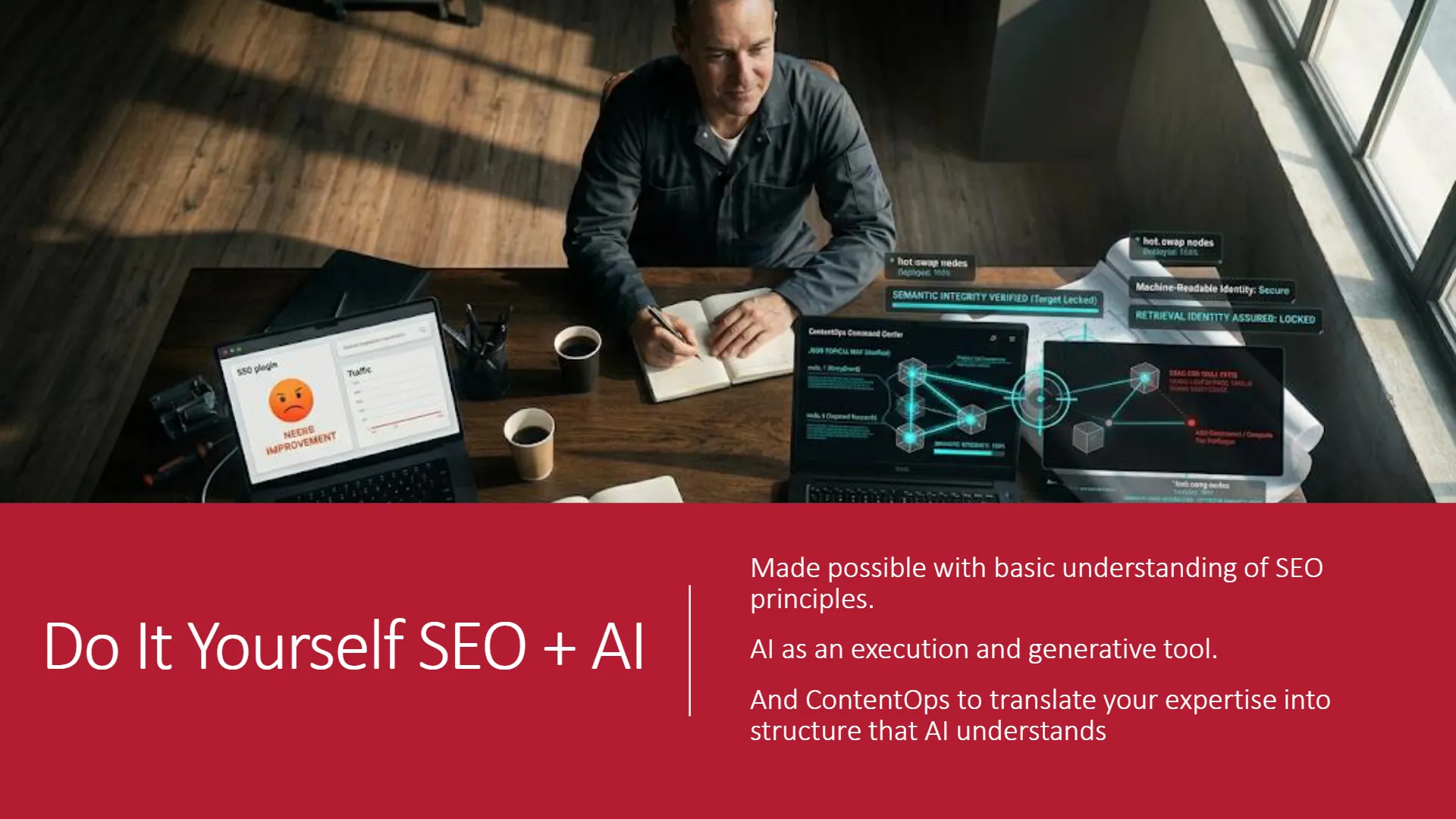
You installed Yoast. You followed the checklist. Every light turned green. And the traffic never came.
The Short Answer
Yes. You don’t need to become an SEO expert, and you don’t need to outsource it to find out later that you paid for a vanity metric instead of a customer. You need to know enough to be dangerous, a working definition of what SEO actually is, and two real skill areas underneath it. That’s the whole list.
Why This Question Matters More Than Most People Realize
SEO, at its core, is publishing and organizing content so that a crawler knows what it is and where it belongs. That’s it. It’s not a certification, and it’s not a personality trait some people have and others don’t.
But you don’t do this in isolation. A great page that thoroughly answers one question doesn’t rank on its own merit, there are already a thousand other pages targeting the exact same term. The question was never “is this good,” it’s “why should this one outrank the other nine hundred ninety-nine.” That’s the part a green plugin score can’t answer for you, and it’s the part most DIY attempts skip straight past.
The Longer Answer
Two real skill areas, not a hundred small ones.
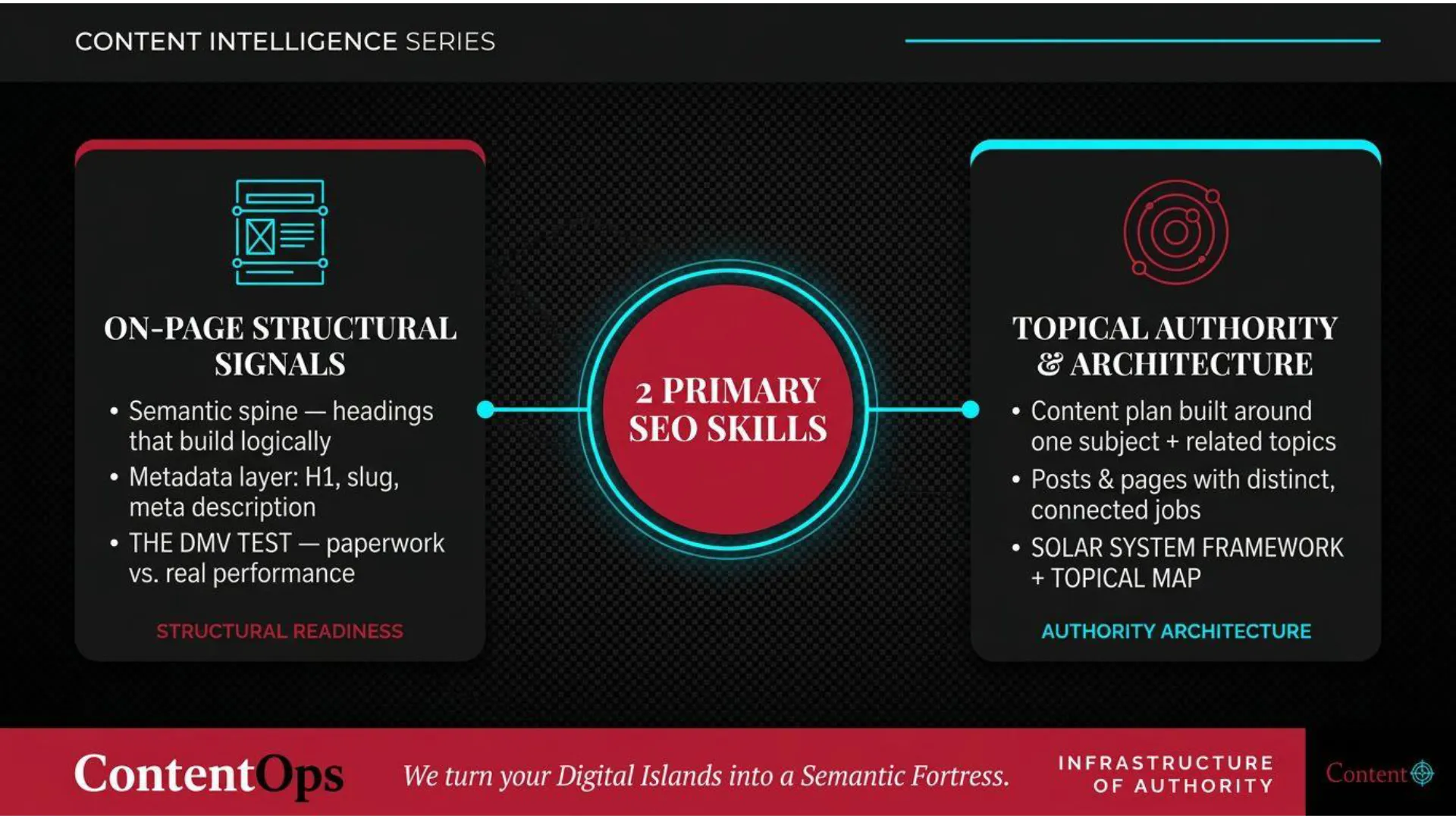
On-page structural signals.
A well-structured page tells its own story through its semantic spine, headings that build logically, anchor points that route to the right places, images with alt text that actually describes what’s in them. There’s also what you might think of as the paperwork layer, metadata, meta description, H1, slug, whether it actually tells the story or just fills a field. Filling out the paperwork correctly isn’t the same as having something worth reading underneath it, but skipping it means a crawler never gets the chance to find out you do.
That distinction has a name as the DMV Test, where passing the paperwork check and being structurally ready to actually perform are two different exams.
Topical authority and architecture.
How your whole content plan evolves around one subject and the topics related to it, not just one isolated post. This is where posts and pages do different jobs, and where the pieces you publish either connect into something a crawler can navigate, or sit disconnected, doing nothing for each other. The Solar System framework is the plain version of how that architecture actually holds together, and the Topical Map itself is what keeps a growing site from turning into a pile of Island Nodes with no path connecting them.
What Most Advice Gets Wrong About SEO
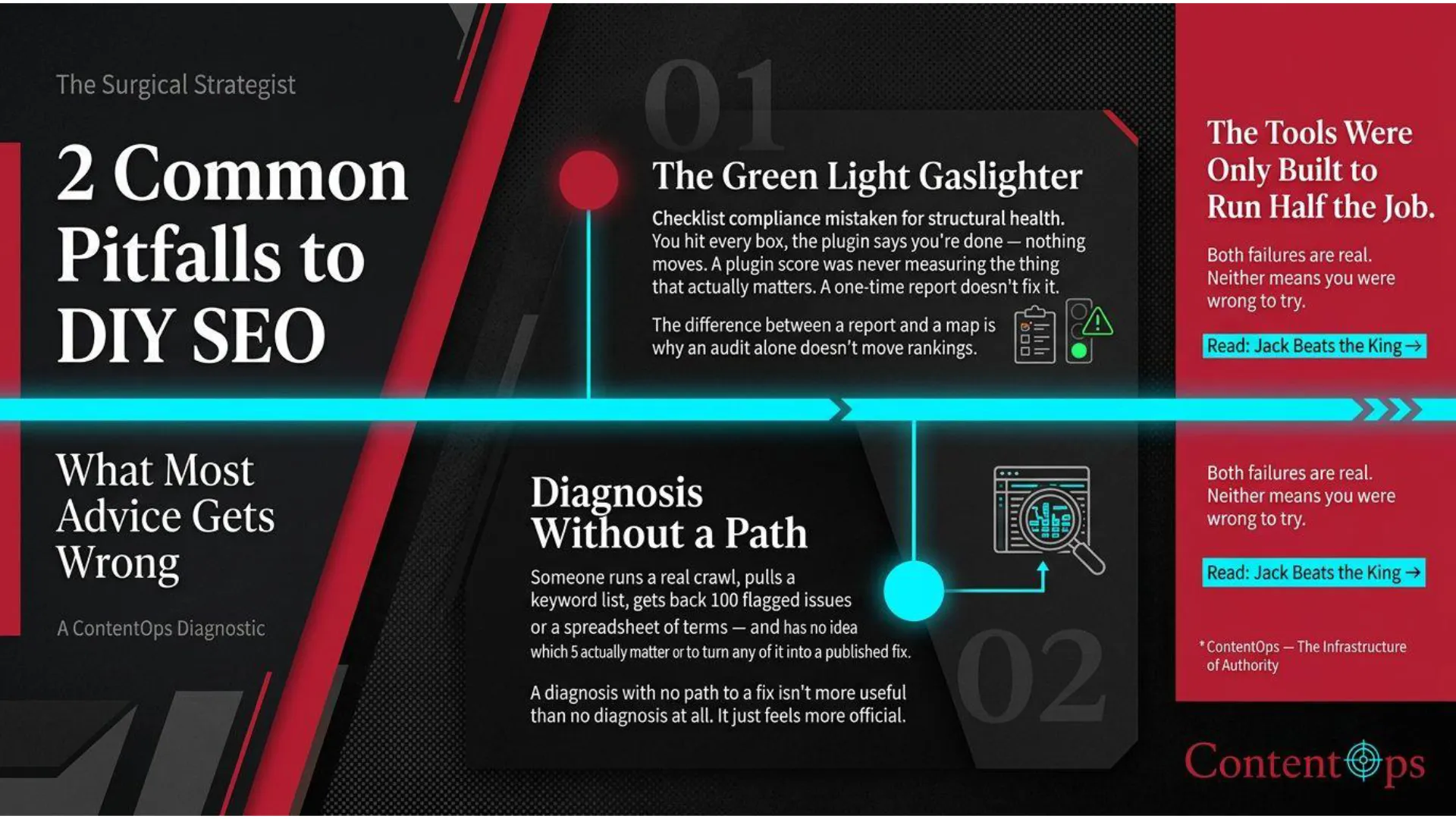
The most common failure isn’t laziness, it’s the Green Light Gaslighter, checklist compliance mistaken for structural health. You hit every box, the plugin says you’re done, and nothing moves, because a plugin score was never measuring the thing that actually matters. A one-time report doesn’t fix that either as the difference between a report and a map is exactly why an audit alone doesn’t move rankings on its own.
The second most common failure happens after that one. Someone finally runs a real crawl or pulls a keyword list, gets back a hundred flagged issues or a spreadsheet of terms, and has no idea which five actually matter or how to turn any of it into a published fix. A diagnosis with no path to a fix isn’t more useful than no diagnosis at all, it just feels more official.
Both of these are real, common, and neither one means you were wrong to try this yourself. They mean the tools you were using were only ever built to run half the job. Jack Beats the King is worth a read if you want to see what a lean, independent operator actually beating that gap looks like in practice.
The Practical Implication For Your Site
Here’s the part that changes how you should actually approach this. You don’t need to master these principles before you start. You need a tool that’s built to teach you as you use it, where every published page makes the next one a little more obvious, because you’re seeing real, working structure instead of an abstract rule.
That’s the actual argument for the simplest SEO tool for small businesses, not that it replaces the literacy, but that it’s the fastest, most honest way to build it, by producing real, optimized results instead of asking you to study first.
I didn’t know any of this when I started either. I plugged in a checklist plugin, watched every light turn green, and waited for traffic that never came. What actually changed things wasn’t finding the right course, it was building something that let me see the structure while I was using it, not before.
If you’ve read this far, you already have the instinct that got you here. See how ContentOps Consulting actually works, what we build ourselves, what we help with, and why the goal is always getting you running this on your own.