

How Much Does SEO Cost for a Small Business?
What Agencies Actually Charge
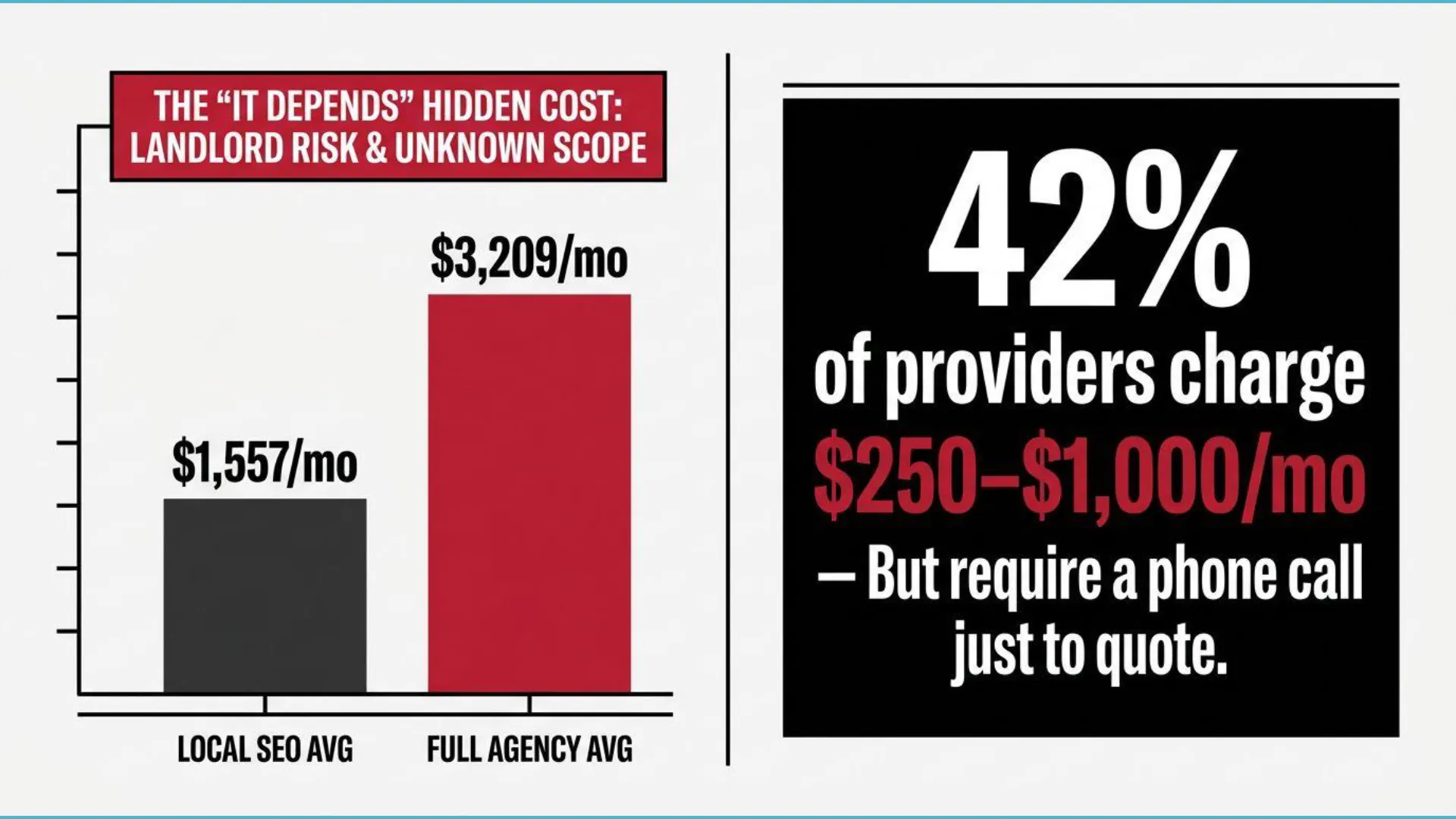
According to Ahrefs’ survey of 439 SEO providers, small business SEO averages around $1,557 a month, with 42% of providers charging somewhere between $250 and $1,000 monthly. Full agency retainers run higher, averaging $3,209 a month across the whole survey, but a small business is more often looking at the lower end of that range, closer to local SEO pricing than to enterprise retainers.
The range itself is wide for a real reason, scope varies enormously between providers. But that same range gets used defensively too, “it depends” is technically true and also a way to avoid quoting a number until you’re already on a call. If a provider won’t tell you the range before you’ve given them your contact information, that’s worth noticing.
The Tool Overlord Stack
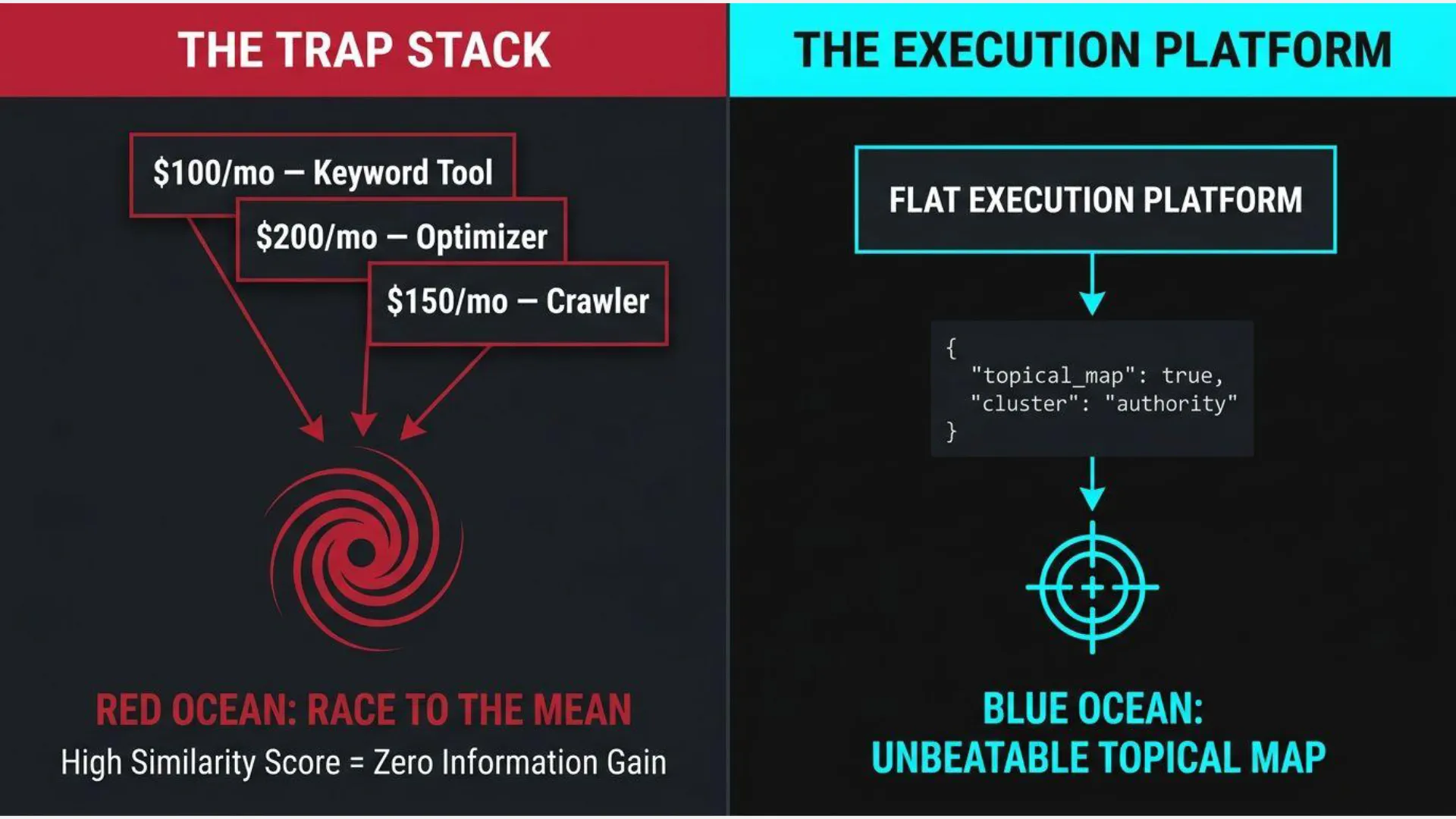
A hundred to five hundred dollars a month buys a real, respectable-looking toolkit. A keyword research platform, a content optimizer, a crawler, maybe a rank tracker. It looks like doing SEO, because it produces reports, scores, and dashboards. What it doesn’t produce is execution, and it quietly steers you toward two specific traps most people never notice they’re in.
The keyword trap
Your research tool shows you exactly which keywords a competitor ranks for. The obvious move is going after the same ones. If that competitor is a Goliath, a domain with years of accumulated backlink authority, they win that fight on volume alone, even with content that’s merely adequate. You’re not competing on quality anymore. You’re in the Red Ocean, a crowded, high-volume keyword space where brute-force domain authority decides the outcome regardless of who actually wrote the better page.
The content-score trap
Your optimizer scores your draft against whatever’s already ranking, similar terms, similar structure, similar coverage. Hit a good score, and you’ve written something that closely resembles the pages already at the top. That’s not a coincidence, that’s what the score is measuring. But an AI answer engine isn’t looking for another version of what it’s already read a dozen times, it’s looking for something the existing pages don’t already say. A high similarity score and genuine information gain pull in opposite directions. Optimize hard enough for the first one, and you land exactly in the Race to the Mean, indistinguishable from everything already there, and easy for an answer engine to skip.
None of this makes the tools bad. Ahrefs, Semrush, Surfer, they’re genuinely good at what they measure. The trap isn’t the tool, it’s mistaking a diagnostic instrument for an execution plan.
What ContentOps Actually Costs
The Command Center, the self-serve app, is $9.99 a month or $99 a year. That’s the Topical Map, the HTML Audit Suite, SlideShift, and Publishing Accelerators, execution tools built to help you actually do the work, not just diagnose it.
For the parts that genuinely benefit from a second set of hands, real, flat, stated prices, no range, no quote request. Organic SEO Consulting runs a five-session bootstrap package at $600 flat, or $80 an hour for one-off help with a specific problem. A Topical Authority Map Build runs $299 to $599 depending on scope. Every price is stated before you commit to anything.
Agency vs. Tool Overlord Stack vs. ContentOps
| Agency | Tool Overlord Stack | ContentOps | |
|---|---|---|---|
| Monthly cost | ~$1,557 avg for small business, 42% of providers charge $250-$1,000/mo | ~$100-500/mo in software | $9.99/mo or $99/yr |
| What it actually buys | Someone else does the work, scope often unclear until you ask | Data, recommendations, text-level on-page diagnostics, and rank tracking | Topical Map, HTML Audit Suite, SlideShift, and Publishing Accelerators, execution tools that help you actually do the work |
| The hidden cost | Often none stated up front, real Landlord risk if ownership isn’t spelled out | Red Ocean keyword fighting against Goliaths you can’t out-backlink, and a content score built to sit exactly at the Race to the Mean | The work still has to happen, but the Audit Suite’s AI Missions hand you the exact fix instead of a diagnosis, and the Topical Map does the planning and structural thinking as you write, not after |
What Most Advice Gets Wrong About This
The real problem was never that SEO pricing is complicated. It’s that vague pricing benefits the side that’s setting it. A stated, flat number is a competitive disadvantage for anyone whose actual number would look bad sitting next to it, so the range stays wide and the quote stays a phone call away. The three real paths above, and their real costs, are the same whether or not anyone tells you about them upfront.
Whichever path fits your situation, the actual next step is the same one. Organic SEO Consulting lays out the full philosophy behind self-serve, guided, and done-for-you. The Services Hub has every price named, no exceptions.