
Step 5: The Miyagi Method & Full Publishing Flow
In martial arts, the Miyagi Method isn’t about fighting; it’s about doing the repetitive, foundational chores—wax on, wax off—that build muscle memory. In ContentOps, this is how you make your publishing flow feel effortless and reflexive.
The Philosophy: By front-loading the hard work of grounding your AI and building your “Digital Team,” your actual content production becomes lightning-fast, highly authoritative, and completely reflexive.
Phase 1: Context Loading & The Digital Brain
Standard AI tools write generic slop because they lack context. You must build your foundational documents to beat the “Context Eraser.”
🚨 The Context Eraser Rule: If you are on the free tier, AI forgets your rules mid-chat. The Fix: Paste your Master System Prompt at the very beginning of every new chat, and re-paste it periodically to refresh its memory.
Build these 4 Foundational Documents:
- The Framework Report: Your master synthesis of target persona, pain points, and solution (e.g., StoryBrand).
- Brand Vocabulary: A specific glossary of your branded terms.
- The Writing Clone: Samples of your past writing/transcripts. Ask the AI to synthesize your tone, cadence, and formatting.
- The No-Go “Slop” List: A strict list of banned AI phrases (e.g., “In today’s digital landscape,” “Unlock the power of”).
Phase 2: Building Your AI Team
Do not use one generic chat for everything. Build specialized assistants.
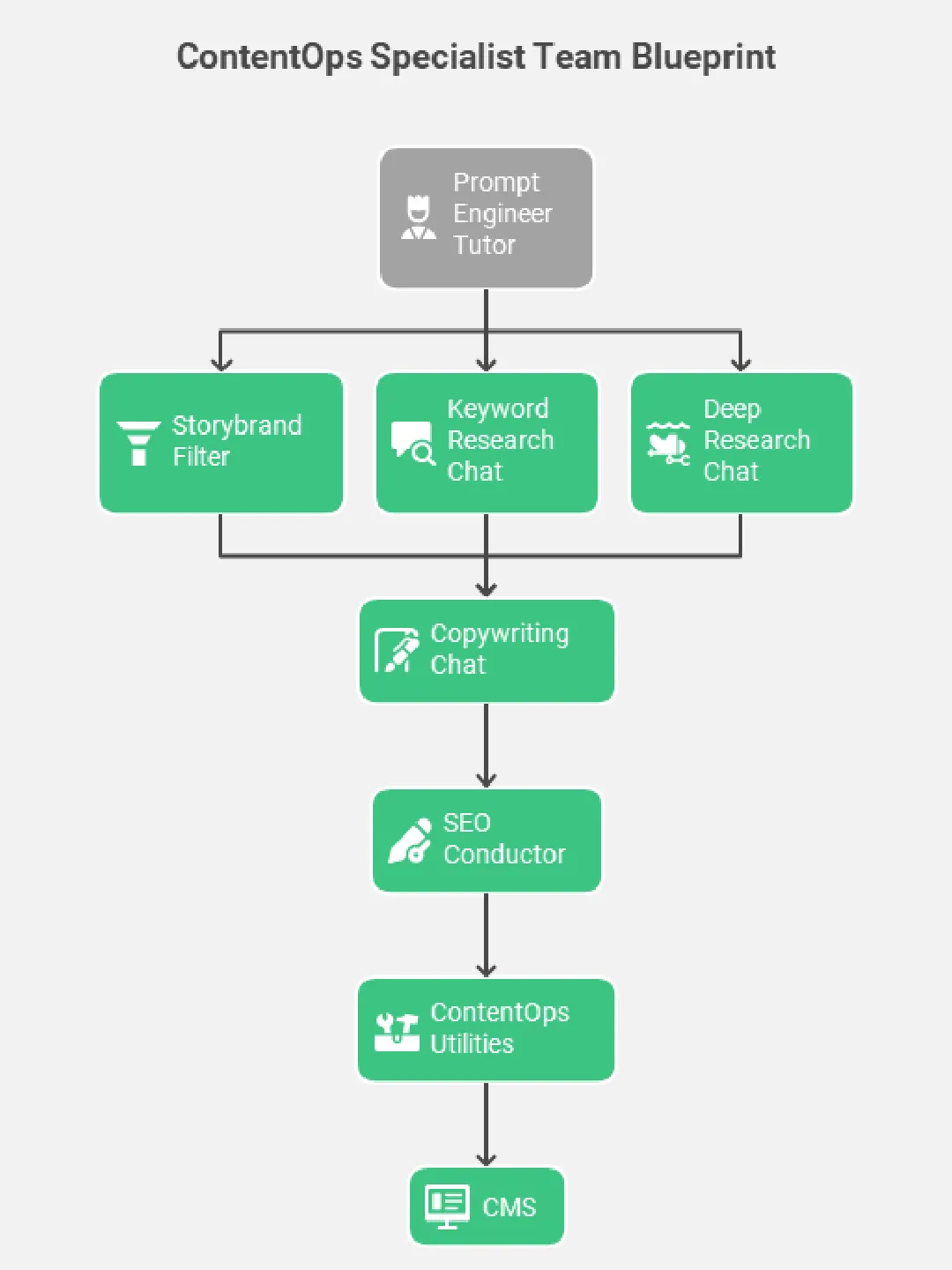
- Master Prompt Engineer: Your tutor. Creates the “System Prompts” for all other assistants.
- Framework Filter: Synthesizes raw ideas into briefs using your Framework Report.
- Keyword Researcher: The “Inference Mirror.” Finds keywords aligned with your content premise (not just volume).
- Deep Researcher: Scours Reddit/Quora for “Shadow Questions” (Pure Information Gain).
- The Copywriter: The drafter (uses Writing Clone + No-Go List).
- The SEO Conductor: The technical editor that injects links and transition sentences.
Phase 3: The Daily Assembly Line
- The Spark: Soundboard raw ideas out loud into a voice-to-text app.
- The Filter: Paste the monologue into your Framework Filter assistant.
- The Research Phase: Lock in your target keyword and gather “Shadow Questions.”
- Master Compilation: Feed your Copywriter assistant: The brief, keyword synthesis, research, and your JSON Topical Map. Command it to front-load keywords and weave in your Brand Vocabulary.
- Human 10%: You act as Editor-in-Chief. Inject stories, anecdotes, and human cadence.
Phase 4: Weaponized SEO & Publishing
- Wrap & Audit: Smart Wrapper -> HTML -> Audit Suite (Missions 1-4).
- SEO Conductor: Drop audited HTML + JSON Map into the SEO Conductor to inject internal links and transitions.
- Visuals: Create slide visuals -> SlideShift PDF export -> WebP widgets.
- CMS Assembly: Use the Splitter to get clean HTML blocks. Paste into CMS. Add SlideShift widgets. Publish.
Phase 5: Map Maintenance
Wax on, wax off. Keep the system alive:
- Context Injection: Flash Inject your new node code daily.
- The Harvester: Paste live post HTML (Ctrl+U) into the Harvester tab to bi-directionally wire your new content.
- Power Up: Run Mission 3 (Power Up) in the Audit Suite to find older posts that need to link to your new article.
- Export Version Control: Export your new
Map_V2.jsonso the AI always has the updated brain.
Workflow Jammed?
If your manufacturing line is stalling, send us a ticket. We’ll recalibrate your process.