
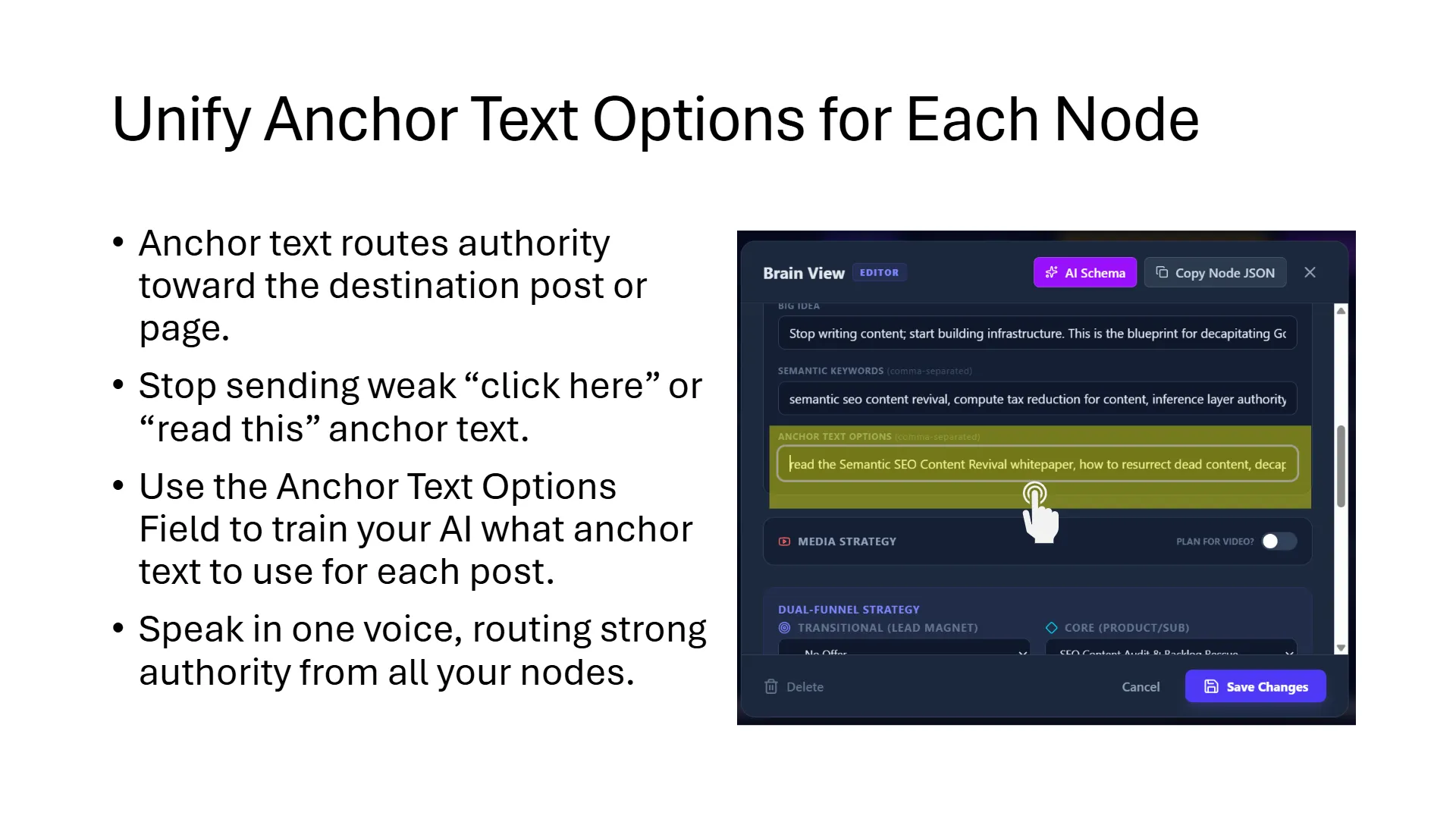
Configure universal anchor variables using the calibrating-anchor-options-for-ai protocol to enforce strict linking rules across independent authors. By defining precise, semantically dense tracking strings inside your node profiles, your content manufacturing assistants can automatically generate highly authoritative contextual internal bridges.
1. Enforcing Universal Linking Agreement via Metadata
When multiple writers or specialized AI agents deploy pages simultaneously across a single cluster, anchor text often fragments. One clerk utilizes a broad keyword phrase, while another links a generic URL string, destroying your site’s entity validation weight. ContentOps neutralizes this by encoding explicit linking preferences directly inside the master database. The anchorTextOptions array acts as a sitewide decree. When an AI copywriter begins drafting a child asset and reads the parent node cargo, it immediately recognizes exactly what text strings this node desires, creating absolute alignment across the map.
2. Strategy Rules for Text Variation Strings
To keep anchor profiles looking natural to modern re-ranking algorithms while maintaining maximum entity definition weight, follow these three rules inside your configuration panel:
- The Verbatim Anchor: Include one exact string matching the node’s core
targetKeywordparameter for baseline alignment. - The Semantic Alternative: Craft an alternative string utilizing complex industrial nouns or conceptual phrasing to pass rich topical context during ingestion loops.
- The Action Bridge: Formulate an operator-oriented action string that cleanly guides human visitors toward conversion events without losing data density.