
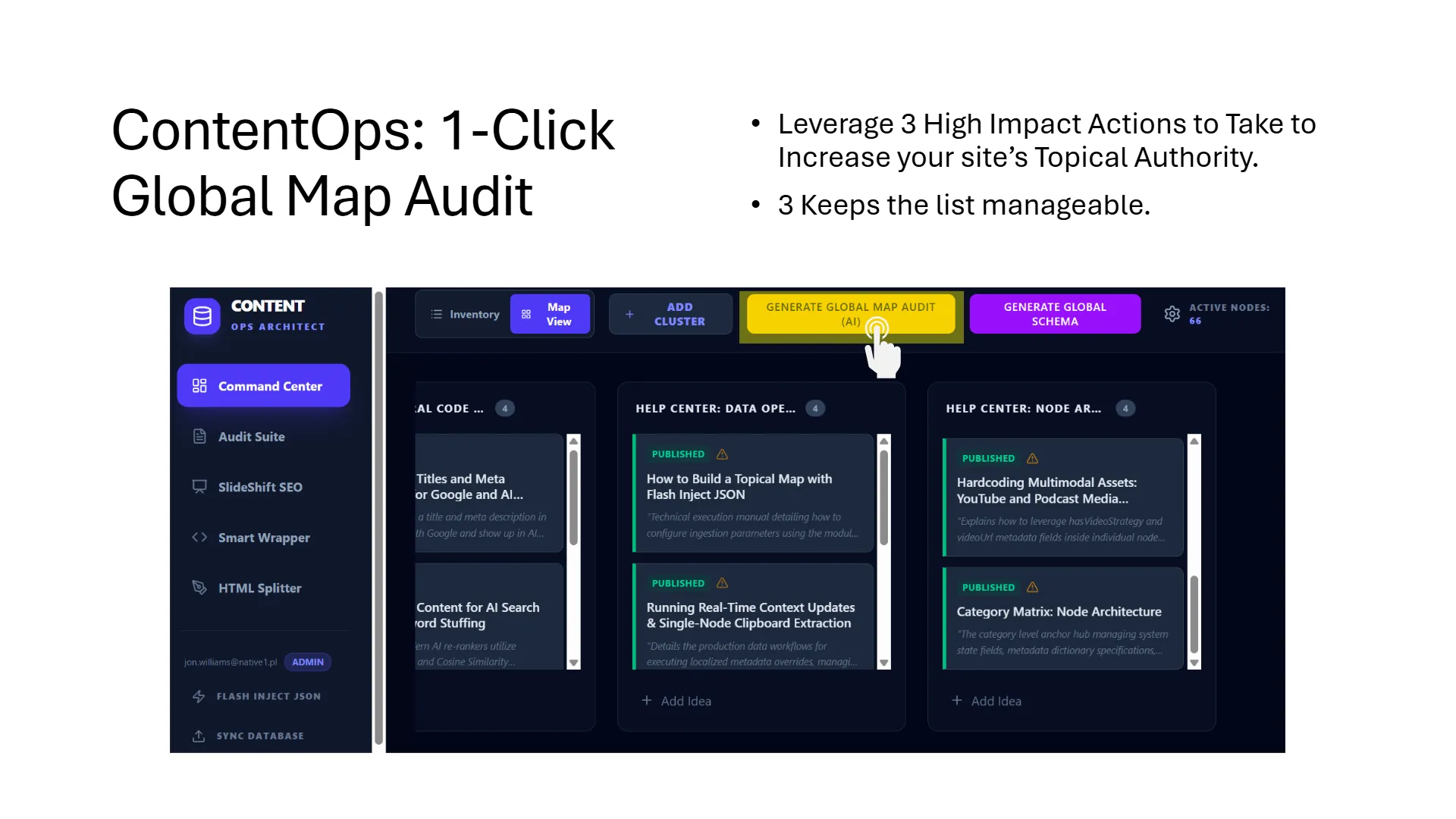
Configure automated diagnostic pipelines inside your global-map-audit-mechanics workspace manual to systematically pinpoint layout pathogens across large-scale structures. By triggering global structural scans from the master interface, the system parses network link allocations to deliver strategic actions that optimize your mapping grid.
1. Intercepting Architectural Decay and Ghost Spines
When domains scale past 100 content pieces, manual interlinking audits completely break down. Isolated nodes inevitably accumulate—forming disconnected tracking clusters that lack inbound internal linking edges or carry skipped header paths that confuse real-time search models. The Global Map Audit fixes this by conducting a unified server-side diagnostic pass. It isolates thin, single-post directory clusters and flags legacy assets where content teams forgot to map backlinks from newer supporting assets, protecting your graph against structural leaks.
2. The 3 High-Leverage Strategic Action Prompts
Instead of drowning operators in raw metrics data, the system evaluates the serialized payload using a low-temperature configuration of 0.4 to ensure strict logical consistency. It compresses sitewide vector coordinates to output exactly three direct action commands that yield the highest ranking utility margins. The resulting text block isolates precisely which supporting nodes require immediate internal link welds, completely stripping away code snippets to preserve the processing window’s token safety.