
BYOK Credentials

Help Center // Documentation Node 034-2

Configure localized application settings inside the mothership-byok-credentials documentation profile to verify environment access boundaries. By managing user parameters, system IDs, and Bring-Your-Own-Key variables natively from the dashboard panel, you preserve secure communication lines across back-end Firebase servers while maintaining runtime control.
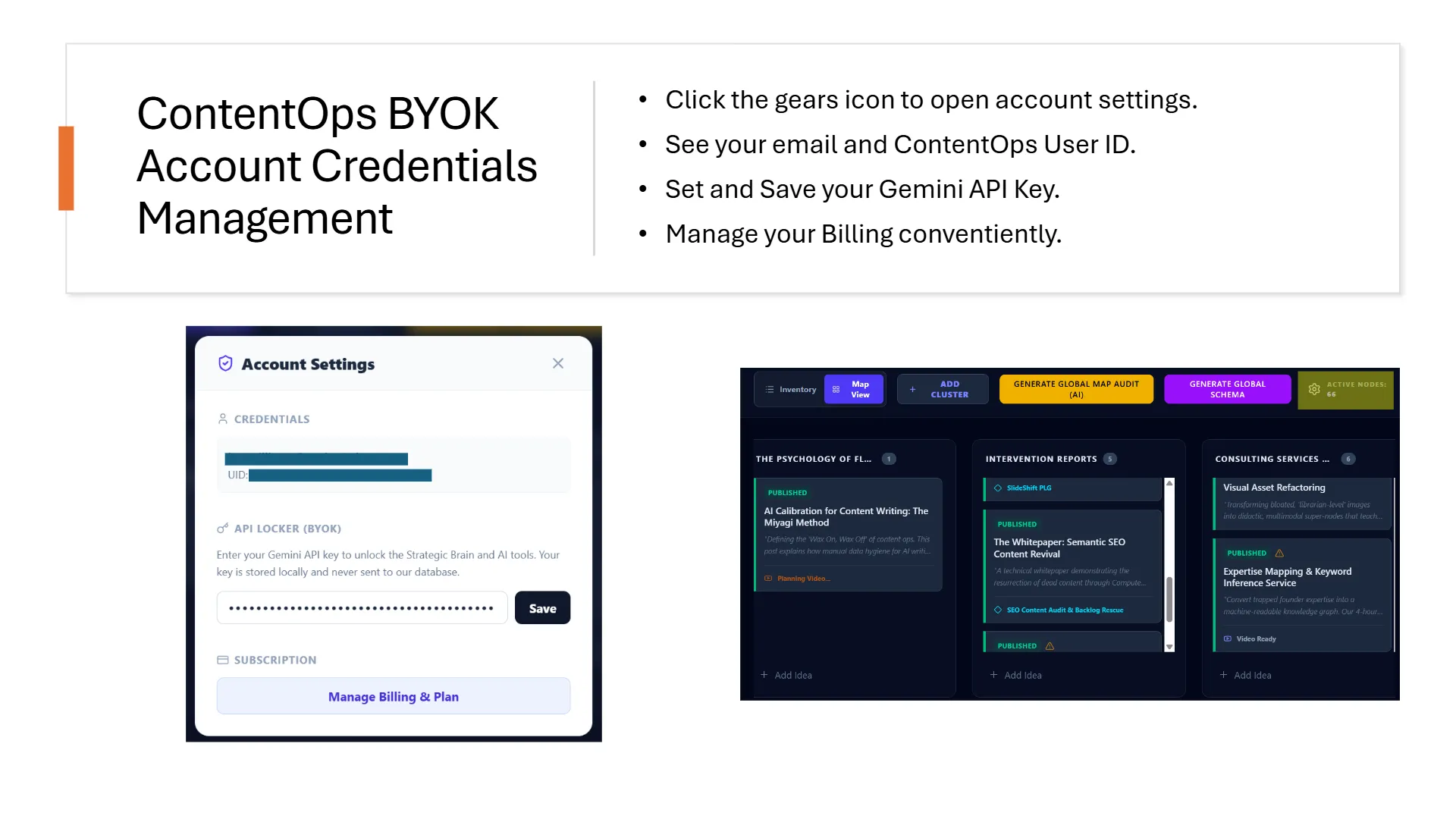
Slide titled 'ContentOps BYOK Account Credentials Management' with a bulleted list of instructions: 'Click the gears icon to open account settings.', 'See your email and ContentOps User ID.', 'Set and Save your Gemini API Key.', 'Manage your Billing conveniently.'. Below, two screenshots are displayed. The left screenshot shows an 'Account Settings' modal with 'CREDENTIALS' (UID blurred), 'API LOCKER (BYOK)' for entering a Gemini API key, and 'SUBSCRIPTION' with a 'Manage Billing & Plan' button. The right screenshot shows a dark-themed ContentOps dashboard with navigation elements 'Inventory', 'Map View', 'ADD CLUSTER', 'GENERATE GLOBAL MAP AUDIT (AI)', 'GENERATE SCHEMA', and 'ACTIVE NODES: 66'. Content sections include 'INTERVENTION REPORTS' displaying 'SlideShift PLG', 'The Whitepaper: Semantic SEO Content Revival', and 'SEO Content Audit & Backlog Rescue', alongside 'CONSULTING SERVICES' showing 'Visual Asset Refactoring' and 'Expertise Mapping & Keyword Inference Service'.
This slide details the process for managing ContentOps BYOK (Bring Your Own Key) account credentials, including setting and saving your Gemini API Key to unlock strategic AI and content optimization tools, and managing billing.

1. Calibrating the Bring-Your-Own-Key (BYOK) Data Window

To power the automated auditing suite and run real-time schema generation prompts without middle-man usage markups, ContentOps operates on an isolated BYOK infrastructure layer. Operators input their proprietary AI keys directly within the account dashboard settings view. This value is encrypted locally within your client session parameters and transmitted securely to back-end models only during active mission runs, allowing your development team to monitor processing usage limits directly from their master workspace console.

2. Managing Core User IDs and Subscription States

The dashboard view provides transparent visibility over your operational account data structures. The account frame maps your canonical registry parameters—displaying your primary user ID strings, account configuration tokens, and secure subscription states. If database synchronization errors lock your editor or require credentials reset, you can flash the environment clean from this control screen, manage subscription billing plans, or re-verify your Firebase connection to restore your knowledge graph pipeline instantly.

Frequently Asked Settings Questions

How do I securely reset my localized processing API credentials if my workspace sessions fail to sync database edits with the master server layers?

Navigate directly to your Account Settings panel inside the sidebar main menu, update your encrypted application keys inside the BYOK parameters input layout, and hit save to instantly re-establish verified server communication routes.