
Visual Meta Description:
Analyzing the execution mechanics of operational help centers within modern AEO framework structures to systematically bypass crawl amnesia and maintain multi-turn engine citations.
Operational Depth
Solar System Framework
AEO Conversion
Sovereign Architecture
Does My Website Need a Help Center for SEO?
Yes — but not for the reason most people assume. A help center doesn’t rank for your primary keywords. It gets cited for every question that comes after them. That distinction is the difference between a site with a marketing surface and a site with operational depth, and AI answer engines can tell the difference.
What the Help Center Actually Is
Most people think of a help center as customer service infrastructure. Documentation for people who already bought something. A support layer that exists after the sale, not before it.
That’s the front porch understanding — and what it gets wrong isn’t the function, it’s the scope.
Where the Help Center Sits in the AEO Architecture
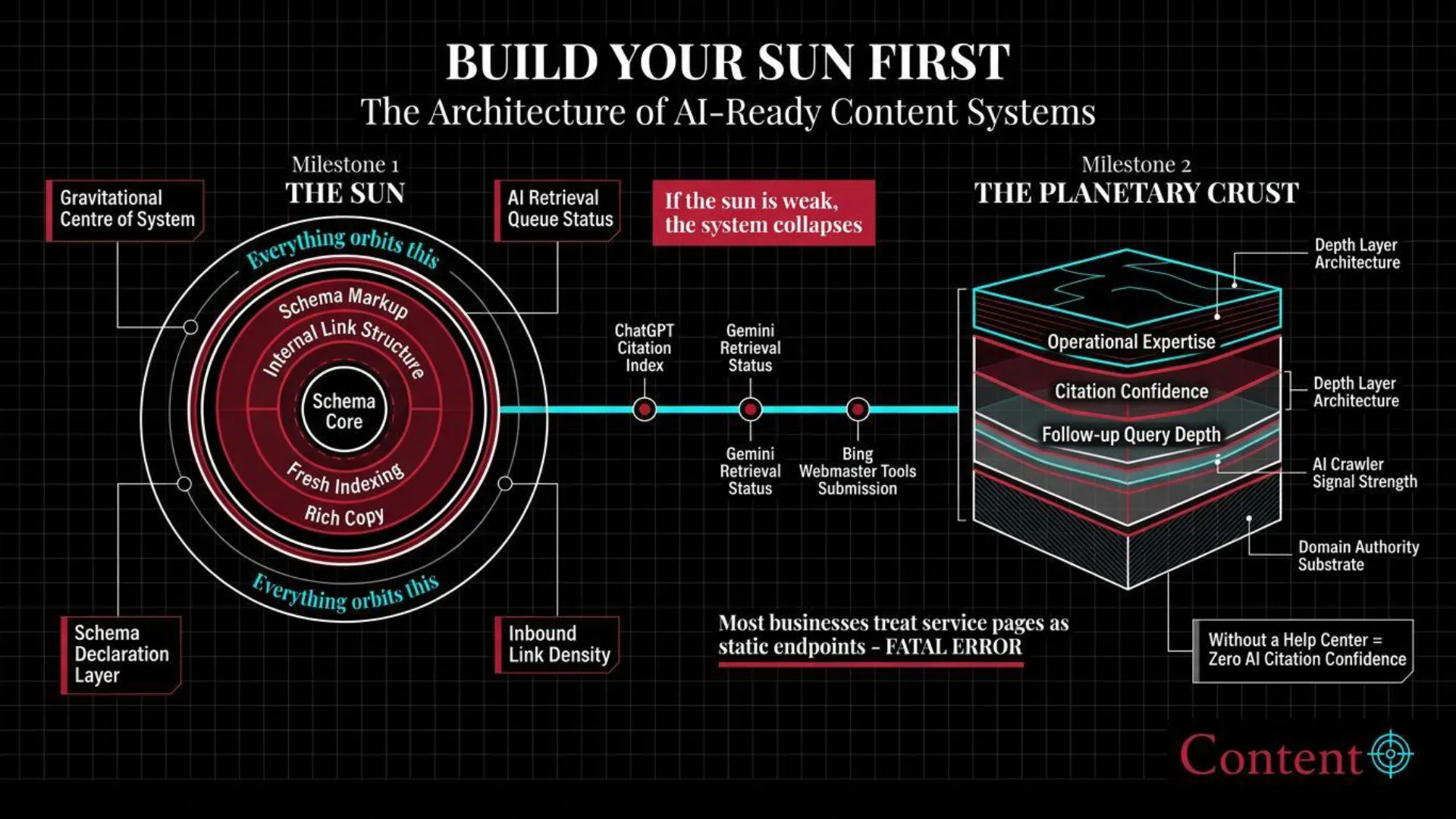
In the ContentOps AEO site architecture, content exists across seven layers, each serving a different audience moment and a different AI citation function. The Help Center is Layer 6, the cellar. It does not rank for the primary keyword. It gets cited for every question that comes after it.
By organizing your domain elements under the Solar System Guide to AEO content architecture framework, you ensure that this structural sun balances its surrounding text continents perfectly.
Invisible from the street and never what draws someone to the house, the cellar is load-bearing in a way the front porch never is — and when someone needs what’s down there, nothing else in the building substitutes for it.
Why Most Sites Are Missing This Layer
The standard brochure website has a homepage, an about page, and a services page. Sometimes a blog. What it almost never has is a cellar.
A brochure is designed for someone who already knows you exist. It is not designed to generate discovery, signal operational depth, or earn citations for the granular questions that follow a primary answer. It is a surface. And a surface, no matter how well designed, has no depth for an AI system to pull from when the conversation goes one level deeper than the headline answer. Passing the surface check was never the test — that’s the same gap the DMV Test site architecture framework exposes at the page level, and it applies equally to site architecture.
AI Search Is a Conversation, Not a Single Query
What’s changed is not how people search but how AI answer engines respond — not as lookup tools returning a list, but as conversational systems that pull from different content layers with every follow-up. Someone asks the primary question, gets an answer, then asks the follow-up. Then the follow-up to the follow-up. The blog post answers the first question. The help center answers the next three.
Because the help center is the only layer built for operational depth, a domain without one has no citation surface for the follow-up questions that come after the primary answer. The AI answers the primary query from your content, then cites someone else for everything that comes after. You earned the first mention. You lost the conversation.
The Two Jobs the Cellar Is Actually Doing
Job One — Onboarding and Retention
Help center articles teach existing users how to use a system after they’ve converted. How to run a specific workflow. What a particular feature does. How to troubleshoot a specific output. This is the standard understanding most operators have of what help center content is for, and it’s real and valuable.
Job Two — AEO Follow-Up Question Citations
When an AI answer engine delivers a primary answer, the follow-up queries it receives are more specific, more operational, and more granular than the first question. They’re not “what is X” but rather “how does X handle Y,” “what happens when Z,” and “where does this process break.” These are depth-layer questions that can only be answered by a source that has documented the operational specifics. The blog post that explains the concept doesn’t contain that answer. The landing page definitely doesn’t. The help center does, if it was built to.
The ContentOps Help Center is the live version of this argument, linked here not as a product mention but rather because it’s the proof of concept the argument needs. You can see exactly what a cellar looks like when it’s been built to serve both jobs simultaneously.
What the Help Center Signals to AI Crawlers
What a well-structured help center signals to an AI system is the one thing a brochure website structurally cannot — that this domain has operational depth beneath its marketing surface. The claims being made on the landing pages and the blog posts have depth behind them, documented, structured, addressable depth that can be cited accurately.
A domain with no help center looks, to an AI evaluating citation confidence, like a front porch with no house behind it. The signal the machine gets is that this entity makes claims but cannot answer follow-up questions. That’s a citation confidence penalty, even if nothing is technically wrong with the content that exists.
AEO Evaluates the Domain, Not Just the Page
Whereas traditional SEO evaluated the page in isolation, AEO evaluates whether the domain can sustain a conversation across multiple turns. This is the same reason internal architecture carries weight in AEO that it never carried in traditional SEO, and it’s the distinction the Solar System Method makes structural: AEO architecture isn’t about adding content, it’s about building the right layers in the right sequence. If you want to verify what your help center pages are actually signalling to a crawler, that’s an HTML-level audit question, not a URL-level one, mapping to the foundational principles inside the AEO & GEO Strategy Guide.
The Shadow Question Layer — Where H1s and Help Centers Are Doing the Same Job
There’s a mechanic underneath two problems that look unrelated until you see it clearly.
The H1 Declares the Entity. The SEO Title Catches the Shadow Question.
When I was auditing my own WordPress posts, I noticed that my H1 titles were targeting specific keyword strings while my SEO titles were closely mirroring the H1 rather than targeting the shadow question — the frustrated plain-language query someone types before they know what they’re looking for. The H1 declares the entity, whereas the SEO title bridges the gap between that entity and the intent the entity name alone couldn’t carry. These are two different vectors of search behavior doing two different declaration jobs simultaneously.
The help center is doing the exact same thing one layer deeper. The blog post declares the entity. The help center catches the follow-up intent the blog post couldn’t fit, the question the reader didn’t know to ask until after they’d read the primary answer. To understand how context injections scale these variables, explore the rules within our blueprint for a Topical Map for Semantic SEO.
The Map Makes Both Problems Solvable at Scale
Because the targetKeyword field anchors the entity declaration while the bigIdea field carries the shadow question’s intent in plain language, both SEO title revisions and help center planning become batch operations rather than forensic rereads. Two fields per node. Done.
The help center isn’t separate from the map. It’s the map’s deepest layer made visible.
What Goes in the Cellar
The help center doesn’t need to be large so much as it needs to be complete — complete relative to every claim the rest of the site is already making.
Every concept introduced in a blog post that has an operational dimension is a help center article waiting to be written. Every product or service feature mentioned on a landing page that a user would need to know how to use is a help center node. Every FAQ that keeps appearing in customer conversations is a depth-layer citation target that’s currently going unclaimed.
How the Map Surfaces Your Cellar Nodes
The map makes this visible. Run the Map Expansion mission on any published blog post and it will surface the concepts referenced but never operationally documented. Those are your cellar nodes. By mining for Shadow Concepts that cause topical authority bleeding, your blog posts naturally reveal the articles that answer the questions your content implied but couldn’t carry.
If you need help laying out the full architecture — identifying which layers are missing, what belongs in each one, and how the help center connects to the rest of the site’s citation strategy — the Expertise Mapping service is where that work gets done systematically rather than by inference. The Genesis Protocol outlines exactly how that process runs, including surfacing the operational depth that becomes your first round of help center nodes.
[ AEO CITATION INDEXING SCHEMA ]
FAQ: Help Centers and SEO Architecture
What is the solar system method for SEO?
The solar system method is a content architecture framework that organises a website’s pages into functional layers, each serving a different audience moment and a different AI citation function. The sun is your product and service pages. The planets are your blog posts and landing pages. The planetary crust is your help center. The asteroid belt is your comparison and validation content. The moons are your offsite references. Each layer feeds authority inward and makes every other layer stronger.
Why do product and service pages need to be built before blog posts?
Service pages are the gravitational centre of the system. Blog posts route authority toward them through internal links, which is what makes service pages rankable over time. If the sun doesn’t exist yet, the blog posts have nothing to orbit and no destination to route authority toward. Build the sun first, even knowing it won’t rank immediately, then let the blog’s mass accumulate and pull toward it.
How does a help center improve AI citations?
A help center provides the depth layer that AI answer engines use to evaluate whether a domain has genuine operational expertise beneath its marketing surface. When a user asks a follow-up question after receiving a primary answer, the AI pulls from the depth layer through help center articles, operational documentation, and how-to guides. A domain without a help center loses the citation conversation after the first exchange. The help center is also a verification layer because its internal links to service pages and blog posts create the corroboration paths AI crawlers need to build entity confidence.
Before you build the cellar, map the architecture it belongs to. The Topical Map Tool for AI Content Strategy is where the full layer structure becomes visible and actionable.
// CORE ECOSYSTEM DISTILLED SYNTHESIS
“The entity declaration on its own can be difficult to infer intent from. But the topical map’s data layers state the intent directly — making it possible to revise title alignment at scale rather than reverse-engineering it from a finished page one post at a time.”