
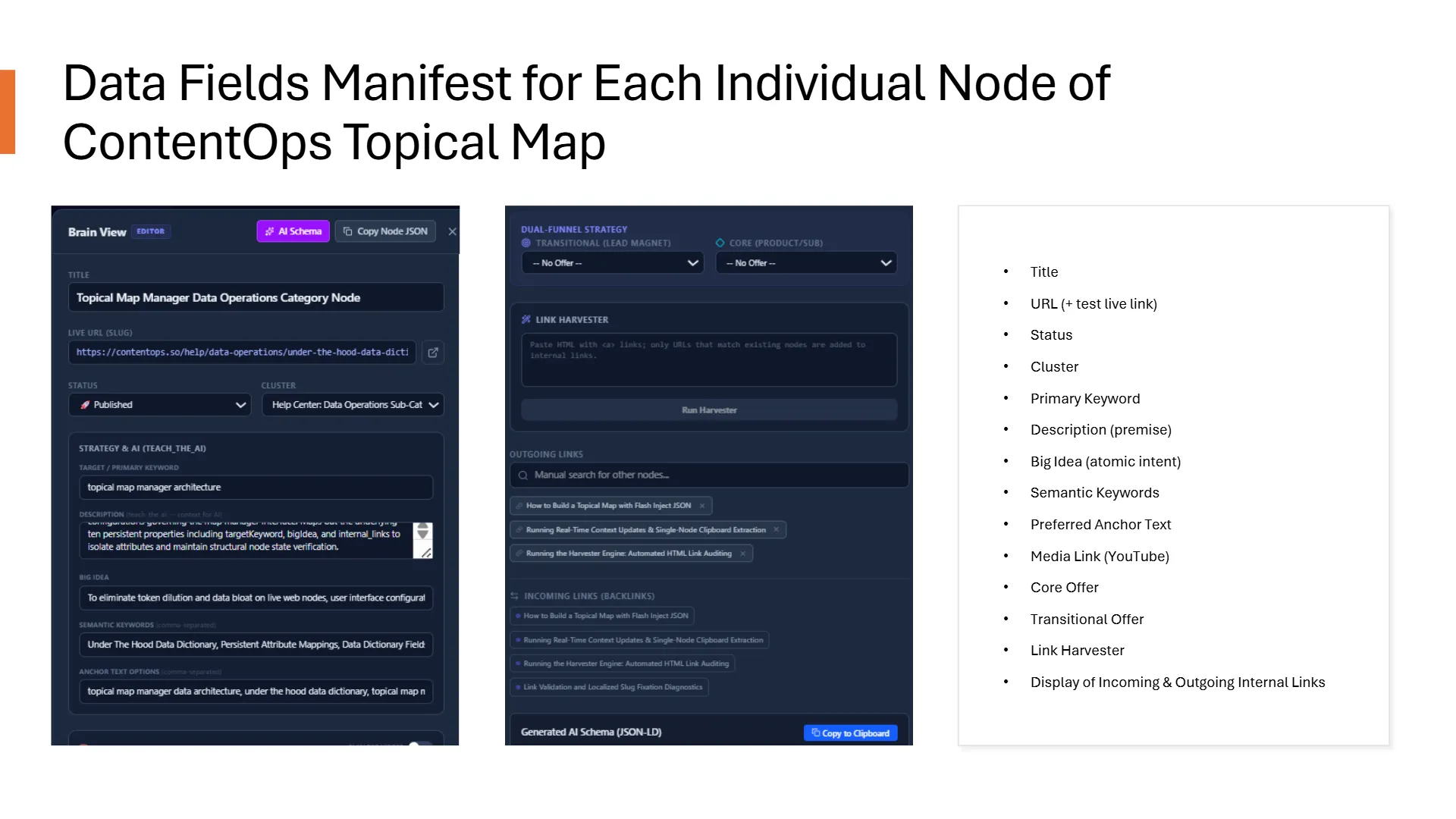
Configure the hidden metadata variables inside your under-the-hood-data-dictionary manual to properly calibrate user-facing field structures for AI consumption. This system configuration outlines how fields like semanticKeywords and anchorTextOptions switch on the stadium lights for AI engines, establishing an active knowledge graph.
1. Activating the Stadium Lights: Core Grounding Fields
Standard AI copywriters write flat text because they are contextually starved. To defeat this, ContentOps replaces flat row spreadsheets with persistent node properties that store complex business metadata. By populating the user-facing configuration options, you transform your strategy data from static cargo into active logic:
semanticKeywords: Explicitly maps out the entity definitions (both abstract concepts and physical assets) present within a post to give the AI a complete map of your content layout.anchorTextOptions: Establishes universal semantic agreement across your website, telling your writing assistants exactly what desired text anchors this page wants sibling posts to utilize.
2. Algorithmic Creation: Overwriting State with Automated Payloads
While all of these data dictionary parameters are fully customizable and manually editable via the web dashboard user interface, executing updates node-by-node introduces manual data entry friction. In practical day-to-day operations, users will primarily leverage advanced external LLM compilation models to auto-generate structured, formatted data blocks.
These compiled payloads are injected directly to establish fresh nodes or mass-overwrite existing out-of-spec attributes in a singular execution pass. To configure your external prompting matrix and avoid database coercion drops during clipboard uploads, review the step-by-step instructions in the Topical Map Flash Inject Guide.
3. Downstream Benefit 1: Real-Time Creation & Attribution
The first major structural advantage of this calibration is inside your daily creation workflow. When you pass a single-node JSON data snippet into an external chat window, the engine instantly reads your entity configurations without having to scrape or parse an entire live post. Because your brand voice rules, core angles, and structural topics are hardcoded into the data payload, the AI can reference, contextualize, and adapt its prose accurately to match your authentic domain insights without guessing or hallucinating.
4. Downstream Benefit 2: Multi-Media & URL Ingestion Welding
The second major operational payoff affects your site’s physical linking structure. By storing live URLs, media assets (like YouTube and podcast streams), and anchor options natively inside your map properties, you grant the AI model full visibility over your site’s technical blueprints. When a page draft is processed and wrapped within standard, semantic HTML elements, your assistant can effortlessly pull the precise target paths and affix them cleanly into your paragraph transitions. This creates a high-velocity, bidirectional pipeline where supporting posts link back to pillars automatically at the writing stage, completely bypassing manual editor chores.
Frequently Asked Data Dictionary Questions
How does the system ensure that the AI writer references our exact user-facing anchor text options when executing multi-offer injections inside a live HTML wrapper?
anchorTextOptions as clean, tokenized data arrays. The writing assistant references these variables to build contextual sentences around the exact links, ensuring you don’t mangle existing prose just to fit a keyword.
What explicit structural fields handle system state records within the underlying content database architecture to limit token dilution metrics?
id, title, cluster, and status (which enforces strict ideas, drafts, or published state flags) alongside optional configuration vectors to compute contextual paths safely.