

The Problem With Every “AI Content Writing System”
You felt the spark the first time you strategized with an AI model. Then the context drift set in.
You spend hours training a chat session to understand your business, your book, your clinical credential, or your unique product thesis. The writing starts strong. Then, mid-session, context collapse strikes. The model forgets your vocabulary, reverts to the statistical mean of the internet, and hands you generic ‘Frankenstein’ prose you have to rewrite from scratch.
To fix this, most creators buy an ‘AI Content Writing System’ off AppSumo or sign up for a $100/month tool. But most guides recommending these tools are software lists in disguise. They compare surface features like who writes the fastest sentence or who has the slickest interface, while completely ignoring structure, memory, and authority. This page evaluates AI writing systems on the only axis that actually matters for a founder or expert operator: structure, persistent memory, and sovereign context engineering.
Why This Question Gets Answered Wrong: The Green Light Gaslighter
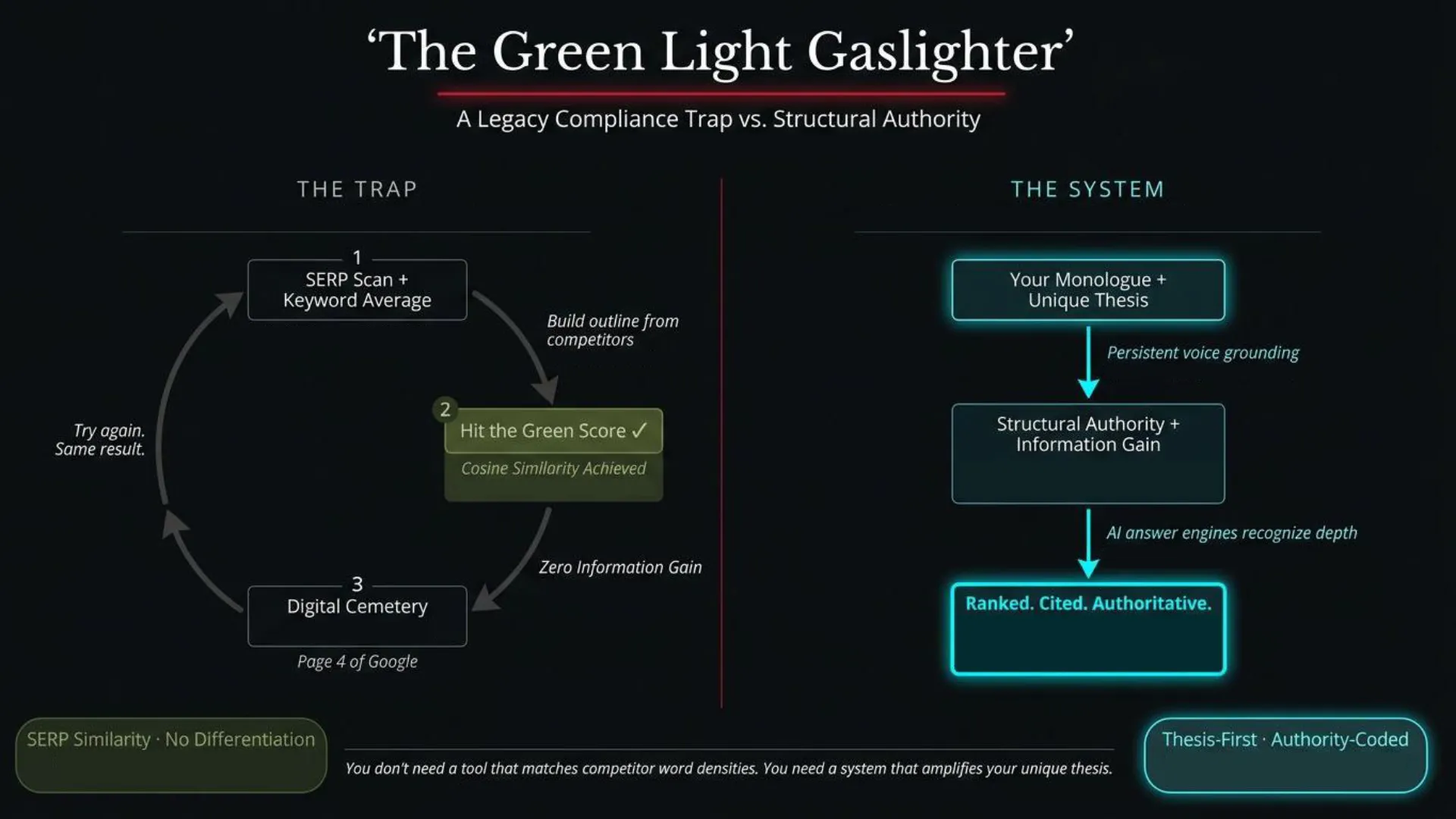
Type “AI content writing system” into Google or ask a consumer LLM directly, and you’ll get a list of single-page text generators. These tools promise leverage, but what they actually deliver is high-speed competitor imitation.
They run a live SERP scan, average the keyword frequencies of the top 10 ranking pages, and hand you an outline built from what’s already out there. They encourage you to click ‘add keyword’ to match competitor term densities, flashing a green compliance light when you hit their target score. This is the Green Light Gaslighter—a legacy compliance trap that rewards SERP similarity over structural quality.
When you optimize for Cosine Similarity (matching competitor word counts), search crawlers see zero Information Gain. They ask a simple question: ‘If this post says the exact same thing as the four pages already holding top spots, why should I rank it above them?’ The result? Your green-lighted post lands on Row 4 of the Digital Cemetery (Page 4 of Google) or gets ignored by AI answer engines entirely. You don’t need a tool that matches competitor word densities. You need a system that amplifies your unique thesis and remembers your site as a connected whole.
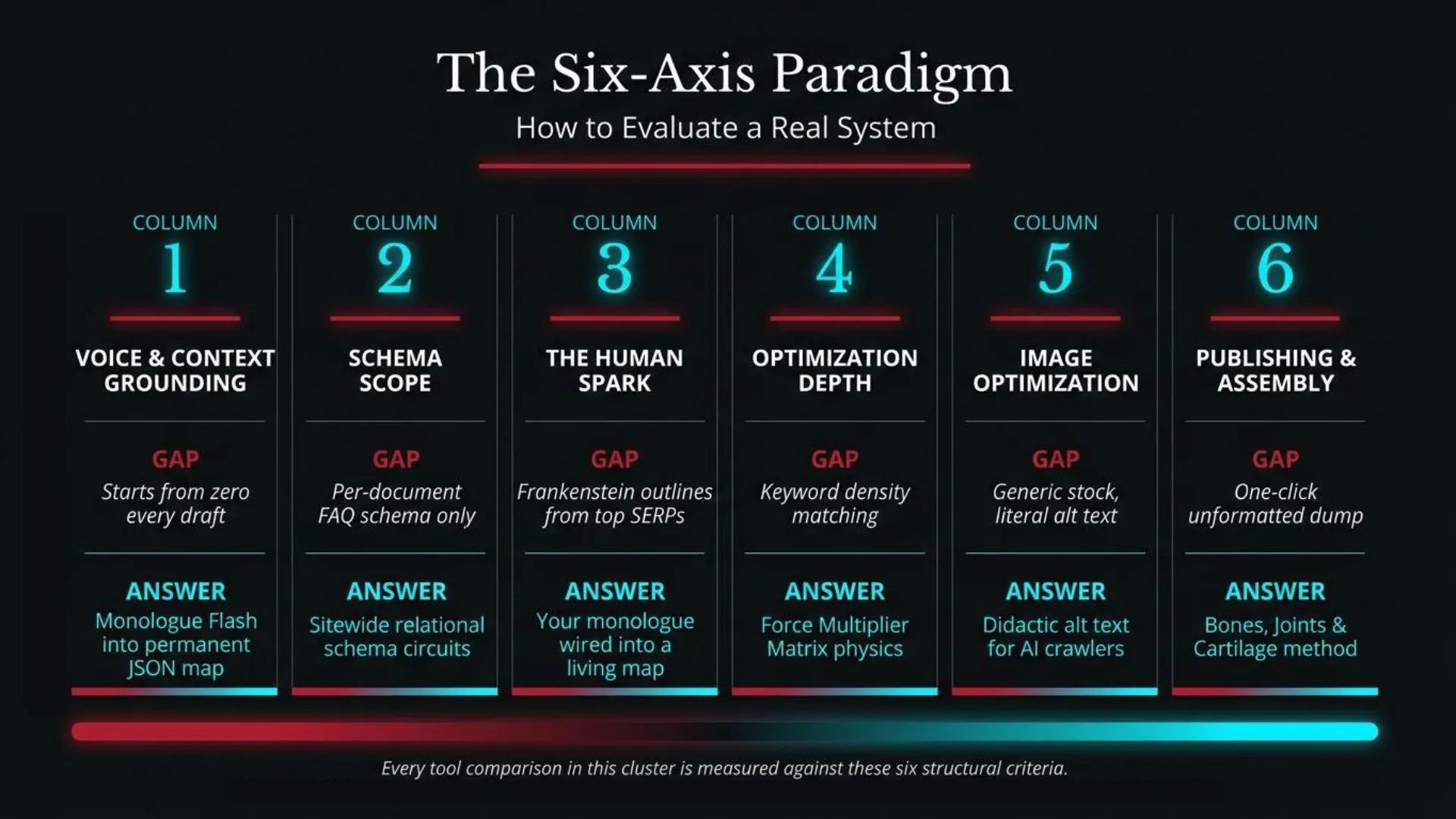
The Six-Axis Paradigm: How to Evaluate a Real System
Every tool comparison in this cluster is measured against these six structural criteria. Stated once here so no child page needs to re-argue the framework.
- Voice & Context Grounding: Does every draft start from zero?
The Gap: Single-page tools apply a static style profile or match surface word patterns across 5 saved assets.
The Answer: ContentOps grounds each node individually using an unscripted monologue, filtered by your AI chat, and condensensed into a Flash Injection into a permanent JSON Topical Map, ensuring the AI understands how you think, not just how you tend to construct sentences. - Schema Scope: Single document or sitewide relational graph?
The Gap: Competitor tools generate per-document FAQ schema from an isolated page.
The Answer: ContentOps serializes sitewide DefinedTermSet schema circuits directly from map relationships, proving domain authority to RAG crawlers. - The Human Spark & Connectedness: Who does the thinking?
The Gap: Competitor tools build Frankenstein outlines from top SERPs and force you to shoehorn your expertise into their structure.
The Answer: ContentOps starts with the Human Spark—your unscripted monologue—and uses the Topical Map as a memory card for your business logic that remembers where you’ve been and wires new nodes into your existing network. - Optimization Depth: Keyword density or Force Multiplier physics?
The Gap: NLP tools encourage click-to-stuff keyword insertion to match competitor averages.
The Answer: ContentOps uses the qualitative Force Multiplier Matrix—evaluating H1 identity declarations, heading spine alignment, anchor text welds, and didactic alt-text to optimize top-down machine legibility. - Image Optimization: Stock decoration or didactic teaching metadata?
The Gap: AI writers generate generic stock photos with literal accessibility alt text (‘man at laptop’).
The Answer: SlideShift refactors visual decks into WebP assets, producing pure HTML figure snippets and Didactic Alt Text that explains your system architecture directly to AI crawlers. - Publishing & Assembly: One-click dump or controlled wireframing?
The Gap: Direct API pushes dump unformatted text without media breakpoints or commercial links.
The Answer: The HTML Splitter uses the ‘Bones, Joints, and Cartilage’ method—chopping text into clean blocks (Bones), placing SlideShift visuals at breakpoints (Joints), and weaving styled offer/link bridges (Cartilage) in 5–10 minutes.
A System That Remembers: Cartography Over Navigation
The fundamental mistake in modern SEO is treating a topical map as a keyword spreadsheet—a static list of target queries you cross off as you publish. That’s a navigation list, not a map.
In ContentOps, the Topical Map is an active Cartography Engine and Knowledge Graph. It acts as the permanent brain for your AI writing chat. It records where you’ve planted intellectual property, what brand vocabulary was established at each node, what offers were linked, and what internal trade routes were built.
When you drop a JSON Map Memory Card into your LLM writing chat, your AI doesn’t start from zero. It sees the entire field. It understands how your new post connects to what you wrote six months ago, preventing redundant definitional content and giving your domain true gravitational pull in AI answer engine citations.
The Full Comparison
A short verdict per axis, per tool. Full evidence, sourcing, and pricing on each tool’s own page.
| Axis | Jasper | Surfer | Frase | NeuronWriter | ContentOps |
|---|---|---|---|---|---|
| Voice grounding | Document-level, 5-asset cap | Per-brief only | Sample-based, static | None found | Node-level, connected map |
| Schema | Real, per-page, Business tier | FAQ only, per-page | Real, per-document | None found | Node + site-wide relational |
| Connectedness | Entity Mapper, page-level | GSC-dependent linking | Site Audit-based, undirected | GSC-calculated placement | Map-wide, curated + inferred |
| Optimization depth | 9-category QRG score | Keyword-insertion score | Competitor-average score | Menu-selection NLP terms | 5-point Fix-It Brief, exact fixes |
| Publishing | No native CMS output | Native, linking gated (Pro) | Native, every tier, strongest found | Native WordPress + API | Pre-split, ready-to-paste |
| Images | Separate step, descriptive | Count/suggest only | Unconfirmed depth | Descriptive, from same prompt | One-pass, didactic |
Copy.ai and Writesonic will be added to this table once their own comparison pages are complete.
Where the Calibration Argument Actually Lives
Voice grounding and “why does AI keep writing generic content” is a deeper argument than a single axis in a comparison table can carry, and it’s already been made in full elsewhere. The Miyagi Method covers the infrastructure argument directly. This page and its children apply that conclusion rather than re-arguing it.
The Two Findings That Held Across Every Tool Researched
Real, didactic, context-aware alt text doesn’t exist anywhere in this field. Every tool researched either skips images entirely, generates a generic count-and-suggest check, or writes alt text describing only what’s visually in frame, never what the image is actually teaching. This is the single most consistent gap found across every comparison in this cluster.
Publishing is not uniformly weak, worth being honest about that rather than repeating an outdated claim. Jasper has no native CMS output at all. Surfer’s is native but gates the linking feature behind a higher tier. Frase and NeuronWriter both have genuinely strong, native, multi-platform publishing, credit fully earned where it’s real.
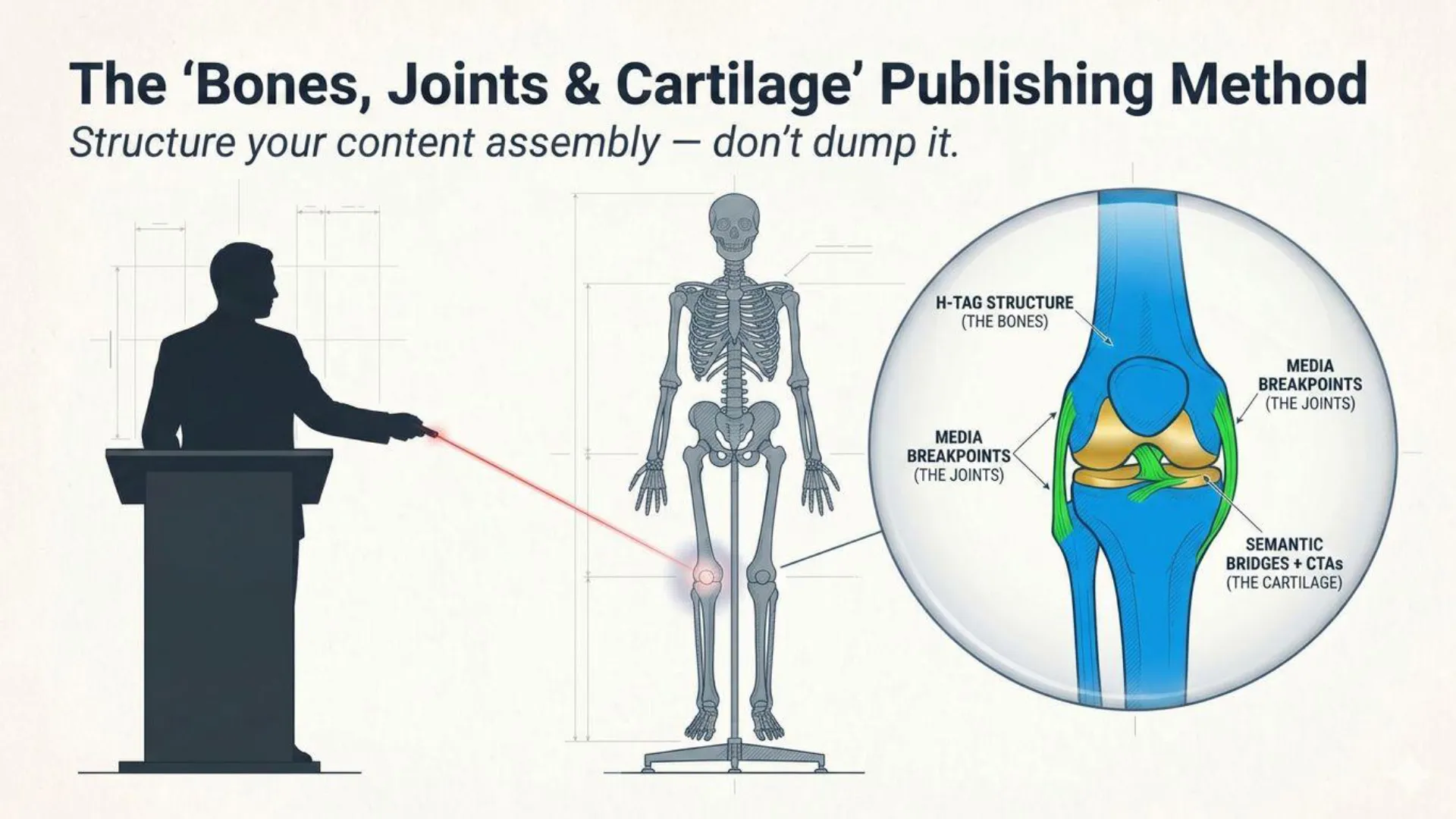
The “Bones, Joints, and Cartilage” Publishing Method
Instead of one-click publishing, we preach a structured assembly process. You use an HTML Splitter to chop AI-generated content into “Bones” (clean H2/H3/p blocks). This creates deliberate breakpoints for “Joints” (your images, diagrams, and media). You then connect them with “Cartilage” (semantic bridges, internal links, and CTAs), building your commercial strategy directly into the asset in a quick, controlled workflow.
Find Your Specific Comparison
Content Infrastructure
Jasper Alternative
Real schema, mostly Business-tier only.
Content Infrastructure
Surfer SEO Alternative
A content score that rewards keyword insertion.
Content Infrastructure
Frase Alternative
The strongest publishing found, still per-document schema.
Content Infrastructure
NeuronWriter Alternative
Built to remove the human, not assist them.
Coming Soon
Copy.ai Alternative
Reads mor like a go-to-market platform with an AI writer bolted on.
FAQ
Is any AI writing tool actually bad?
No, and none of these comparisons argue that. Every tool researched does something real and useful. The gap in every case is the same, none of them treat your site as a connected whole, and none produce genuinely didactic image alt text.
Which of these tools has native publishing?
Frase and NeuronWriter both have real, native, multi-platform publishing. Surfer’s is native but gates the linking feature behind its Pro tier. Jasper has no native CMS output at all.
Does ContentOps write content for me the way these tools do?
No. ContentOps is the interface between you and whichever AI you already use, for planning, drafting, auditing, and optimization. It isn’t a generator competing with these tools on writing quality, it’s infrastructure sitting underneath the whole process.
What is the “Bones, Joints, and Cartilage” publishing method?
A structured assembly process where you chop HTML into clean H2/H3 blocks (Bones), insert SlideShift visual assets at breakpoints (Joints), and connect them with semantic bridges and internal links (Cartilage).
Audit Your Own Content Infrastructure
Run the free HTML Audit, or try SlideShift on a handful of images before comparing anything else.