

What Does SEO Stand For?
What SEO Is, and What It Isn’t
If you already have a website, there’s a decent chance you installed Yoast or Rank Math before you fully understood what SEO actually meant. That’s a completely normal order to do things in. You publish a page, the plugin runs its checklist, and a little face goes from red to orange to green as you work through it.
Don’t Fall for the SEO Checklist Trap
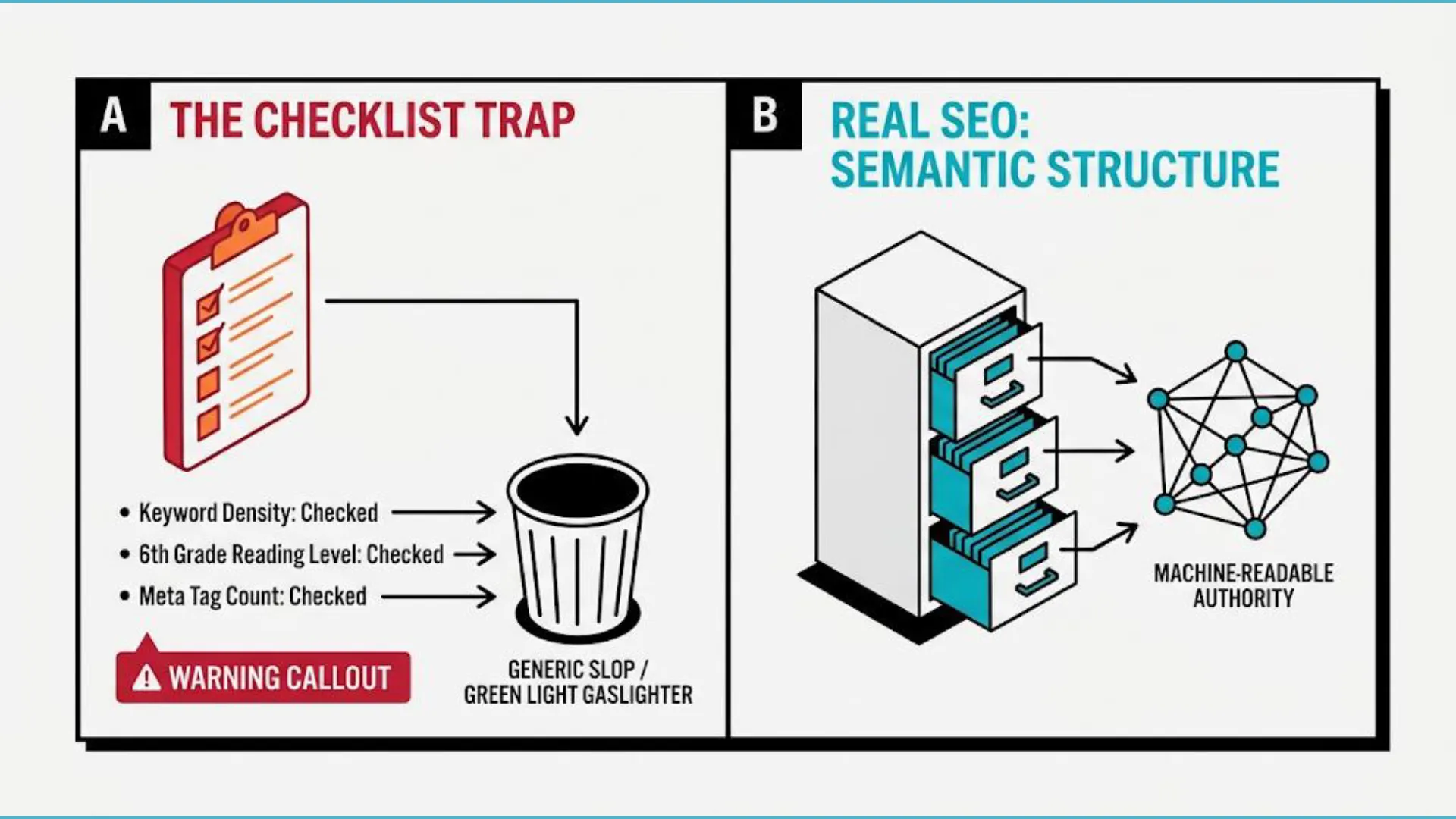
Here’s the problem: that face is measuring compliance with a checklist, not whether your page is actually good. And when the checklist flags something, it hands you a symptom with no cure. I used to hunt down every instance of passive voice by searching every conjugation of “be” one at a time. I wrote a Word macro that highlighted transitional words across a whole document just so I could count them and add more. Neither of those fixed anything. They were ways of patching a red flag I didn’t fully understand, invented from scratch because the plugin tool gave me a failure checklist but never told me what to actually do about it.
Write to satisfy that kind of checklist instead of your reader, and you get a specific, recognizable kind of writing, keyword-stuffed, short and choppy, pitched at roughly a sixth-grade reading level because that’s what the score rewards. This is the Green Light Gaslighter in action, and it’s worth naming directly rather than as a footnote, since it’s very likely the actual reason you’re asking this question in the first place.
SEO Isn’t Just Meta Data and Keyword Density Either
SEO is not a traffic light. It’s not a keyword count. It’s not writing simply because a plugin rewards simplicity. It’s structuring what you already know how to write so that a crawler can find it, the same way a well-organized filing cabinet helps a colleague find a document, without changing what’s actually in the file. If you want the fuller version of this distinction, the DMV Test covers exactly this gap, passing your checklist tells you that you showed up with the right paperwork. It doesn’t tell you whether you can actually ride the motorcycle.
Why This Question Matters More Than Most People Realize
The real gap usually isn’t “I don’t know what the acronym stands for.” It’s “I’ve been doing something in its name for months, and I still don’t know if it’s working.” Those are two very different problems, and only one of them gets solved by reading a definition.
The Longer Answer to What SEO Actually Is
SEO breaks down into three real areas, not a hundred small ones.
On-page SEO
What’s actually on the page itself, the words, the headings, the structure that tells both a reader and a crawler what this content is about and how it’s organized.
Technical SEO
The behind-the-scenes setup, whether the page loads properly, whether a crawler can actually read it, whether the underlying code is clean or bloated.
Off-page SEO
What happens outside your own site, whether other trusted sources reference or link back to what you’ve built, which is a signal that your content is worth trusting in the first place.
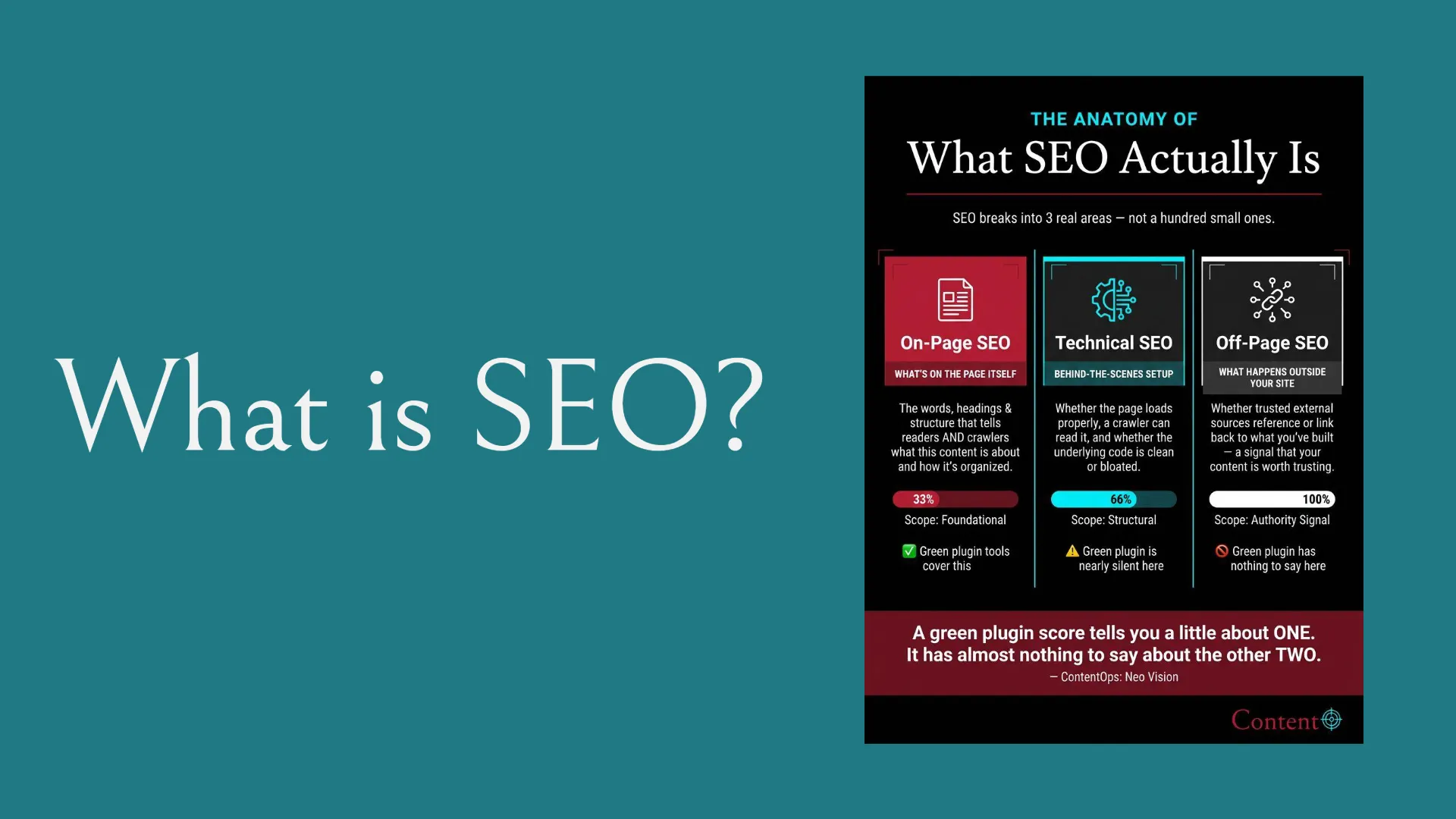
A green plugin score can tell you a little about the first one. It has almost nothing to say about the other two.
Two More Things a Checklist Can’t Measure
On-page, technical, and off-page all describe visible outputs, headings, page speed, backlinks. But two things actually determine whether any of that earns you a ranking, and neither one shows up on a checklist.
Domain and Topical Authority
A perfect on-page score doesn’t tell you who else is competing for the same query. When I first started publishing, I trusted the checklist completely, score higher than the other posts on the page, and mine should rank higher too. What I didn’t know was that I wasn’t just competing against other blog posts, I was competing against entire domains with years of accumulated trust behind them, Goliaths a checklist has no way to flag.
And topical authority isn’t the same as topical coverage. I was writing about every angle of my subject, genuinely covering the ground, and assumed that alone built authority. It didn’t, because none of those posts were actually linked to each other. Authority doesn’t accumulate by existing near related content, it accumulates by being wired to it, real internal links routing weight between pages. Without that, a large body of on-topic writing is really just a pile of disconnected Island Nodes, each one starting from zero.
Competition
The same keyword can be a real opportunity on one site and a lost cause on another, purely based on who else already owns that space. A checklist treats every keyword identically, regardless of who you’re actually up against.

The Practical Implication For Your Site
Once you actually know what SEO is, the next real question isn’t “what does the acronym mean,” it’s “Can I do SEO myself”, and whether the checklist you’ve been chasing was ever the right thing to chase in the first place.