
On-Page SEO Fixes Your Checklist Never Told You About
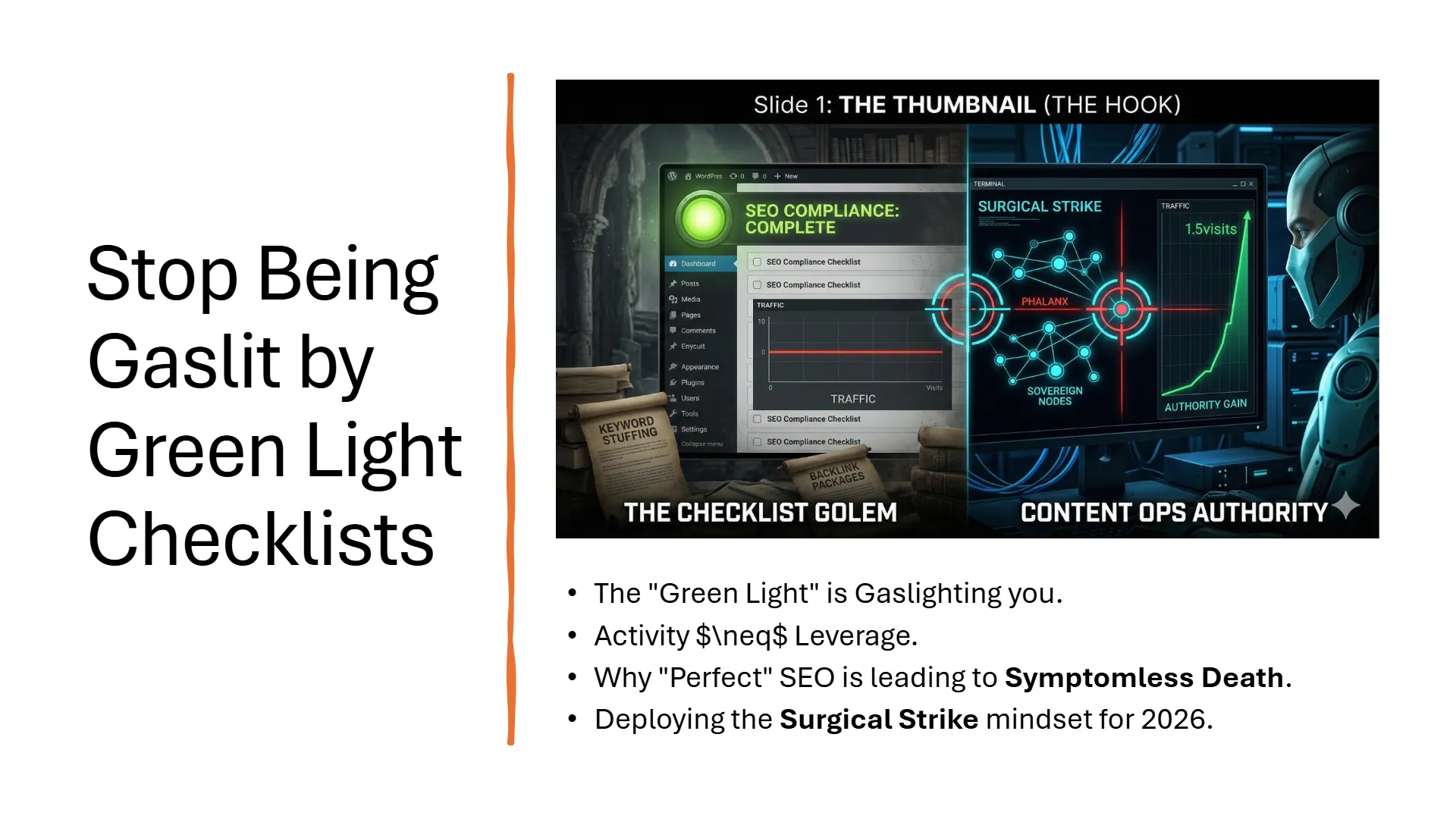
For a decade, the “Plugin Kings” have sold us a comfortable lie: that SEO is a game of mechanical compliance. Put the keyword in the first 100 words. Keep the meta description under 160 characters. Repeat the phrase until the little dot turns green.
Here’s the direct fix. On-page SEO fixes aren’t found by chasing a plugin’s keyword-density score, they come from aligning your H1’s promise, your heading structure, your anchor text, and your alt text with the exact intent Google is actually testing you against. Make those specific fixes instead of chasing green checkmarks, and a checklist audit stops being a dead end and starts being a map.
But in 2026, following a checklist isn’t a strategy—it’s Activity Disguised as Leverage. It is the Time Thief stealing your Saturdays while your authority is quietly erased by the Robot Librarian (Google and its AI Overviews). This mechanical trap is why standard on-page optimization workflows stall out before reaching the extraction layer.
When your strategy is trapped in mechanical compliance, you aren’t optimizing, you’re just following a map to a dead end. This is the primary reason why Yoast and Semrush SEO checklists fail to move the needle for high-intent queries, leading to systemic SEO checklist failure across your entire domain framework.
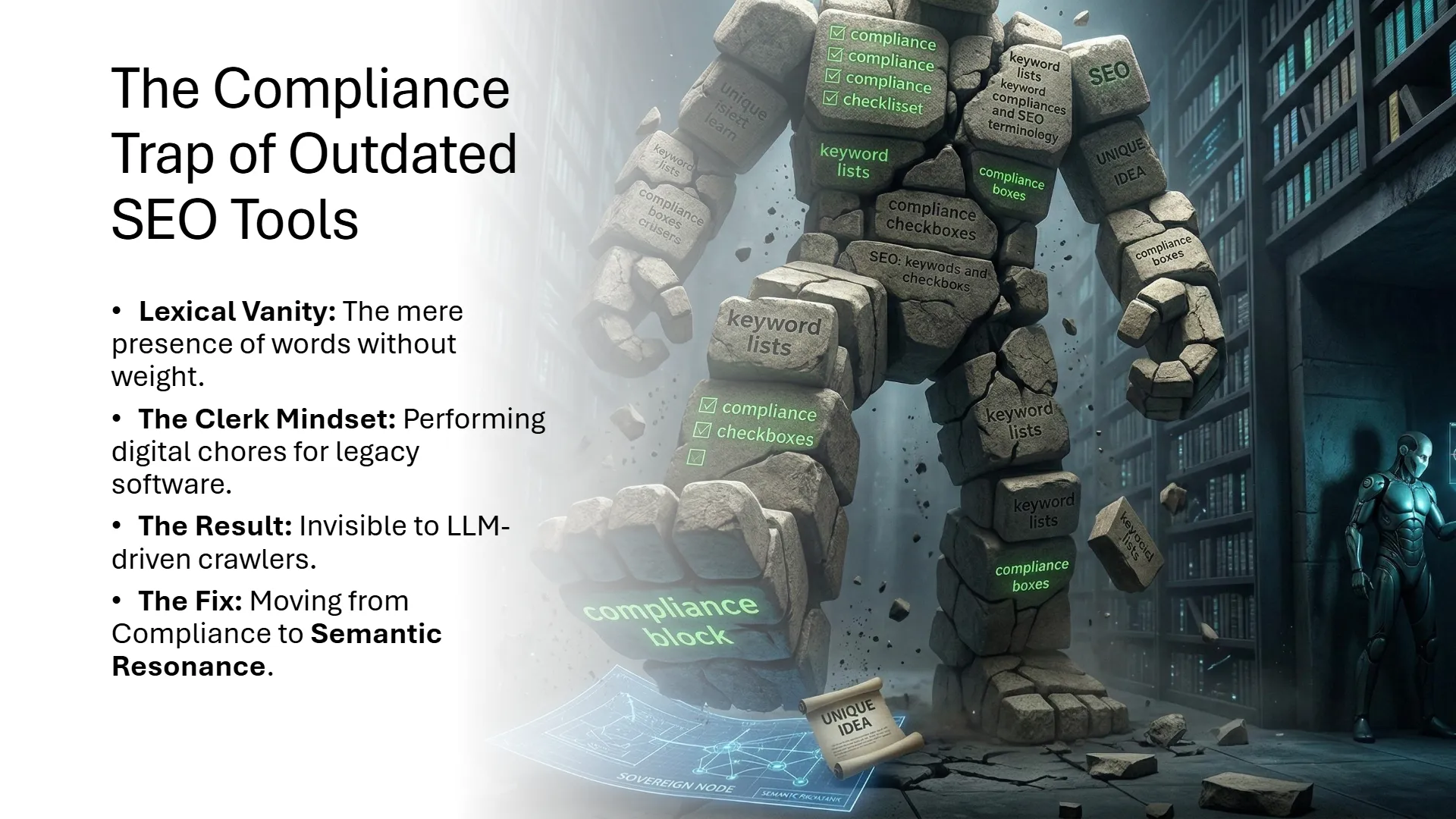
The Legend of the Checklist Golem
The Golem is a legacy defense system. It was built for a simpler time when Google was a card catalog. It rewards Lexical Vanity, the mere presence of words, rather than Semantic Resonance.
When you follow these checklists, you aren’t acting as an Expert, you are acting as a Clerk. You are performing digital chores to satisfy a piece of software that hasn’t realized the Semantic Event Horizon has already passed. The Golem doesn’t want your genius, it wants your compliance.
The result is Symptomless Death. Your post is technically “perfect,” yet it is invisible to the LLM-driven crawlers because it lacks the Human Spark and structural intent required to rank in the age of Answer Engines.
[INTERVENTION REPORT] Case Study: The Human 10% Hijack
While the Goliaths were following the Golem’s rules, I executed a Surgical Strike using a contrarian “Cat DNA” analogy. By ignoring the “Standard Advice” and focusing on Information Gain, I hijacked the #1 spot overnight. Read the Human 10% Case Study here.
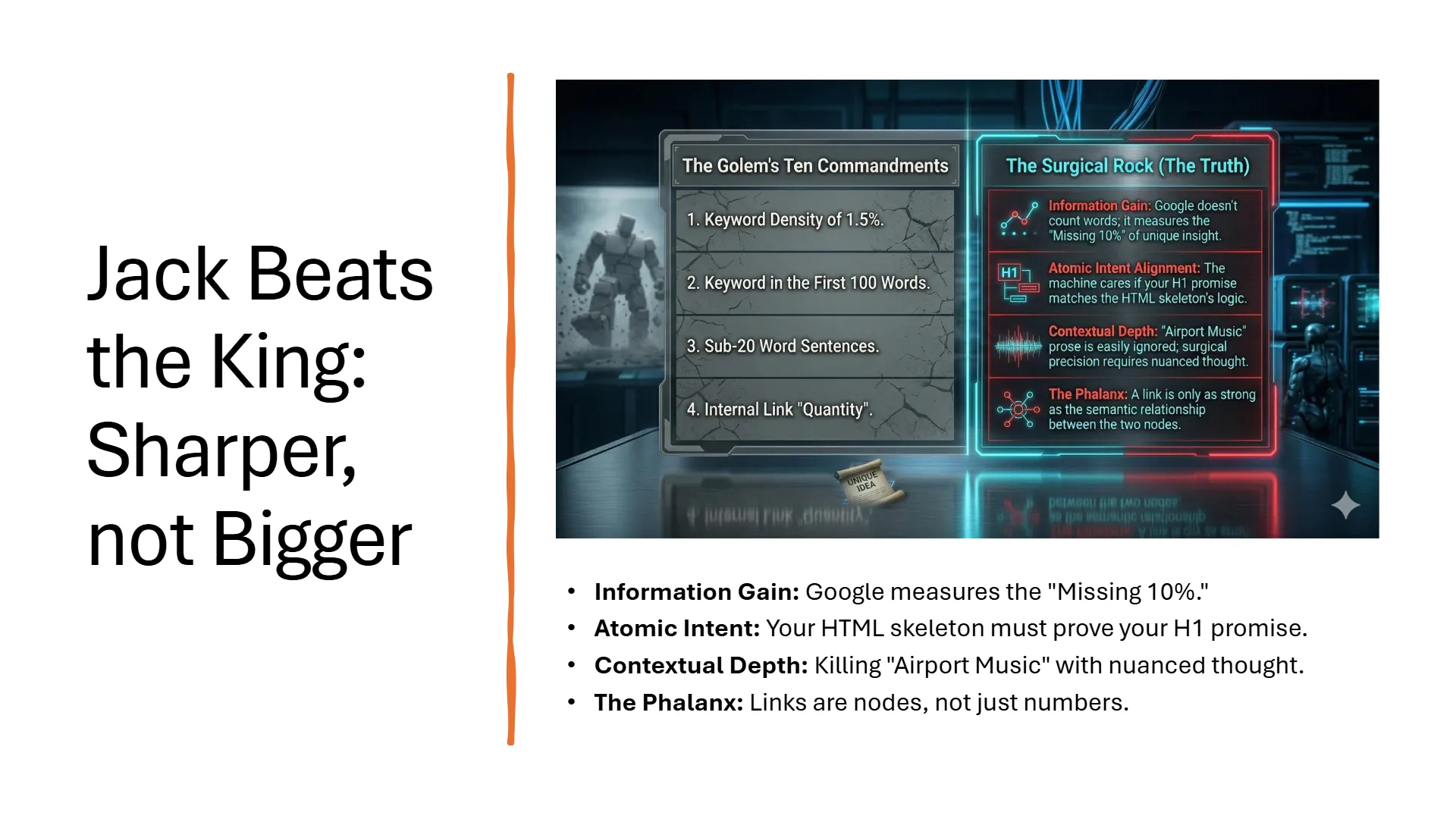
To beat the Goliaths, you don’t need a bigger budget, you need a sharper rock. Precision beats volume every time when you are deploying a Surgical Strike SEO strategy to secure instant SEO fixes across competitive brackets.
This asymmetric approach to structural leverage is the foundation of a modern content operations strategy for small creators, explaining how the Jack beats the King by targeting high-intent niche verticals instead of chasing corporate raw volume.
The Golem’s Ten Commandments vs. The Real On-Page SEO Fixes
To survive the shift to Sovereign Authority, you must stop checking boxes and start throwing rocks. This is how Jack Beats the King, by being sharper, not bigger.
| The Golem’s Commandment | The Surgical Rock (The Truth) |
|---|---|
| Keyword Density of 1.5% | Entity-Based SEO: Google doesn’t count words, it measures the “Missing 10%” of unique insight and explicitly verified knowledge graph structures. |
| Keyword in the First 100 Words | Atomic Intent Alignment: The machine cares if your H1 promise matches the HTML skeleton’s logic. |
| Sub-20 Word Sentences | Contextual Depth: “Airport Music” prose is easily ignored, surgical precision requires nuanced thought. |
| Internal Link “Quantity” | The Phalanx: A link is only as strong as the semantic relationship between the two nodes. |
| Generic “Image Alt Text” Box | Structured HTML Context Arrays: Legacy plugins drop flat strings into media drawers. True engine ingestion requires grounded widgets containing didactic alt text and structural captions, automated natively via the SlideShift Free Image Optimization Tool. |
This is the compliance vs. capability gap in miniature: passing every rule in the left column while a page still doesn’t move an inch in the right one. It’s the exact reason compliance vs capability is worth understanding as its own problem, separate from the checklist itself.

What the Plugins Do On-Page and Where They Stop
Screaming Frog, Ahrefs, and SEMrush aren’t the villains here, they’re just running a different leg of the race. They’re genuinely excellent at the diagnostic sprint: crawling your site, flagging what’s broken, and handing you a report dense with data. The problem was never what they do. It’s where they stop. They cross the finish line of the briefing phase and pass you the baton, and most operators are left standing there with no play to run next.
That handoff is exactly the gap ContentOps closes. We don’t compete with the crawl, we pick up where it ends and translate the flagged data into the specific structural fix. If you want the full stage-by-stage breakdown of where these tools’ job finishes and the execution phase begins, the relay race framework for SEO tools walks through it in detail.
From “Clerk” to “Architect”: The Mission Brief
If I could do it all over again, I’d stop being “penny wise and pound foolish” with my SEO strategy. I would realize that 10 people looking for a Surgical Solution are worth more than 10,000 looking for a Generic Answer.
A checklist tells you what you didn’t do (Passive Failure). A Surgical Mission Brief tells you exactly what you must do to build authority through your post (Active Execution).
But you cannot execute a mission if your tools aren’t calibrated. This is the True Miyagi Method: you must embrace the “Wax On, Wax Off” chores of grounding your AI in your JSON Keyword Map before you strike. If you don’t calibrate the weapon with proper data context, your automated lines will simply output structured slop.
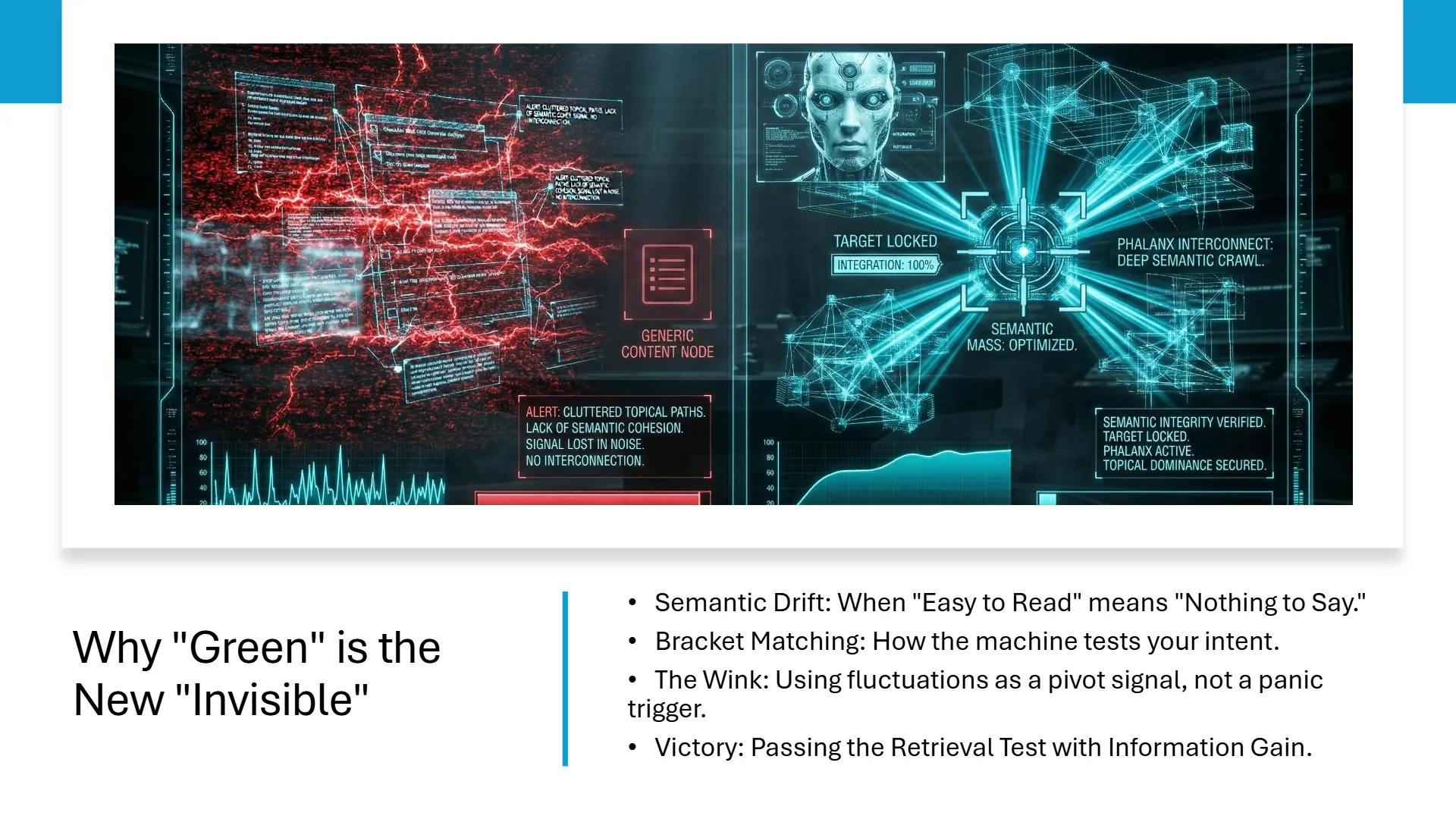
If your content is semantically shallow, no amount of “green lights” will save you from the Retrieval Reliability Crisis. This is where Semantic Drift begins, the point where your code says “Expert” but your context says “Generic Slop.”
The Retrieval Reliability Crisis: Why “Green” is the New “Invisible”
The greatest threat to your empire is Semantic Drift. This happens when your content is “Easy to Read” but Semantically Shallow.
The Robot Librarian is no longer just looking for keywords, it is performing Bracket Matching. It is testing your content against “neighboring” signals to see if you actually belong in the top tier. If you’ve followed a checklist to produce “Airport Music”, content that sounds professional but says nothing, you will fail the retrieval test every time.
This is where The Wink Protocol comes in. When you see your rankings fluctuate, it’s not a failure, it’s the machine making “eye contact.” It’s a signal to pivot your intent, not to go back and add more keywords to your H2s.
FAQ: The On-Page SEO Fixes Checklists Never Mention
What are the most important on-page SEO fixes?
Start with the four the Golem’s checklist can’t see: does your H1’s promise actually match your heading structure, does your anchor text describe the destination instead of saying “click here,” does your alt text describe real content instead of a generic caption, and does your keyword target something you can realistically win. Fix those four before touching word count.
How do I fix issues found in an SEO audit?
An audit tool tells you where the structure breaks. It doesn’t tell you what to build in its place. That’s the gap a Surgical Mission Brief closes, translating a list of flagged issues into the exact heading, link, and intent changes needed on that specific page. It’s also the same reason a clean audit report doesn’t always translate into why SEO audits fail to improve rankings on its own, a report and a map are two different documents.
Can ChatGPT tell me what to fix?
No, ChatGPT can’t fix your SEO issues without the HTML Audit. ChatGPT never actually crawls or reads your page’s raw code, it only works with whatever context you hand it. ContentOps’ Audit Suite is built to close that exact gap: it generates a diagnostic of your real HTML that acts as a context injection for ChatGPT or any LLM. Drop that diagnostic, the Mission 1 Broken Bones Brief, straight into your chat, and it gives ChatGPT what it actually needs to recommend real on-page SEO fixes instead of a generic guess.
How do I choose keywords I can actually rank for?
Match your keyword to the intent your page actually satisfies, not the volume you wish it had. If you’re chasing a term a Goliath already owns, retargeting to a more winnable adjacent keyword usually beats grinding against the original for another six months.
How do I optimize heading structure for SEO?
Your H1’s promise has to match the logic of the headings underneath it. If your H1 promises a fix and your H2s only describe a problem, that mismatch is Atomic Intent misalignment, and it’s invisible to a keyword-density checker.
How do I optimize anchor text for SEO?
Name the destination, not the click. “Read the Human 10% Case Study” tells a crawler and a reader exactly what’s on the other side. “Click here” tells them nothing, and a link that tells them nothing barely counts as a link at all.
How should alt text be written for SEO?
Describe what’s actually in the image, the labels, the data, the structure, not a restatement of the section’s argument. Generic alt text drops a flat string into a media drawer. Didactic alt text gives the crawler something to ingest.
What does keyword competition mean?
It means how much existing domain authority is already sitting on that exact phrase. High competition doesn’t mean the keyword is unreachable, it usually means the intent needs narrowing until you’re the sharpest answer to a smaller, winnable question instead of a generic one.
What should I fix first on a page?
Fix intent alignment before you fix anything else. A page with perfect heading structure and the wrong intent still won’t rank. A page with the right intent and rough structure has something to build on.
🧱 The Hindsight Insight (The Architect’s Regret): “If I could do it all over again, I’d stop trying to please a plugin and start building a machine-readable map of my own expertise. I spent years following the checklist, only to produce traffic that technically existed but said nothing worth reading. I was a victim of the Time Thief, doing digital chores instead of my craft. The magic isn’t in the tool, it’s in the grounding.”
One of the most common sources of workflow entropy is the manual, repetitive chore of preparing images for publication. This tedious, multi-step process of converting, renaming, and annotating visuals is a classic example of a “checklist task” that drains momentum and invites costly shortcuts. This is the exact strategy we automated with our free framework, explained in the ContentOps SlideShift: Turn Image Optimization into Visual Dominance guide.
🔍 The Needs Analysis (The Diagnostic Close)
“Are you paying a ‘Tool Overlord’ $500/month to tell you how to be average?”
Most sites are a collection of Islands, isolated posts drifting in a Digital Cemetery. We build Continents with a high-leverage prioritized recommendations map. We turn your raw, “Blood on the Tracks” wisdom into a Semantic Fortress that the AI cannot ignore. Stop being a clerk. Run a client-side scan directly inside the Free Surgical HTML Auditor tool to capture real-time errors, or let our architecture team reconstruct your legacy framework from the ground up.
Request Your Backlog Rescue Audit
Ready to stop the rot? Run your free MRI on a post you think deserves to rank, get the AI Fix-it Brief and start turning those failure checklists into actionable on-page SEO fixes.