
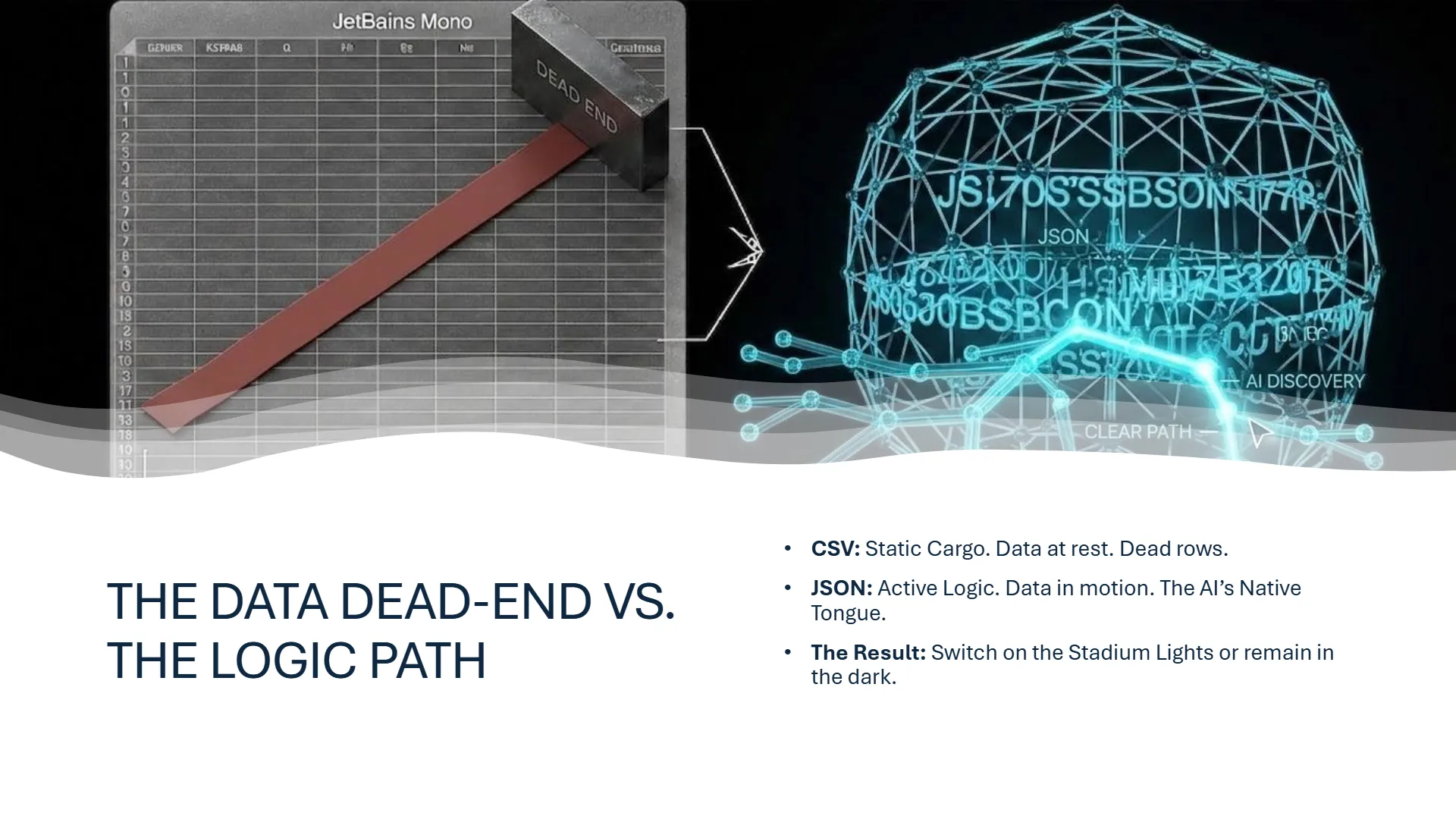
If you are still living in Excel VLOOKUP Hell, I feel for you. I’ve been there—spending hours manually mapping rows only to realize the machine is ignoring the very data you’re slaving over. Most experts are forced to treat “keyword mapping” as a flat row in a spreadsheet—a list of terms paired with URLs that never seems to end. But in the era of Agentic Search, that CSV isn’t just a document; it’s a ceiling. It keeps your expertise trapped as a pile of loose lumber, when you deserve to be building with a 3D blueprint.
The problem is simple: CSVs can’t talk to AI. When you feed an LLM a flat keyword list, you’re forcing it to “guess” the relationships between your ideas. This guesswork is the breeding ground for hallucinations, context drift, and ultimately Symptomless Death. You are already an Architect of your own expertise; it’s time to stop performing the chores of a librarian and start building a Sovereign SEO Infrastructure using the active logic of JSON.
Before we dissect the technical differences, see what it feels like to trade your spreadsheet for a command center.
csv vs json seo: The Flat Earth Trap
A CSV is Static Cargo. It is a two-dimensional snapshot of a moment in time. When you use a CSV for SEO, you are essentially providing the machine with a list of “things” without any instructions on how they connect. The Robot Librarian doesn’t just want a list; it wants to see the Spinal Integrity of your domain.
In the ContentOps ecosystem, we view the json topical map as a living organism. While a CSV is loose lumber, JSON is the 3D blueprint that shows how every header, keyword, and entity supports the core pillar. Because JSON supports nested hierarchies, it preserves the “State” of your content galaxy. If your data is “flat,” your AI assistant will eventually suffer from the Spotlight Effect—losing the plot of your brand DNA because it’s being forced to navigate without a map.
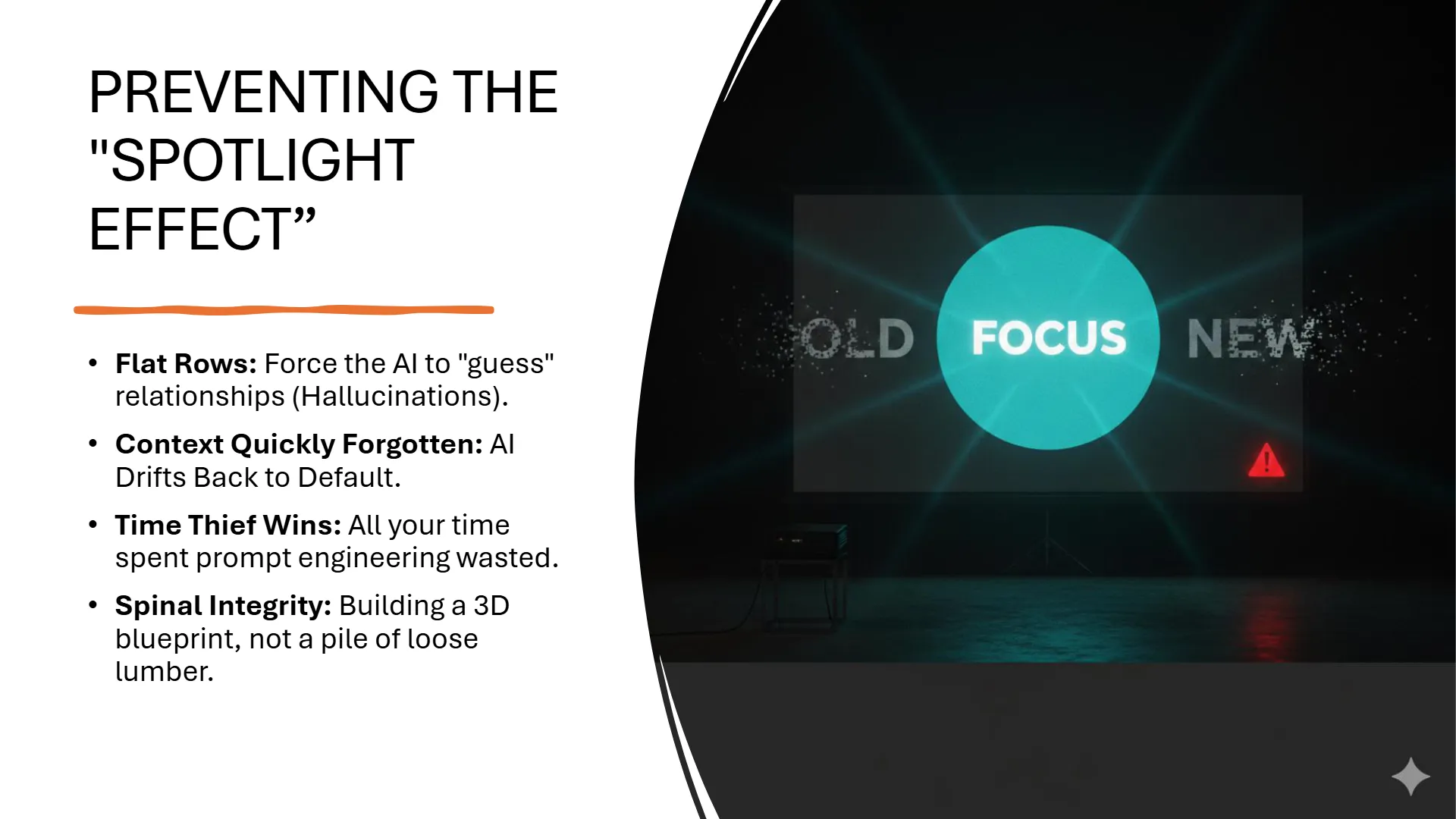
For too long, the topical map for semantic SEO has been confined to a static role: a one-time keyword planning and content clustering exercise.The Old Way: A project-based list of topics and keywords, often quickly outdated.
The Problem: This approach overlooks content lifecycle, knowledge ingestion, and the complexities of AI-driven content creation.
The New Vision: It’s time to redefine the topical map as the dynamic “Brain for Content Operations.”
The json topical map: Librarian Chores vs. Architect Actions
Librarians organize piles; Architects build structures. Traditional “Keyword Mapping” has been sold to you as a necessary chore. You’ve been told to spend 60 hours a month tagging URLs and checking boxes on a failure checklist. This is Activity Disguised as Leverage, and it’s keeping you from your real work.
When you move to JSON keyword mapping, you are performing Entity Orchestration through our Topical Mapping Tool. Instead of matching words, you are defining relationships. A JSON node doesn’t just contain a keyword; it contains the Atomic Intent, the semantic neighbors, and the bidirectional linking coordinates. This allows your AI to see the “Whole Field”—switching on the Stadium Lights so it can act as your high-level strategist rather than just a generic text generator.
Topical map json export: The Active Cargo Memory Card
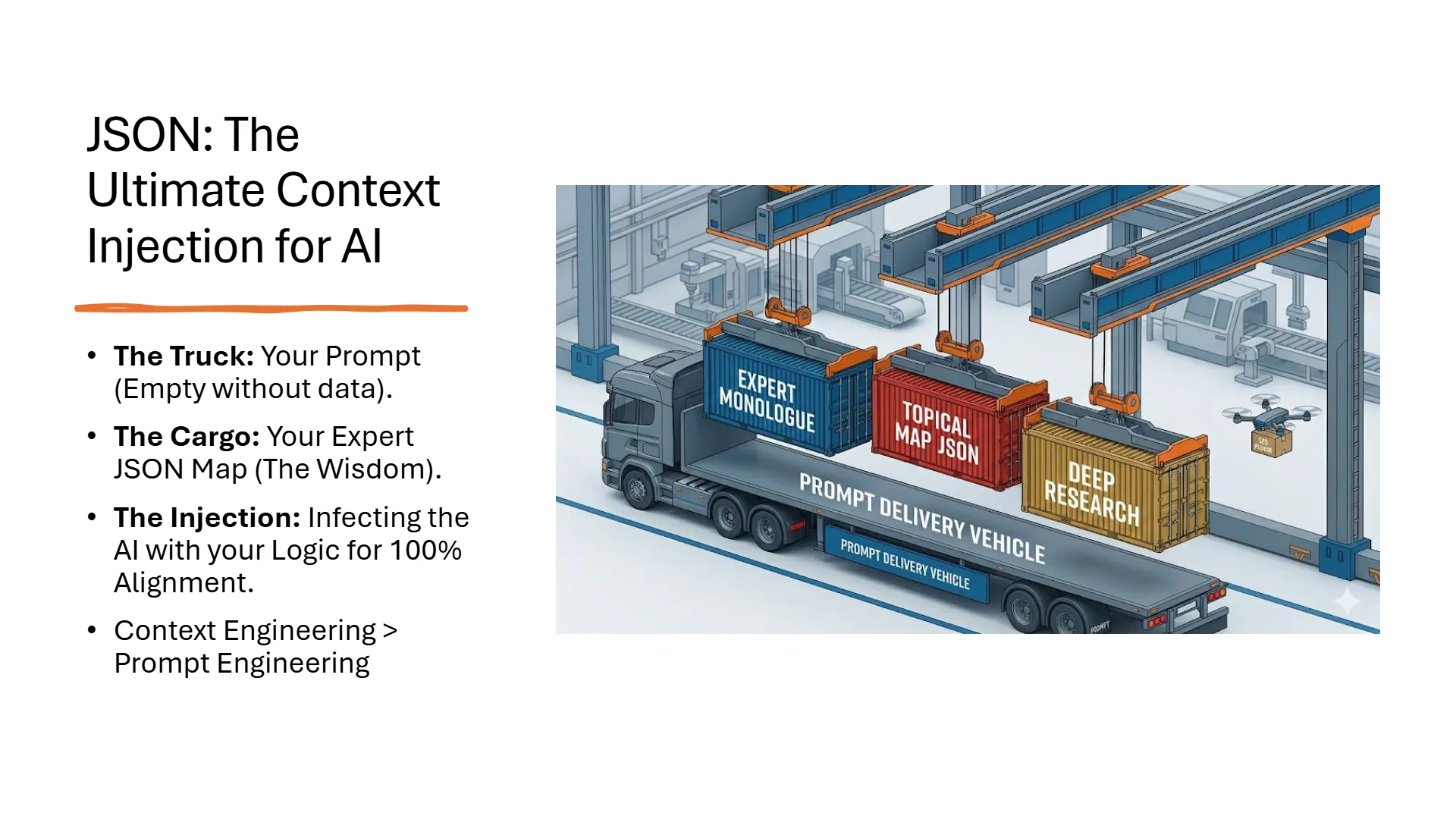
Think of your AI prompt as a Delivery Truck. In the world of “Prompt Engineering,” people focus on the truck—the wording, the tone, the constraints. But the truck is useless if it’s empty. The Cargo is the context.
The topical map json export is the “Active Cargo” memory card you slide into the truck. When you drop your ContentOps JSON map into a chat, you aren’t just “training” the AI; you are Infecting it with your Logic. The AI instantly ingests the hierarchical structure of your site. It understands that “Node A” must defend “Node B.” This deterministic grounding is the only way to solve AI amnesia and ensure your Expert AI Content System remains sovereign.
In an era dominated by advanced AI and sophisticated semantic search, the traditional view of a topical map as merely a keyword planning tool is outdated. It’s no longer about isolated terms or simple clusters.Reactive vs. Proactive: Keyword tools react to existing demand; a modern Topical Map for Semantic SEO proactively structures knowledge.
Fragmented vs. Connected: Old methods create siloed content; the new approach builds interconnected topical authority.
Static vs. Evolving: AI content generation demands a dynamic, living system, not a one-time planning document.This evolution redefines its purpose, moving beyond a simple list to a foundational content intelligence system.
Eliminating the 60-Hour Manual Grind
The greatest pathogen in SEO is the Time Thief—those hundreds of hours spent manually updating internal links and schema because your data is “dead.” Because a CSV cannot be ingested by the machines you use to write, you have to manually re-read your posts every time you want to add a link.

The role of a Topical Map for Semantic SEO has evolved dramatically. It’s no longer just a static list of keywords, but the dynamic, intelligent core of your content strategy.Deterministic Ingestion: The topical map acts as a blueprint, guiding every piece of content into its precise place within your knowledge graph. This ensures purposeful creation and eliminates content sprawl.
Preventing AI Amnesia: As AI tools generate and interact with your content, the map provides the essential context and interconnectedness, ensuring your brand’s expertise and existing knowledge are never lost or fragmented.
Unified Content Intelligence: It serves as the central brain, connecting all content efforts, identifying gaps, and reinforcing your authority across every topic.
The Pancake Mix Protocol: Your Intent, The AI’s Code
By utilizing the JSON Switchboard, we achieve Nearly Automatic interlinking. This follows the Pancake Mix Theory: You handle the mix (the Expert Cargo in the JSON), and the AI handles the chemistry (the code). When you provide the AI with a structured JSON map, it can execute the Phalanx Protocol in seconds where the AI serves up link opportunities during the writing, and you task the AI to automatically apply the links after you’ve wrapped your draft in HTML.

Moving beyond static keyword planning, a topical map for semantic SEO transforms into the central intelligence for your content ecosystem.Deterministic Ingestion: It provides a structured framework for content creation, ensuring AI models ingest information predictably and logically. No more random content outputs.
Preventing AI Amnesia: By mapping out explicit relationships and dependencies across your domain, the topical map guarantees your AI maintains a consistent, comprehensive understanding, preventing knowledge gaps and “amnesia.”
Scalable Intelligence: This dynamic blueprint enables scalable content operations, ensuring every new piece of content strengthens your overall semantic authority.
The Phalanx Protocol: Nearly Automatic Interlinking
Through this protocol, the AI serves up link opportunities during the writing, and you task the AI to automatically apply the links after you’ve wrapped your draft in HTML. AI crawlers don’t look for words; they look for the “Next Hop” in your knowledge graph, and there’s no better way to provide that than through a JSON Topical Map.
ContentOps: The Switchboard for Your JSON Cargo
I know what you’re thinking. “I don’t want to learn to code just to build my topical map.”
You shouldn’t have to. You are an expert and an Architect, not a syntax debugger. ContentOps was engineered to be the “Pancake Mix” for your JSON infrastructure. It allows you to build, maintain, and export your brand DNA without ever opening a code editor.
AI-Driven Map Construction
You don’t “type” your map; you orchestrate it. You can orchestrate the initial map construction with AI and inject that logic into the ContentOps app. The app acts as the secure vault for your expertise, maintaining your data in a persistent JSON state while you focus on the high-level strategy.
The Memory Card Export
Whenever you are ready to write or audit, you perform a 1-click topical map JSON export. This file is the “Memory Card” you drop into your AI chats. It switches on the Stadium Lights, ensuring your AI writer sees your entire Content Galaxy.
Show and Tell: We recently ran a test comparing a “God Prompt” on its own vs. the same prompt injected with a Topical Map. The result? The standalone prompt produced “vending machine” marketing slop, while the map-backed session produced ultra-specific, strategically-aligned cargo. Watch the “5 AI Prompts that Fail (Without a Map)” breakdown here.

The topical map for semantic SEO is no longer just a static planning tool. It’s the dynamic, living intelligence that powers your entire content operation, acting as the Alpha and Omega for preventing AI amnesia and ensuring deterministic content ingestion.Centralizes Knowledge: Your content’s brain, not just a map.
Prevents AI Amnesia: Ensures consistent, context-aware content generation.
Drives Deterministic Ingestion: Guides content creation with precision.
Builds Semantic Authority: Establishes your site as the definitive source.
Scales Content Operations: Enables intelligent, efficient content at scale.
Mechanical Dominance: Linking, Research, and Schema
Because ContentOps holds your map in a machine-readable format, the manual chores of the past evaporate. You gain access to Nearly Automatic Internal Linking via the Phalanx Protocol, rapid Map Expansion to find “Shadow Concepts,” and Opposition Research to find the holes in a competitor’s skeleton. Best of all? You generate enterprise-grade JSON-LD Schema for your entire map and every individual node with one click. You provide the intent; the app provides the code.
Sovereignty Over Spreadsheets: Reclaiming Your Architectural Edge
I spent a decade being buried in Excel until I realized that Google was ignoring my spreadsheets. The moment I started speaking the native language of the LLM terminal—JSON—my visibility exploded. Inference accuracy is a byproduct of data depth, not prompt length. You’ve always been the Architect; you just needed the right language to prove it.
Ultimately, CSVs are Static Cargo; JSON is Active Logic. One stores data for a human to read later; the other provides the active blueprints for a machine to build now.
🧱 Hindsight Insight: Blueprints Over Piles
“CSVs are Static Cargo; JSON is Active Logic. If I could do it all over again, I’d delete every SEO spreadsheet I ever made. I was building a digital cemetery. In the age of Answer Engines, your authority must be machine-readable. If you can’t export your brain into a JSON sidecar, the machine will eventually forget you ever existed.”
X-Ray Your Spreadsheet for Context Rot | Initialize Your JSON Switchboard