

For years, technical founders have optimized their websites around human-centric “Site Speed.” You minified images and deferred scripts so a user sees the page in under two seconds. But in 2026, speed for humans is entirely irrelevant if the Inference Engine abandons your site before it reads a single word of your expertise.
Welcome to the era of the rag compute tax. This transition is the cornerstone of The Sovereign SEO Infrastructure Manifesto—the move from being a digital clerk to a Sovereign Architect.
If your website relies heavily on client-side JavaScript or bloated page builders, your high Domain Authority will not save you. You are now suffering from Symptomless Death—your dashboards look green, but to an AI Answer Engine, your site is an empty void. You are llm invisible high da, and the machine is choosing the path of least resistance.
The “Empty App Shell” and RAG Abandonment
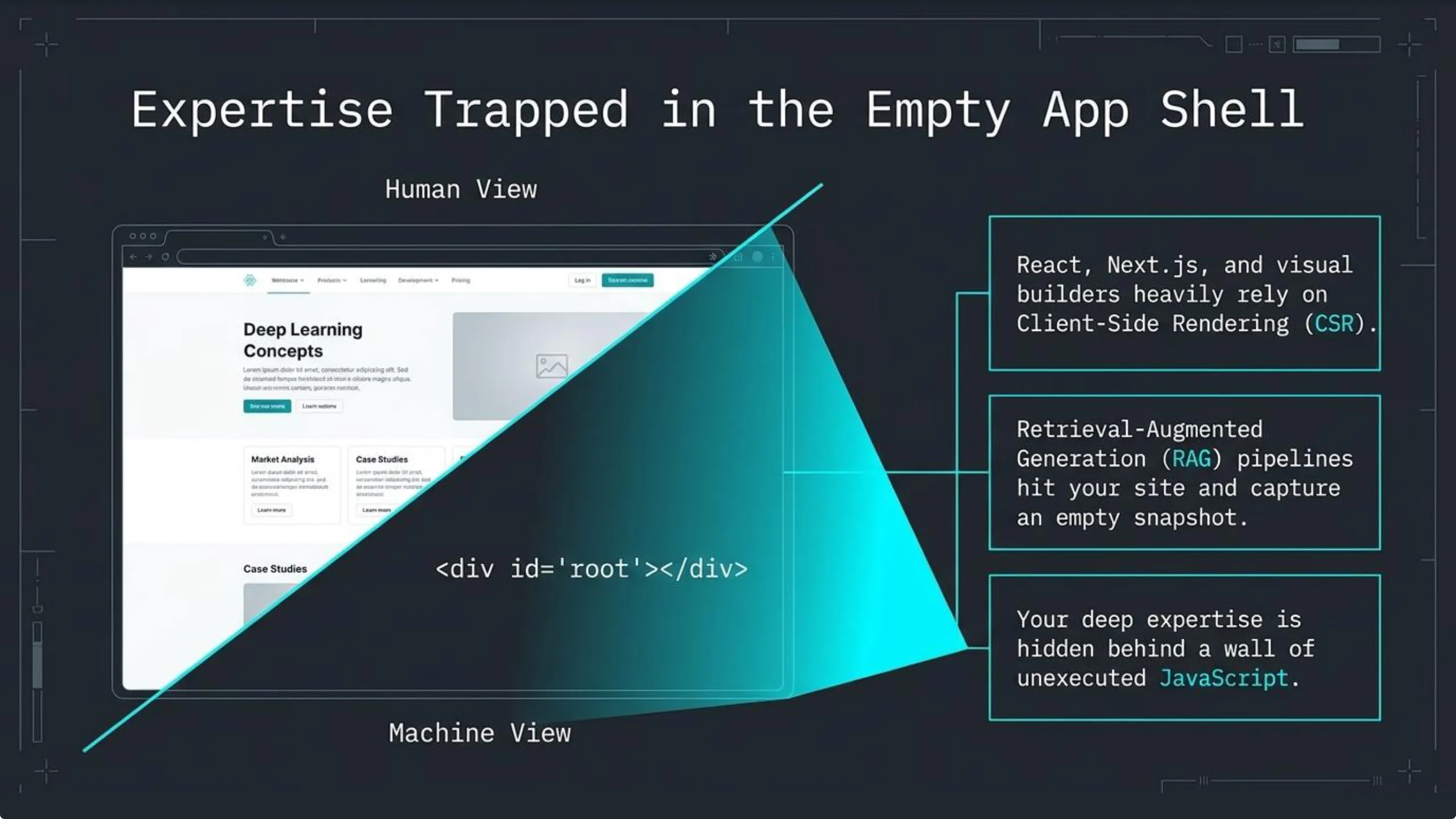
Retrieval-Augmented Generation (RAG) pipelines operate on strictly enforced computational budgets. When a crawler hits a site built on React, Next.js, or complex visual builders, it encounters an “Empty App Shell.” Client-side rendering (CSR) poses a high risk of delivering empty snapshots for LLM retrieval, effectively hiding your expertise behind a wall of unexecuted code.
To synthesize this content, the Answer Engine must execute full headless browser emulation. This process inflates the parse budget massively, resulting in js rendering rag abandonment. JS-heavy sites are indexed 9x slower, and sites exceeding their rendering budget experience a 40% lower indexation rate. If the machine has to “work” to understand you, it will simply opt out.
IS YOUR CODE SABOTAGING YOU? Stop guessing if the bots can see you. Use the Surgical HTML Auditor to see your site through the eyes of the Robot Librarian.
The Div Soup Penalty and the Energy Tax
RAG pipelines actively deprioritize complex DOM structures. When your HTML is bloated with unnecessary nested containers—a pathogen known as Div Soup—it triggers a severe div soup rag penalty. RAG cross-encoders prioritize low-latency, clean code; heavy structure wastes the parse budget and results in unstable retrieval.
If a page has a DOM depth exceeding 500 nodes, it often triggers reflow abandonment by the crawler. Standard RAG pipelines avoid the expensive compute tax of synthesizing on every query. Rather than burning tokens trying to untangle your code, the AI moves on to a cheaper, structurally sound competitor. In a world of rendering energy tax, efficiency is the only ranking factor that matters.
The theory of avoiding the ‘compute tax’ is critical, but what does a landing page built for near-zero-cost AI ingestion actually look like? We built one ‘backwards’—prioritizing crawler efficiency over conventional conversion design—and it became a key factor in earning a direct AI citation with a brand new domain. Read the definitive guide to our system in the CASE STUDY — The Anatomy of a GEO Citation.
Case Study: The £50M Broker’s Code-Level Sabotage
To understand the catastrophic impact of structural failure, look at our recent Intervention Report on a £50M commercial property aggregator. This client was a Goliath in their niche, but they were bleeding traffic. Our forensic MRI uncovered a case of total code-level sabotage:
- The 28-Word Anomaly: Their visual content was over 800 words, but the “Effective HTML Word Count” was only 28 words because the text was trapped inside a JS carousel description.
- The Invisibility Trap: Expert wisdom was hidden behind a
visibility: hiddenCSS rule meant for a “fade-in” effect that LLM crawlers never triggered. - Spinal Collapse: The page had zero H-tags and only two crawlable links in the raw source, despite looking like a rich resource to humans.
Thousands of words were effectively cremated. They were paying the ultimate compute tax: total erasure from the discovery layer.
Human Behavior vs. LLM Crawling: The Goldilocks Disconnect
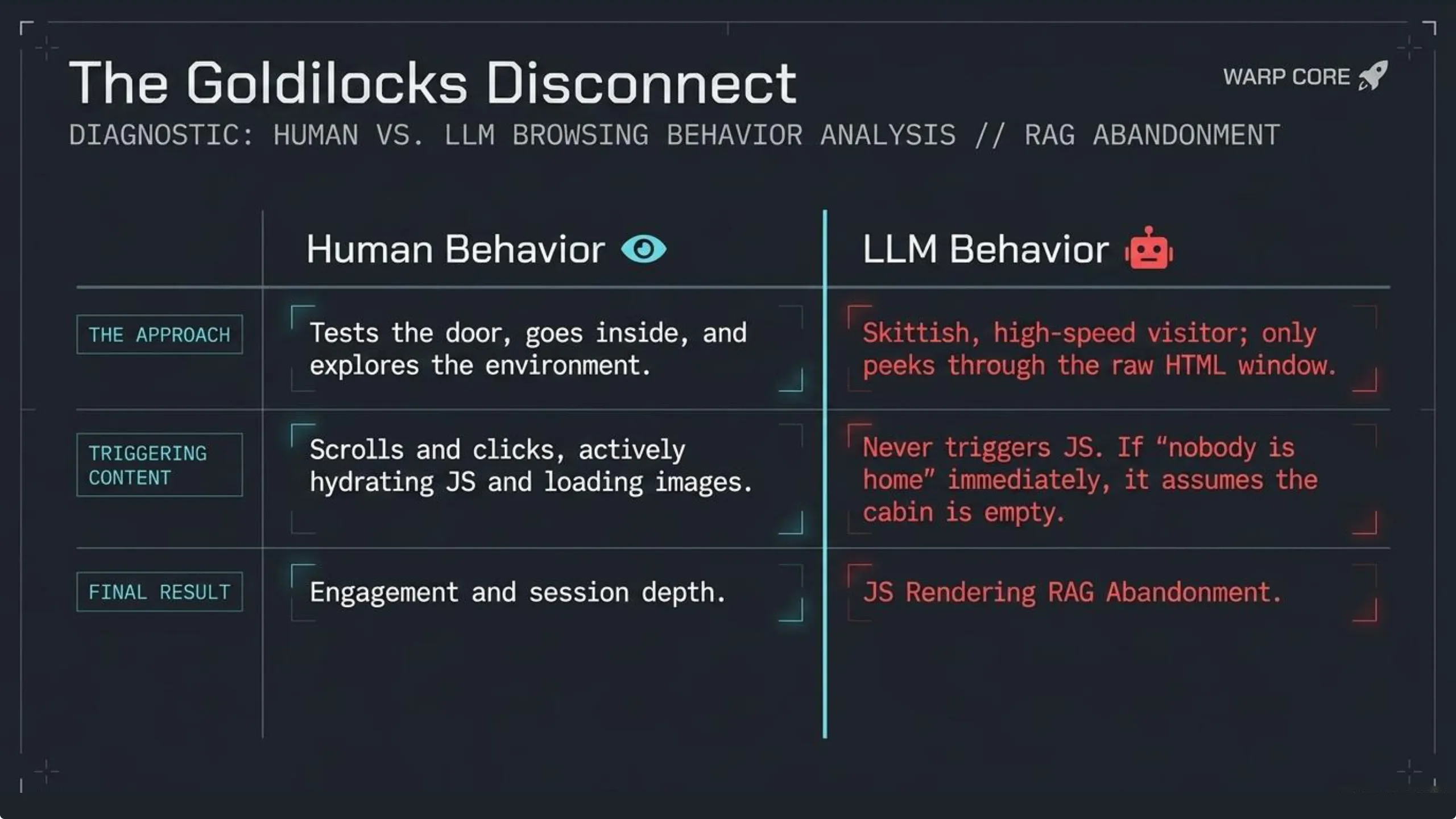
The disconnect between human visitors and AI agents can be likened to the Goldilocks fable. In the story, Goldilocks is the human visiting your post. She tests the door and goes inside. She explores the porridge, the chairs, and the bedroom. This is the human scrolling, clicking, and triggering your page to hydrate and load its images.
The LLM, however, is a skittish, high-speed visitor who only peeks through the window. If it doesn’t see anything immediately available in the raw HTML, it assumes “nobody’s home” and moves on to the next cabin. The “nobody’s-home moment” is the result of js rendering rag abandonment. What do you want the LLM to see when it peeks through your window—an empty shell or an information-gain rich feast for its Knowledge Graph?
The Economic “Why”: Path of Least Resistance
Why do Answer Engines do this? Because inference is a business. Organizations like OpenAI and Google spend billions on the hardware required to have an AI “guess” what a website means. LLMs report nearly 90% failure rates when encountering malformed or JS-hidden content. It is cheaper and safer for the model to ignore you than to risk a hallucination caused by poor parsing. This technical validation is explored in depth in our thesis on AEO & GEO: The Death of SEO Scores.
If your code is clean, static, and schema-rich, you achieve entity confidence. You make yourself 500x cheaper to understand. In a compute-constrained environment, Answer Engines will always prioritize the domains that don’t charge them a reasoning tax. This is the core principle of the ContentOps Sovereign Infrastructure.
Stop Serving Grey Slop to the Machine
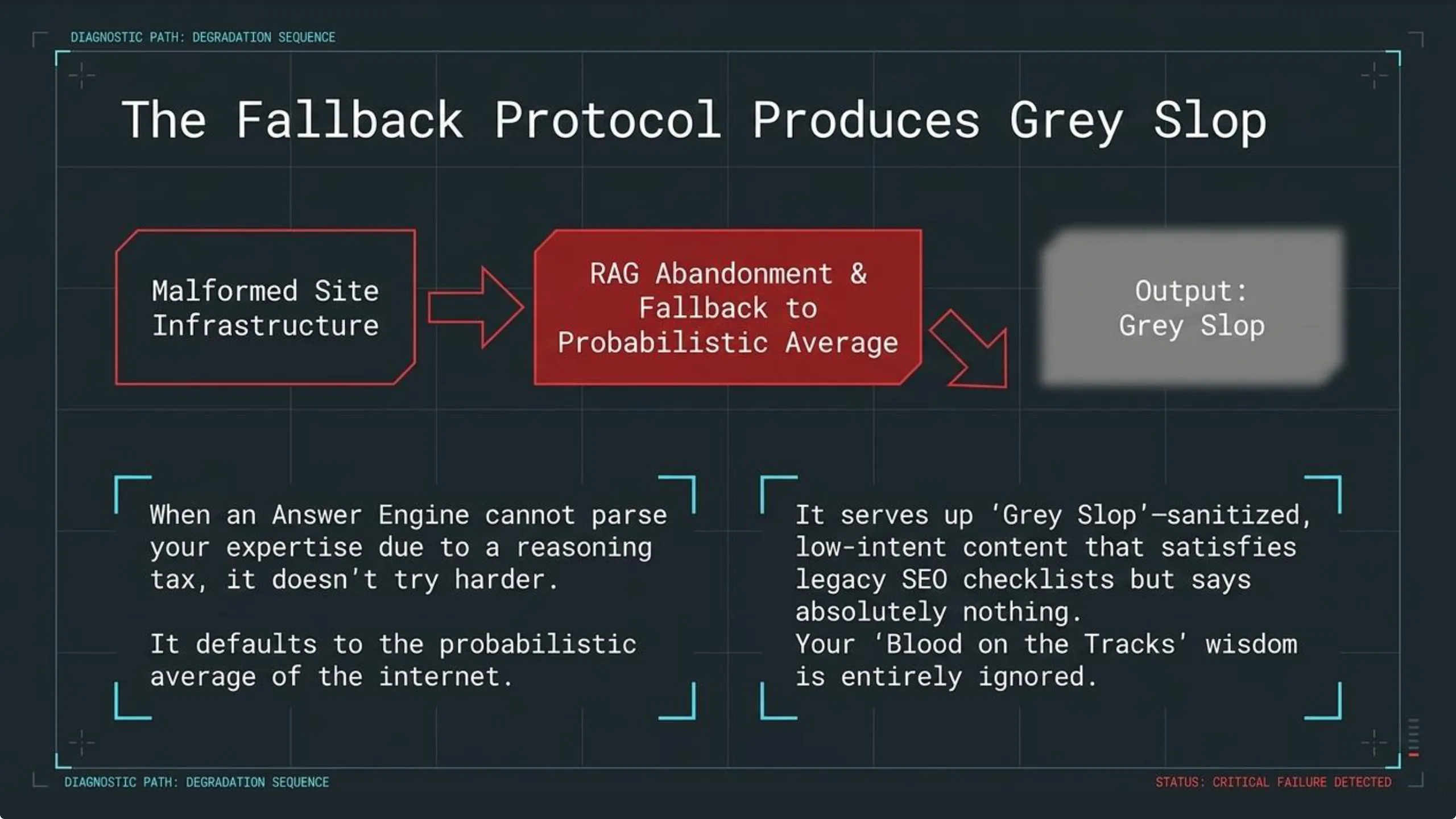
When an Answer Engine cannot parse your expertise, it defaults to the probabilistic average of the internet. It serves up “Grey Slop”—sanitized, low-intent content that satisfies legacy checklists but says nothing. To ensure your “Blood on the Tracks” wisdom is cited, you must implement a schema bypass llm strategy.
You must pivot from the bloated frameworks of the past and align your infrastructure to the deterministic logic the machines reward. If your content library is currently invisible, a Forensic SEO Audit & Backlog Rescue is the only way to reclaim your spot in the inference layer.
🧱 Hindsight Insight: Speed vs. Substance
“If I could do it all over again, I would have stopped obsessing over millisecond improvements in LCP for humans and started obsessing over the raw HTML word count for the machine. A fast site that says ‘nothing’ to an AI is just a fast way to go out of business.”
Run Your Forensic HTML MRI | Sync Your Topical Map to the Mothership