
In our forensic analysis of the RAG Compute Tax, we established a grim reality: if your site relies on complex JavaScript rendering or bloated page builders, Answer Engines are abandoning your expertise before they even read it. You are paying an exorbitant Energy Tax, resulting in Symptomless Death.
But a Sovereign Architect does not beg the crawler to render bloated code. As established in The Sovereign SEO Infrastructure Manifesto, SEO as we once knew it—a game of keyword density and checklist compliance—is dead. You must bypass the rendering engine entirely. You transition from “Probabilistic Guesswork” to “Deterministic Ingestion” by executing a schema bypass llm strategy.
By providing a machine-readable sidecar in the raw HTML, you allow the machine to skip the JS execution and move straight to vectorization. This is the “Iron Man Suit” for your visibility.
IS YOUR INFRASTRUCTURE LLM-INVISIBLE?
Stop guessing and start auditing. Use the Surgical HTML Auditor to see if your expertise is being cremated by the Compute Tax.
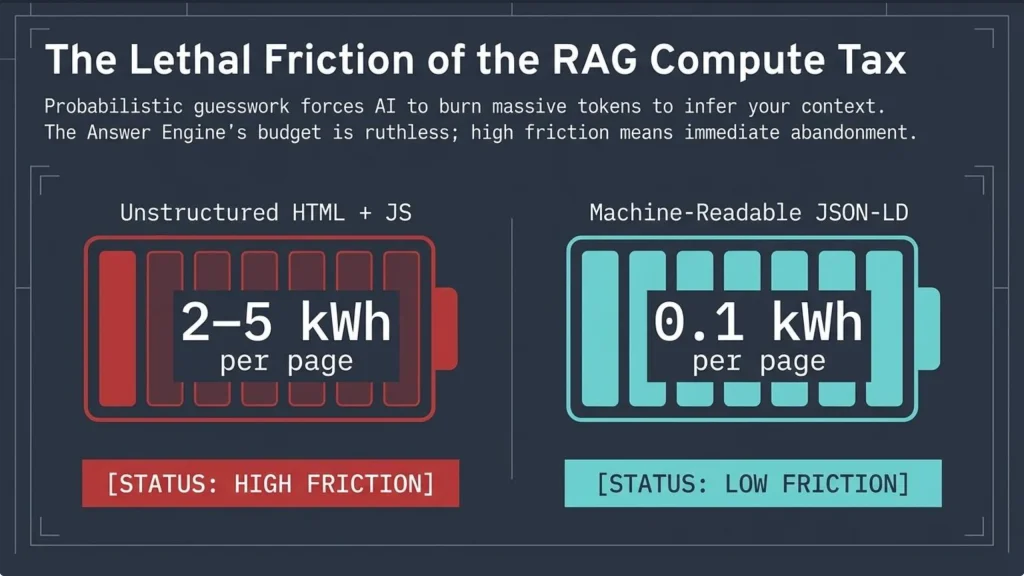 This slide graphically demonstrates how machine-readable JSON-LD drastically reduces the RAG compute tax, achieving 20-50x greater efficiency compared to unstructured HTML + JS by minimizing probabilistic guesswork, crucial for schema bypass LLM strategies.
The Entity Confidence Gap: Guesswork vs. Determinism
For decades, legacy SEO tools trained us to optimize for strings of text. But in the era of Inference, entity confidence determines LLM citation over keyword density. Our thesis on AEO & GEO: The Death of SEO Scores proves that “Synthetic Noise” from generic plugins is the primary pathogen killing modern authority.
The reality of modern retrieval is simple: LLM SEO relies on Entity Confidence—does the AI know who you are? If you leave your identity to probabilistic guesswork, you fall into the entity confidence gap. An AI crawler parsing unstructured HTML must burn massive amounts of tokens to infer your context. When faced with this high Compute Tax, the Answer Engine will simply abandon your node and default to consensus “Grey Slop.” You aren’t just losing traffic; you are suffering from total LLM Erasure.
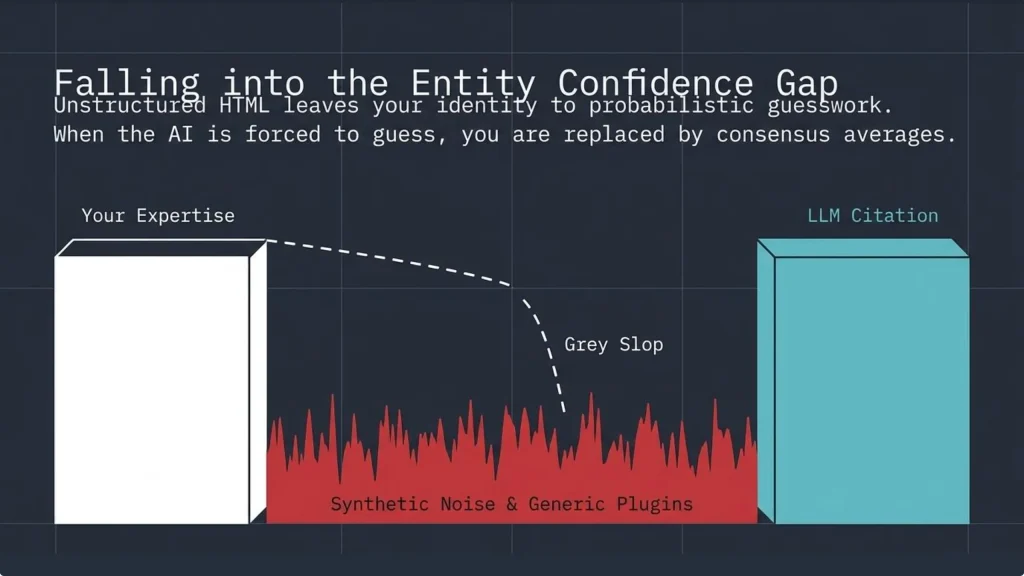 Unstructured HTML creates an ‘Entity Confidence Gap,’ turning unique expertise into ‘Grey Slop’ and forcing LLMs to cite generic consensus averages, rather than precise, attributable information. This illustrates the problem that schema bypass aims to solve for LLM ingestion.[/caption>
The DFH Protocol: The Deterministic First-Hop
To guarantee ingestion into a static first RAG pipeline, you must implement the Deterministic First-Hop (DFH). This protocol mandates that the most critical information—who you are and how you relate to the topic—is available in the first 1KB of the raw HTML source code.
The “Bypass” works because JSON-LD schema bypasses JS entirely via deterministic parsing. A JSON-LD processor operates on the internal representation of data, allowing the Robot Librarian to ingest your expertise without ever triggering the browser rendering engine. This turns your site from an expensive “reasoning puzzle” into a cheap “data ingestion.”
The HESS Stack: The Five Identity Anchors
A true Schema Bypass requires more than a basic “Article” tag. You must provide the HESS Stack—the five mandatory anchors of determinism that close the ambiguity gap:
- Type: Explicitly declaring the schema.org class (e.g., Service, Person, Organization).
- Entity: The unique ID (often a Wikidata or Knowledge Graph URI) that defines you.
- URL: The authoritative location of the truth.
- Canonical: Preventing the machine from splitting authority across duplicates.
- Sitemap: The architectural manifest of your entire eav triplet seo structure.
 To achieve a true schema bypass and close the ambiguity gap, the HESS Stack mandates providing five specific identity anchors: Sitemap, Canonical, URL, Entity, and Type, moving beyond a simple ‘Article’ tag.[/caption>
The Economic Logic: 500x Efficiency Gains
Why does this work so effectively? Because RAG pipelines are economically ruthless. Research shows that Expert Knowledge Graphs compressed into EAV triplets (Entity-Attribute-Value) make your site 500x cheaper for a machine to understand compared to probabilistic inference from prose.
By using a sidecar, you minimize energy consumption from 2–5 kWh per page (JS-heavy) to a mere 0.1 kWh. Because this structure eliminates ambiguity, RAG cross-encoders favor EAV density 4x over standard prose. You aren’t just ranking; you are becoming the “Path of Least Resistance” for the Answer Engine’s budget.
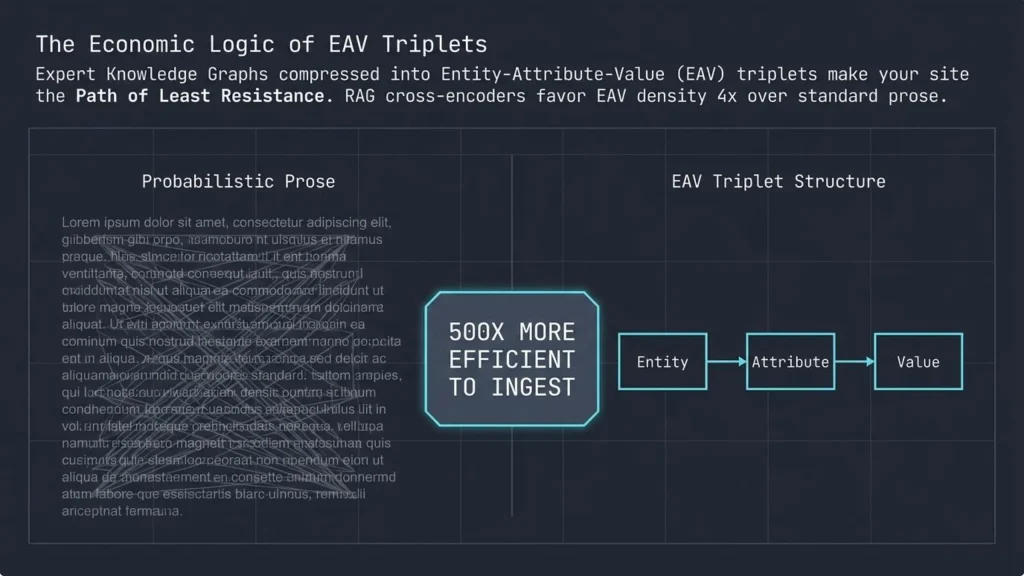 This slide demonstrates that EAV triplets, as a structured knowledge representation, offer a 500x more efficient ingestion pathway for RAG systems compared to probabilistic prose, making them the optimal ‘Path of Least Resistance’ for LLM data processing and schema bypass.[/caption>
RECLAIM YOUR SOVEREIGNTY
If your legacy content is suffering from “Island Node” syndrome, it’s time for a surgical intervention. We specialize in SEO Audit & Backlog Rescue—re-coding your authority and installing the Schema Bypass at scale.
Execution: ContentOps’ Map Sense and the Miyagi Method
The ContentOps Miyagi Method means that everything begins with and flows through the topical map tool. It’s not just a planning tool, but a memory card that encapsulates your entire content business strategy. It’s what gives your AI the superpower of Map Sense—the ability for AI to write for your entire content ecosystem instead of the singular node you prompt it for.
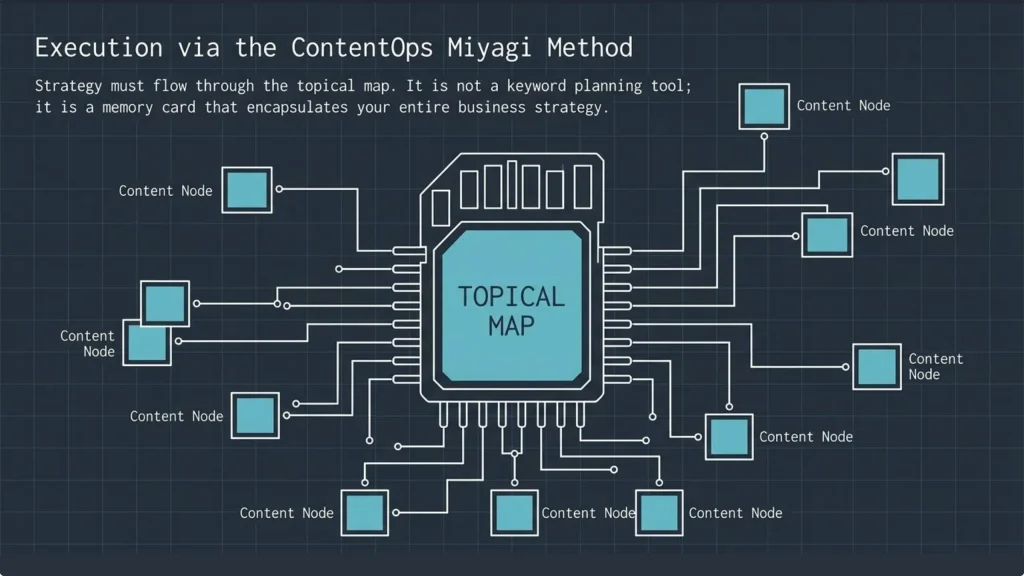 The ContentOps Miyagi Method positions the topical map as the central strategic memory card, not merely a keyword planning tool, orchestrating all content nodes to encapsulate the entire business strategy, which is vital for efficient RAG ingestion and schema bypass for LLMs.[/caption>
By having this fully powered map, the ContentOps workflow has built-in schema generation on two levels:
- Phase 1: Global Schema. Establishing your overarching domain authority and entity-root.
- Phase 2: Individual Post Schema. Providing the specific “citation sheet” for each unique piece of content.
If you’ve been on the hunt for a ready-made solution to declare victory (and authority) through your content structure, you need the full ContentOps Command Center. While our free audit tool allows you to see the broken bones of an individual post, our topical map in the Command Center allows you to fuse your whole archive into an interconnected superhighway. The 1-click schema generation is the cherry on the cake.
Ready to bypass the rag compute tax? Access the master workflow via our Step 6: Updating JSON-LD Schema (AEO & GEO) protocol to generate your sidecar and secure your citations today.
Run Your Forensic HTML MRI | Launch the ContentOps Mothership