StoryBrand for AI Writing: Build a Content Strategist Chat that’s in Your Corner

A boxing coach intently instructs a boxer resting on a stool in the corner of a boxing ring. The coach, an older man, leans in and points with both hands while speaking to the boxer, who is wearing boxing gloves, drinking from a water bottle, and listening attentively. This candid scene illustrates the concept of a strategic advocate providing guidance and support.

  AI Writing Workflow // The StoryBrand Calibration Method How I Built a StoryBrand Chat That Puts AI in My Corner For years, my English grammar lessons were correct and dry. StoryBrand turned them into stories with villains my students already recognised from their own struggles. But what actually changed the work was not the … Read more


Common Problems with AI Content Writer Tools: Why My First AI Writer Is Still an Unpublished Draft

"Slide title: 'The Average of the Internet. vs. What You Actually Know.' Visually, a prominent, bright blue horizontal line representing 'What You Actually Know' is centered, contrasting with numerous thinner, wavy, gray horizontal lines above and below it, which represent 'The Average of the Internet.'"

Common Problems with AI Content Writer Tools: Why My First AI Writer Is Still an Unpublished Draft A few years ago I ran a blog post through an AI writing tool off AppSumo, called WP Autoblog. That draft is still sitting unpublished in my WordPress right now, today. It’s a small, real case study in … Read more

Internal Linking for Small Websites: The Switchboard Method

The Switchboard Method: Internal Linking for Small Websites OPERATIONAL SUMMARY: Internal linking for small websites does not require a team or a plugin. It requires a map, a draft, and an AI that can read both at once. This guide shows you how to build an internal linking structure that works for a one-person operation … Read more

HTML to Semantic HTML: A Prompt-Driven Workflow for Refactoring WordPress Posts

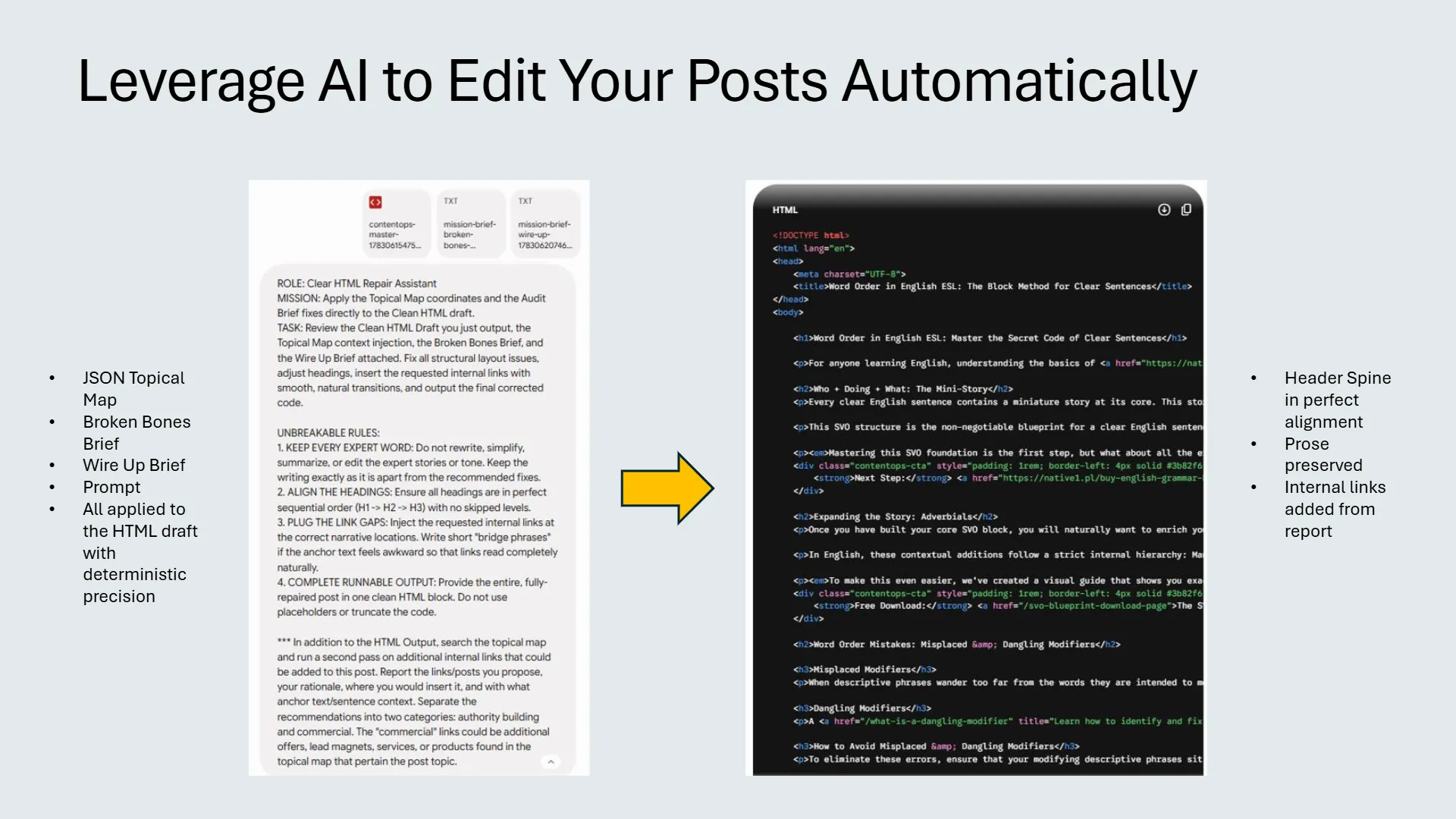
Slide titled 'Leverage AI to Edit Your Posts Automatically' illustrating an AI-driven HTML content optimization workflow. On the left, an AI prompt for a 'Clear HTML Repair Assistant' details the task of applying a JSON Topical Map, Broken Bones Brief, and Wire Up Brief Prompt to an HTML draft, with unbreakable rules for editing and output. A yellow arrow points to the right, where the output is a clean HTML code snippet showcasing a perfectly aligned header spine, preserved prose, and internal links added from the report, demonstrating the conversion to semantic HTML.

CO ContentOps Intel Topical Maps Sovereign Services The System Launch Command Center Category: Surgical Assembly Line | Status: Active Workflow | Phases: 6 Visual Meta Description: A six-phase prompt-driven system for converting widget-heavy WordPress posts built in Elementor or Divi into clean semantic HTML — without changing a single word of the original content. HTML … Read more

Do I Need Screaming Frog as a Solo Blogger? The Tool Stack Question Nobody Answers Honestly

CO ContentOps Intel Topical Maps Sovereign Services The System Launch Command Center Category: Tool Infrastructure | Status: Active Node Visual Meta Description: The honest SEO tool stack for solo creators — naming what you actually need, what’s optional, and how to sequence a legacy site audit without expensive subscriptions that solve problems you don’t have. … Read more

URL-Level vs HTML-Level: The SEO Audit Distinction Nobody’s Talking About

Most SEO audits tell you what exists on your site. They map the links, flag the broken ones, count the pages, and report back. What they can’t tell you is what’s happening inside each page at the code level, or whether the structure a machine reads when it ingests your content is actually saying what … Read more

Why I Stopped Asking ChatGPT to Crawl My Site (And You Should Too)

Infographic titled 'Can ChatGPT Really Crawl Your Website? The Answer: NO'. The slide details four reasons ChatGPT cannot crawl: it performs a stateless single request fetch ('Boilerplate Tax'), strips navigation and chokes on JavaScript ('Crawl Abandonment'), reads empty page-builder shells ('Spaghetti Fraud'), and resorts to templated guesses ('Parametric Escape'). It contrasts true crawling (systematic link following, sitemap building) with ChatGPT's actions (fetches one page, strips layout, no systematic crawling or link following). The fetch process is shown as Send request -> Grab HTML -> Strip boilerplate -> Extract text tree -> Close connection, with 'NO SCREENSHOT, NO RENDERING, NO PIXELS'. It highlights 'The JavaScript Problem' where AI fetchers see SPA sites as blank. A table compares Google Search (rendering, JS execution, full visual indexing) with Consumer AI Tools (no rendering layer, speed-optimized only, single-request architecture).

CO ContentOps Intel Topical Maps Sovereign Services The System Launch Command Center Category: Auditing | Status: Active Node Visual Meta Description: Using the motorcycle DMV written test analogy to explain why green light plugin checkmarks represent mere paperwork compliance, separating basic technical SEO setup from the underlying code-level structure required to rank. The DMV Test … Read more

What Are Shadow Concepts? The Missing Nodes That Are Silently Killing Your Topical Authority

What is an entity gap — and more importantly, how do you find one before your competitors do? Shadow Concepts are the entity gaps hiding inside your own published content: supporting ideas referenced, implied, or assumed across your posts but never given their own dedicated node. Every mention without a destination is a broken promise … Read more

Entity Based SEO: Moving from Spreadsheet Layouts to Graph Architecture

High-tech visual of a glowing circuit board representing a knowledge graph architecture. A central processor connects via illuminated pathways to labeled components: 'ENTITY NODES', 'ATTRIBUTES', and 'GRAPH EDGES'. A top status bar displays '[STATUS: DETERMINISTIC INGESTION ACTIVE] -> [CITATIONS SECURED]'. The overlay text at the bottom reads: 'Ditch the Spreadsheet Keyword Lists in favor of a Entity-Based SEO'.

OPERATIONAL SUMMARY: Modern search engines index relationship networks, not flat text strings. Discover how to transition from brittle spreadsheet templates into a high-performance entity based seo network, leveraging machine-readable JSON architectures to secure definitive generative search engine citations. Every morning, thousands of digital marketers log into their spreadsheets, filter raw rows of keywords by difficulty, … Read more