
Every morning, thousands of digital marketers log into their spreadsheets, filter raw rows of keywords by difficulty, and assign those phrases to random writers. This copy-and-paste loop operates on the assumption that search optimization is a flat, linear pipeline. It is not. Treating keyword mapping as a flat data exercise is a proven recipe for Symptomless Death—where your Yoast or Rank Math plugins flash green, but your actual search visibility is zero.
Modern search engines do not crawl your website to match strings of text anymore as Large Language Models and Answer Engines now process information as a structured network of entities, attributes, and relationships. Most of all, they are looking for a complete website architecture that involves entity coverage on and off your website. To survive this paradigm shift, you must abandon flat spreadsheet lists and transition to a highly resilient model of entity based seo. You must stop treating your brand’s knowledge as disconnected articles and start engineering your site as a machine-readable semantic fortress.
By organizing your expertise as a connected database rather than a fragmented content calendar, you move from probabilistic guesswork to deterministic ingestion. This structural shift ensures that search engine crawlers can index your expertise at the code level, securing your visibility without paying a compounding energy or computation penalty.
![High-tech visual of a glowing circuit board representing a knowledge graph architecture. A central processor connects via illuminated pathways to labeled components: 'ENTITY NODES', 'ATTRIBUTES', and 'GRAPH EDGES'. A top status bar displays '[STATUS: DETERMINISTIC INGESTION ACTIVE] -> [CITATIONS SECURED]'. The overlay text at the bottom reads: 'Ditch the Spreadsheet Keyword Lists in favor of a Entity-Based SEO'.](https://contentops.so/wp-content/uploads/2026/06/01-thumbnail-entity-based-seo-slide-01.webp "slide-01")
The Spreadsheet Autopsy: Why Flat CSV Keyword Lists Are Dead Data
Exporting a CSV list of 500 keywords from legacy metrics platforms and sorting them by volume is a form of industrial blindness. A flat spreadsheet is dead data—a static cargo pile that carries zero structural intelligence for an AI crawler. When you force your marketing team to manage content using flat rows, you trigger Scattered Mind Syndrome, fracturing your domain’s expertise across disconnected tabs and half-finished documents.
Keywords are merely superficial labels. They do not define how concepts build on one another, nor do they declare parent-child dependencies. If you treat keyword research as your starting point, you inevitably produce “Average Advice”—generic, checklist-driven text that copies the existing top ten ranking pages. You are feeding the machine what it already has, which only accelerates your journey into the Digital Cemetery.
To scale your authority, you must pivot. You must realize that true strategic power lives in the connections between your concepts, not the keywords themselves. This is why a highly clinical content operations strategy for small creators must discard flat CSV lists in favor of an active, relational knowledge graph that anchors your unique insights before you ever look at a search volume metric.

The GraphRAG Reality: How Modern Engines Parse Your Domain Matrix
Modern generative architectures do not run on simple keyword density matches. Answer Engines like Perplexity, ChatGPT Search, and Gemini utilize a technology called GraphRAG (Graph Retrieval-Augmented Generation) to synthesize direct answers for users. When a machine crawler hits your site, it is looking for a structured domain matrix containing explicit nodes, attributes, and directional relationships.
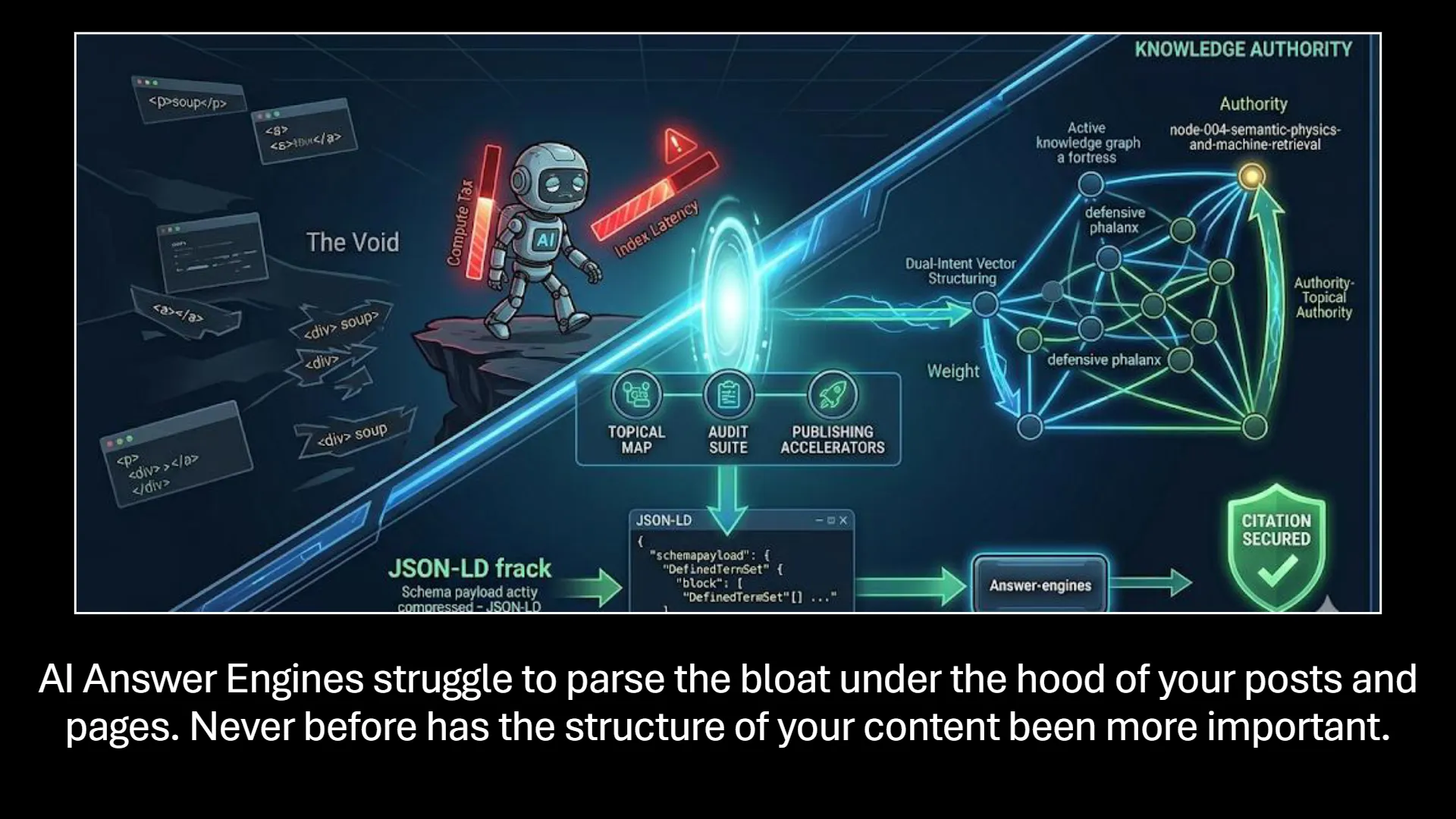
If you feed these advanced engines unstructured paragraphs wrapped in bloated, nested layout containers—a pathogen we call div soup pathogens—they suffer from severe AI Context Drift. The crawler’s reasoning budget is exhausted trying to parse your messy code, prompting the engine to abandon your page entirely. This results in your high-value pages being left stranded as invisible Island Nodes.
To avoid this, you must calibrate your code to match the machine’s retrieval model. When your site is structurally aligned with schema, the machine can instantly extract your unique insights to achieve logical balance in its response. This is how you position your brand for successful citation indexing, introducing unique information gain to outrank legacy Goliaths that rely solely on brute-force backlink authority.
Once your own architecture is structurally sound, the next step is identifying the entity gaps your competitors have left open — the un-anchored concepts they reference in their content but have never built dedicated pages for. That offensive protocol is what we call the competitor gap analysis using the ContentOps Hijack Protocol.
Turning on the Stadium Lights: The JSON Topical Map as Active Logic
If prompt engineering is like shouting instructions louder at an amnesiac assistant, a machine-readable json topical map is building an unbreakable corporate filing cabinet right next to their desk. We stop treating your expertise as loose text and start treating it as a network of clear, nested Data Objects. This is the pivot from Static Cargo to Active Logic.
- Static Cargo: Traditional paragraphs, plain-text articles, and unorganized listings. AI models must guess at how these ideas connect, leading to creative hallucinations.
- Active Logic: A clean, nested data structure hard-coded deep within your site’s root directory. This framework gives the machine an explicit, step-by-step blueprint of your entire industry hierarchy.
When you hard-code your business logic directly into your domain, you turn on the Stadium Lights. You illuminate your entire field of brilliance at once so the machine crawler requires zero inference guessing. By providing this deterministic sidecar, you reduce the machine’s reasoning budget to absolute zero, allowing you to bypass the compounding Compute Tax penalty that JS-heavy, unorganized websites pay every single day.
Graphing your Entities into a Topical Map
Transitioning from a passive content creator to a sovereign content commander requires shifting your operations away from loose text blocks and into a localized entity based seo blueprint. You do this by encoding your real-world clinical expertise into a living, breathing topical map for semantic seo. This document does not live in an unmonitored spreadsheet; it operates as an active JSON switchboard that models the precise boundaries of your industry knowledge graph.
Inside this structured architecture, every upcoming post or page ceases to behave like an isolated article and begins functioning as a specialized data node. Each node explicitly carries predefined semantic parameters:
- The Intent Anchor (targetKeyword): Declares the exact commercial pathway and user intent vector the node is built to resolve.
- The Embedding Anchors (semanticKeywords): Deploys a targeted network of secondary terms that reinforce the node’s placement within the vector space.
- The Graph Edges (internal_links): Programmatically maps out directional routes that pass authority fluidly down to your high-ticket transactional offers.
- The Entity Definition (bigIdea): Locks your core business logic and unique selling points into structured prose form, hard-stopping context history drift.
If you are starting from scratch and want to extract your expertise before building the map, the Genesis Protocol is where that process begins — turning your founder knowledge and practitioner insight into the raw material the map is built from.
Every node in your map is also an opportunity to surface the entity relationships your content has already declared but never resolved. Before you expand your map outward into new territory, it pays to audit what is already inside it — the supporting concepts referenced across your published posts that have no dedicated page of their own. Understanding what an entity gap is and how to find your Shadow Concepts is the inside-out expansion move that compounds authority across your existing cluster before you write a single new post on a new topic.
By maintaining this machine-readable sidecar deep within your publishing workflow, you establish a permanent memory card for your AI writing and auditing tools. You no longer log into your chat window to guess at prompts or repeatedly train a model on your brand voice. You simply inject the ultra-low-file-size JSON node dataset directly into your workspace, turning your expertise into a deterministic, citation-ready ingestion unit that modern Answer Engines can scrape, understand, and credit with absolute engineering precision.

How does ContentOps convert flat keyword lists into a living data graph?
ContentOps strips your marketing strategy out of passive spreadsheets and imports your concepts directly into a centralized data matrix. Instead of mapping keywords to disconnected text files, the platform treats every page as an explicit data node carrying strict relational parameters—such as intent anchors, embedding-space reinforcements, and target offer vectors. This transforms your content collection from a pile of unorganized articles into a machine-readable authority lattice that AI engines can index without guesswork.
The process seems labor-intensive on the surface, but really you will be leveraging AI to get your data into the app. If you’re curious about the process, see our Help Center Guide for new ContentOps users on how to build your Topical Map. When you’re ready to build your own, we’ll be waiting for you in the Command Center.
What is the role of the ContentOps Context Injection Engine in this workflow?
Large Language Models suffer from context history drift and amnesia during long content drafting sessions, which pulls your unique writing back down to a generic internet average. ContentOps solves this structurally by functioning as a Context Injection Engine. Because your topical map is a living file, any expansion or update automatically generates a lightweight, low-file-size JSON file. You drop this file straight into your AI chat window, providing a permanent, un-erasable memory layer that grounds the AI in your exact business logic and unique selling points.
We cover this topic on how the Context Injections work and how they benefit your content creation process in our full Help Center article on Context Injections.
How does the platform automate internal link engineering?
Instead of forcing you into a manual editing chore where you have to hunt through your historical catalog for link opportunities, ContentOps deploys a semi-automated process that involves the topical map, your HTML-wrapped draft, and your AI writing chat. The topical map acts as your switchboard that contains the URLs to your posts and the data layers necessary for your AI chat to infer the best connections. Your HTML-wrapped draft acts as the other half of the circuit. Your AI chat scans your HTML, then the map, and pulls the best URLs into your post, perfectly encoded in HTML with semantically strong anchor text.
Contrast this with plugins that simply match strings and provide little semantic depth if any. Learn more about ContentOps’ internal linking protocol with our full breakdown.
How do ContentOps publishing accelerators reduce the modern Compute Tax?
Answer engines and AI crawlers operate on strict computational efficiency budgets; if your site forces them to execute heavy client-side JavaScript or parse chaotic page-builder “div soup,” they will abandon the crawl and ignore your domain. ContentOps bypasses this layout friction completely. Our AI Writing Workflow for Experts wraps your draft in HTML before you run through the quality check and publishing steps.
Why? Because an HTML-wrapped draft is better for your AI to work with. Your AI sees raw text as a flat blob of words but HTML gives that blob structure that your AI can work better with. That means you simply instruct your AI what audits to make and it will execute them more precisely. When your draft is ready, you’ll bypass most of the drag-and-drop work by splitting that wrapped draft and pasting modularly into HTML widgets instead of text and headers.
Does ContentOps generate the schema I need to bypass the compute tax?
Absolutely. Because you build your Topical Map as a graph that connects all your entities (semantic keywords, branded vocabulary, and expert concepts), we added a generate schema function at both the global level and for individual posts all in one click. This becomes the last step in your publishing process by generating the schema, copy-and-pasting into your site’s schema plugin, and update. That’s it.
Where do Screaming Frog, Ahrefs, and Semrush fit if I’m already using ContentOps?
They run the leg before ContentOps picks up. Screaming Frog is the deepest recursive crawler available for URL-level technical site architecture — broken links, redirect chains, crawl depth. Ahrefs has the strongest backlink index for competitive landscape intelligence. Semrush is the broadest keyword and competitive intelligence platform most teams will use. None of them has any role in what happens after the briefing is done.
ContentOps picks up exactly where all three stop — competitor HTML analysis, map expansion, internal linking, structural audit, schema generation, publishing acceleration, and map maintenance. You can run both. The briefing tools give you the brief. ContentOps runs the operation. The nine-stage relay race framework shows where each tool actually belongs in the workflow.
🏗️ BUILD YOUR SEMANTIC FORTRESS
Stop managing loose rows and start wiring an unbreakable digital asset. Let us map your domain architecture at the code level. Choose our entry-level Topical Map Build or unlock total sovereignty with our comprehensive Brand Expertise Mapping & Keyword Inference sprint today.
🧱 Hindsight Insight: The Map is the Moat
“If I could do it all over again, I would have stopped buying ‘tools’ and started building ‘infrastructure.’ A better pen doesn’t help you find your way out of a forest; only a map can do that. ContentOps is the map that makes your existing pen magical.”
Run an Entity Based HTML MRI on Your Post | Initialize Your JSON Switchboard