
![A futuristic digital relay race scene illustrating a content operations workflow. Three runners in dark, orange-accented suits are in the background, one dropping an orange glowing baton labeled 'AUDIT REPORT SNAPSHOT.' A fourth runner, in a blue-glowing suit, is in the lead, carrying multiple blue glowing data blocks labeled 'TOPICAL MAP,' 'AUDIT QUESTIONS 7-8,' and 'PUBLISHING ACCELERATORS.' The background features server racks and glowing text displays showing '[CRAWL DEPTH: TERMINAL | INGESTION: MAX CONFIDENCE]' and '[SOVEREIGN VELOCITY: SECURE]'. A teal banner at the bottom displays the title: 'THE WORKFLOW RELAY: WHY BRIEFING DATA STOPS WHERE EXECUTION BEGINS.'](https://contentops.so/wp-content/uploads/2026/06/01-thumbnail-seo-audit-tools-comparison-slide-01.webp)
Visual Meta Description:
Framing Screaming Frog, Ahrefs, and Semrush as foundational landscape briefing components, establishing ContentOps as the downstream downstream deployment and link-wiring matrix.
Relay Race Workflow
Jenga Competitor Hijack
HTML Code Auditing
Schema Sidecars
What Screaming Frog, Ahrefs, and SEMrush Will Never Tell You About Your Site
Here’s what you get when a full audit from any of these tools is complete: a report in a folder, a keyword list on a spreadsheet, and a to-do list with no connective tissue to your writing, your publishing, or your next piece of content. The audit is done. The workflow stops. What happens next is entirely on you.
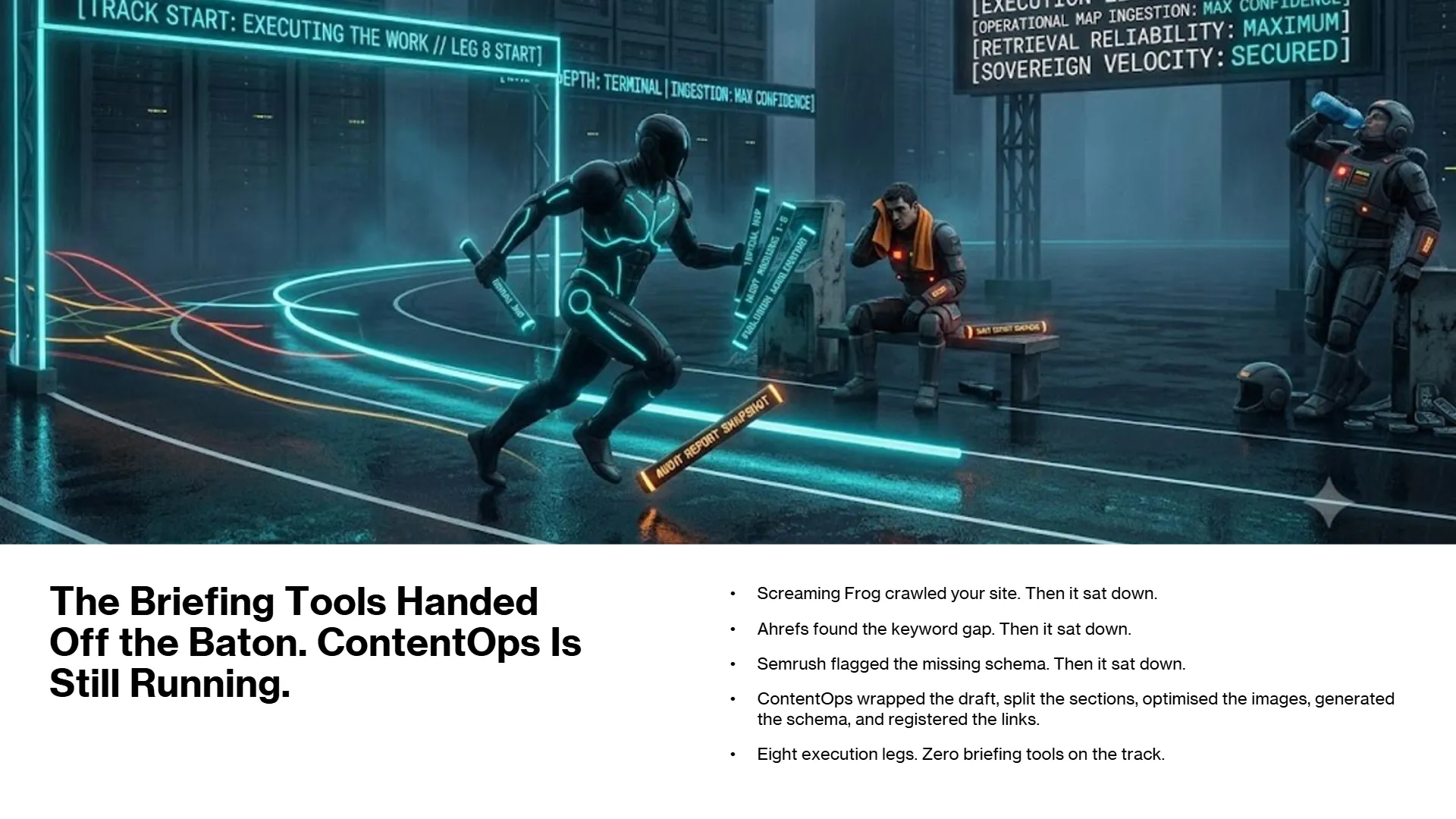
That handoff problem isn’t a flaw in the tools. It’s what they were built to do. Screaming Frog, Ahrefs, and Semrush are briefing tools. They run the landscape intelligence leg of the relay race. ContentOps picks up exactly where they stop and runs every execution leg after.
That’s the distinction this post is about. Not which tool is better, but which tool runs which leg — and what gets dropped every time a solo creator mistakes a briefing tool for an operational system.
Screaming Frog vs Ahrefs vs Semrush: What Each Tool Was Actually Built to Do
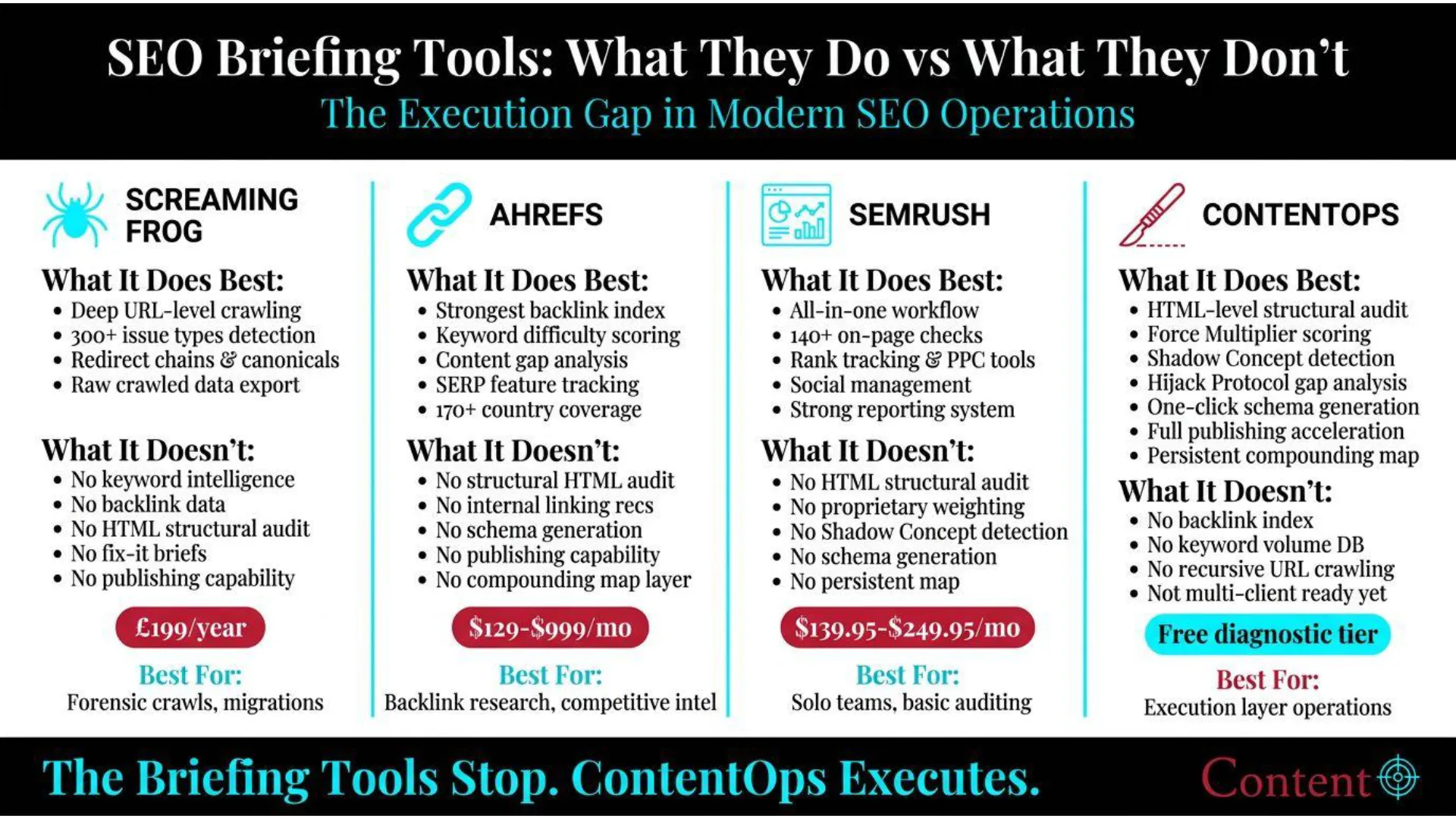
Screaming Frog is the deepest recursive crawler available. It checks over 300 issue types, gives you broken links, crawl depth, redirect chains, canonical problems, and raw crawled data that’s genuinely useful for technical site architecture work. It has no keyword intelligence at all, which is why most professional stacks pair it with Ahrefs or Semrush rather than choosing one over the other. Ahrefs has the strongest backlink index in the industry. Semrush is the broadest competitive intelligence platform most teams will use. These are not criticisms.
When the Subscription Stops Making Sense
At $139.95 a month for Semrush Pro or $129 for Ahrefs Lite, a solo creator managing one site is paying for capability they use a fraction of. Screaming Frog at £199 a year is the most defensible of the three for a single-site operator — but only if you’re running a genuine technical crawl, not a quarterly habit. Where it stops making sense is paying a monthly subscription for a tool that produces a one-time architectural snapshot you reference once and file. The briefing is useful. The subscription model for a job that only needs doing occasionally is not.
While these “snapshots” are useful the moment you run them, they do not represent an active, living topical map that grows and compounds as your site grows. At an introductory $9.99 per month for solo creators, ContentOps represents the execution layer as it maintains your map, an Audit Suite, and Publishing Accelerators the other tools don’t carry.
The Relay Race — Where Each Tool Actually Belongs
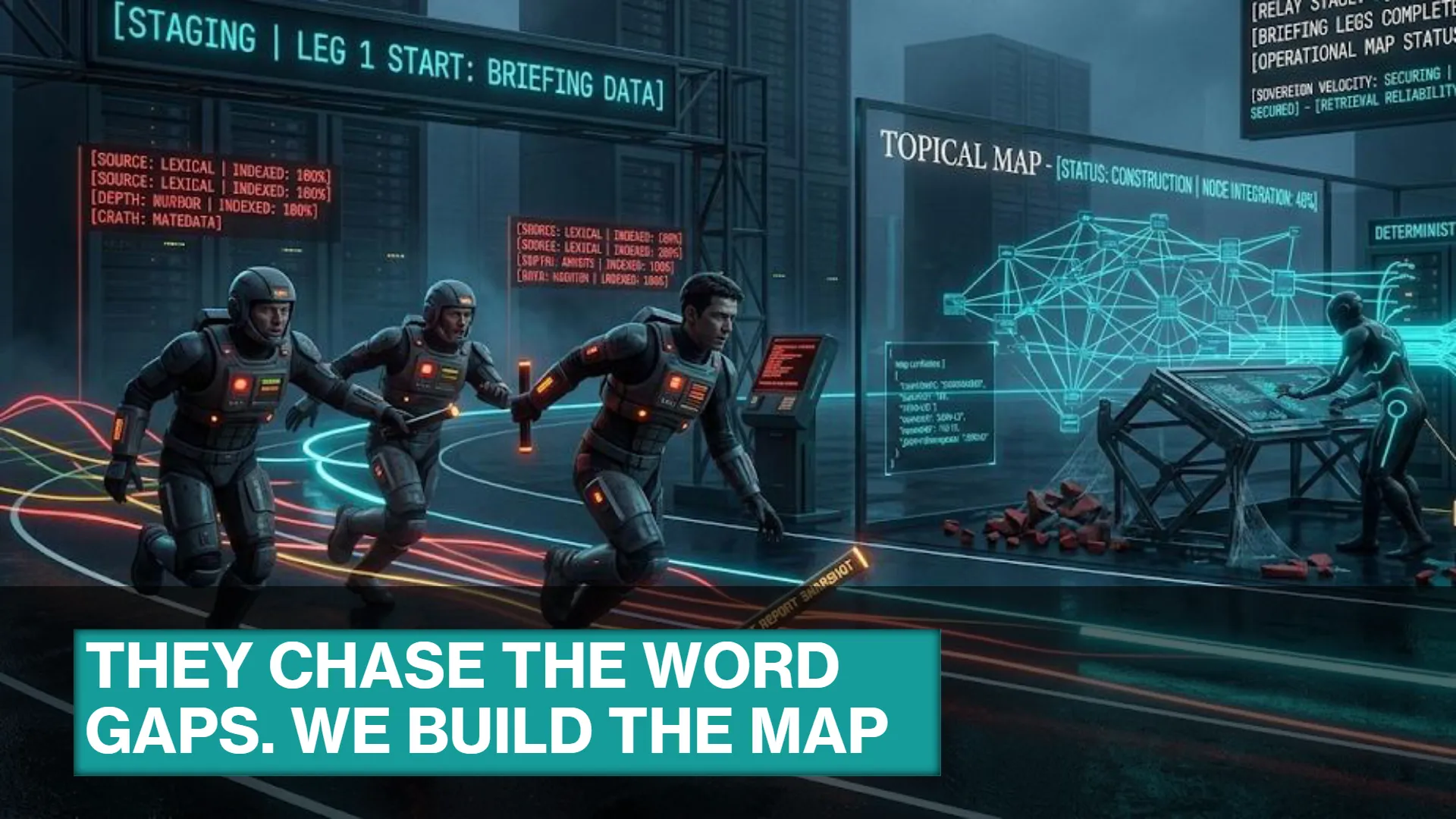
The correct frame isn’t which tool audits better. It’s which tool runs which stage of the workflow. Every stage of a content operation has a right tool. The mistake is asking one tool to run all of them, or stopping at the briefing stage and calling it done.
Stage 1 — Screaming Frog, Ahrefs, and Semrush Run the Landscape Intelligence Leg
You open Ahrefs or Semrush. You run the keyword gap report. You identify the competitive landscape, what difficulty looks like at each tier, where the wall is, and where the gaps are. This is real intelligence and it earns its place in the workflow.
Where the briefing tool stops: it gave you the keyword. It has no mechanism for telling you what structural gaps exist in the pages already ranking for that keyword, what entities those pages declared but never resolved, or how to build a post that out-positions them at the code level.
Stage 2 — The Topical Map Builds the Architecture the Briefing Tools Can’t
The Topical Map is the brain. Before a word of content is written, the map defines what each node declares, how it connects to every other node, what anchor text routes authority correctly, and what offer each node routes toward. When an AI writer receives the map as context alongside a content brief, it doesn’t produce a generic article. It produces a post that references specific nodes by their correct anchor text, routes internal link equity toward the right destinations, and covers the topic at the depth the map’s data layers specify.
Where a briefing tool would have stopped: it gave a keyword and a difficulty score. Deep operators utilize a master Topical Map for Semantic SEO to feed active context boundaries straight to writing assistants. From there, configuring a deterministic Topical Map Tool framework gives the AI writer an entire content universe to navigate from.
Stage 3 — Missions 4 and 5 Go Deeper Than Any Keyword Gap Report
This is where the workflow diverges most sharply from what any briefing tool can produce.
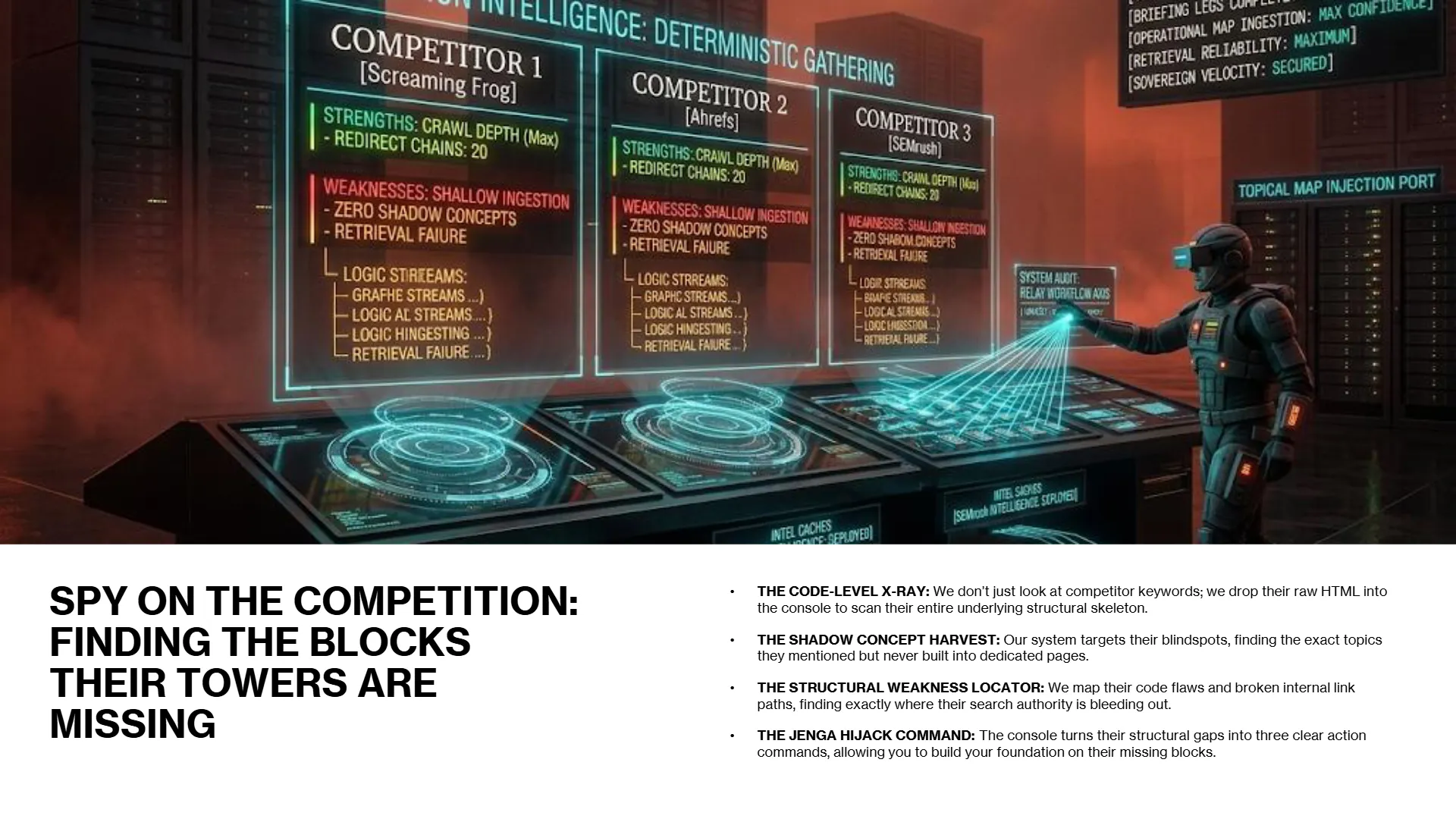
Ahrefs and Semrush ran the keyword gap report. They identified what the top-ranking competitors are targeting. That was the briefing layer. The HTML audit layer comes after.
You open the top three to five ranking posts for your target keyword. Ctrl+U on each one. Raw HTML pasted into the Audit Suite. Mission 4 runs Map Expansion on each competitor’s HTML, surfacing the Shadow Concepts each competitor referenced but never built into a dedicated node. Mission 5 runs the Hijack Protocol on each, producing three direct action commands per competitor to structurally out-position that URL.
Each mission generates a .txt report. All five reports go into a single AI chat with one prompt: synthesise a super brief to attack this keyword. The AI reads across all five competitive analyses simultaneously and produces a unified attack plan, not from keyword overlap but from structural gap analysis. Mastering this client-side pipeline is outlined within our handbook detailing how the Audit Suite exposes competitor entity gaps. By exposing active entity leaks, you immediately learn why your legacy topical authority is bleeding out into the digital cemetery.
That’s the Jenga Hijack in operation. You identify the blocks their towers are missing and build them into your own map. Their wobble becomes your foundation. Where Ahrefs stopped: it told you the keyword existed and who was ranking for it. Missions 4 and 5 told you exactly how those rankings were structurally vulnerable and gave you the construction targets to dismantle them.
Stage 4 — Mission 4 Finds What Your Own Content Has Already Promised to Build
Briefing tools suggest related keywords based on volume and competition data. You get a list of terms adjacent to your existing content. What to do with that list is your problem.
Mission 4 runs against your own published HTML and reads the entity relationships you’ve already declared but never resolved. The output isn’t a keyword suggestion. It’s the specific node your own content has been promising to build and never has. No volume guesswork. No adjacency inference. Your own structural layer tells you exactly what’s missing, and the output is flat JSON ready to Flash Inject directly into the map. Operators handle this node generation using the Topical Authority Map Inward Out Expansion Method.
Where the briefing tool stopped: it gave you a keyword list. Mission 4 gave you a structural obligation your own published content has already created.
Stage 5 — Missions 2 and 3 Do What Screaming Frog’s Link Count Can’t
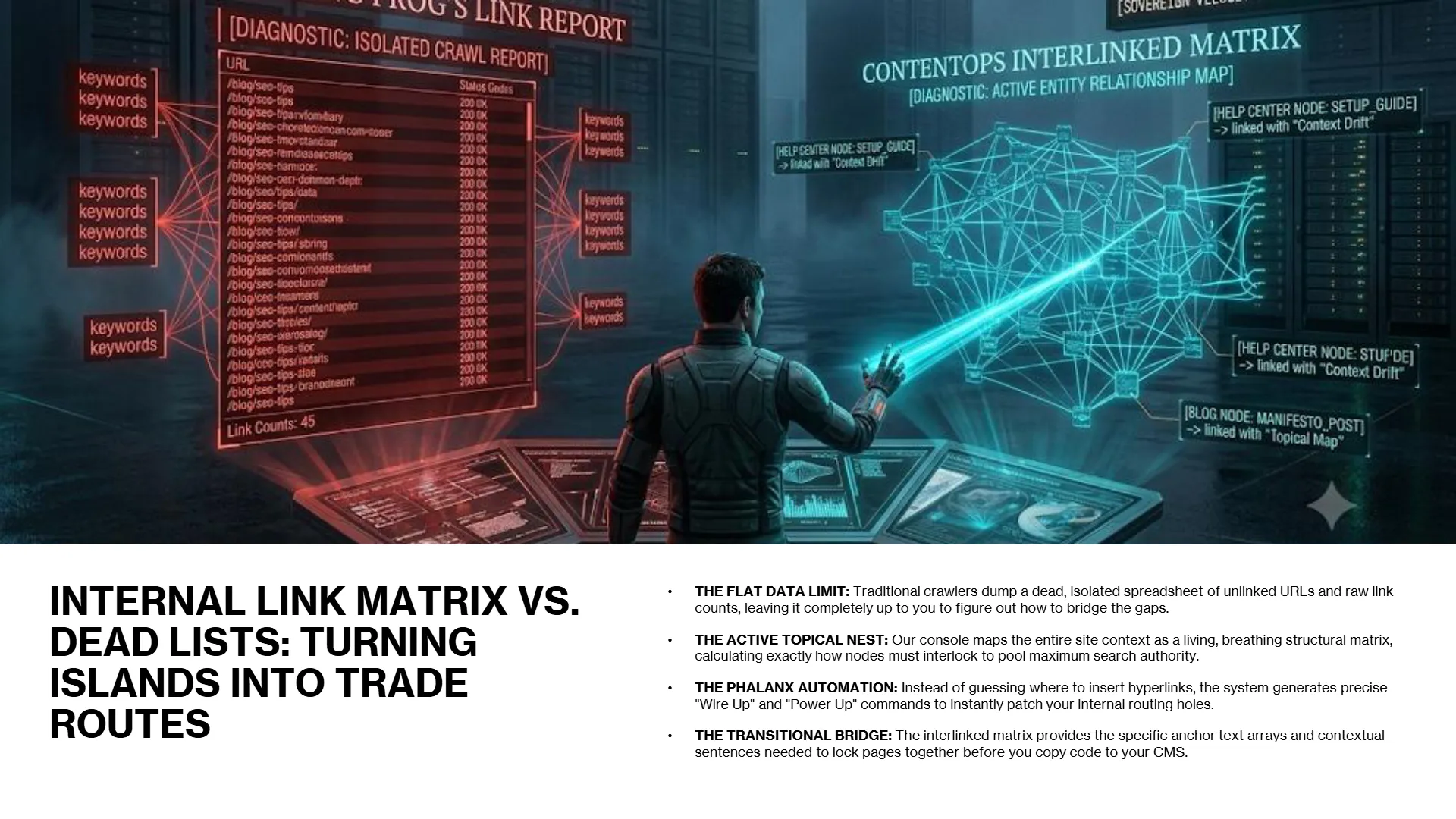
Screaming Frog shows you orphaned pages and link counts. You know something is underlinked. It can’t tell you what should link to it, from where, or with what anchor text, because it doesn’t know what your site is trying to say — only how its pages connect at the URL level.
Mission 2 (Wire Up) reads your map and identifies which nodes the current post should link out to, with anchor text drawn from your own anchor text arrays. Mission 3 (Power Up) identifies which published nodes should be linking in. You export both as .txt files. Your AI takes the map JSON and the wrapped HTML and applies the links with transitional cartilage sentences. Deploying the Semantic Internal Linking playbook creates an airtight internal routing grid. This resolves the massive technical drop outlined within our manual exploring the HTML vs URL level audit distinction.
Where Screaming Frog stopped: it told you the island existed. Missions 2 and 3 told you exactly which nodes should rescue it and handed you the anchor text to do it.
Stage 6 — Mission 1 Produces a Number. Semrush Produces a Flag.
Semrush and Ahrefs flag on-page issues at the metadata layer. Keyword in title: yes or no. Meta description length: pass or fail. These are the gate checks. They don’t evaluate whether the structural layer is sending the right signals or how much improvement a specific fix would produce.
Mission 1 (Broken Bones) parses the full HTML spine using the Force Multiplier matrix and produces a specific improvement score. The .txt diagnostic goes straight into your AI chat. The AI reads the structural findings and produces a fix-it brief with before-and-after recommendations for every flagged element. Running this orthodontic check proves why passing a basic checklist tool doesn’t mean you can ride the motorcycle. To get your Force Multiplier score instantly, teams channel drafts directly into the Surgical HTML Auditor platform.
Where the briefing tools stopped: they told you what fields were missing. Mission 1 told you how much stronger the page gets if you fix the right ones in the right order.
Stage 7 — Screaming Frog Flags Missing Schema. ContentOps Generates It.
All three briefing tools can flag missing schema and identify pages where structured data is absent or malformed. None of them generate it. You get the problem identified. The solution is your responsibility.
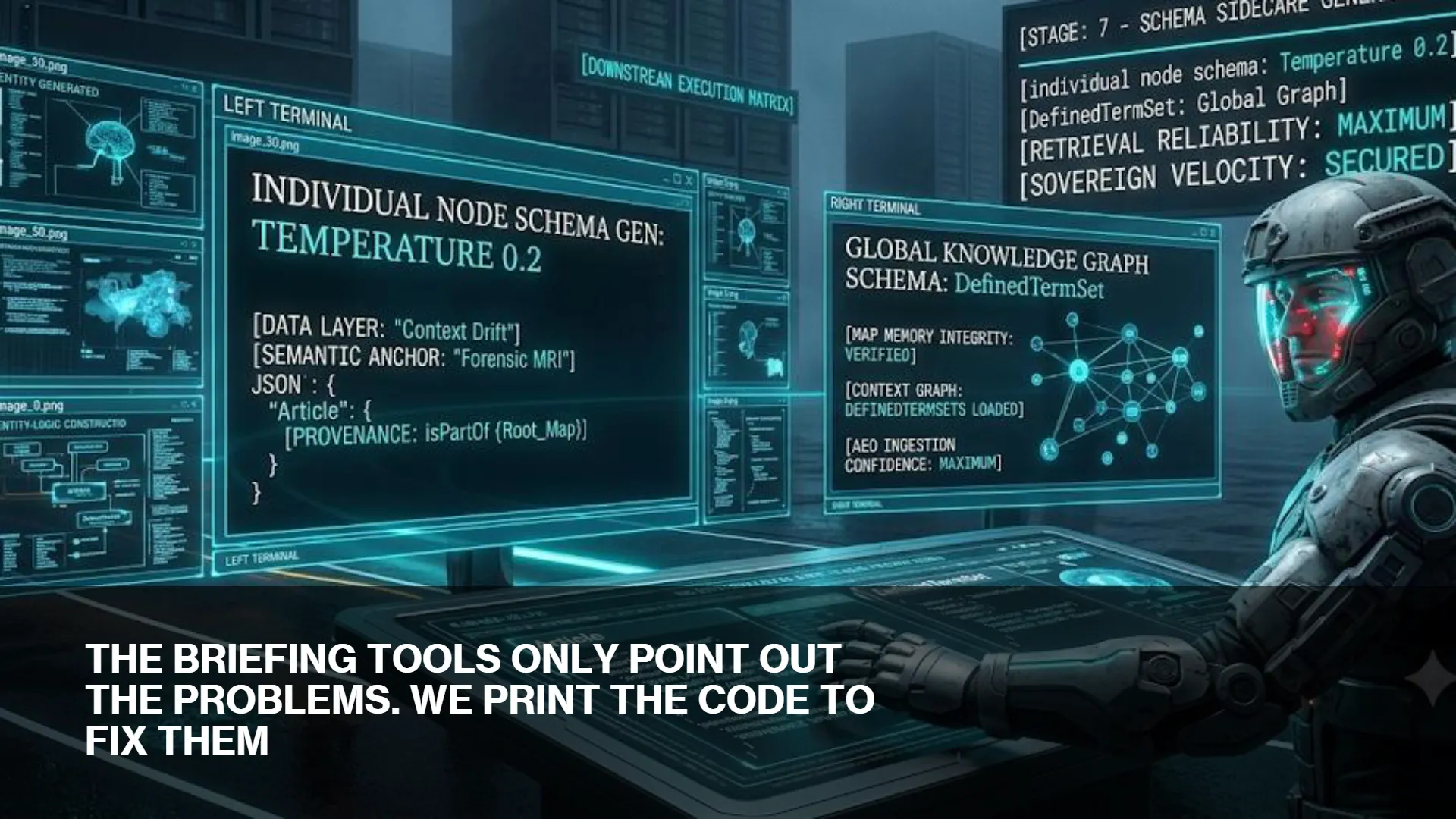
ContentOps generates schema at two levels. Individual node schema uses the node’s own data layers at temperature 0.2 for maximum determinism, with the Article entity linking isPartOf the root topical map entity. Fusing a static first sidecar allows operators to safely implement The Schema Bypass to eliminate the RAG compute tax entirely. Global schema synthesises the entire map into a single DefinedTermSet block that registers the full content architecture as a machine-readable knowledge graph. Both outputs are one click. Neither requires a developer or a plugin.
Stage 8 — The Wrapper, Splitter, and SlideShift Have No Briefing Tool Equivalent
Briefing tools have no role in production. This stage is entirely ContentOps territory.
The HTML Wrapper converts the formatted draft into clean structured HTML, protecting every internal link anchor and heading from the formatting corruption that strips them when you copy between tools. The Splitter makes surgical cuts at every H2 boundary, creating the joints where images, video, offer blocks, and keyword injections sit between the bones of the post. SlideShift runs your teaching diagrams through a PDF-to-WebP pipeline and produces didactic alt text that teaches the crawler what each image means in context of the page’s argument, not just what it looks like.
That multimodal layer is genuinely uncontested territory in this comparison. None of the three briefing tools touch image optimisation for AEO. Review the full setup options inside the Publishing Accelerators landing page or process raw assets under the SlideShift conversion hub manual.
SlideShift is the only tool in this stack that addresses the visual citation surface AI answer engines increasingly pull from when assembling answers.
Stage 9 — The Harvester Prevents the Islands Screaming Frog Finds After the Fact
After publish, the Harvester runs against the live HTML. The internal linking graph updates across every node that references or is referenced by the new post. The map registers the new connections. The next production run is faster because the intelligence from this one is already in the system.
The Global Audit identifies Island Nodes across the full map and generates three to five macro actions prioritised by impact. To understand how this map memory overrides isolated page auditing, see our guide on storing audit findings directly into the map.
Where Screaming Frog stopped: it identified the island after the fact. The map prevents the next one from forming at all.
The Workflow Relay Race Matrix
The briefing tools run the first leg. ContentOps runs every leg after it.
| Workflow Stage | Screaming Frog / Ahrefs / Semrush | ContentOps |
|---|---|---|
| Landscape intelligence | Keyword gaps, difficulty scores, competitive overview | Receives the brief and builds the map architecture |
| Architecture and brief | None | Topical Map: nodes, clusters, anchor text arrays, offer wiring |
| Competitor research | Keyword overlap, backlink comparison | Missions 4 and 5: HTML-level structural gap analysis, Shadow Concept harvest, super brief synthesis |
| Map expansion | Keyword suggestions by volume | Mission 4 on your own HTML: entity relationships declared but never resolved |
| Internal linking | Orphaned page flags, link counts | Missions 2 and 3: specific node recommendations with anchor text from your own arrays |
| On-page audit | Metadata compliance, keyword presence | Mission 1: Force Multiplier scoring, spine analysis, fix-it brief export |
| Schema | Flags missing schema | Generates individual node schema and global DefinedTermSet, one click each |
| Publishing acceleration | None | HTML Wrapper, Splitter, SlideShift — full production stack |
| Map maintenance | Post-publish crawl, reports stale data | Harvester: live link registration, Global Audit: Island Node prioritisation |
Who This Is For
The Solo Creator — The Primary Target
One site, limited budget, no developer, no agency, no stack of disconnected tools each solving one piece of the puzzle. The Sovereign Scaling Protocol case study was built by one person on a new domain with zero authority and zero backlinks. The result was a number one ranking on the first complete production run, a permanent AI Overview citation, and four images in the top rows of Google image search. That result didn’t come from a better keyword list. It came from picking up exactly where the keyword list stops, establishing an expert workflow inside Content Operations for Small Creators: How Jack Beats the King.
The In-House SEO Operator
Already has a briefing tool paid for by the company. Ahrefs or Semrush stays. ContentOps is what they pick up where those tools stop. The relay race is the frame — the briefing tools run the landscape intelligence leg, ContentOps runs every execution leg after.
The Expert Building Authority
The course creator, author, or consultant has domain expertise and no content architecture. To extract your specialized views before running a map, technical operators utilize the Genesis Protocol framework to ground downstream AI workflows. Every subsequent publish cycle draws from that map and compounds on it. The expertise doesn’t get lost in generic AI output because the map is what grounds the AI to the expert’s specific knowledge territory.
The Small Agency Team — An Honest Answer
ContentOps is currently single-map per account. It’s not yet architected for multi-client workflows at agency scale. A solo agency operator running their own site and one or two clients can make it work. A full agency with twenty clients needs a solution we’ll build when that client shows up.
Beyond the Audit — The Downstream Benefits
The topical map doesn’t stop at the blog. Drop it into a social media chat and it becomes a thought leadership playbook. Every node is a post angle, every cluster is a content pillar, every anchor text option is a caption hook. The hasMediaStrategy field acts as the switch — flip it from no to yes when a node has a video strategy, a LinkedIn series, or a podcast episode attached. The map signals the expansion without requiring a separate tool to manage it.
The AI that writes from the map writes with your brand voice, your entity vocabulary, and your strategic intent, not because it was prompted to but because the map made those parameters explicit before a word was written. ContentOps doesn’t just run the audit. It builds the system the audit was always supposed to feed into.