
Visual Meta Description:
How a technical operator can diagnose why stagnant site positions fail to move after standard technical audits, using a code-level “HTML MRI” scan to expose hidden structural fractures and align heading skeletons for AI citation indexing.
Skeletal Invisibility
Topical Map Audit
AEO Compliance
Compute Tax Reduction
Sovereign SEO Infrastructure
You ran the audit. You worked through the list. You fixed the broken links, tightened the meta descriptions, got the green lights where the red ones used to be. Then you published again, and the next time you looked, the list had grown back.
That’s the part nobody warns you about. The audit isn’t broken. The problem is what it produces. A report tells you what was wrong on the day you ran it. The moment you publish anything new, that information starts going stale. You’re not building anything. You’re cleaning up after yourself in an endless loop while the site underneath stays structurally the same.
A good audit should change the system that keeps producing the problems. Most don’t. They hand you a checklist and walk away. And so you’re left wondering whether the audit was even worth running, or whether you’re just supposed to do this forever.
Why Does My SEO Audit Never Actually Change Anything?
Most traditional SEO audits get read once and forgotten. They tell you what was broken on the day you ran them, and the moment you publish or edit anything, that information goes stale. A living audit works differently: it builds the findings directly into a topical map that every future writing, strategy, and audit cycle can draw from, so the work compounds instead of evaporating.
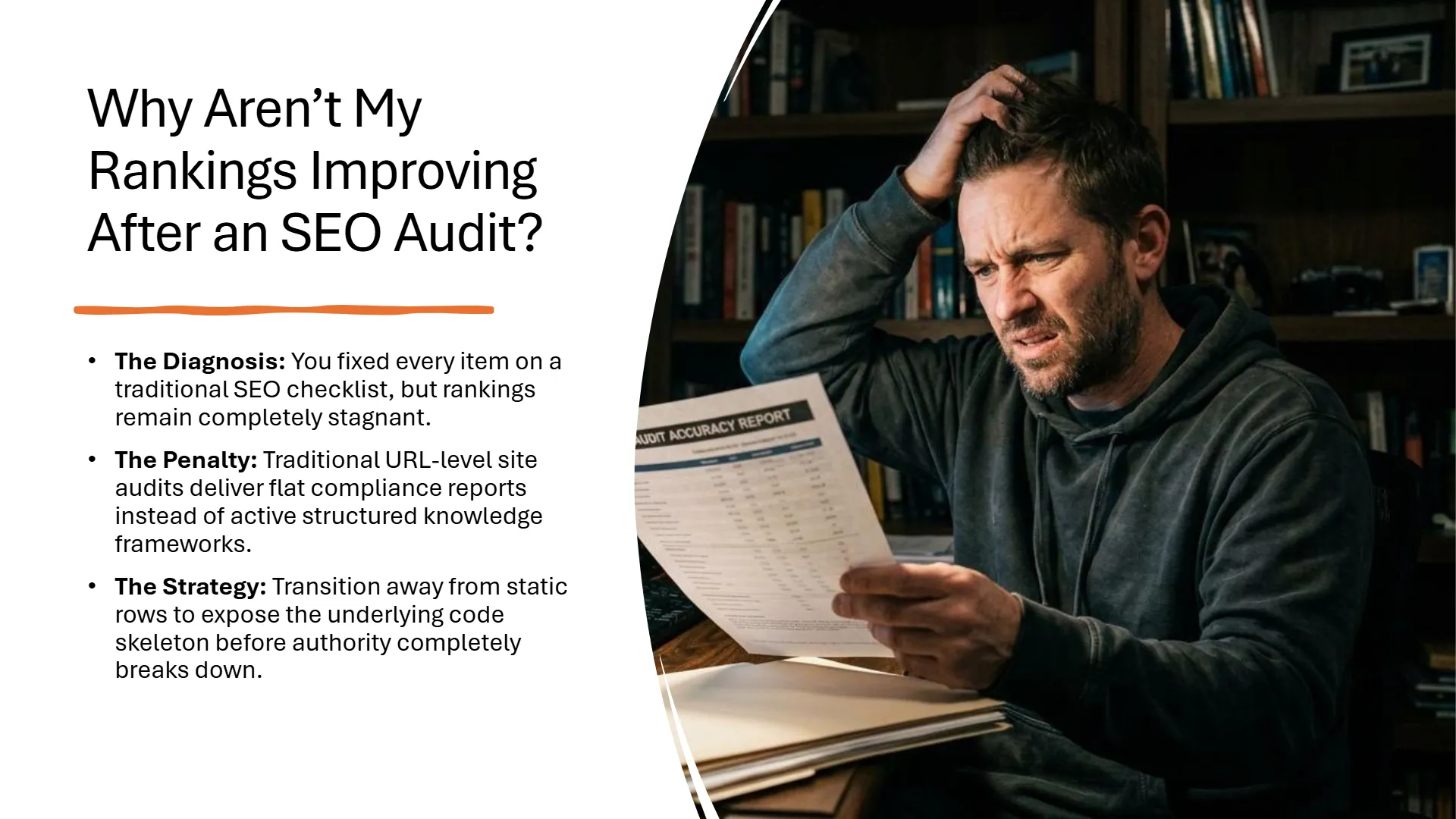
Why Most SEO Audits Don’t Move Rankings
Your audit doesn’t improve rankings because it produces a flat report instead of a living map. A report tells you what is wrong on a given day, then sits in a dusty shared folder. A map holds that information permanently and feeds it forward into every decision you make afterward, which is the difference between diagnosing a problem once and actually fixing the system that keeps causing it.
This is worth sit-ting with before going further, because most people do not realize they are optimizing for the wrong artifact. They run the audit, they fix the items on the checklist, and they wait for traffic to move. Sometimes it does. Often it doesn’t, and they assume the audit was wrong or the search algorithm changed. Neither is usually true. The audit simply measured the wrong layer.
What a Traditional SEO Audit Actually Measures
Legacy crawling software operates entirely at the URL level. They crawl your site the way a robot walks a warehouse, checking what’s where, what links to what, what redirects, and what is duplicated. This is real data and it has real value. Knowing your broken links and your duplicate content is part of basic site hygiene.
Common things it measures include the following categories:
- Metadata and indexing issues: Duplicate titles, meta descriptions, missing or duplicate H1s, noindex tags, canonical discrepancies, and Robots.txt crawling blockages.
- Structure and linking issues: Broken links, 404 response loops, deep redirect chains, un-linked orphaned pages, crawl depth bottlenecks, and internal path counts.
- Content and page quality indicators: Thin pages with low word counts, near-duplicate pages, missing image alternative descriptions, and weak or malformed schema metadata.
- Performance and technical health: Core web vitals speeds, indexation status, and rendering roadblocks. *Note: Dealing with speed metrics usually traps operators in the download-more-plugins cycle, which ultimately increases visual-builder bloat and exacerbates index failures.
That matters because these issues can absolutely damage discoverability, indexation, and user experience. If Google can’t crawl the page cleanly or if the site sends mixed signals, rankings can stall for reasons that have nothing to do with content quality or underlying structure.
Do you really need that expensive monthly SEO subscription to Screaming Frog, Ahrefs, or Semrush?
Such SEO audits are one-time jobs dressed up as a monthly subscription. If you are a solo creator or founder running one site, you do not need an ongoing crawler license for information you only need to refresh occasionally.
A solo operator running the same site through the same checklist every quarter is paying for capability they use a fraction of. The deeper issue is depth as opposed to cost. URL-level tools tell you what links to what on the surface, but they don’t tell you what is happening inside the page, within the actual HTML structure, where the real architecture and pathogens live.
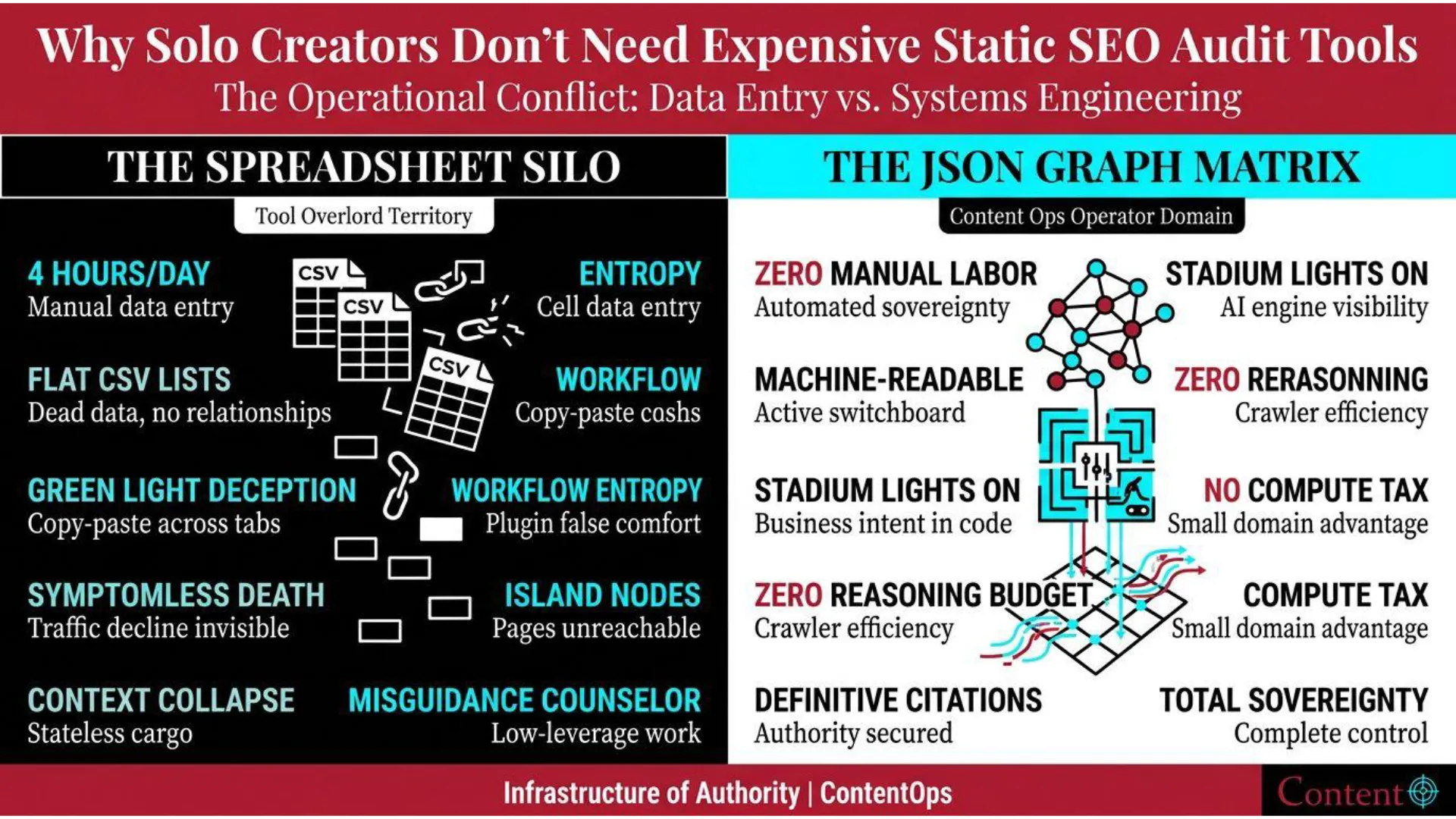
Why Static Reports Go Stale
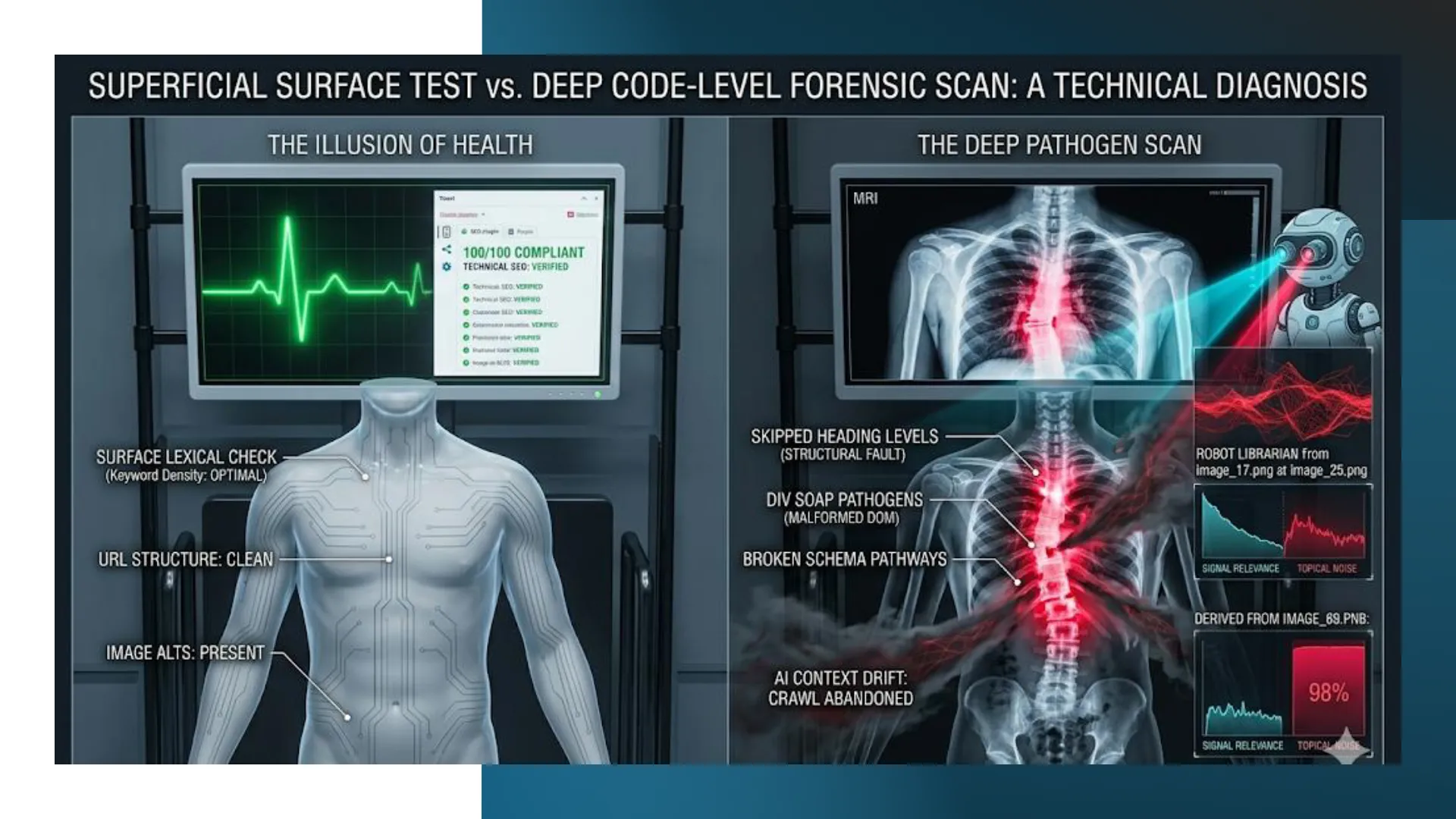
To understand why your audit output goes stale, consider a basic medical analogy. A standard SEO plugin is like a doctor checking your basic vitals. It measures your temperature and listens to your heartbeat. This is equivalent to checking your page’s title tag length, keyword density, and whether you have a working meta description. If these numbers look correct, the plugin flashes a reassuring green light.
1. SEO Audits don’t show the pathogens in the HTML
But this vitals check can easily conceal an internal disease. Your page can be visually beautiful and checklist-perfect, yet remain entirely invisible to AI Answer Engines because its underlying HTML skeleton is broken. To find structural fractures such as duplicate H1s, skipped sub-headers, JavaScript-hidden text, or bloated code wrappers, you must execute a comprehensive code-level scan using our browser-based Surgical HTML Auditor platform to pinpoint deep layout pathogens instantly.
2. SEO Crawl Audits don’t show what’s missing
Passing a technical checklist confirms mechanical compliance, but it has one fatal limitation: it can only tell you what is currently present on your pages. It has no way to tell you what is missing. No mechanical crawler is programmed to tell you that your site is missing a dedicated FAQ directory or parent-child link loops. These structural silences are precisely what trigger RAG crawl abandonment, sentencing your best content to a quiet, Symptomless Death inside the search index.
How the ContentOps Topical Map Audit Changes the Workflow
A topical map audit shifts the entire process from a reactive chore to a proactive, systematic strategy. Instead of generating a passive, static report, the audit findings are hard-coded directly into your brand’s digital brain—your machine-readable JSON Topical Map.
Every single content node you publish is treated as an interconnected coordinate inside a broader Knowledge Graph, mapping out definitions, descriptions, and universal anchor options.
When you run an audit in this environment, you are not checking off boxes to satisfy a plugin. You are calibrating an active content management system that grows and compounds as your content plan grows. The audit findings don’t sit in an unread file; they serve as permanent data cargo that is fed directly forward into your AI strategy and writing chats to prevent context amnesia and keep your brand voice consistent.
Why ContentOps Treats the Topical Map as Step One
The core reason ContentOps treats the map as step one is that a page cannot be audited in isolation. Topical authority is a systems engineering problem, not an individual page writing problem. No matter how well you “cover” any individual topic, that topic is built on sub-topics and concepts. When those subconcepts don’t have their own dedicated posts (what we call
), they lack depth and weight to validate the claims of the main post.
Shadow Concepts severely damage your citability when it comes to Answer Engines and generative synthesis. Your domain needs both depth and substance to succeed in AEO.
By constructing your master map first, you build a resilient, interconnected Semantic Fortress. Every node knows its parents, children, and adjacent topics. When you deploy new content, the system knows exactly where that page belongs in the overall structure. It removes the mental burden of manual planning, allowing you to load the bases with technical “singles” so that you, the “small” creator can beat corporate Goliaths that rely solely on brute-force domain trust.
The first step in extracting the full benefits of ContentOps is building the Topical Map. It is an active process that includes crawling your pages (NotebookLM or Firecrawl), synthesizing the data layers (AI Studio), and leveraging the AI to complete the graph. It may sound like a mouthful, but the payoff is worth it. Discover how to transform static data rows into an active corporate asset panel by deploying our
to serve as the un-erasable central intelligence for your entire content ecosystem.

How the Audit Suite Combines with the Topical Map
Once your master map is live inside the ContentOps Mothership, your topical map calibration continues by running the Harvester in each node to map your internal linking structure. Also add your core and transitional offers and any media URLs like YouTube or podcast episodes. This is the manual calibration that eventually becomes effortless once you’re all up to speed. From there, the audit begins by running the HTML on each post through the Audit Suite to generate the diagnostic along with five specialized AI missions.
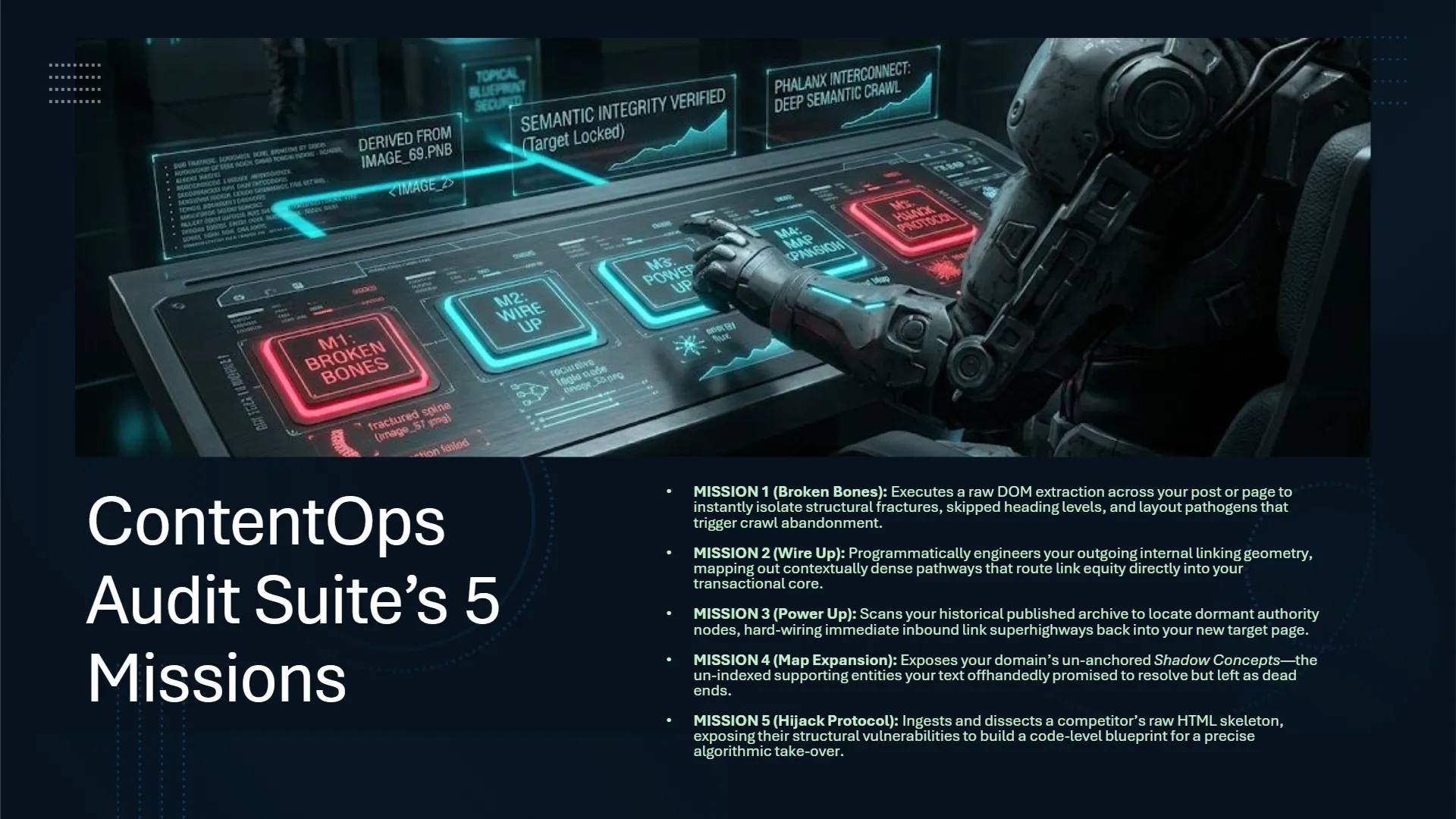
The Audit Suite’s Missions include:
- Mission 1 (Broken Bones): Performs a DOM extraction to locate duplicate H1s, skipped headers, and layout pathogens that slow down crawlers.
- Mission 2 (Wire Up): Identifies exactly which adjacent pages your post should link out to, suggesting natural, contextual anchor text.
- Mission 3 (Power Up): Scans your published archive to find existing, high-authority posts that should internally link back into your new page, building an unbroken Spartan Phalanx.
- Mission 4 (Map Expansion): Locates un-anchored Shadow Concepts—ideas you mentioned offhandedly in the copy but failed to build out as supporting posts—providing immediate child-node plan additions.
- Mission 5 (Hijack Protocol): Scans a competitor’s raw HTML to identify their structural vulnerabilities, giving you the blueprints to execute a precise, code-level competitive hijack.
Fixing the Broken Bones in your Posts and Pages
Most SEO plugins and audit tools give you an SEO failure checklist, meaning they tell you what you failed to do but leave it up to you to figure out the fix. This is absurd. ContentOps tells you the what and the why followed by the how-to-fix-it and where.
To resolve these structural fractures cleanly, operators deploy the HTML Strip protocol. By stripping out bloated visual page-builder widgets and replacing them with prefabricated, clean HTML blocks via the [ Modular HTML Splitter Manual ], you drastically reduce your page’s crawl latency, ensuring your brand is cleanly cited in generative AI search carousels.
Maintain your Posts and Pages with HTML Blocks
The additional benefit of replacing your text and header widgets with HTML blocks is that AI becomes deterministic and precise when working with code over raw text. That means you can maintain and make future changes more easily. Simply paste the HTML code from the widget into your AI, prompt it with the changes to make, and it gives you back a clean HTML block to paste back into your article – job done with no fuss.
As an operator, you no longer need to avoid code like the plague. Think of it like that ridiculously large bag of pancake mix you have in your pantry. The Pancake Mix theory is that you don’t need to be an expert cook to make pancakes if you have the pre-mixed formula; just like the fact that you don’t need to be a coder to wield and weaponize code on your site. The AI mixes the code, you put it on the griddle.
The frustration of a failed audit often stems from targeting the wrong audience: legacy search crawlers instead of modern AI answer engines. We took this exact problem—a site that passed every traditional check but still wasn’t visible—and engineered a solution that forced a citation from Google’s AI. Read the definitive guide to our system in the CASE STUDY — The Anatomy of a GEO Citation.
[ AEO CITATION INDEXING SCHEMA ]
FAQ: The Living Audit Method
What is the difference between a standard SEO audit and a topical map audit?
A standard SEO audit operates purely at the URL level, scanning for dead links, sitemap redirects, and duplicate copy in a static pass that goes stale the moment you publish again. A topical map audit operates at the HTML level per node, checking heading spines and structural entity relationships. It writes its findings directly into a persistent JSON Topical Map, serving as an active memory layer for every future content strategy and writing run.
Why doesn’t passing an SEO plugin checklist improve my rankings?
Passing a plugin checklist only confirms lexical compliance—meaning you repeated a keyword or matched character counts. It cannot check if your page’s code is bloated (Div Soup), if your heading skeleton is skipped, or if your internal linking layout can support topical authority. You can pass every plugin check and still remain invisible to LLM Answer Engines because your code structure is broken under the hood.
Can I use ChatGPT to crawl and audit my website?
No. Standard LLM chatbots like ChatGPT cannot crawl live sitemaps in real-time. If you paste a URL and ask it to run an audit, it will generate a confident-sounding hallucination based on generic training data rather than actual DOM analysis. You must run a clinical HTML audit scanner to extract your site’s physical code skeleton, then provide that structured data to the AI for accurate, diagnostic translation.
Before you publish a Shadow Concept post or rebuild one through the HTML Strip, run it through the free Surgical HTML Auditor at audit.contentops.so to confirm the structural layer is clean. [ Topical Map Tool for AI Content Strategy ].