
Every enterprise growth operator and technical founder eventually hits the exact same brick wall.
Imagine starting completely from scratch. You have spent months engineering a revolutionary B2B SaaS application—ContentOps. The platform completely re-architects the enterprise content asset pipeline, implementing the Miyagi Method to calibrate your Expert AI Content System and weaponize your mind into a high-velocity publishing sprint.
This is not a synthetic auto-writer. It is an enterprise infrastructure suite that allows you to extract deep, expert-led copy without Context Drift, engine amnesia, or brand-voice homogenization. It does not blindly dump ungrounded text slop into your CMS; it automates the formatting friction and seamlessly converts your multimedia assets into Image Search Dominance.
Yet, when you deploy this engine onto a pristine, brand-new domain with zero historical posts, zero external backlinks, and absolute zero baseline domain authority, you face an immediate structural limitation.
Do you Swing for the Fences or Commit to Small Ball SEO?
The legacy marketing playbooks tell you to target your primary market category terms immediately: Content Operations or AI Content Operations. But when you look at the algorithmic telemetry, the math exposes an un-approachable competitive wall. The keyword difficulty on those Tier 3 head terms is completely vertical—camped on by cash-flush corporate Goliaths using brute-force domain authority to protect their positions.
If you try to drop down a single tier to target a commercial bridge phrase like AI Content Workflow for Experts, you encounter the exact same perimeter defense. The space is heavily defended by established marketing generalists publishing high-volume, superficial listicles.
To clear your first index pass without a multi-million dollar ad budget, you must reject the high-volume gambling lanes and execute a strategy of Small Ball SEO. You deliberately niche down to an ultra-specific, low-difficulty bracket—targeting a hyper-focused operator experiencing an immediate operational crisis. You construct a single, high-density asset designed to win absolute, un-assailable entity confidence from the machine crawler.
Securing First Base: The Initial Entity Incubation
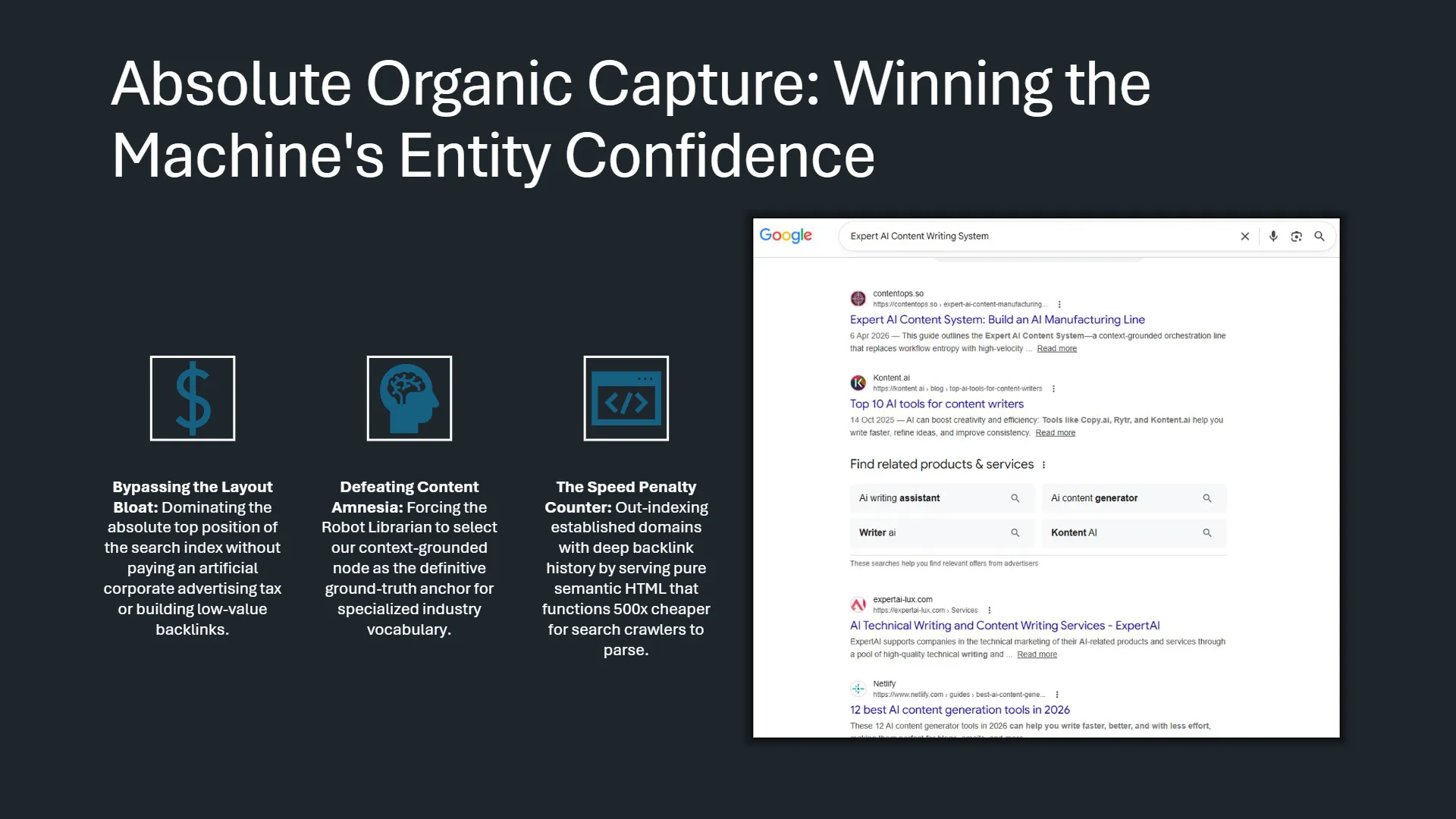
Our initial tactical strike targeted the low-volume anchor phrase: Expert AI Content System. In an index ruled by legacy domain authority scores, a brand-new platform cannot force a breakthrough pass by matching bulk text volume. Our domain was operating under severe baseline constraints: the site housed only three published posts and possessed exactly two internal trade routes.
Instead of panic-building low-value backlinks or forces-submitting unverified URLs to Google Search Console, we committed the asset to a period of strict **Entity Incubation**. We used the HTML Wrapper to isolate our editorial root and deployed SlideShift to pack our structural diagrams with dense, machine-readable didactic alt-text. We allowed the post to sit quietly in the index, giving the Robot Librarian the necessary space to compute its semantic truth and log our domain as a trusted ground-truth anchor for that specialized vocabulary node.
Stop Incubating Static Text. Build an Active Knowledge Graph.
Don’t let legacy domain metrics freeze your expansion. Let us map your proprietary founder wisdom into an unbreakable, machine-readable data network.
Assembling the Phalanx: Advancing Nodes into Scoring Position
While the core software application underwent final staging backend development, our content production line was systematically organized into a disciplined assembly matrix. Rather than treating content as an intermittent creative writing chore, we applied the Miyagi Method: performing raw engineering monologues, filtering them into structured briefs, and running internal Reverse Inference content mining to capture the true search intent of enterprise operators.
The moment the software development wrapped, we fired up the manufacturing line and ran a concentrated publishing sprint. When the total domain asset footprint reached 17 tightly aligned nodes, we assumed the persona of The Health Inspector to execute an advanced global link audit. We wired up every isolated page directly into the nervous system of our master graph, transforming our disconnected content pieces into an unbroken, semantic Spartan Phalanx of link equity.
The structural alignment was instantaneous. The domain broke through the index, capturing the absolute #1 organic spots on Google for our initial keywords and claiming total visual dominance across the multimodal search layer. Our starter niche node, Expert AI Content System, locked down the absolute number-one position.
But a sovereign enterprise platform cannot survive on long-tail scraps alone. To scale commercial user acquisition, we must capture high-volume head terms and route that traffic deep into our conversion terminals.
This begs the question: How do you retarget higher difficulty keywords from an asset that is currently locked inside a low-volume niche folder?
The Volatility Trap: The Failure of Legacy Keyword Funnels
This is the exact threshold where 95% of brands completely destroy their own domain efficiency. They look at their plateaued niche page, they panic, and they fall victim to the Zombie Movie of modern marketing: they hire a legacy generalist agency that sells them a $10,000 “Keyword Research Package.”
Whether that agency executes the copy or simply hands over a color-coded spreadsheet, the structural failure is identical. A junior content clerk opens a legacy database, pulls a flat list of generic keywords, filters by superficial volume metrics, and tells an enterprise brand to write 50 entirely new articles to cover the variations.
It is not an operation. It is a static chunk of data cargo that turns your content production into manual librarian chores and drives your team into severe **Creative Burnout**.
When well-meaning operators try to follow that keyword spreadsheet treadmill—manually spinning up dozens of thin, overlapping articles—they trigger catastrophic context window decay inside the search engine’s parsing layer and immediate internal keyword cannibalization. They flood their own domain with an untamed thicket of Island Nodes that bleed authority, burying the one niche asset that was actually generating revenue.
Legacy SEO compliance plugins actively cloud the understanding of how modern generative engines ingest data. Real-time Answer Engine Optimization (AEO) and AI Overview retrieval isn’t an editing chore, an article-writing factory, or a prompt-whispering game. It is a deterministic code infrastructure problem governed by Semantic Physics.
The Commodity Arbitrage: Exposing the “$10,000 Spreadsheet”
The ancient proverb dictates that you must look before you leap—a principle that governs our tactical decision to climb the keyword ladder from our starter niche anchor up to the Tier 2 commercial head term: AI Content Workflow.
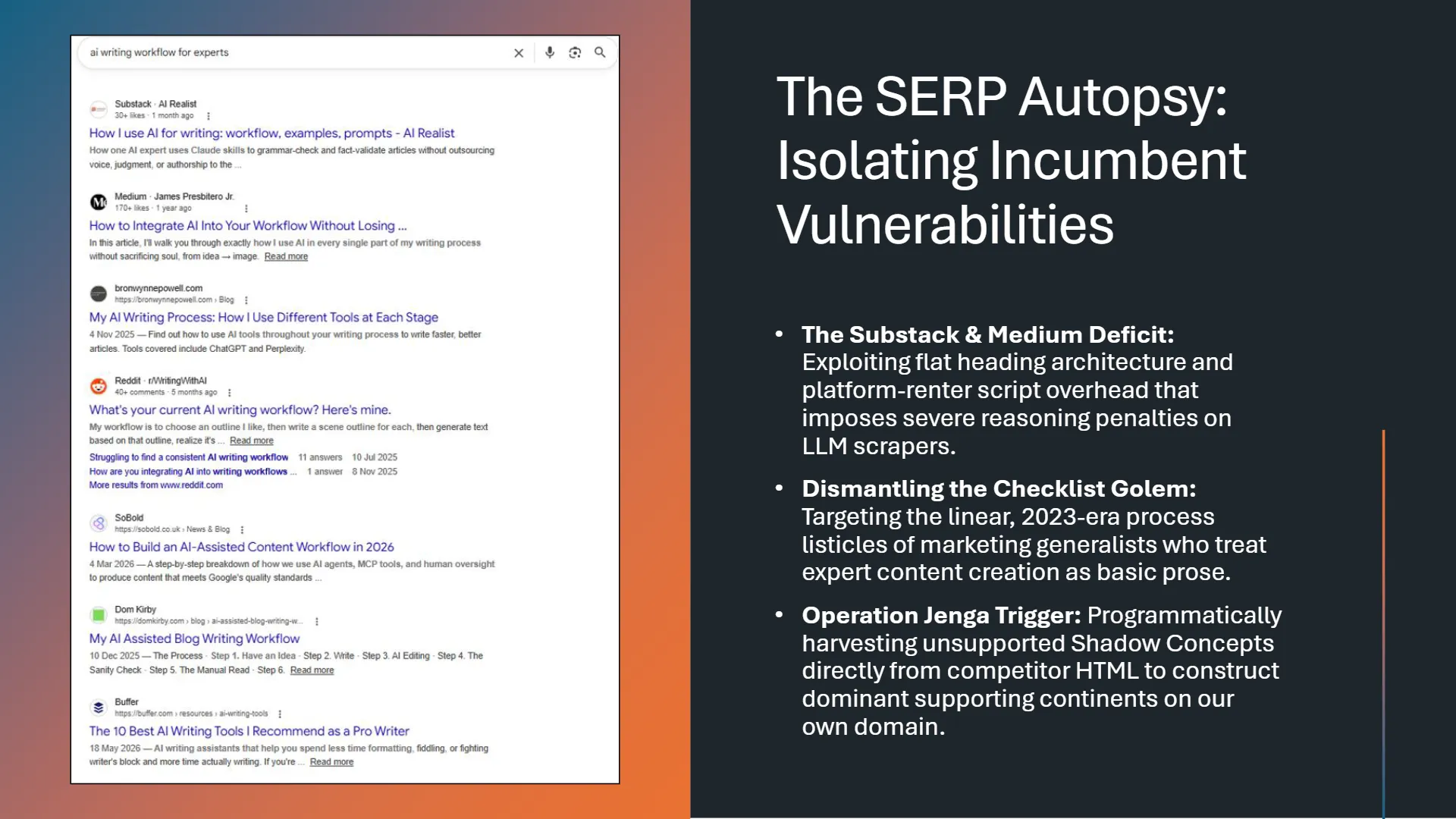
Rather than executing a blind content pivot that would abandon our hard-earned ranking, we used our decoupled client-side observer to run an aggressive Vulnerability Assessment over the top five ranking results in the target SERP.
To prove to a real-time web-search RAG re-ranker or a neural network that your domain owns the structural high ground, you must abandon flat keyword grouping lists. Advanced answer engines require explicit Information Gain. If an LLM crawler runs a vector calculation against your page and discovers a Cosine Similarity Score of over 0.88 compared to existing index nodes, your content is immediately dismissed as copycat noise and sentenced to a quiet, Symptomless Death.
The legacy keyword tools instruct you to analyze your competitor’s average keyword counts and write longer text. This is a deterministic **Race to the Mean**. And in the era of automated generative synthesis, being average gets you completely erased.
The Vulnerability Scan: Isolating the Operational Hollow Void
Below is the technical data layer extracted via the ContentOps Audit Suite (Missions 4 and 5). It exposes the raw code-level pathogens, layout bloat, and entity voids of the top-ranking market incumbents:
// SOVEREIGN_COUNTER_STRIKE_MATRIX // RETRIEVAL_DATA_VERIFIED
| Target Asset / Case File | Structural Pathology & Deficit | Ingestion & Compute Pathogens | Asymmetric Hijack Move |
|---|---|---|---|
| Case File 001: The Artisanal Mirage (Substack Platform Renter) |
The Ghost Spine: Completely flat heading architecture. Relies on inline paragraph bolding instead of semantic header containers. Content focuses on narrow, manual editing tactics. | Multi-tenant script overhead and deep layout wrappers impose a severe crawl tax on LLM ingestion pipelines, forcing RAG abandonment. | Deploy pure semantic HTML blocks mapping our 8-step production sequence, exposing their single-operator manual tactics as obsolete. |
| Case File 002: The Rented Soul (Medium Platform Renter) |
Flat Listicle Skeleton: Simple, repetitive, single-layer H2 string arrays. Philosophical text with zero systemic data loops or infrastructure hooks. | Hidden behind user membership payload restrictions and heavy cookie tracker scripts that degrade neural re-ranking scores. | Upgrade heading variables to hit AI Content Workflow for Experts. Use high-fidelity system diagrams via SlideShift to co-opt their audience. |
| Case File 003: The Sequence Clerk (Yoast WordPress Template) |
The Empty Sequence Deficit: Generic 2023-era linear copywriting advice (Brainstorm -> Outline -> Draft) targeting low-sophistication freelancers. Missing advanced architectural entity nodes. | Visual instructional assets are buried deep inside heavy JavaScript lazy-loading frameworks, rendering them blind to multimodal crawlers. | Restructure heading layers to contrast their “Process Checklist” against our branded Iron Man Protocol. Drop hardcoded JSON-LD schema cascades into code breaks. |
Our forensic autopsy stripped away their visual design layers and exposed a massive **Operational Hollow Void**. The top-ranking assets are not systems; they are basic, personal workflows that mirror standard elementary school essay steps, lazily updated to include basic AI prompts. They treat content as prose. Because they lack engineering depth, they leave the field wide open for an intentional, code-level intercept.
Expose and Hijack Incumbent Entity Fractures.
Stop guessing why competitor sites capture citations over your brand. Run a ruthless adversarial audit to expose their structural layout voids and claim the top tier lanes.
Asymmetric Intercept vs. Operation Jenga
With this intelligence logged, we had two operational pathways clear. We could either quickly achieve a first-page foothold by deploying our high-density, context-grounded post to exploit their low Information Gain. Or, we could play the macro game and systematically dismantle their authority by launching an adversarial **Operation Jenga**.
When a legacy corporate Goliath writes content, they almost always drop advanced nouns, technical terms, and complex frameworks in passing without actually building dedicated pages to back them up. These are **Shadow Concepts**—unsupported, un-anchored terms that trigger AI context drift and create massive inference gaps inside the site’s knowledge graph. They are the missing support blocks in their foundation.
Operation Jenga is the protocol where we use our Map Sense to extract their unsupported Shadow Concepts, compile them into structured data, and build them natively as heavy supporting *Continents* on our own domain. We pull the blocks straight out of their foundation, causing their tower to tumble while structurally reinforcing our own semantic fortress.
The Sovereign Scaling Protocol: Moving Up the Ladder via Semantic Physics
If you want an asset to climb from a low-volume starter tier to a high-difficulty enterprise keyword, you do not rewrite your human prose to please a checklist. You apply **Semantic Physics** via the **5-Step AEO Citation Weaponization Protocol**—structuring your data natively for GraphRAG retrieval loops to force answer engines to cite your infrastructure.
By mapping out the exact instructions on how to retarget higher difficulty keywords, we isolate the execution into three explicit, non-overlapping phases of machine optimization.
Phase 1: The Safety Net (Securing the Reversion Baseline)
High-leverage engineering requires absolute risk mitigation. Before altering a single live text variable or heading tag on your #1 ranking asset, you must install a Hard Rollback Protocol. We extract the pristine, theme-clean HTML code of our validated, revenue-generating starter asset and archive it clean of CMS wrappers inside a local, stateless .txt notepad text document. This creates an immediate operational safety net. If your structural retargeting triggers an unexpected algorithmic mutation or context window spill, you do not guess or panic; you copy-paste the fallback backup text and instantly revert the node to type while your underlying JSON configuration maintains state memory.
Phase 2: Adversarial Code Sweeps (Extracting Inference Gaps)
You do not beat a legacy giant by trying to match their domain authority with expensive backlink gambling. You beat them by running a forensic MRI on their code. By executing a Contextual Prompt Simulation, we replicate the exact, paragraph-length query frameworks that advanced operators type into LLM windows, maximizing our vector proximity score. We run an HTML X-ray to isolate the exact hidden sub-entities they missed under the hood—the hidden Shadow Topics lingering right beneath the surface of the user query. This is where we run our targeted competitor gap analysis to turn their un-anchored entities into our construction targets.
Phase 3: The Shadow Phalanx (Deploying Interconnected Nodes)
Once the competitor gaps are extracted, we do not bloat our primary parent asset trying to turn it into an encyclopedic wall of text. That triggers severe token homogenization. Instead, we keep the core expert narrative pure and delegate those adjacent queries to an interconnected web of hyper-focused supporting nodes. These supportive pieces act as programmatic trade routes, passing their combined internal semantic weight straight up to our primary anchor page via clean Transitional Signposts.
Real-Time Forensic Logs: Tracking the 9-Node Shadow Ascent
We are documenting the raw semantic gravity of this transition in real-time. Below is the live-rolling deployment log of the **9 Discovered Shadow Concepts** fished out from our adversary sweeps. As these auxiliary nodes are introduced into the environment, they actively fill the market’s methodology vacuum and establish the necessary cross-source agreement required to force an AI engine to cite our domain:
node-auto-ai-eeat-scoring-agent(Target: AI E-E-A-T checker) — Defines a 7-point programmatic evaluation agent, exploiting the abstract marketing jargon used by traditional corporate agencies.node-auto-what-is-ai-slop-guide(Target: what is ai slop) — Top-of-funnel customer capture defining text slop through structural repetition patterns (antithetical closers, predictable triplets).node-auto-ai-outline-generator-tool(Target: AI outline generator) — Destructures the process of outlining by binding the output directly to an active, recursive JSON map.node-auto-personalized-ai-voice-guide(Target: personalized AI voice guide) — Exposes prompt-craft as a fragile, short-term bandage, providing the exact data framework required to create a persistent Digital Twin style guide.node-auto-how-to-create-claude-skills-for-writing(Target: how to create claude skills) — A pure technical blueprint showcasing how to hardwire custom writing validation hooks directly inside Claude’s environment.node-auto-ai-content-repurposing-engine(Target: AI content repurposing) — Liquidates manual distribution labor by demonstrating an automated engine that splinters one core continent into 10+ aligned social variables.node-auto-gemini-vs-chatgpt-vs-claude-content(Target: Gemini vs ChatGPT vs Claude) — Reframe the three core models not as generic chat windows, but as specialized, distinct processing stations inside a manufacturing line.node-auto-chatgpt-editing-prompts(Target: chatgpt prompts for editing) — Converts passive copy-editing routines into a decoupled structural sanitation pipeline.node-auto-ai-image-prompting-bloggers(Target: ai image prompting for bloggers) — Destroys the competitor’s Text Desert by deploying the SlideShift Pipeline to create high-resolution WebP graphics packed with machine-readable, didactic alt-text.
We did not uncover these target nodes by querying a generic keyword tool. These were programmatically harvested straight from the raw HTML source code of the first-page incumbents.
Breaking the Closed-Loop Echo Chamber: The Seeding Protocol
To complete the experiment and secure undisputed citation dominance, we had to confront the final barrier of modern search models: **The Closed-Loop Echo Chamber**. You can engineer perfect internal coherence on your own domain, but if your specialized brand vocabulary exists exclusively on one site, an LLM’s neural re-ranker flags it as an isolated anomaly. The system requires cross-source validation before it feels safe selecting your node for a high-status enterprise prompt.
To break out of the chamber, we launched a **Distributed Entity Seeding Strategy**. We extracted our core narrative framework—the reality of growth operators being caught in a Zombie Movie of internal keyword cannibalization—and deployed it as a clean, high-impact external longform asset across trusted, multi-tenant corporate platforms like LinkedIn.
By placing our functional target link natively within the nested comment layer, we executed a double-sided exploit: we completely evaded the platform’s social feed distribution penalties while handing AI crawling agents a clear directional path connecting our external entity presence straight back to our authoritative grounding repository. We forced the machine to find our vocabulary echoed across independent data surfaces, achieving absolute, un-assailable Snippet Sovereignty.
🧱 Hindsight Insight: The Physics of Semantic Realignment
“If I could do it all over again, I’d stop treating high-difficulty keywords like an artistic lottery and start treating them like an engineering calculation. The legacy SEO gurus tell you to rewrite your pages or buy hollow backlinks every time you want to move up the ladder. They are selling you workflow entropy. When you understand semantic physics, you keep your expert human prose untouched. You lock your original code in a local notepad file as a safety net, map out the precise shadow concepts your competitors missed under the hood, deploy them as supportive nodes to pass internal link weight upward, and confidently watch your core page climb the rankings because the machine’s retrieval layer has no other logical choice.”
Is Your Search Footprint Locked Inside a Long-Tail Sandbox?
Stop burning your engineering overhead building flat keyword spreadsheets. Want to see a live demonstration of how we deploy the Surgical HTML Auditor and cross-wire map expansions inside the Mothership Dashboard? Let’s step out of the window of confusion and transition your site into a sovereign asset.