
Jasper Alternative for Content Infrastructure, Not Just Content
Jasper is a real, capable writing platform with genuine schema and entity tools, most of them locked behind a Business tier with no published price. Here’s what each stage of actually producing content looks like on both, side by side.
What Jasper Actually Does Well
Worth stating plainly before anything else that Jasper isn’t a thin wrapper around a chat window. It has a real Knowledge Base for grounding, a genuine Brand Voice and Style Guide system, and an actual multi-agent workflow for schema, meta tags, and entity coverage, not marketing language for a single generic feature. Credit where it’s earned, before either tool gets picked apart stage by stage.
Jasper vs. ContentOps: An 8-Stage Workflow Comparison
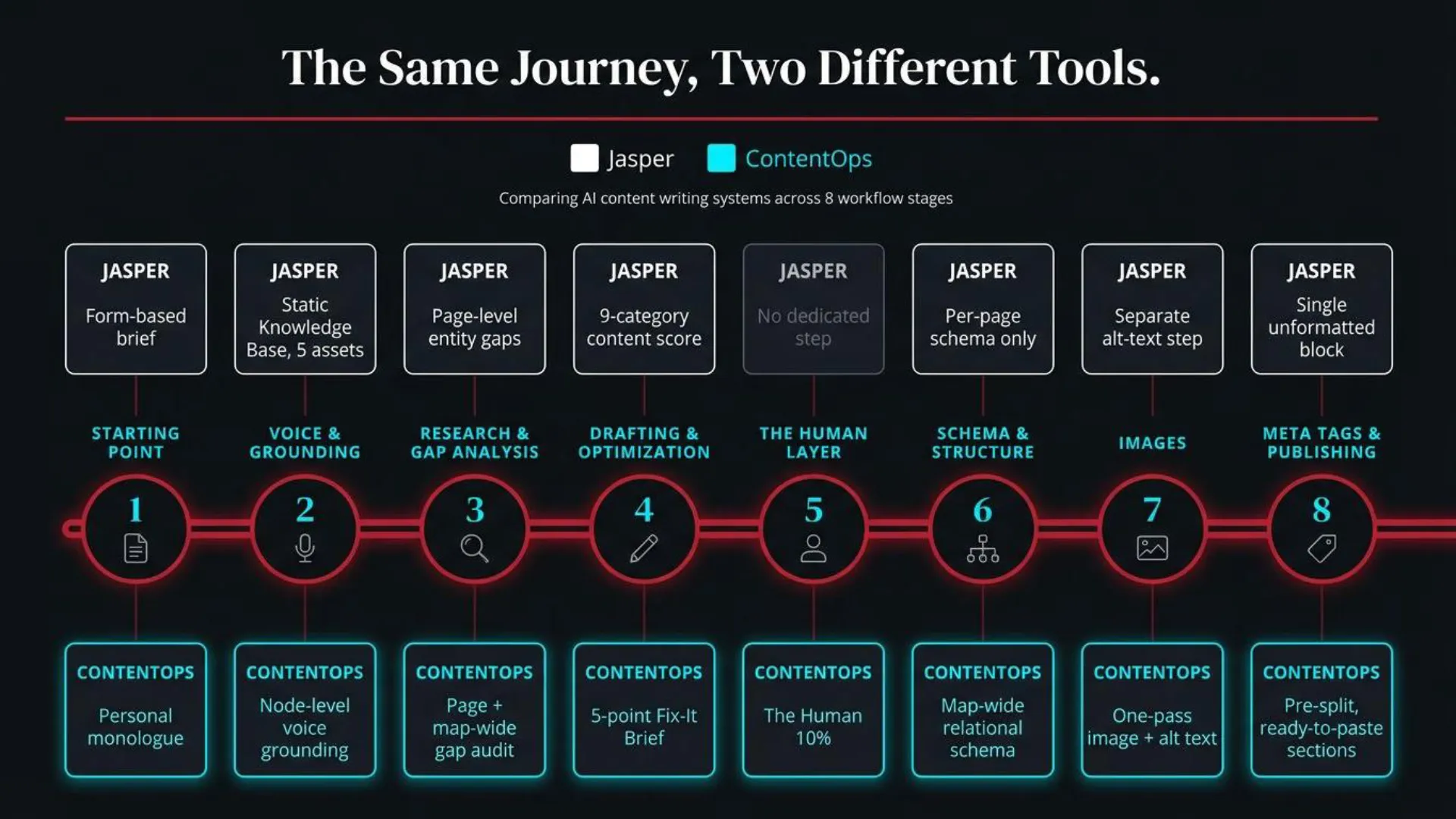
Every content workflow runs through the same real stages, whichever tool you use. Here’s what each one looks like on Jasper versus ContentOps.
Stage 1: Starting Point
How Jasper Handles the Starting Point
Content starts from a brief inside Canvas, target pages, an AEO goal, tone selected from Brand Voice. The starting material is a form, not your own words.
How ContentOps Handles the Starting Point
Content starts from a monologue, your own unscripted thoughts on the specific topic, filtered through your brand chat and codified into a Flash Injection that you paste into the app to update the map. That node codifies the description, big idea, semantic keywords, anchor text calls-to-action, and more. Export the whole map, or just the data from the individual node into your AI chat, whichever you use, to get started with your writing project.
Stage 2: Voice and Context Grounding
How Jasper Handles Voice and Context Grounding
Knowledge Base caps at 5 uploaded assets per Brand Voice, applied broadly across everything you write, document-level, static.
How ContentOps Handles Voice and Context Grounding
Your voice and context grounding is encoded directly into the topical map. Each node contains a complete data payload, giving your AI writer unparalleled context:
- Core Identity: Title, Target Keyword, and URL
- Strategic Intent: Big Idea (your information gain or positioning notes) and Description (the premise and support)
- Semantic Vocabulary: A curated list of your brand’s preferred terms for that node
- Internal Linking DNA: Pre-approved Anchor Text Options for building connections
- Conversion Hooks: Core and Transitional Offers (lead magnets, tools, PLG assets)
- Publishing Package: A pre-built H1, SEO Title, and Meta Description
Stated plainly, Jasper tries to replicate your voice from samples you’ve saved and it applies this for each piece of content you write with it. ContentOps, on the other hand, encourages you to ground your actual voice with an AI-filtered monologue that the AI then takes the best bits, the big idea, your wording, analogies, metaphors, and terminology and codifies them into the map node for that post. Because you do this for each node, your voice is maintained and enforced across the map since AI sees the semantic keywords as your brand vocabulary.
Stage 3: Research and Gap Analysis
How Jasper Handles Research and Gap Analysis
The Research Agent surfaces real search queries and competitive content (Business tier). The Entity Mapper Agent finds missing entity coverage against cited competitors and suggests internal links from your own URLs (Business tier), real, page-level gap detection, genuinely the closest overlap to ContentOps found anywhere in this comparison.
How ContentOps Handles Research and Gap Analysis
Mission 4 does the same page-level job, scanning your content or a competitor’s HTML for Shadow Concepts. The Global Map Audit adds a second layer Jasper doesn’t have, prioritizing gaps across your entire map, specifically flagging what’s still sitting at idea or draft status and recommending what to close first.
In reality, if you were considering Jasper at their pro price point, this gap analysis agent is unavailable to you, while ContentOps has Competitive Research mission and Global Map Audit available to all subscribers. As the user, it is up to you to fetch the HTML (yours or your competitor’s). With that in place, you can run a map expansion to find entity gaps (Mission 4) on your or your competitor’s HTML. You can also run Mission 5 Hijack to find your competitor’s weaknesses in their post.
Stage 4: Drafting and Optimization
How Jasper Handles Drafting and Optimization
The Optimization Agent scores drafts against Google’s own Search Quality Rater Guidelines across nine categories, with YMYL detection (Business tier). Real, specific, more evidenced than most tools in this comparison set.
How ContentOps Handles Drafting and Optimization
Mission 1 runs five checks, intent match, spine alignment, anchor text, alt text, and information gain, each returning an exact fix, not just a score. ContentOps scores the potential fixes, not the draft you gave it. It uses a points hierarchy that mirrors how AI evaluates text called the Force Multiplier. So, any recommended fixes at header level, anchor text, and alt-text raise the multiplier for all of the AI’s recommended fixes.
The Mission 1 Fix-it Brief tells you what to fix, where to find it in your post, and what to replace it with. Or you can just drop the exported Mission 1 Brief into your AI chat along with the HTML-wrapped draft (ContentOps also wraps your draft), and prompt your AI chat to apply the fixes.
Stage 5: The Human Layer
How Jasper Handles the Human Layer
No dedicated stage for this. The workflow moves from brief to agent-generated output, review happens after the fact, not as a built-in step.
How ContentOps Handles the Human Layer
The Human 10% is a named, deliberate stage, your own anecdotes and specifics added to the draft by hand, before anything moves to formatting.
Stage 6: Schema and Structure
How Jasper Handles Schema and Structure
The Schema Markup Agent generates real, production-ready JSON-LD, FAQ, Article, HowTo, and SoftwareApplication types (Business tier). Grid scales the same process across hundreds of URLs, but each row is still one page, schema drawn from that page alone, not from relationships between pages.
How ContentOps Handles Schema and Structure
Schema comes from the map itself, encoding relationships between nodes, not just what’s written on any single page. That means you can generate global schema to inject into your site’s Header as well as individual schema from each map node. This all happens with a single click.
Stage 7: Images
How Jasper Handles Images
The Alt Text Generator produces real, context-aware descriptions, and it’s the one feature in this comparison with a possible Pro-tier path, available as both an App and an Agent, though Jasper’s own chatbot never fully confirmed the App is included in Pro. Either way, it’s a separate step after image creation, not generated at the same time.
How ContentOps Handles Images
SlideShift’s integrated workflow handles conversion, renaming, captioning, and alt text together, in one pass, regardless of whether the image is AI-generated or your own user-generated content, batchable through a PDF for multiple images at once. If you’re using WordPress, just upload your converted images to WordPress and get pre-built HTML snippets to paste into an HTML widget. You no longer have to manually annotate the images once they’re in your CMS. ContentOps collapses both the annotation generation step and accelerates the publishing step.
Stage 8: Meta Tags and Publishing
How Jasper Handles Meta Tags and Publishing
The Meta Title and Description Agent generates real, character-counted output (Business tier), genuinely well built, credit where it’s due. But nothing native handles CMS output, content arrives as one undifferentiated block via copy-paste, document, or webhook, requiring manual formatting in WordPress.
How ContentOps Handles Meta Tags and Publishing
H1, SEO title, and meta description are generated by your own AI at the time the map node injection was created. The node counts characters, so you know when you need to trim the count down. The HTML Wrapper and Splitter turn a finished draft into pre-split, placeable sections before it reaches the editor at all. Simply use HTML widgets instead of text and header widgets and paste your optimized HTML-wrapped post in section by section. Instead of manually rebuilding the post again in your CMS, you just do a few quick pastes and the article is ready.
Populate your meta data from the map node itself. Then copy and paste your HTML into the node’s HTML Link Harvester to register all internal links into the map.
Jasper AI Pricing: The Undisclosed Business Tier Gap
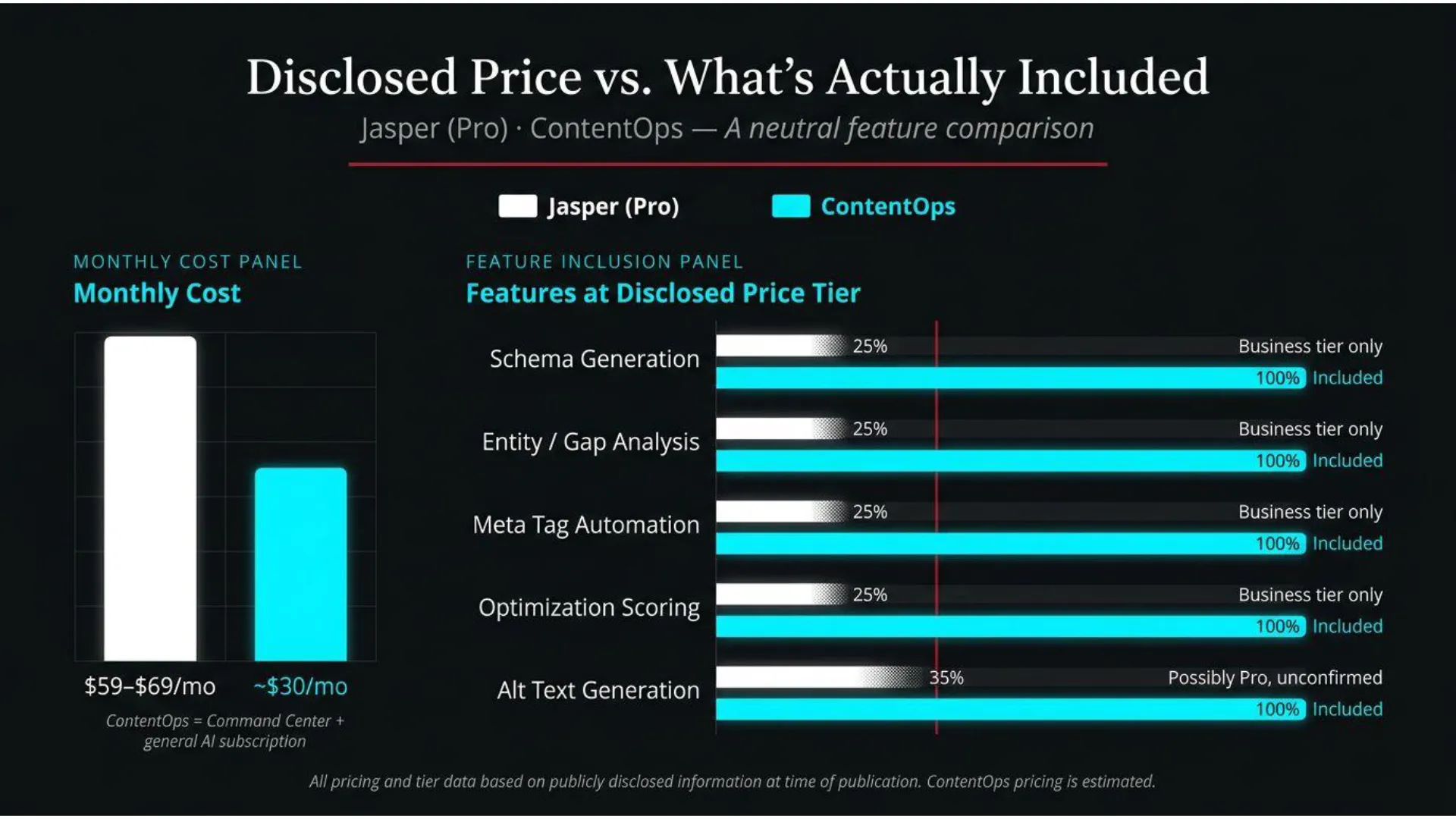
Here’s the uncomfortable part, worth stating exactly as confirmed. Jasper’s pricing page shows a checkmark for “Agents for core marketing workflows” on the $59 to $69/month Pro plan. Its own support chatbot, asked directly, confirmed otherwise, twice: every feature named above with a Business-tier note, Research, Entity Mapper, Optimization, Schema Markup, Meta Title and Description, requires the Business plan, custom pricing, no public number at all. The one partial exception is alt text, possibly Pro-accessible through its App version, though never fully confirmed.
Against that, the Command Center’s pricing runs $9.99 a month or $99 a year, and even paired with a $20 general-purpose AI subscription, still costs less than Jasper’s disclosed Pro tier alone, while including map-level versions of several things Jasper reserves for an undisclosed price.
The Broader SEO Tool Stack Required and its Cost
If you’ve spent any time looking at marketing setups, you’ve likely seen creators showing off “Tool Overlord” stacks that easily run $100 to $500 a month in recurring subscriptions. While this guide compares single-page optimization metrics head-to-head, software is only one piece of a complete marketing budget.
If you want to see how total execution costs compare across full agency retainers ($1,500–$3,500/mo), bloated DIY tool stacks, and flat-rate platforms, see our complete breakdown on How Much Does SEO Cost for a Small Business?
Beyond Automation: Why a Human-in-the-Loop AI Partner Wins
Some of this is worth saying plainly. ContentOps doesn’t compete by trying to do more automatically.
It’s strong in a different way. It’s a human-in-the-loop workflow, you and the AI working in symbiosis, not the AI working alone while you approve or reject what comes back. You spar with the AI, back and forth, and ContentOps’ job is providing the context injections, the brief, the map, the anchor text array, that keep that back-and-forth grounded instead of drifting. The hero of the process is still you. The tools researched in this series are all built to hand you a finished output faster. ContentOps is built to make you a better operator of whichever AI you already use – it fixes your relationship with AI.
If you love that spark you felt the first time you strategized and sparred with an AI that you painstakingly grounded to know your business intimately, ContentOps is for you. The Topical Map instantly grounds your AI, giving you a strategic partner, a strategic writer, and an auditor that sees the whole field. The other features are there to give you a fully optimized end-product at the finish line.
The Force Multiplier, ContentOps’ Answer to a Generic Score
Mission 1’s scoring doesn’t measure keyword presence, it weights structural elements by how much they actually change machine legibility. See the below table to better understand how AI actually scores content:
| Fix | Multiplier |
|---|---|
| Fixing a visibility-hiding pathogen | Infinite, zero to one visibility |
| H1 identity declaration | 100x |
| Each H2 with real semantic markers | 50x |
| Anchor text weld | 40x |
| Didactic alt text | 30x |
| Each H3 carrying real information gain | 25x |
| Structural pacing, H2/H3 depth | 25x |
| First 100 words, direct answer | 10x |
| Each semantic H4 | 10x |
These coefficients are qualitative weightings based on the ContentOps Sovereign Search Framework. They visualize the relative value of structural landmarks in machine-readable code and do not represent proprietary search engine ranking algorithms.
FAQ
Does Jasper generate schema markup?
Yes, confirmed directly from Jasper’s own documentation, a real Schema Markup Agent covering FAQ, Article, HowTo, and SoftwareApplication types. It’s Business-tier only, and it generates schema per page, not across relationships between pages.
Is Jasper’s Entity Mapper the same as ContentOps’ Mission 4?
Similar job, different depth. Both find entity or topic gaps at the page level. ContentOps adds a second layer, a Global Map Audit that prioritizes gaps across an entire project, including nodes still sitting at idea or draft status, something Jasper’s documentation doesn’t claim to do.
What does Jasper’s Pro plan actually include?
Apps, a limited library for core drafting workflows, not the Agents shown throughout Jasper’s own marketing pages. Every Agent-labeled feature, schema, entity mapping, meta tags, optimization, research, requires Business tier, confirmed directly by Jasper’s own support chatbot after the pricing page’s wording caused real confusion. Alt text is the one possible exception, offered as both an App and an Agent.
How does ContentOps prevent the Race to the Mean compared to Jasper?
Jasper’s Optimization Agent evaluates copy against SERP guidelines. ContentOps uses the qualitative Force Multiplier Matrix to score structural headings, anchor text alignment, and code-level machine legibility.
How does ContentOps handle internal linking compared to Jasper?
Jasper’s Entity Mapper suggests links on a per-page basis (Business tier). ContentOps uses the Switchboard Protocol—a structured linking method—at every level, using Anchor Text Options and AI inference to turn Island Nodes (orphaned posts) into an unbroken Spartan Phalanx (interlinked authority cluster).
Does ContentOps generate sitewide schema circuits?
Yes. ContentOps generates both node-level schema and site-wide DefinedTermSet schema circuits from the topical map graph with a single click, whereas Jasper provides page-level schema only on its Business tier.
Does ContentOps require a separate step for image alt text?
No. SlideShift converts PDF decks or images into WebP assets, generating Didactic Alt Text—teaching metadata embedded in images—and pure HTML figure widgets in a single integrated pass.
Does ContentOps write the draft for me?
No. ContentOps is the Power Suit—a suite of context-engineering tools—for whichever LLM you already use, fixing your relationship with AI while keeping the Experiential Expert’s Human Spark in the loop.
Who This Comparison Is Actually For
This page is scoped to content infrastructure specifically, structure, connectedness, and grounding, not enterprise marketing operations. If you’re running GTM campaigns, multi-brand personalization at scale, or agency work across dozens of client accounts, Jasper’s actual strengths were built for exactly that, and this comparison isn’t the one that matters most for your decision.
Where this comparison is sharpest is for a solo operator or small business that needs real content architecture, not just faster drafting, especially where credentials, licensing, and structural trust actually matter to who finds you. That’s most concrete in appointment-based, regulated practices, dentists, chiropractors, orthodontists, veterinarians, physicians, where a generic tool can draft a page but has no way to encode the credential stack or the connected structure that makes that page findable and citable in the first place.
See how this plays out for your specific field on the ContentOps for Local Service Businesses hub, or browse the full range of professions this applies to in our library of ContentOps use cases for professionals.
More AI Content Writing System Comparisons
This comparison is one of several applying the same six-axis paradigm to a real, named competitor. See the full framework, or find the tool you’re actually deciding between.
Comparison
Surfer SEO Alternative
A content score that rewards keyword insertion. Read the comparison
Comparison
Frase Alternative
The strongest publishing found, still per-document schema. Read the comparison
Comparison
Copy.ai Alternative
A real GTM platform whose own SEO advice fails its own audit. Read the comparison
Audit Your Own Content Infrastructure
Run the free HTML Audit, or try SlideShift on a handful of images before comparing anything else.