
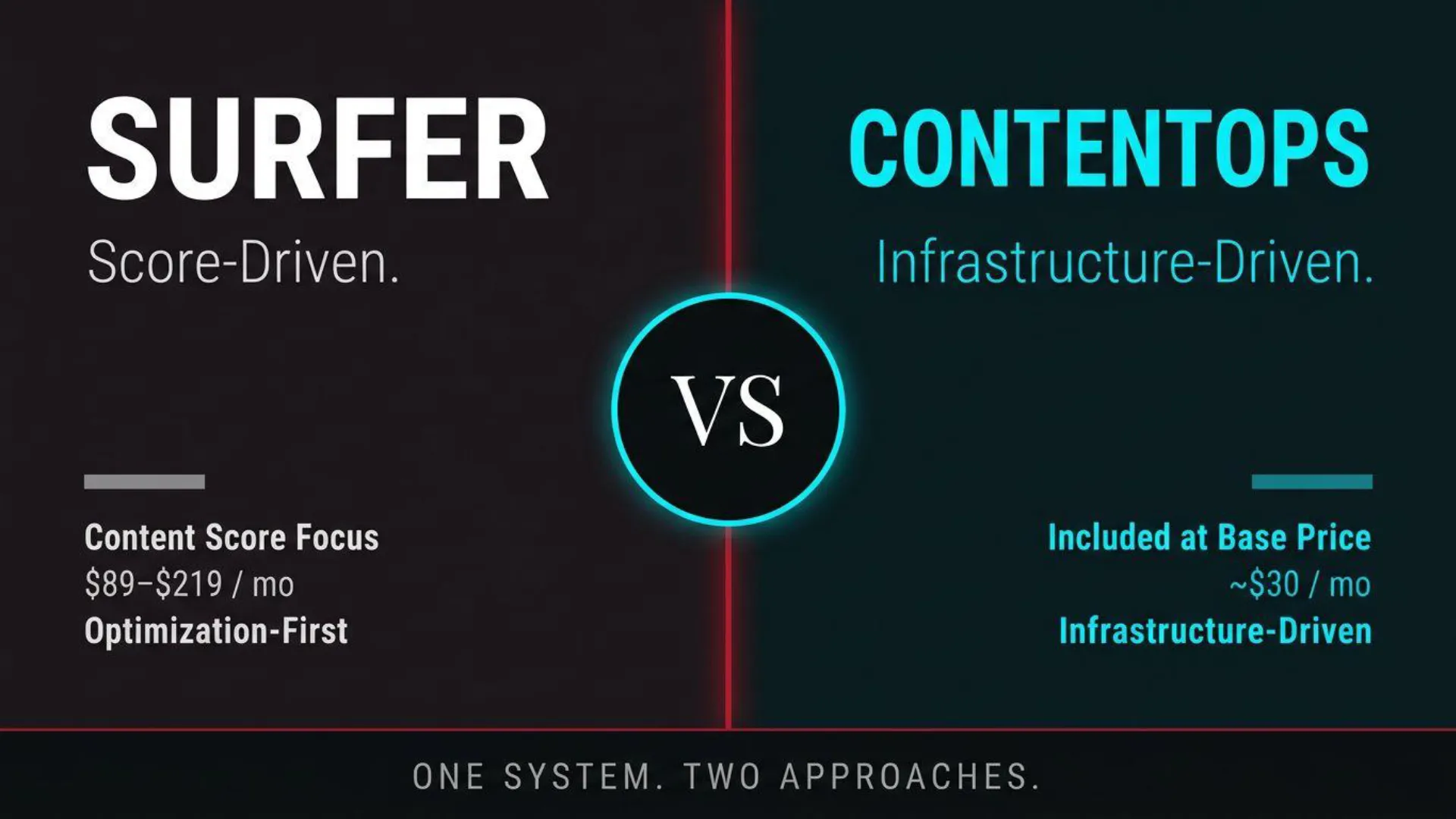
Surfer SEO Alternative for Content Infrastructure, Not Just a Content Score
Surfer is a real, capable content optimization platform, confirmed through direct hands-on testing, not secondhand research. Its Content Score rewards keyword insertion in ways its own guide admits can hurt your writing. Here’s what each stage of actually producing content looks like on both, side by side, including what tier you’d need to be on to get what Surfer’s own marketing implies.
What Surfer Actually Does Well
Worth stating plainly before anything else. Surfer’s SERP-based content briefs are real and genuinely useful, its structural checks go beyond raw keyword counting, and Surfy is a real, native writing assistant, not borrowed from Jasper as some secondhand sources still claim, Surfer confirmed this directly on their own site. Its WordPress connection is also genuinely more built out than Jasper’s, direct publish support with Gutenberg block-level splitting, not a single undifferentiated block. Credit where it’s earned, before either tool gets picked apart stage by stage.
Surfer vs. ContentOps: An 8-Stage Workflow Comparison
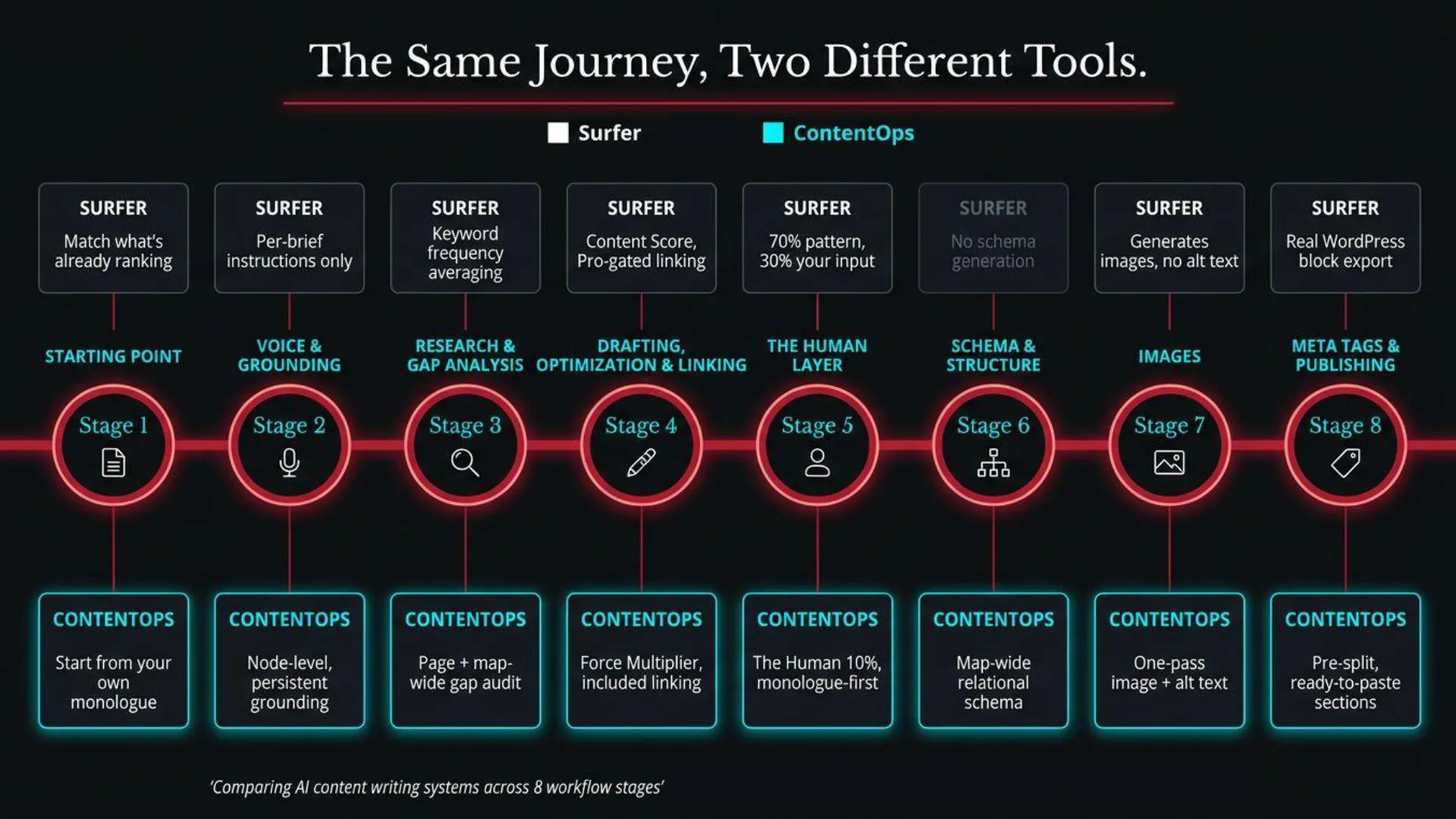
Every content workflow runs through the same real stages, whichever tool you use. Here’s what each one looks like on Surfer versus ContentOps, and what plan you’d need to be on to actually get it.
Stage 1: Starting Point
How Surfer Handles the Starting Point
Surfer checks what’s already ranking for your target keyword and tells you to match that content type, a how-to if how-tos rank, a listicle if listicles rank. (Discovery tier and up). This is a real, useful check on its own. But Surfer’s own tutorial content goes further, suggesting you build your outline from a top-ranking competitor’s structure before you’ve done any original thinking. That’s the Race to the Mean by definition, confirmed directly, not inferred.
How ContentOps Handles the Starting Point
Content methodology starts from a monologue consisting of your own unscripted thoughts on the specific topic, filtered through your brand chat and codified into a Flash Injection that updates the map.
The difference between the two is stark.
If you’re interested in just making content to target a keyword and the topic is such that you don’t need to add anything new, then a tool like Surfer is a great starting point.
However, if you have a real angle that offers something new, you need a starting point that filters your ideas and helps you to write structured content that ranks. A monologue is a great starting point to get the topic out, in your own voice, and with your unique perspective. ContentOps doesn’t capture the monologue directly, but your AI filters out the best bits and prepares a Flash Injection into ContentOps that encodifies your vocabulary, excerpts, semantic keywords, big idea, and description within the topical map. This ensures your AI writing chat understands your exact angle, vocabulary, and strategic positioning as guardrails for the writing step.
Stage 2: Voice and Context Grounding
How Surfer Handles Voice and Context Grounding
Custom Instructions and Writing Points can be set per individual content brief. There’s no persistent, workspace-level brand voice grounding beyond that, each brief is its own island unless you re-enter your context every time.
How ContentOps Handles Voice and Context Grounding
Your voice and context grounding is encoded directly into the topical map. Each node contains a complete data payload, giving your AI writer unparalleled context:
- Core Identity: Title, Target Keyword, and URL
- Strategic Intent: Big Idea (your information gain or positioning notes) and Description (the premise and support)
- Semantic Vocabulary: A curated list of your brand’s preferred terms for that node
- Internal Linking DNA: Pre-approved Anchor Text Options for building connections
- Conversion Hooks: Core and Transitional Offers (lead magnets, tools, PLG assets)
- Publishing Package: A pre-built H1, SEO Title, and Meta Description
This combined data collection carries the premise, strategic positioning, commercial offers, brand vocabulary, and call-to-action preferences for every node in the map. That gives your AI writer an unparalleled depth of context to draw from at the writing stage, locking in your voice and preventing lost identity. You finally have writing that plausibly sounds like it came from you because the semantic vocabulary and big idea are entirely yours, not a Frankenstein collection gathered from top SERP competitors.
Stage 3: Research and Gap Analysis
How Surfer Handles Research and Gap Analysis
SERP competitor analysis and keyword frequency averaging across the top-ranking pages. Real and useful, but meaningfully thinner than what a dedicated entity-mapping feature does elsewhere in this comparison, no relationship mapping, no cited-competitor comparison, just term frequency.
How ContentOps Handles Research and Gap Analysis
ContentOps isn’t a traditional keyword research tool. Where it excels is analyzing live HTML to uncover structural gaps and vulnerabilities. The Audit Suite features 5 AI Missions for HTML Diagnostics. Mission 4 (Map Expansion) uncovers your Shadow Concepts—un-anchored entity references mentioned in your copy with no published node backing them up. Mission 5 (Hijack Protocol) runs against competitor HTML to reveal structural weaknesses ready for an adversarial hijack. Furthermore, the Global Map Audit analyzes your entire map network to prioritize missing nodes sitting at idea or draft status.
Stage 4: Drafting, Optimization, and Internal Linking
How Surfer Handles Drafting, Optimization, and Internal Linking
The Content Score rewards keyword insertion through a one-click “add this” action, confirmed through direct hands-on demonstration. Surfer’s own guide is honest about its limits though, worth crediting directly: “your Content Score is a guide, not a goalpost, trying to squeeze every last point out of it might actually make your writing worse.” A score of 67 or higher is called publish-ready, chasing 100 isn’t necessary. That honesty doesn’t change what the mechanism actually rewards along the way, score-chasing dressed up as optimization—a mechanism that acts as a Green Light Gaslighter (scoring that rewards SERP imitation) and causes a Race to the Mean (homogenized, average content).
Internal linking is a separate, gated feature (Pro tier and up, $182/month, confirmed directly against Surfer’s own documentation). Even fully unlocked, it comes in two versions. Basic Linking, which Surfer’s own docs label legacy, matches on a single keyword or URL, no semantic understanding. Semantic Linking requires both a connected Google Search Console account and an active Content Audit project, and even then, it’s still matching against one target phrase per link.
How ContentOps Handles Drafting, Optimization, and Internal Linking
With ContentOps, drafting is handled by your choice of external AI. You export the topical map as a context injection alongside your writing prompt, research, and monologue. Your AI writing chat executes in multiple passes:
- Pass 1 writes the initial draft.
- Use ContentOps’ HTML Wrapper to pre-wrap your draft. HTML is deterministic for AI to audit against—it reads heading hierarchy, internal link structures, anchor text, and alt-text.
- Run Mission 1 (Find the Broken Bones) for structural optimization, Mission 2 (Wire Up) for outbound link recommendations, and Mission 3 (Power Up) for inbound internal link bridges.
- Paste the briefs back into your AI chat to apply recommended structural fixes and internal links directly.
- Once applied, you possess an optimized asset ready for rapid publishing.
ContentOps views optimization as structural legibility rather than NLP keyword density (also known affectionately as “keyword stuffing”). We check heading spine alignment, intent satisfaction, information gain, anchor text quality, and didactic alt-text so crawlers can cite your post with total confidence.
Stage 5: The Human Layer
How Surfer Handles the Human Layer
Structure gets imposed before you write, an outline built from competitor patterns, described in Surfer’s own material as roughly 70% proven pattern, 30% your own input. Your thinking fills gaps in a structure that was decided before you had any.
How ContentOps Handles the Human Layer
The Human Spark is monologue-first. You speak your thoughts, angle, and terminology directly to your AI. The Human 10% is your second pass after drafting—adding personal stories, real-world examples, and experiential insight to the skeleton of H2 headings, providing irreplaceable information gain that AI crawlers demand.
Stage 6: Schema and Structure
How Surfer Handles Schema and Structure
It doesn’t. Confirmed against Surfer’s own blog and pricing pages, the definitive source for what the platform actually does, schema markup is never mentioned. Surfer functions as a content optimization and keyword-scoring tool, not a structured data generator.
How ContentOps Handles Schema and Structure
Schema is generated directly from the map graph at both the individual node level and the site-wide header level. It encodes entity relationships between nodes across your entire domain with a single click, rather than treating each page as an isolated island.
Stage 7: Images
How Surfer Handles Images
Surfer can generate AI images inline through a slash command, a real, convenient feature. But its own publishing checklist, the instructions for finishing an article before it ships, tells you to “add internal or external links, include visuals if needed, and personalize sections.” Alt text never appears in that checklist, at any step. Wherever the image comes from, Surfer’s own or elsewhere, annotation is left entirely to you.
How ContentOps Handles Images
ContentOps uses SlideShift’s integrated workflow to optimize visual assets. SlideShift converts PDF decks or images into WebP format, generating descriptive slugs, captions, and Didactic Alt Text (teaching metadata embedded in images) in a single batch pass. The output includes pure HTML figure snippets that skip manual CMS media library annotation, which is a massive time-saver.
Stage 8: Meta Tags and Publishing
How Surfer Handles Meta Tags and Publishing
Real, confirmed, character-counted meta title and description generation, credit where it’s due. Publishing itself is genuinely stronger than Jasper’s: a direct WordPress connection maps content into native Gutenberg blocks rather than one undifferentiated dump, or export as formatted text, Markdown, or an HTML download. A Zapier integration also exists for deeper CMS automation, but it’s gated behind a Custom Plan or a paid API Add-on, and Surfer’s own announcement for that integration opens by naming the tool-switching fatigue their own product structurally contributes to.
How ContentOps Handles Meta Tags and Publishing
H1, SEO title, and meta description are generated as metadata parameters within each map node. The publishing accelerator is the HTML Splitter, which systematically chops wrapped HTML into H2 and H3 sections. This allows creators to rapidly paste pre-split blocks into page-builder HTML widgets in under 5 minutes without div soup clutter.
We Ran Our Own Audit Suite on Surfer’s Pricing Page
Not an argument, a screenshot. We ran ContentOps’ own Audit Suite against Surfer’s live pricing page, targeting “surfer seo pricing” as the keyword. The result: four separate H1 tags on one page, and two direct H1-to-H3 heading skips, no H2 in between, at the “Trusted by 150,000+” section and at the FAQ.
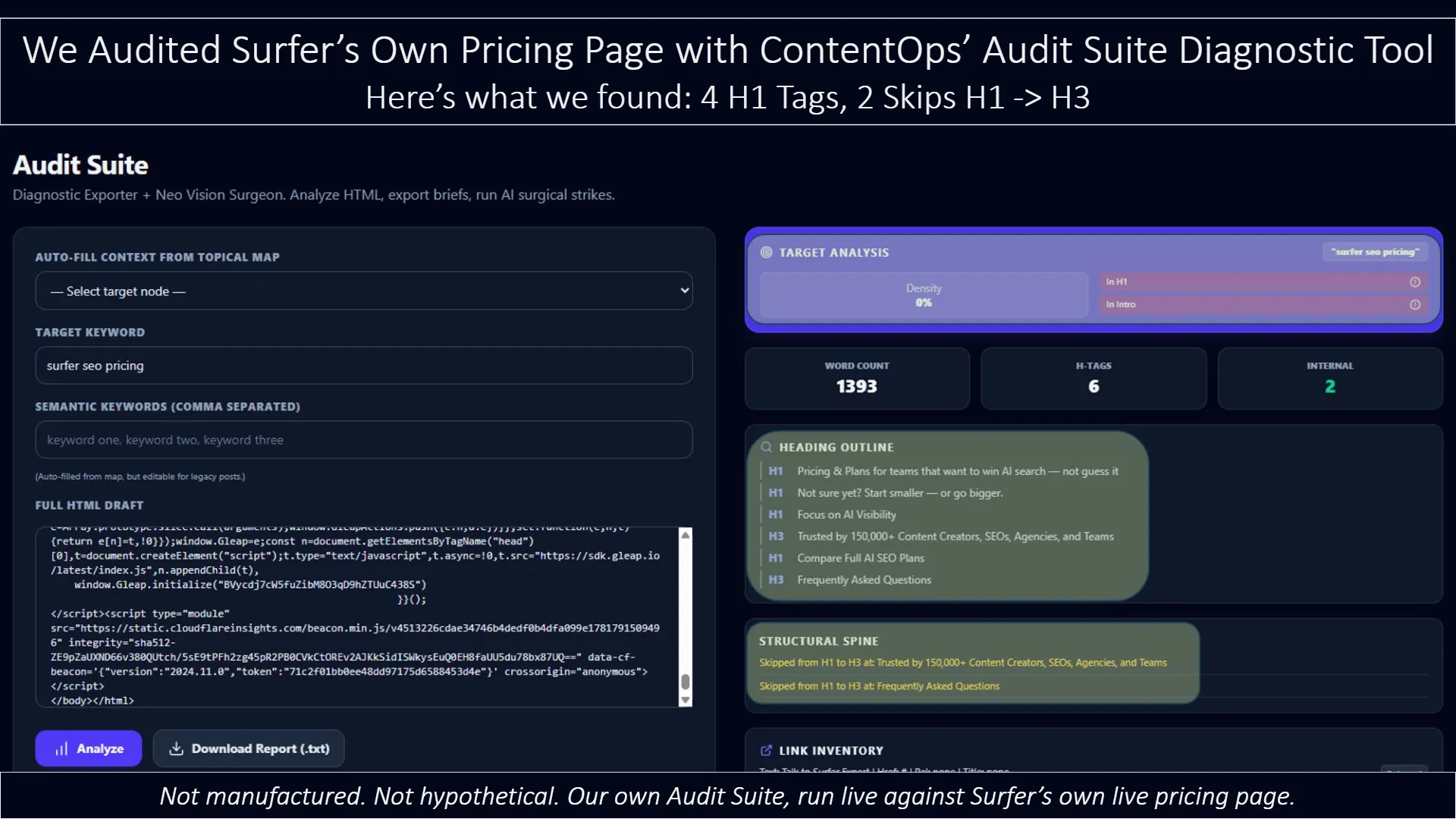
Multiple H1s and skipped heading levels are exactly the pattern a keyword-density content score doesn’t catch. This is the same structural blindness this entire comparison has been describing, demonstrated on the competitor’s own site, by our own tool, unedited.
Surfer SEO Pricing: The $182/mo Pro Plan You Actually Need
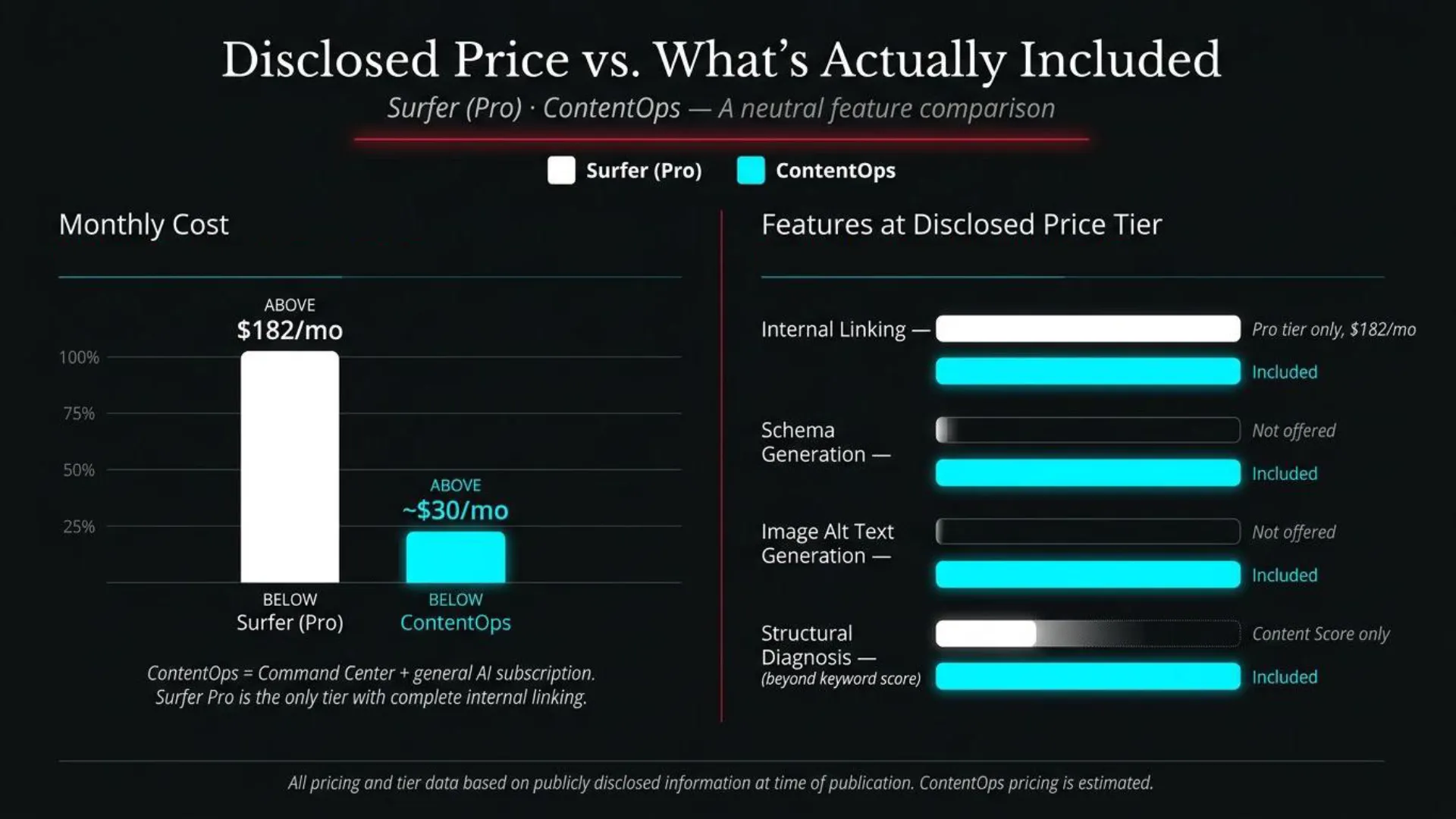
Surfer’s real tiers, billed yearly, monthly equivalent: Discovery at $49, Standard at $99, Pro at $182, Peace of Mind at $299, Enterprise at $999. The honest comparison isn’t the $49 entry tier. It’s Pro, the only plan with the internal linking feature actually described in Surfer’s own tutorials, $182 a month, nearly four times the entry price.
ContentOps isn’t competing as a content generator. It’s the interface layer that helps you operate an AI at every stage, before writing, during, and after. The real comparable number is ContentOps plus a general-purpose AI subscription, roughly $30 a month combined, against Surfer’s $182 Pro tier for the version of the tool that actually does what the marketing implies.
The Broader SEO Tool Stack Required and its Cost
If you’ve spent any time looking at marketing setups, you’ve likely seen creators showing off “Tool Overlord” stacks that easily run $100 to $500 a month in recurring subscriptions. While this guide compares single-page optimization metrics head-to-head, software is only one piece of a complete marketing budget.
If you want to see how total execution costs compare across full agency retainers ($1,500–$3,500/mo), bloated DIY tool stacks, and flat-rate platforms, see our complete breakdown on How Much Does SEO Cost for a Small Business?
Two Tiers of Linking, and Why the Lower One Isn’t Enough
| Basic Linking (legacy) | Semantic Linking | ContentOps | |
|---|---|---|---|
| Plan required | Pro and up | Pro and up | Included |
| Setup required | GSC connected | GSC + active Content Audit project | None |
| Matching method | Single keyword or URL | Semantic, still one phrase per link | Multi-synonym anchor arrays plus AI inference |
Topical Map, Theirs and Ours
Surfer has a real feature called Topical Map. Worth being precise this isn’t the same thing ContentOps means by the term. Surfer’s version pulls from your Google Search Console data and existing content to cluster keywords and surface content gaps, genuinely useful, and worth using.
It’s a keyword-planning tool, Step 0A. Wherever you actually source your keywords, Surfer, Semrush, Answer The Public, your own inference, ContentOps is Step 0B. It doesn’t discover keywords at all. It holds the data layers, node by node, in a persistent state that updates every time you publish something new. Different jobs, run in sequence, not competing for the same leg of the race.
Beyond Automation: Why a Human-in-the-Loop AI Partner Wins
Some of this is worth saying plainly. ContentOps doesn’t compete by trying to do more automatically.
It’s strong in a different way. It’s a human-in-the-loop workflow, you and the AI working in symbiosis, not the AI working alone while you approve or reject what comes back. You spar with the AI, back and forth, and ContentOps’ job is providing the context injections, the brief, the map, the anchor text array, that keep that back-and-forth grounded instead of drifting. The hero of the process is still you. The tools researched in this series are all built to hand you a finished output faster. ContentOps is built to make you a better operator of whichever AI you already use – it fixes your relationship with AI.
If you love that spark you felt the first time you strategized and sparred with an AI that you painstakingly grounded to know your business intimately, ContentOps is for you. The Topical Map instantly grounds your AI, giving you a strategic partner, a strategic writer, and an auditor that sees the whole field. The other features are there to give you a fully optimized end-product at the finish line.
The Force Multiplier, ContentOps’ Answer to a Generic Score
Mission 1’s scoring doesn’t measure keyword presence, it weights structural elements by how much they actually change machine legibility. See the below table to better understand how AI actually scores content:
| Fix | Multiplier |
|---|---|
| Fixing a visibility-hiding pathogen | Infinite, zero to one visibility |
| H1 identity declaration | 100x |
| Each H2 with real semantic markers | 50x |
| Anchor text weld | 40x |
| Didactic alt text | 30x |
| Each H3 carrying real information gain | 25x |
| Structural pacing, H2/H3 depth | 25x |
| First 100 words, direct answer | 10x |
| Each semantic H4 | 10x |
These coefficients are qualitative weightings based on the ContentOps Sovereign Search Framework. They visualize the relative value of structural landmarks in machine-readable code and do not represent proprietary search engine ranking algorithms.
FAQ
Does Surfer generate schema markup?
No, confirmed against Surfer’s own blog and pricing pages, neither mentions it. Surfer is a content optimization and scoring tool, not a structured data generator.
Why does Surfer’s Content Score reward adding keywords?
Because it’s measuring similarity to what’s already ranking, keyword density and NLP term coverage against the top results. Surfer’s own guide admits chasing a perfect score can make writing worse, which is the same critique this comparison makes, just stated in Surfer’s own words.
What plan do I need for internal linking?
Pro and up, $182 a month billed yearly, confirmed directly against Surfer’s own documentation. Discovery and Standard don’t include it, regardless of what a tutorial video not naming the tier requirement might imply.
Is Surfer’s Topical Map the same as ContentOps’ Topical Map?
No. Surfer’s is a keyword-planning and clustering tool. ContentOps’ is a persistent data layer holding structure, schema, and relationships for every published node. Different jobs, not competing features.
How does ContentOps prevent score-chasing compared to Surfer’s Content Score?
Surfer’s Content Score measures term frequency similarity against top SERP competitors, feeding the Race to the Mean—or the homogenization of web copy. ContentOps uses the qualitative Force Multiplier Matrix to score structural headings, anchor text alignment, and code-level machine legibility.
How does ContentOps handle internal linking compared to Surfer’s Pro tier?
Surfer gates its internal linking feature behind its $182/mo Pro tier. ContentOps includes the Switchboard Protocol—a structured linking method—at every level, using Anchor Text Options and AI inference to turn Island Nodes (orphaned posts) into an unbroken Spartan Phalanx (interlinked authority cluster).
Does ContentOps generate schema markup?
Yes. ContentOps generates both node-level schema and site-wide DefinedTermSet schema circuits from the topical map graph with a single click, whereas Surfer provides no native schema generation.
Does ContentOps write the draft for me?
No. ContentOps is the Power Suit—a suite of context-engineering tools—for whichever LLM you already use, fixing your relationship with AI while keeping the Experiential Expert’s Human Spark in the loop.
Who This Comparison Is Actually For
This page is scoped to content infrastructure specifically, structure, connectedness, and grounding, not enterprise content operations at scale. If you’re managing dozens of brand workspaces or need Surfer’s AI visibility tracking across hundreds of tracked pages, that’s a real strength of theirs this comparison doesn’t try to replace.
Where this comparison is sharpest is for a solo operator or small business that needs real content architecture, not just a better score, especially where credentials, licensing, and structural trust actually matter to who finds you. That’s most concrete in appointment-based, regulated practices, dentists, chiropractors, orthodontists, veterinarians, physicians, where a keyword score can’t encode a credential stack or the connected structure that makes a page findable and citable in the first place.
See how this plays out for your specific field on the ContentOps for Local Service Businesses hub, or browse the full range of professions this applies to in our library of ContentOps use cases for professionals.
More AI Content Writing System Comparisons
This comparison is one of several applying the same six-axis paradigm to a real, named competitor. See the full framework, or find the tool you’re actually deciding between.
Comparison
Frase Alternative
The strongest publishing found, still per-document schema. Read the comparison
Comparison
Copy.ai Alternative
A real GTM platform whose own SEO advice fails its own audit. Read the comparison
Audit Your Own Content Infrastructure
Run the free HTML Audit, or try SlideShift on a handful of images before comparing anything else.