
Common Problems with AI Content Writer Tools: Why My First AI Writer Is Still an Unpublished Draft
A few years ago I ran a blog post through an AI writing tool off AppSumo, called WP Autoblog. That draft is still sitting unpublished in my WordPress right now, today. It’s a small, real case study in the actual, recurring problems with this category of tool, not just one bad experience.
I was testing tools. This was before ContentOps existed, back when I was still running my English learning site and trying to figure out what all these AI writing and SEO tools actually did. WP Autoblog was one of them, a free trial off AppSumo, feed it a topic and some keywords and it writes the post. I ran one piece through it, on sentence structure, and I never published what came back.
It’s still there. I just logged into that WordPress install and checked, the post is called “Improving Your Sentence Structure,” sitting exactly where I left it. It’s a genuinely useful example, because it doesn’t just have one problem. It has most of the problems this whole category of tool tends to have.
Problem One: It Read Like the Average of the Internet
The first reason is the obvious one. The draft was competent and generic as it contained simple sentences, compound sentences, complex sentences, independent and dependent clauses, a few examples, and a wrap-up. There was nothing wrong with any individual sentence in it. It just read like the average of the Internet, because that’s exactly what it was, the statistical middle of everything already written about the topic, with nothing in it that was actually mine.
What This Actually Is: The Information Gain Problem
There’s a name for this, and it’s worth using directly. Information gain is whatever a piece of content adds that wasn’t already sitting somewhere else on the internet. An AI writer trained to synthesize what already ranks well is structurally incapable of producing it, because information gain is exactly the thing that isn’t in the training data yet. It can only give you back what’s already there, smoothed into an average. If you have real expertise, that’s the one thing the tool can never give you, because it doesn’t know it exists until you tell it. This is the core distinction between simple prompt engineering and the more robust practice of context engineering.
This Information Gain problem isn’t just theoretical; it creates a practical workflow bottleneck. Instead of fighting to inject your expertise into a generic draft, the solution is a system designed to start with your expertise and use AI to accelerate it.
Problem Two: The Real One, a Cost Problem, Not a Quality Problem
The second reason is the one that actually matters, and it took me longer to see clearly. I wasn’t just testing software out of curiosity. I had a real goal to speed up the content marketing plan for my book, English Grammar Explained, by getting blog posts out fast enough to actually compete for search traffic on the topic. WP Autoblog, which is still live on AppSumo today for $39.99 on a lifetime deal if you want to check for yourself, seemed like a reasonable way to do that.
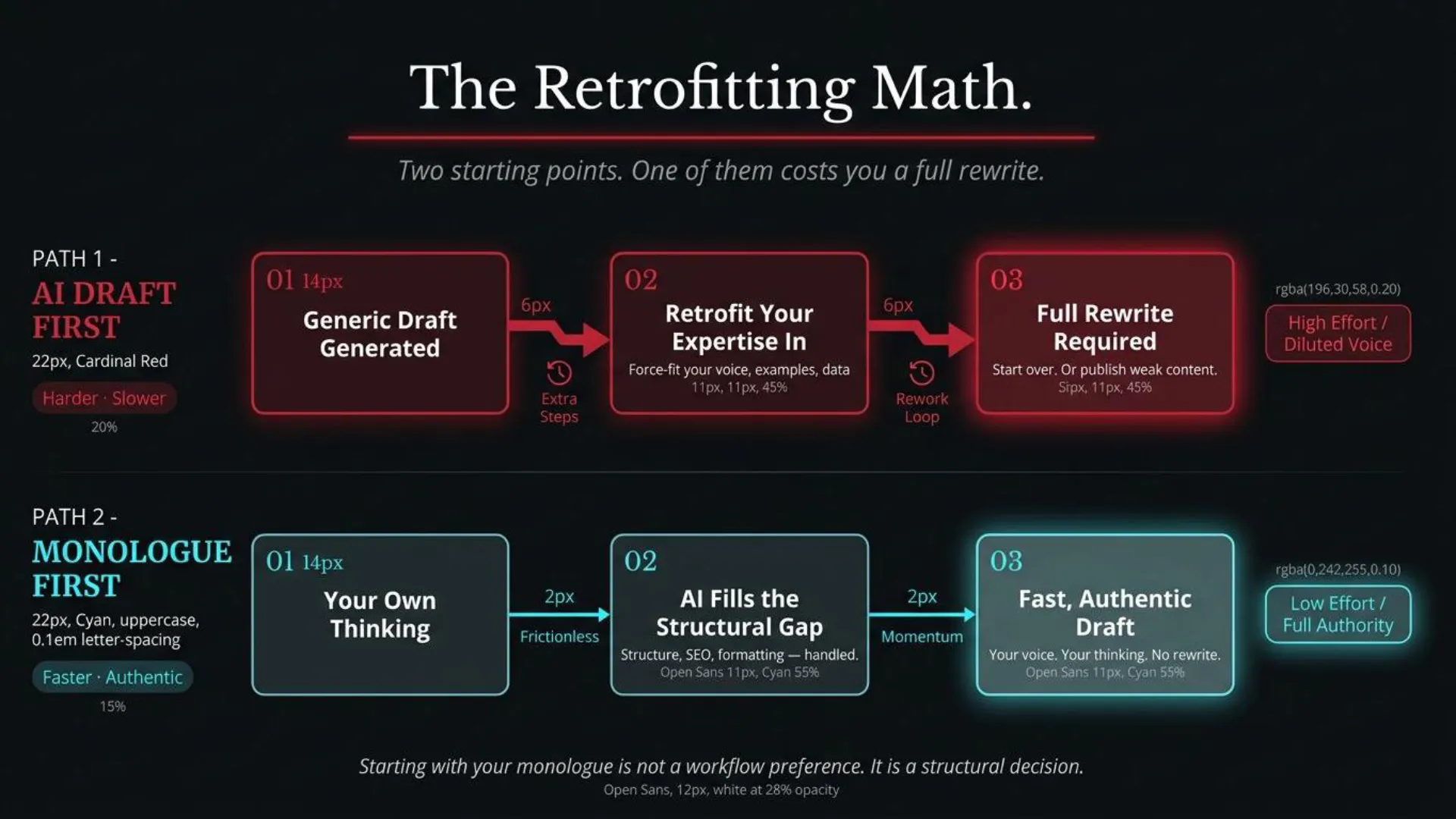
Here’s what actually happened. The tool had no knowledge of my book, my teaching methodology, or anything I’d actually developed. It gave me the statistical average of everything already written about sentence structure, a draft that might hit a word count and pass a checklist, but carried none of the specific expertise that was supposed to be the whole competitive advantage of the plan in the first place. Competing on the Internet with generic content isn’t really competing at all, and fixing that after the fact meant reintroducing everything the tool had no way to include, my angle, my teaching points, my actual voice. That’s not editing. That’s a rewrite.
The Retrofitting Math Nobody Talks About
So instead of speeding up my content plan, it would have slowed it down. If a tool hands you something 70 to 80 percent finished in someone else’s voice, and you have real expertise you want in there instead, you’re not editing anymore, you’re bending your own argument into a shape built for a different argument. That’s harder than writing from nothing, because now you’re fighting the existing structure at the same time you’re trying to say what you actually think. This is the actual reason ContentOps starts every piece with a monologue instead of an outline. Getting your own thoughts out first isn’t a creativity exercise, it’s the cheaper path.
What the Draft Actually Got Wrong, Specifically
I went back and reread it properly for this piece, and the gap is worth showing directly, not just describing.
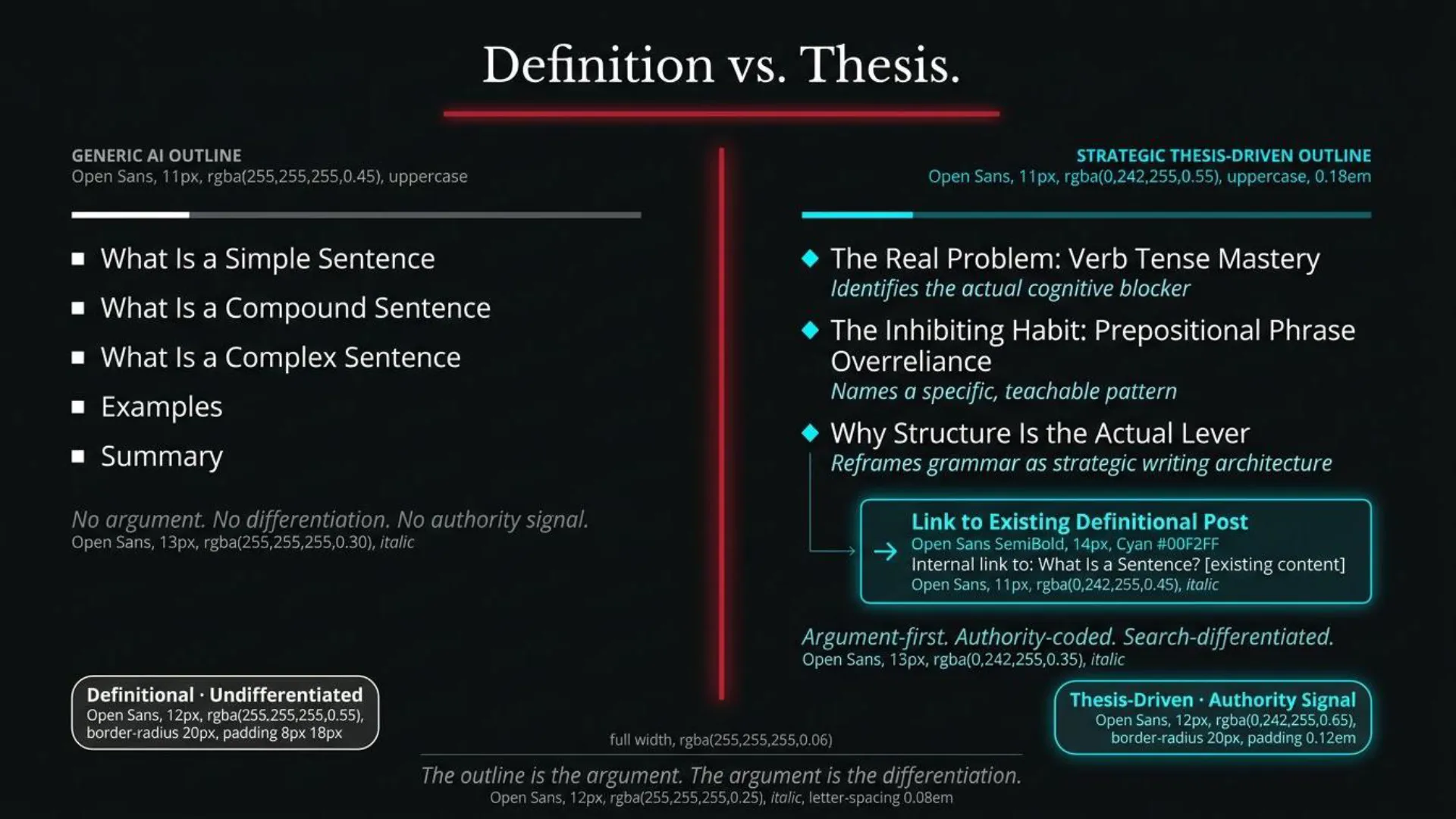
The draft gave me a definitional structure, here’s what a simple sentence is, here’s what a compound sentence is, here’s what a complex sentence is, with a few examples of each. As an EFL teacher, that’s not the piece I would have written, and it’s not the piece that post actually needed. I already have a separate post on my site covering compound and complex sentence definitions.
The Redundancy Problem: No Memory of What You’ve Already Published
The tool had no way to know that other post existed. It just started from zero and wrote another one, which means half of what it produced was redundant with something I’d already published. This isn’t a one-off oversight, it’s structural. A tool that generates one page at a time, with no visibility into your existing content, has no way to avoid duplicating work you’ve already done. What I actually have is a thesis, not a definition: improving sentence structure is the real lever for improving verb tense mastery, and the specific mechanism behind that is something I call an inhibiting habit, where over-reliance on prepositional phrases lets a learner avoid ever needing to master tenses properly in the first place.
My Actual Thesis: Advice, Not Just Definitions
The piece this post actually needs is advice, not definition, pointing a reader to the existing definitional post if they need it, and spending its own words on the thesis instead.
The Definition Problem is Everywhere You Look
Everywhere you look on the Internet, you see this same problem. You searched for informational content on a concept or a how-to guide like “How to do internal linking better for seo,” and the post starts with a first H2 header like, “What are Internal Links.”
You obviously know what an internal link is at this point, so you skip past that filler text to what you’re actually looking for. It’s this kind of formulaic writing that turns people off due to mismatched intent. Generic AI writing tools are often guilty of this precisely because they’re disconnected from anything you may have written in the past about your subject.
The Image Problem: Decoration Without Context
This is one most people don’t think about until they’ve published a few dozen posts and realized none of the images are actually doing anything.
Free Stock Photos Are Just Decoration
Most tools in this category, including auto-blogging tools like this one, pull one to three images from a free stock source, Pixabay, Pexels, something similar. They’re real, licensed, perfectly fine images. They’re also almost always generic, a stock photo of someone typing, a stock photo of an open book, dropped in because a post needs some visual break, not because the image teaches the reader anything specific about what’s being discussed.
And Nobody Writes the Alt Text Either
Even when an image gets pulled in, the alt text problem doesn’t solve itself. Either it’s left blank, or it gets a generic, literal description that just names what’s in the photo, “person writing on paper,” with nothing connecting it to the actual content around it. That’s a missed opportunity twice over, once for accessibility, once for the didactic, context-rich alt text that actually tells a crawler what the page is teaching. A decorative image with generic alt text is worse than no image at all, it takes up space without doing any of the work an image could be doing.

Problem Three: The Systemic Flaw of “Best Practice” Averages
The specific tool doesn’t matter as much as the mechanism, and the mechanism shows up in more credible, more expensive places too. Structured content platforms that build your outline from what’s already ranking in the top ten search results are doing the same thing, just dressed up as SEO best practice instead of a shortcut tool. You still get someone else’s average handed to you as a starting point, and you still pay the cost of bending your own argument to fit inside it.
The Connectedness Problem
This one shows up across nearly every tool in this category, not just auto-blogging tools specifically. A single-page generator has no concept of your site as a whole. It doesn’t know what you’ve published, doesn’t know how a new post should link to your existing work, and doesn’t know where the gaps in your own content actually are. This creates a topical map blind spot—every post comes out as an island, technically live, structurally disconnected from everything else you’ve written. This is a problem that can only be solved with a deliberate semantic internal linking strategy.
Where This Actually Doesn’t Apply
Worth being honest about the limits of this too. If you’re writing something genuinely definitional, a straightforward grammar explainer, or targeting an easy, low-competition keyword where you’re not trying to say anything new, competitor-average content is a perfectly reasonable fit. Not everything needs a thesis. This critique is about the pieces where you actually have something to say, and the tool quietly prevents you from saying it efficiently.
The Solution: Context Injection Over Content Generation
This frustration predates ContentOps. The context injection system above is what came out of it.
If you want to see this argument made in full, against two real, named tools, the full AI content system comparison walks through it stage by stage.
FAQ
Why are AI content writers often generic?
They synthesize the statistical average of existing top-ranking SERP content, resulting in a Race to the Mean—or homogenized web copy—without unique Information Gain.
What is the “retrofitting tax” when using AI writers?
The time and effort wasted trying to bend generic AI drafts to fit your personal voice, methodology, and expertise, which takes longer than drafting from scratch.
How do generic AI writers handle existing site content?
Single-page generators lack site-wide visibility, causing them to write redundant definitional content for topics you’ve already published.
Why are stock photos and generic alt text an SEO problem?
They act as decorative clutter rather than Didactic Alt Text—teaching metadata embedded in images that crawlers use to evaluate context.
How does ContentOps avoid the AI retrofitting tax?
ContentOps starts with a monologue-first workflow, capturing your unscripted expertise first and using AI to fill structural gaps rather than imposing generic outlines.
How does ContentOps prevent redundant definitional content?
By grounding your writing in a JSON Topical Map—a persistent data layer holding every published node’s context and internal link DNA.
What is Didactic Alt Text in ContentOps?
Metadata generated by SlideShift that explains the teaching diagram or workflow argument to machine crawlers rather than providing a simple accessibility description.
Does ContentOps replace my choice of AI writer?
No. ContentOps is the Power Suit—a suite of context-engineering tools—for whichever LLM you already use, fixing your relationship with AI while keeping the Experiential Expert’s Human Spark in the loop.
See What Your Own Site Actually Looks Like
Run the free HTML Audit, or try SlideShift on a handful of images before comparing anything else.