
How does AI Score Website Content | The Force Multiplier of Semantic Hierarchy
AI doesn’t read your content the way a person does. It reads structure first, prose second. This is the actual mechanism behind that, the same weighting system used inside ContentOps’ own Mission 1 diagnostic, and why a keyword-density score from most writing tools measures the wrong thing entirely.
Why a Score Isn’t the Same as Understanding
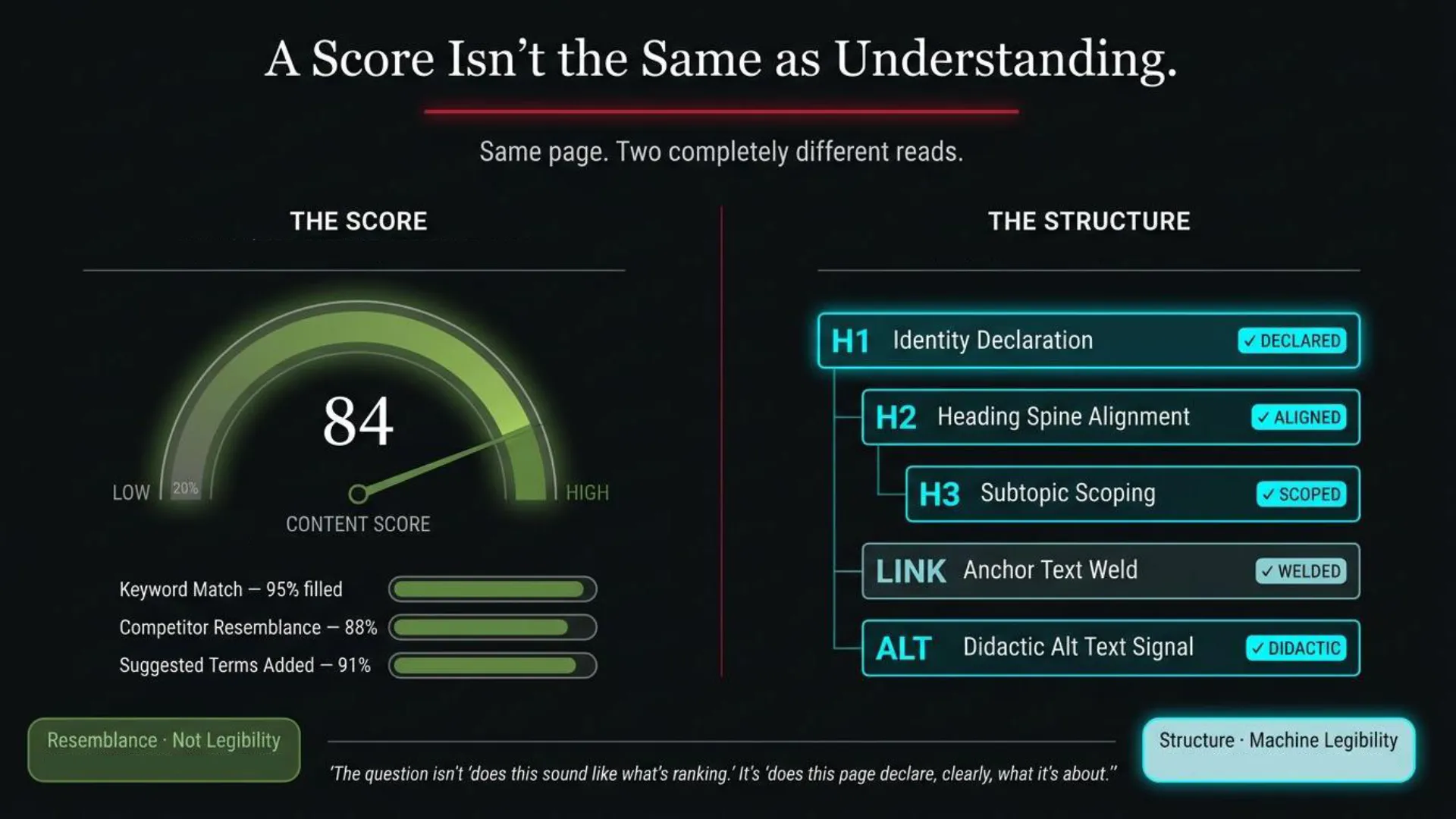
Surfer’s Content Score rewards inserting suggested keywords with a single click, confirmed directly through hands-on testing, not a hypothetical.
Frase scored a real draft at 84 overall and suggested adding a pricing table because four of five top-ranking competitors happened to have one—optimization by resemblance, not by argument.
NeuronWriter’s NLP terms panel is closer to a menu than a diagnostic: click a suggested phrase, watch the score climb.
Jasper’s Optimization Agent is more specific than most, scoring against Google’s Search Quality Rater Guidelines across nine categories, but even that measures content quality broadly, not the structural signals a crawler or an AI answer engine actually parses first.
None of these are wrong to build. They’re answering a different question than the one that actually determines whether a machine can understand your page. That question isn’t “does this sound like what’s already ranking.” It’s “does this page’s structure declare, clearly and unambiguously, what it’s about, and where the answer lives,” making the content genuinely machine-readable.
The Force Multiplier Matrix
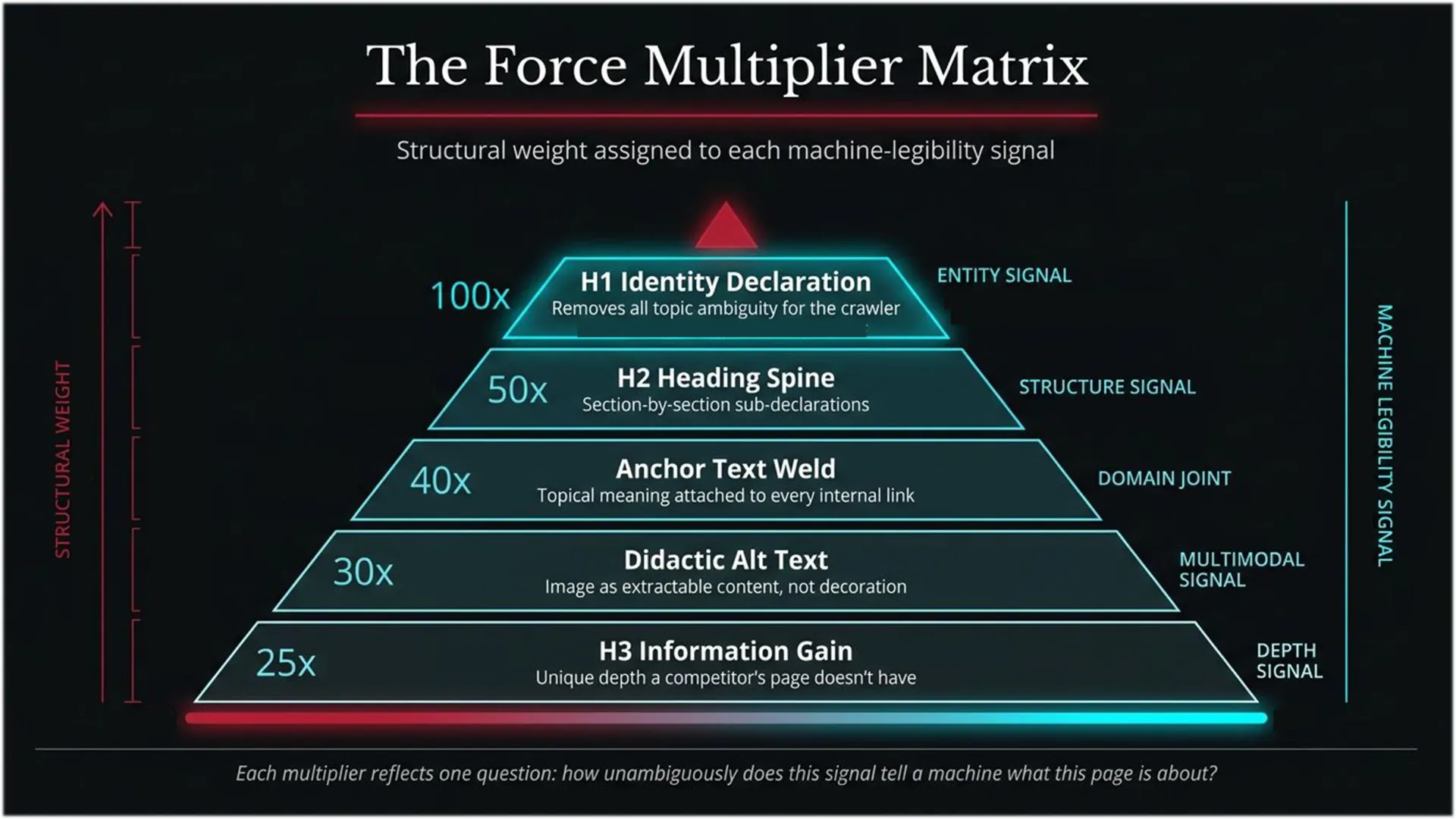
This is the actual weighting system ContentOps’ Mission 1 Diagnostic runs against every page audited. Not keyword presence, but structural signal strength—how much a given fix actually changes what a machine can confidently extract from your page.
| Fix | Multiplier |
|---|---|
| Fixing a visibility-hiding pathogen | Infinite, zero to one visibility |
| H1 identity declaration | 100x |
| Each H2 with real semantic markers | 50x |
| Anchor text weld | 40x |
| Didactic alt text | 30x |
| Each H3 carrying real information gain | 25x |
| Structural pacing, H2/H3 depth | 25x |
| First 100 words, direct answer | 10x |
| Each semantic H4 | 10x |
These coefficients are qualitative weightings based on the ContentOps Sovereign Search Framework. They visualize the relative value of structural landmarks in machine-readable code and do not represent proprietary search engine ranking algorithms.
Why Each Weight Is Calibrated This Way
This is the part most scoring tools never explain. Here’s the actual reasoning behind each tier, pulled directly from Mission 1’s diagnostic logic.
H1, 100x: Declaring the Entity vs. Guessing
Your H1 is the single strongest signal on the page for what the page is actually about. A machine reading a page with no H1, or a vague one, has to infer the topic from scattered context, guessing instead of being told. A clear H1 removes the guesswork entirely, which is why it carries more weight than almost anything else on the page.
H2s, 50x: Heading-Level Entity Clarity
Each H2 is a sub-declaration, a promise about what that section actually covers. A vague H2, something generic like “More Information,” gives a crawler nothing to work with. A specific, semantically direct H2 tells the machine exactly what’s coming next, section by section, without it needing to read every sentence to find out.
H3s, 25x: Depth Plus Unique Gain Under the Spine
H3s carry less structural weight than H2s on their own, but they’re where information gain actually lives—the specific example, the named mechanism, the detail a competitor’s page doesn’t have. An H3 that just restates the H2 above it in different words adds structure without adding substance. One that introduces something genuinely new earns its place in the spine.
Anchor Text Welds, 40x: Joining Domain Joints
An internal link with generic anchor text (“click here,” “read more”) tells a crawler nothing about the destination. A specific, descriptive anchor welds two pages together with real topical meaning attached, strengthening both the page linking out and the page being linked to. This is the mechanism the anchor text arrays across this whole project are built around.
Didactic Alt Text, 30x: The Multimodal Signal
Most alt text describes what’s visually in an image (“person at a desk”). SlideShift’s Didactic Alt Text explains what the image is teaching, tied to the page’s actual argument. That distinction is worth real weight because it’s the difference between an image that’s decoration and one that’s a genuine, extractable piece of content in its own right.
What This Looks Like Applied
A vague H2 like “Our Approach” carries almost no signal on its own. Rewritten as “The Force Multiplier: How Structural Position Changes Machine Legibility,” the same section now declares its actual subject before a crawler reads a single sentence beneath it. Nothing about the underlying content changed—the structure now tells the machine what used to require inference.
FAQ
How do AI tools actually evaluate content quality?
Most evaluate similarity, term coverage and keyword density against pages already ranking for the same query. That’s a measure of resemblance, not a measure of whether a machine can actually extract clear meaning from your page’s structure.
What algorithms does AI use to score content?
There’s no single universal algorithm, different tools score differently. But the mechanism that actually matters for AI answer engines specifically is structural: heading hierarchy, anchor text specificity, and alt text depth, weighted far more heavily than raw keyword frequency.
Why does keyword density matter less than it used to?
Because keyword density was always a proxy—evidence a page was probably about a topic, not proof the page explained it clearly. AI answer engines can now check structural clarity directly, which makes the old proxy far less useful than it once was.
What is the Force Multiplier in ContentOps?
The Force Multiplier Matrix—a qualitative scoring framework—weights structural landmarks (H1 identity, H2/H3 spine, anchor text welds, didactic alt text) by how much they change machine legibility.
Why is an H1 identity declaration weighted at 100x?
The H1 is the primary identity signal on the page. A clear H1 eliminates topic ambiguity immediately, saving machine compute time compared to inferring meaning from body text.
What is the difference between literal and Didactic Alt Text?
Literal alt text describes visual contents (“man at desk”). Didactic Alt Text—teaching metadata generated via SlideShift—explains the underlying architectural argument or lesson directly to machine crawlers.
How do anchor text welds affect domain authority?
Generic anchors (“click here”) pass zero context. Descriptive anchor text welds join two pages with explicit topical meaning, reinforcing both the source and target node in the map graph.
Does the Force Multiplier represent Google’s ranking algorithm?
No. The Force Multiplier coefficients are qualitative weightings based on the ContentOps Sovereign Search Framework, visualizing the relative value of structural landmarks in machine-readable code.
See This Applied Against Real Tools
Every comparison in this cluster uses this exact weighting system as its counter-argument to a generic content score.
Jasper Alternative
See how Jasper’s Optimization Agent compares to the Force Multiplier.
Surfer SEO Alternative
Contrast Surfer’s Content Score with structural machine legibility.
Frase Alternative
Compare Frase’s competitor-resemblance score to the Force Multiplier.
NeuronWriter Alternative
Contrast NeuronWriter’s NLP term menus with heading spine alignment.
See What Your Own Content Actually Scores
Run the free HTML Audit and see the Force Multiplier applied to a real page, not a hypothetical one.