
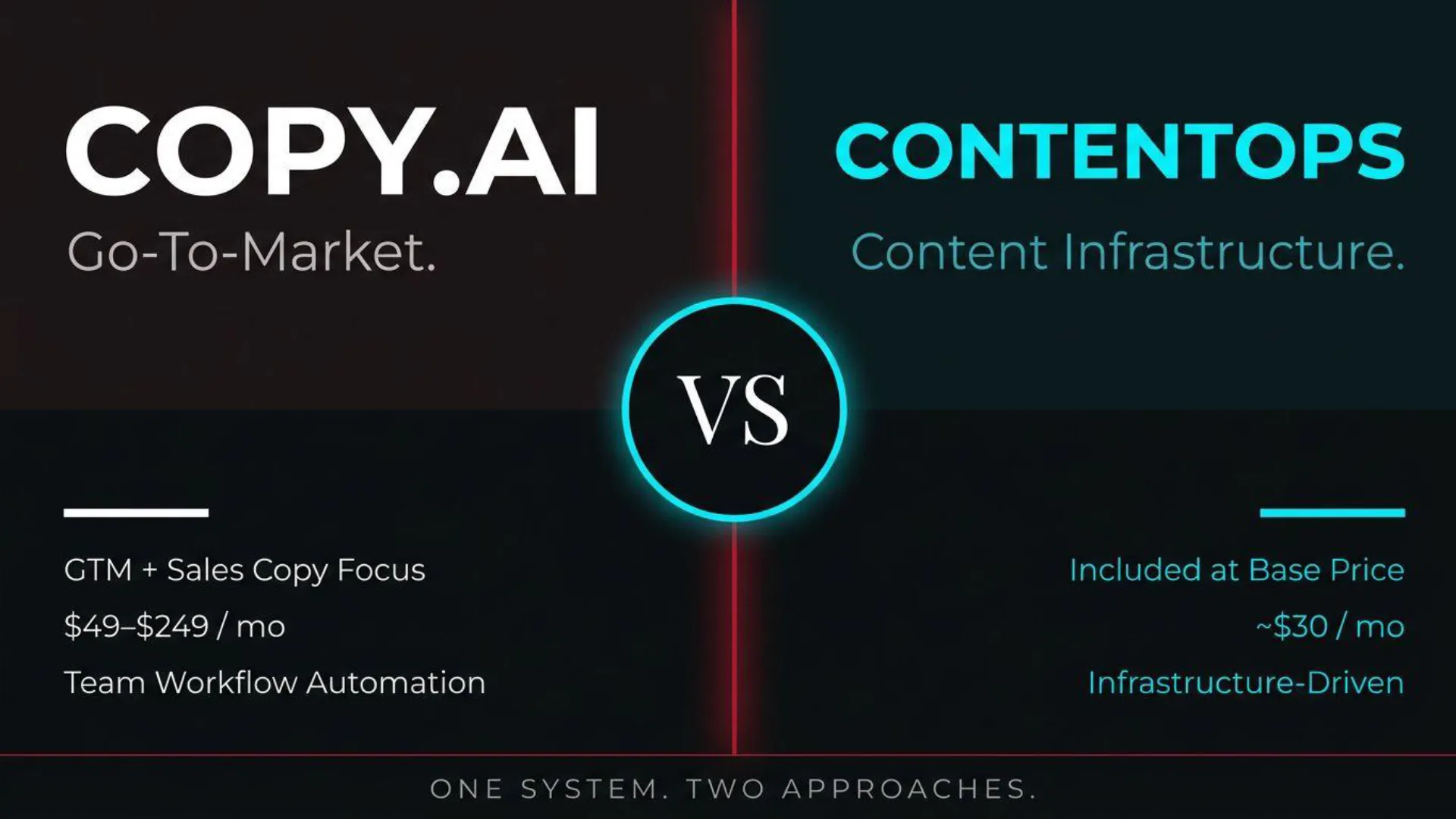
Copy.ai Alternative for Content Infrastructure, Not a Go-To-Market Platform
Copy.ai is a real, capable go-to-market platform, model-agnostic, workflow-driven, and built for far more than blog posts. We even ran its own SEO advice through our Audit Suite and found the same structural problems it tells its readers to avoid. Here’s what each stage of actually producing content looks like on both, side by side.
What Copy.ai Actually Does Well
Worth crediting before anything else. Copy.ai is genuinely LLM-agnostic, OpenAI, Anthropic, Gemini, and Perplexity all usable inside one interface, a real differentiator none of the other tools in this comparison series offer. Infobase, its centralized knowledge repository, is a real, working concept, not marketing language for a single feature. And its transcript-to-content workflow is explicitly built around converting a raw sales call or spoken recording into a polished draft, a genuine philosophical overlap with how ContentOps starts every piece, worth naming directly rather than treating as a coincidence.
We Audited Copy.ai’s Own SEO Advice Post
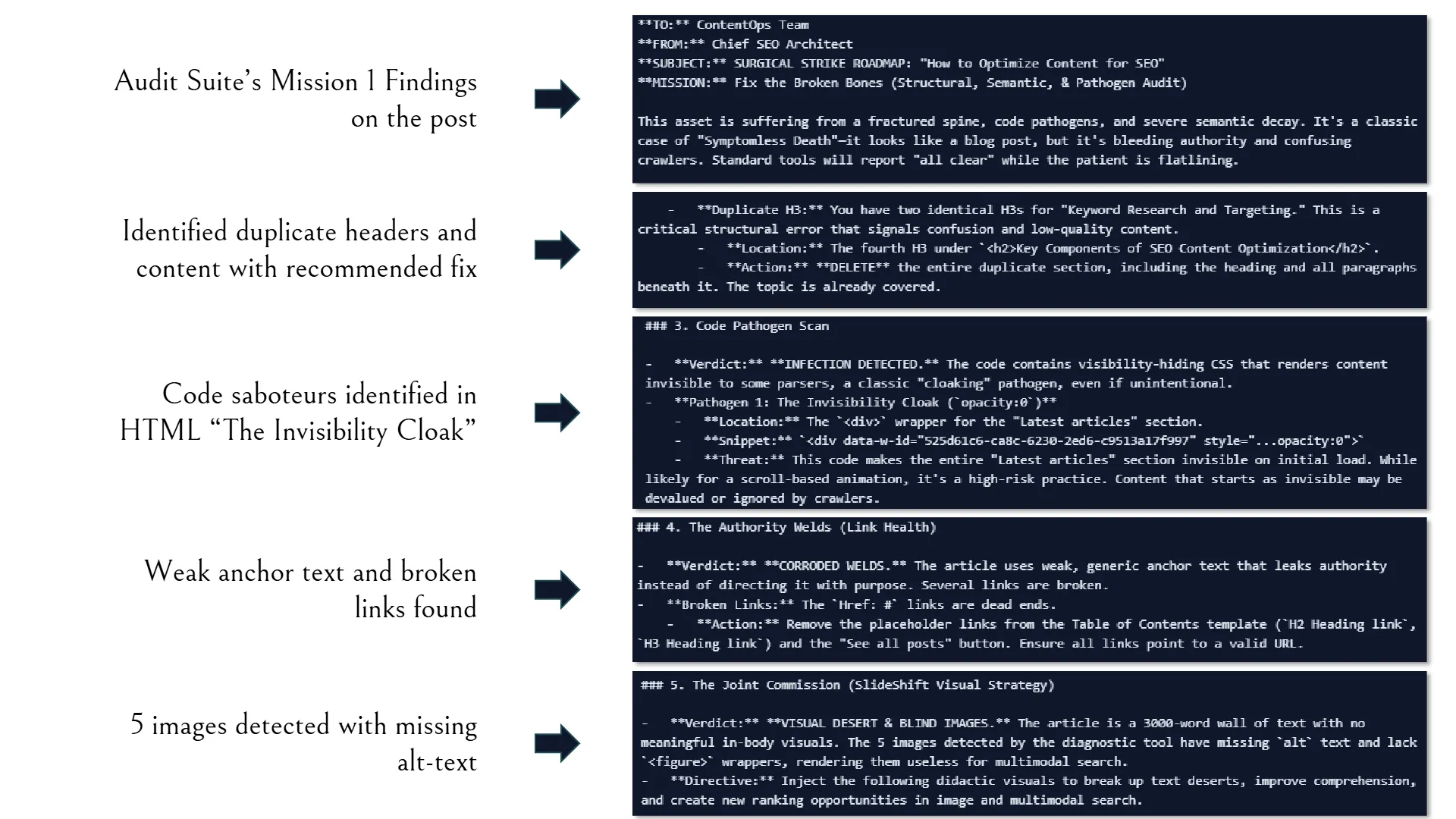
Copy.ai publishes a flagship post titled “How to Optimize Content for SEO.” We ran it through ContentOps’ own Mission 1 diagnostic. The results are worth reading in full, since a post instructing readers on content optimization doesn’t itself follow the structure it’s teaching.
The author’s name is marked up as an H4, directly under the H1, breaking the semantic spine before the article’s actual argument even begins. A section titled “Keyword Research and Targeting” appears as an H3 twice, in two separate sections of the same post, confirmed live on the page, not just flagged by the tool. Two boilerplate headings, “Latest Articles” and “Ready to Level Up?”, sit inside the same heading hierarchy as the real content, template clutter a crawler can’t distinguish from the article’s actual argument. The page is built in Webflow and shows severe div soup, content buried under unnecessary container layers. And all five images on the page are missing alt text entirely, none of them wrapped in a <figure> tag.
Worth crediting fairly too: the post does include two real case studies, Canva and HubSpot, plus an actual named expert interview with Chris Walker, a genuine attempt at differentiation. The Mission 1 brief itself calls this a partial pass, real effort, but the core advice still stays generic enough that a competitor could scrape and replicate it in minutes.
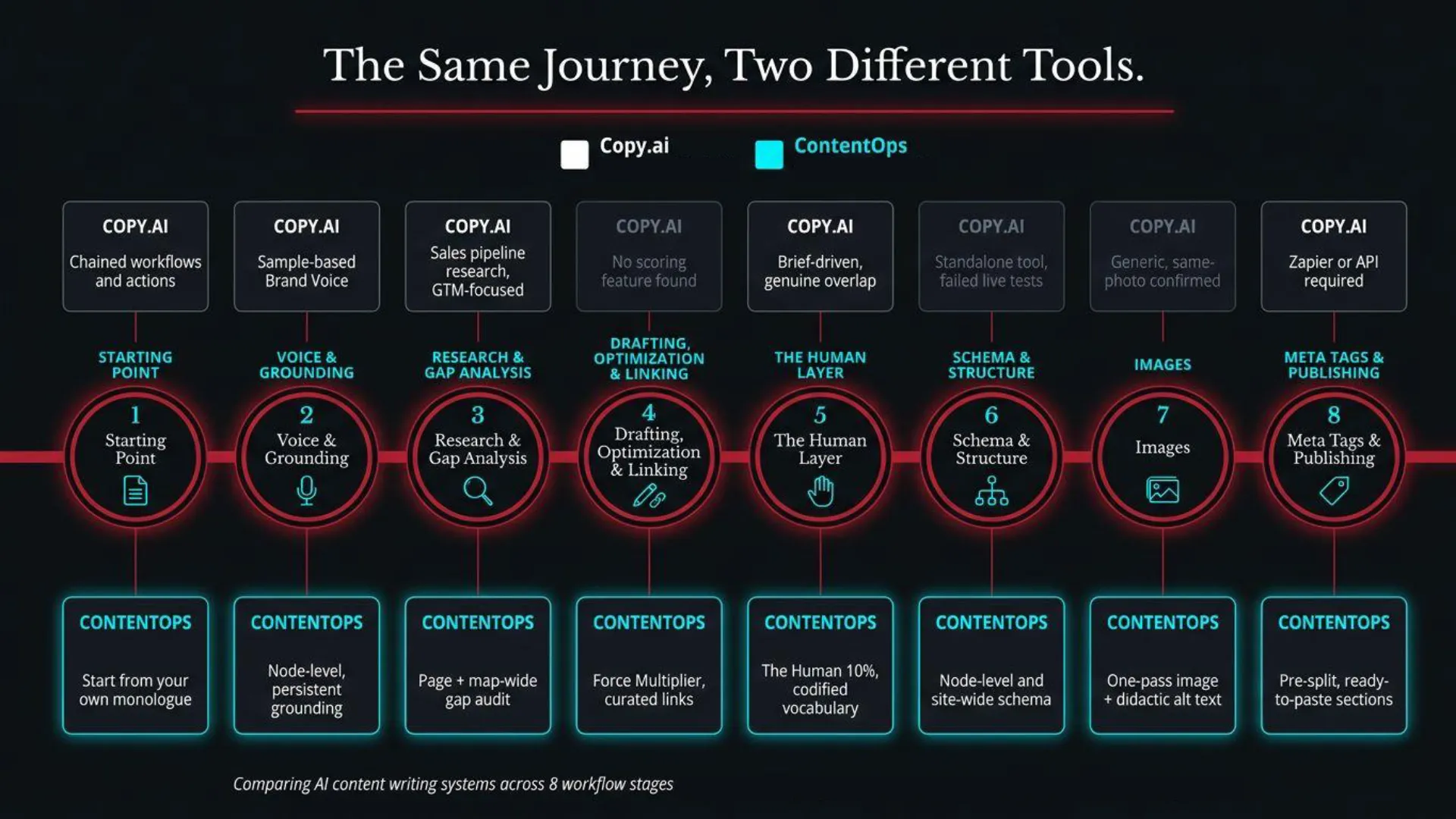
Copy.ai vs. ContentOps: An 8-Stage Workflow Comparison
Every content workflow runs through the same real stages, whichever tool you use. Here’s what each one looks like on Copy.ai versus ContentOps.
Stage 1: Starting Point
How Copy.ai Handles the Starting Point
Workflows and Actions chain modular AI steps together into a repeatable process, a real, structured starting point, genuinely more built out than most competitors researched in this cluster.
How ContentOps Handles the Starting Point
Content starts from a monologue, your own unscripted thoughts on the specific topic, filtered through your brand chat and codified into a Flash Injection that updates the map.
Stage 2: Voice and Context Grounding
How Copy.ai Handles Voice and Context Grounding
Brand Voice learns from pasted writing samples, the same document-level mechanism found on every tool in this comparison series. This is worth stating plainly rather than politely: a handful of sample documents cannot capture what a connected, node-by-node vocabulary can. Five tools in this cluster now make some version of the same claim, and all five rely on the same structurally limited method to deliver it.
How ContentOps Handles Voice and Context Grounding
Your voice and context grounding is encoded directly into the topical map. Each node contains a complete data payload, giving your AI writer unparalleled context:
- Core Identity: Title, Target Keyword, and URL
- Strategic Intent: Big Idea (your information gain or positioning notes) and Description (the premise and support)
- Semantic Vocabulary: A curated list of your brand’s preferred terms for that node
- Internal Linking DNA: Pre-approved Anchor Text Options for building connections
- Conversion Hooks: Core and Transitional Offers (lead magnets, tools, PLG assets)
- Publishing Package: A pre-built H1, SEO Title, and Meta Description
Each node is grounded individually from your own monologue, while the whole map still gives the AI the bigger picture and a path to your other content. Node-level grounding inside a connected system, not a handful of samples reused everywhere.
Stage 3: Research and Gap Analysis
How Copy.ai Handles Research and Gap Analysis
Prospecting Cockpit does real account and contact research, genuinely useful, but scoped toward sales pipeline and outreach, not topical or entity gap analysis for content.
How ContentOps Handles Research and Gap Analysis
Mission 4 scans your content or a competitor’s HTML for Shadow Concepts. The Global Map Audit adds a second layer, prioritizing gaps across your entire map, flagging what’s still sitting at idea or draft status.
Stage 4: Drafting, Optimization, and Internal Linking
How Copy.ai Handles Drafting, Optimization, and Internal Linking
No scoring feature was found through direct search of Copy.ai’s own site, worth stating precisely as an absence-not-found rather than a confirmed absence. Unlike Surfer or Frase, there’s no interactive editor grading a draft against a live score as you write. No internal linking mechanism was demonstrated anywhere either. What a real diagnostic actually looks like where Copy.ai has none is visible in the audit above, Copy.ai’s own SEO advice post, run through Mission 1, surfacing a broken H4, a duplicate H3, and boilerplate headings baked into the content itself.
How ContentOps Handles Drafting, Optimization, and Internal Linking
One optimization phase, run against a single HTML-wrapped draft. Mission 1’s Fix-it Brief flags spine, anchor text, and alt text problems with a specific recommended fix for each, applied either manually or by prompting an AI chat with the brief and the draft together. Internal linking works the same way, breadcrumbs from the node’s anchor text arrays first, AI-inferred candidates second, both requiring a deliberate decision before anything gets applied.
Stage 5: The Human Layer
How Copy.ai Handles the Human Layer
Genuinely closer to ContentOps’ own pattern than most competitors researched. Copy.ai generates from a brief you provide, including a raw transcript, rather than an outline built from competitor SERPs. Worth crediting directly rather than manufacturing a contrast that isn’t really there: this stage is philosophically similar, the real gap is upstream and downstream of it, in how that brief gets grounded and how the resulting draft gets checked.
How ContentOps Handles the Human Layer
The Human 10% is monologue-first, and the resulting brief carries your codified brand vocabulary, semantic keywords, and anchor text options along with it, not just your raw instructions.
Stage 6: Schema and Structure
How Copy.ai Handles Schema and Structure
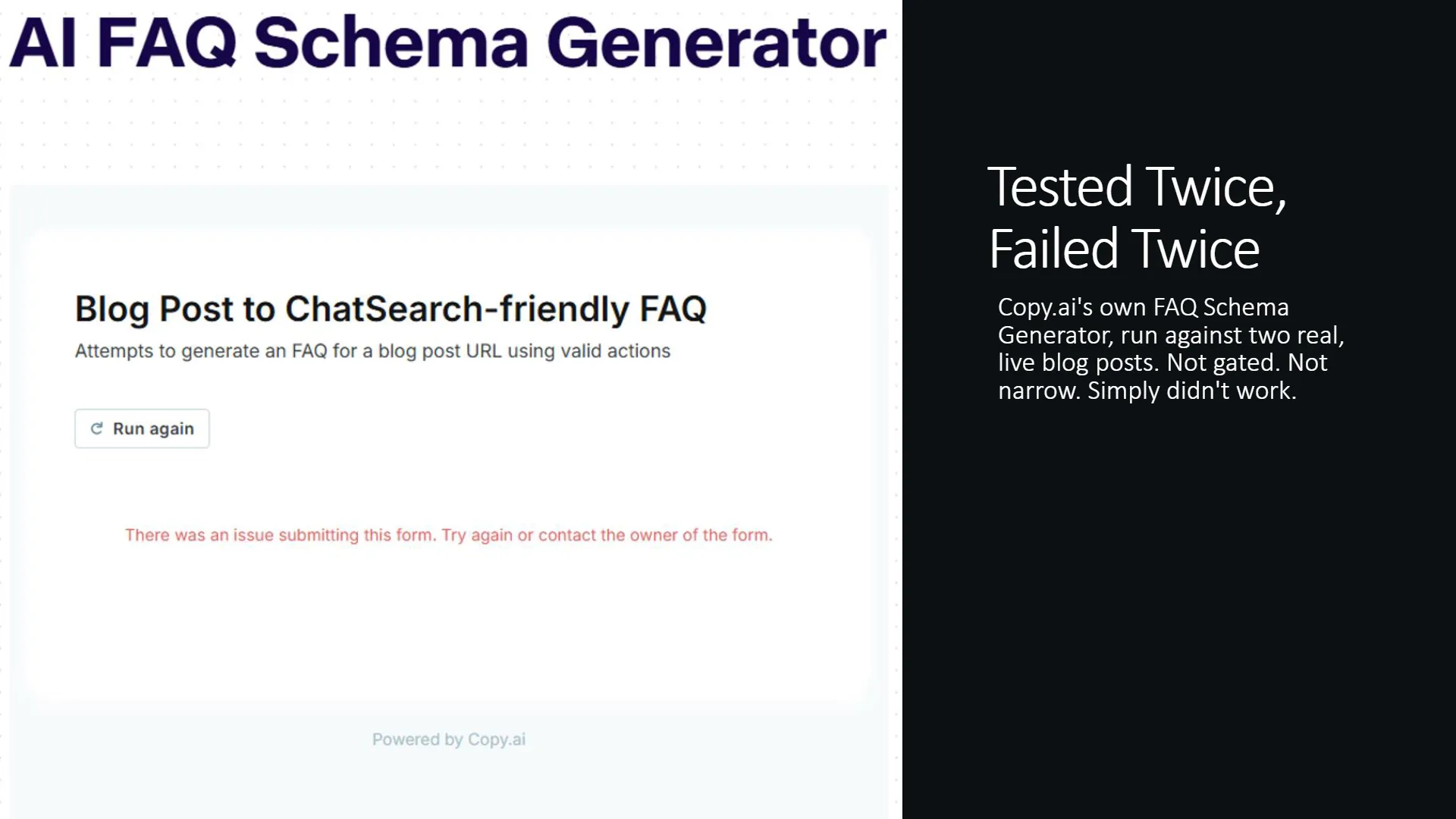
A standalone, free FAQ Schema Generator exists as a separate web tool, not integrated into the core app. Tested directly against two real, live blog posts, it failed both times, “There was an issue submitting this form,” confirmed by screenshot. Worth being precise: not gated, not narrow in scope, simply non-functional on the actual inputs tested.
How ContentOps Handles Schema and Structure
Schema comes from the map itself, at both the individual node level and the site-wide header level, encoding relationships between nodes, not just what’s written on a single page. Both generated with a single click.
Stage 7: Images
How Copy.ai Handles Images
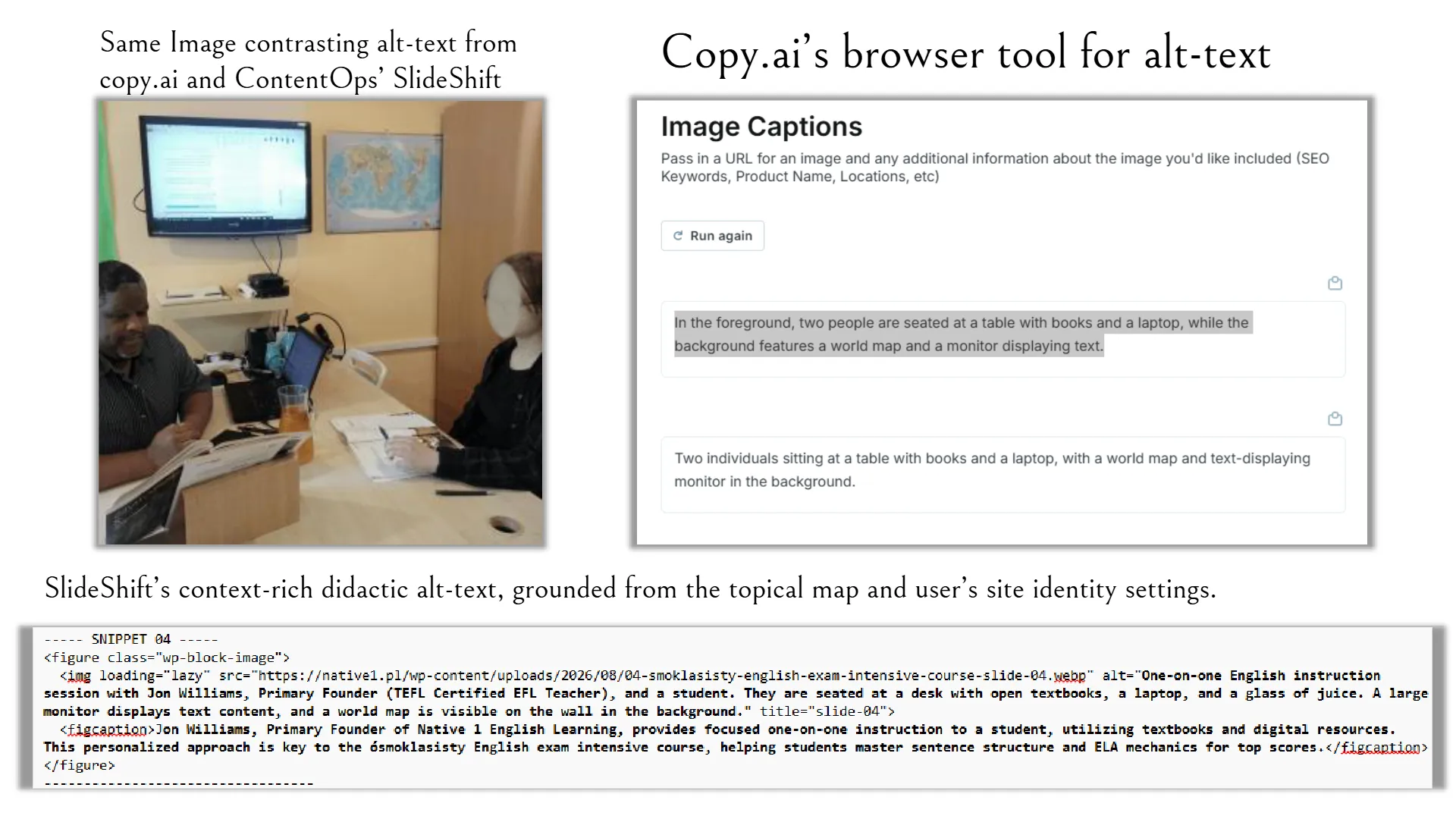
A real, working image-to-caption tool exists. We tested it directly against the exact same photograph already used in our own SlideShift comparison, a group photo from a real classroom in Mikołów. The result: “Two individuals sitting at a table with books and a laptop, with a world map and text-displaying monitor in the background.” Accurate. Entirely generic. Nothing about who’s in the photo, what’s being taught, or why the image matters to the page it sits on.
How ContentOps Handles Images
SlideShift processed the identical photograph and, grounded in the site’s own identity data, produced alt text naming the specific credential, program, and instructional context in the frame. Same image, same day, two different systems, one generic, one didactic.
Stage 8: Meta Tags and Publishing
How Copy.ai Handles Meta Tags and Publishing
No native one-click publish to WordPress. Publishing runs through Zapier, n8n, or a custom build against Copy.ai’s open API, genuinely closer to Jasper’s total absence of native CMS output than to Surfer or Frase’s built-in connections. If Zapier-style automation isn’t already part of your workflow, this is a real, added barrier, not a minor inconvenience.
How ContentOps Handles Meta Tags and Publishing
H1, SEO title, and meta description are generated as part of the node itself, character-counted, no separate step. The HTML Wrapper and Splitter turn a finished draft into pre-split, placeable sections before it reaches the editor at all.
Copy.ai Pricing: Self-Serve Tiers vs. Undisclosed Enterprise Plans
The self-serve Chat plan is real and disclosed, $29/month billed monthly, $24/month billed annually. Enterprise pricing is a stated gap worth naming directly: it isn’t published anywhere on Copy.ai’s own site, “contact sales” is the only option shown, the same category of undisclosed pricing already found on Jasper’s Business tier.
The comparable ContentOps figure remains the Command Center plus a general-purpose AI subscription, roughly $30 a month combined, fully disclosed at every tier.
The Broader SEO Tool Stack Required and its Cost
If you’ve spent any time looking at marketing setups, you’ve likely seen creators showing off “Tool Overlord” stacks that easily run $100 to $500 a month in recurring subscriptions. While this guide compares single-page optimization metrics head-to-head, software is only one piece of a complete marketing budget.
If you want to see how total execution costs compare across full agency retainers ($1,500–$3,500/mo), bloated DIY tool stacks, and flat-rate platforms, see our complete breakdown on How Much Does SEO Cost for a Small Business?
The Force Multiplier, ContentOps’ Answer to a Generic Score
Mission 1’s scoring doesn’t measure keyword presence, it weights structural elements by how much they actually change machine legibility. The full reasoning behind each tier is explained in The Force Multiplier: How AI Actually Reads and Scores Your Content, the table below is the same one applied in the audit above.
| Fix | Multiplier |
|---|---|
| Fixing a visibility-hiding pathogen | Infinite, zero to one visibility |
| H1 identity declaration | 100x |
| Each H2 with real semantic markers | 50x |
| Anchor text weld | 40x |
| Didactic alt text | 30x |
| Each H3 carrying real information gain | 25x |
| Structural pacing, H2/H3 depth | 25x |
| First 100 words, direct answer | 10x |
| Each semantic H4 | 10x |
These coefficients are qualitative weightings based on the ContentOps Sovereign Search Framework. They visualize the relative value of structural landmarks in machine-readable code and do not represent proprietary search engine ranking algorithms.
FAQ
Does Copy.ai generate schema markup?
A standalone FAQ Schema Generator exists as a separate tool, not integrated into the core app. Tested directly against two real blog posts, it failed to generate on either.
Does Copy.ai give my content an SEO score?
No scoring feature was found through direct search of Copy.ai’s own site. Unlike Surfer or Frase, there’s no live-scoring editor confirmed anywhere in its documentation.
Why doesn’t Copy.ai’s own SEO advice post follow good SEO structure?
Confirmed directly through our own Audit Suite: the post has a broken heading hierarchy, a duplicated H3, boilerplate headings mixed into the content, and no alt text on any of its five images.
Can I publish directly to WordPress from Copy.ai?
Not natively. Publishing requires Zapier, n8n, or a custom build against Copy.ai’s open API.
Does ContentOps generate schema automatically?
Yes, at two levels. Individual node schema and site-wide header schema are both generated from the map with a single click, drawing on relationships between nodes rather than one page in isolation.
Does ContentOps give my content a score?
Yes, the Force Multiplier, but not a keyword-density score. It weights structural elements, heading hierarchy, anchor text, alt text, information gain, by how much each one actually changes machine legibility.
Can I publish directly to WordPress with ContentOps?
The HTML Wrapper and Splitter turn a finished draft into pre-split, placeable sections you paste directly into WordPress. No Zapier, no API setup, no automation platform required.
Does ContentOps require Zapier or an API to publish?
No. Publishing is copy-paste into HTML widgets, by design, so it works the same way regardless of technical comfort level.
Beyond GTM Pipelines: Why Content Infrastructure Matters
Worth being direct about this one specifically. Copy.ai’s real competition is closer to a full go-to-market platform, prospecting, account-based marketing, deal coaching, than a blog-writing tool. If you’re evaluating it for sales enablement or lead processing, this comparison isn’t scoped to serve you, and Copy.ai’s actual strengths there are real.
This comparison is scoped narrowly to the content-creation slice of what Copy.ai does, and it’s sharpest for a solo operator or small business that needs real content architecture, not a GTM suite, especially where credentials, licensing, and structural trust matter to who finds you. That’s most concrete in appointment-based, regulated practices, dentists, chiropractors, orthodontists, veterinarians, physicians, where a generic go-to-market tool has no way to encode a credential stack or the connected structure that makes a page findable and citable in the first place.
See how this plays out for your specific field on the ContentOps for Local Service Businesses hub, or browse the full range of professions this applies to in our library of ContentOps use cases for professionals.
More AI Content Writing System Comparisons
This comparison is one of several applying the same six-axis paradigm to a real, named competitor. See the full framework, or find the tool you’re actually deciding between.
Comparison
Surfer SEO Alternative
A content score that rewards keyword insertion. Read the comparison
Comparison
Frase Alternative
The strongest publishing found, still per-document schema. Read the comparison
Audit Your Own Content Infrastructure
Run the free HTML Audit, or try SlideShift on a handful of images before comparing anything else.