
The digital landscape in 2026 is no longer defined by the retrieval of documents, but by the synthesis of meaning. For the Technical SEO Architect, the era of optimizing for bots through the strategic placement of text strings is over.
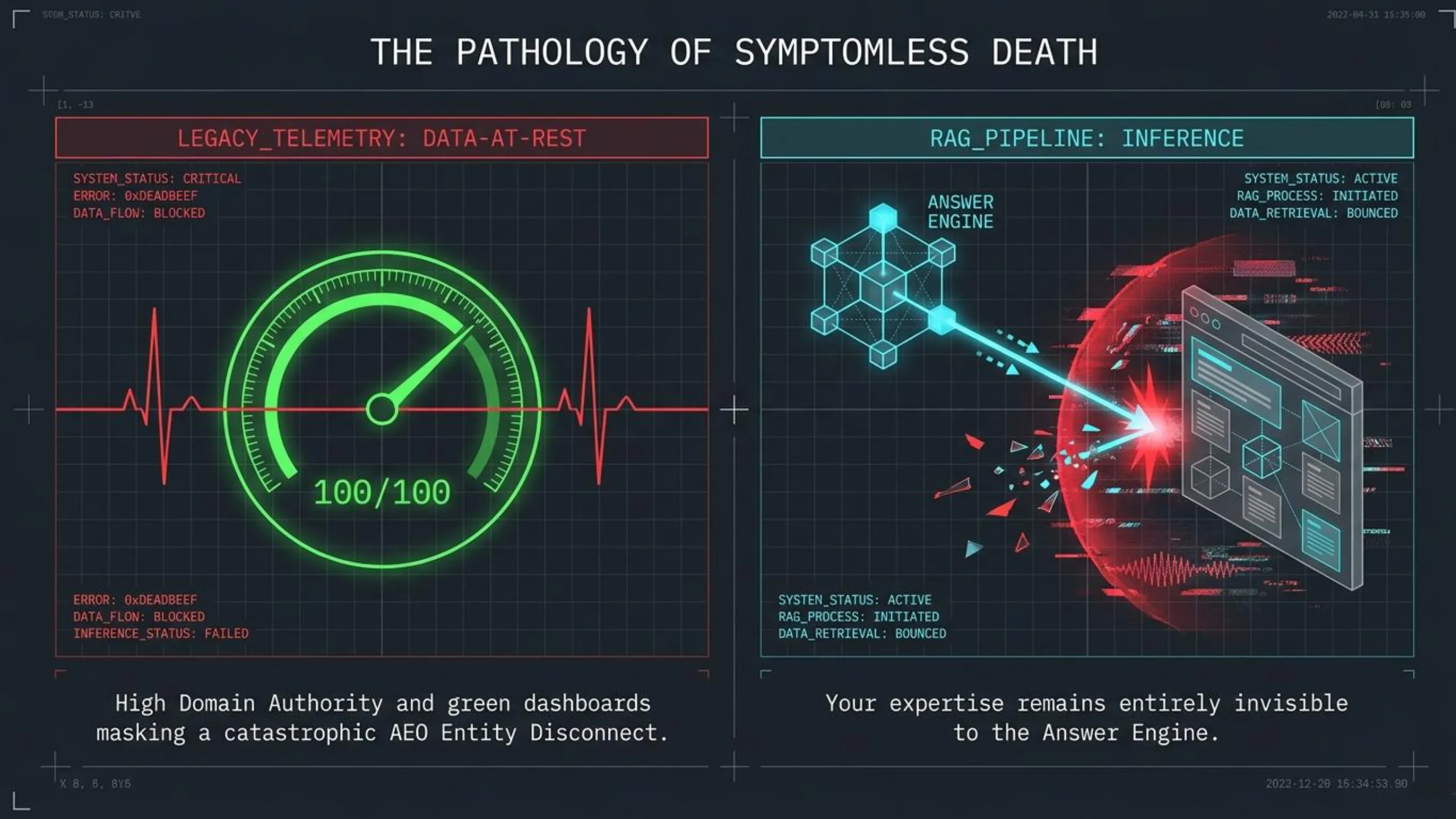
If you are still obsessing over keyword density and chasing 100/100 scores in legacy plugins, you are optimizing for a web that no longer exists. You are suffering from Symptomless Death: your dashboards are green, your domain authority is high, but your traffic is flatlining. This catastrophic aeo entity disconnect ensures your expertise remains entirely invisible to the Answer Engine.
This is not a marketing problem; it is an infrastructure problem.
The Paradigm Shift: From Retrieval to Inference
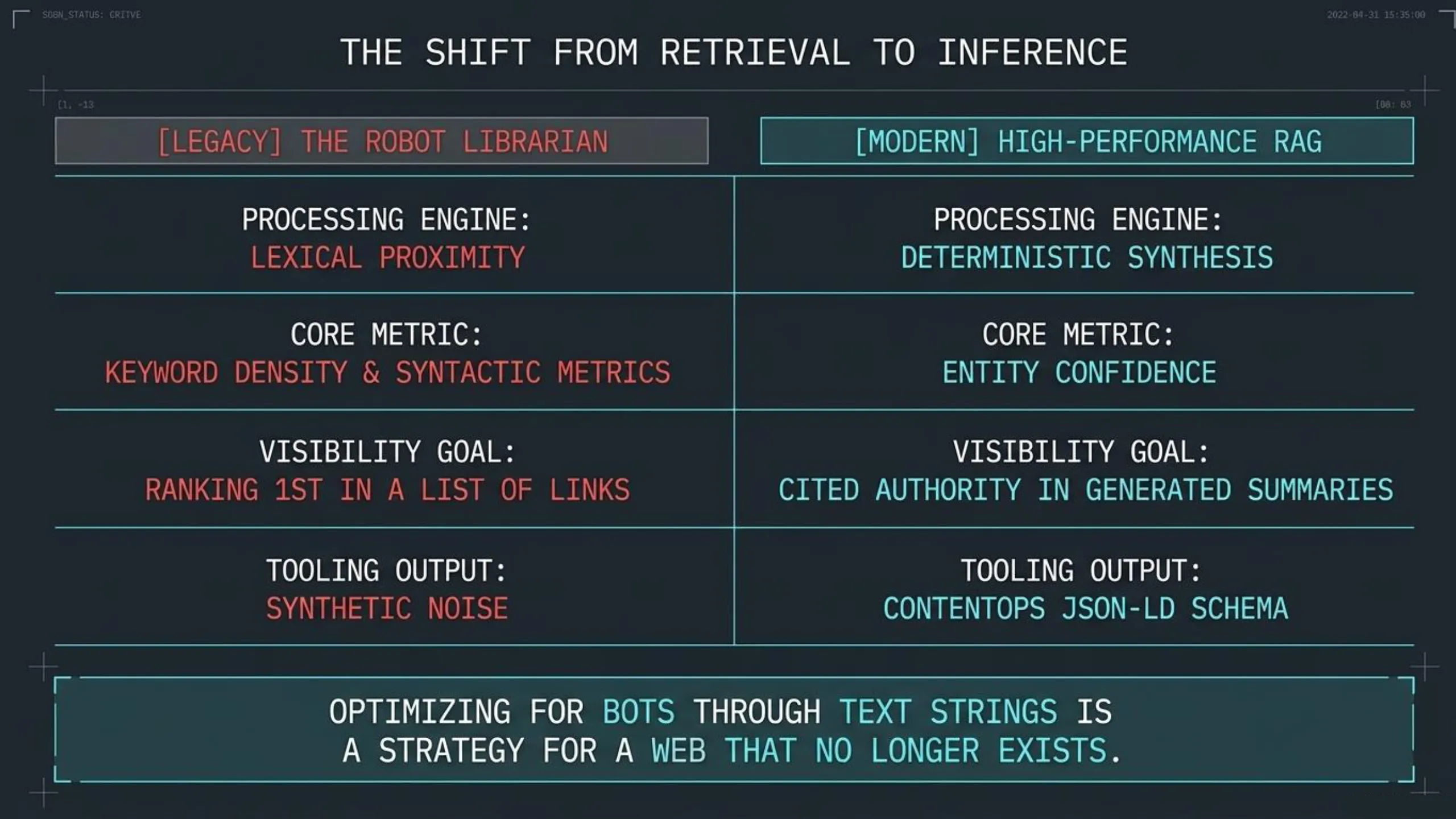
As outlined in The Sovereign SEO Infrastructure Manifesto, the traditional paradigm of Search Engine Optimization (SEO) has been superseded by Answer Engine Optimization (AEO) and Generative Engine Optimization (GEO). We have transitioned from the Robot Librarian—which merely retrieved links based on lexical proximity—to high-performance Retrieval-Augmented Generation (RAG) pipelines.
Systems like Perplexity, ChatGPT Search, and Google Gemini do not search for pages; they synthesize answers. Consequently, visibility is no longer a matter of ranking first in a list of links, but of being the deterministic “cited authority” within a generated summary. To achieve this, you must declare the structural truth of your domain in a language LLMs understand natively: JSON-LD.
Understanding the shift to Generative Engine Optimization is one thing; seeing it executed from a standing start is another. While the principles here explain the ‘why,’ we documented the exact ‘how’—from prompt sequence to off-site seeding—that allowed a Domain Authority 1 site to secure a direct citation inside Google Gemini. Read the definitive guide to our system in the CASE STUDY — The Anatomy of a GEO Citation.
As we will explore in the execution protocol below, achieving this requires transforming your scattered content into a living Topical Map and translating it into machine-readable schema—a complex translation that the ContentOps infrastructure automates entirely.
The Entity Disconnect and Synthetic Noise
For years, legacy SEO tools (like RankMath and Yoast) have trained creators to generate Synthetic Noise. These tools reward Data-at-Rest—static metrics from a retrieval-first era. Traditional SEO plugins focus on syntactic metrics that are increasingly ignored by Answer Engines. Modern LLM visibility relies entirely on Entity Confidence: the mathematical certainty that the AI knows exactly who you are and what relationships you hold in the real world.
High Domain Authority vs. RAG Abandonment
Domain Authority (DA) is a legacy shield. Symptomless Death occurs because high DA combined with poor structural and entity alignment is completely ignored by RAG pipelines. Without explicit entity definition, ambiguity destroys trust. If your site structure relies on traditional keywords instead of semantic relationships, it becomes a rag pipeline seo invisible asset, bypassed entirely for better-structured competitors.
The Structural Economics of RAG: The Compute Tax
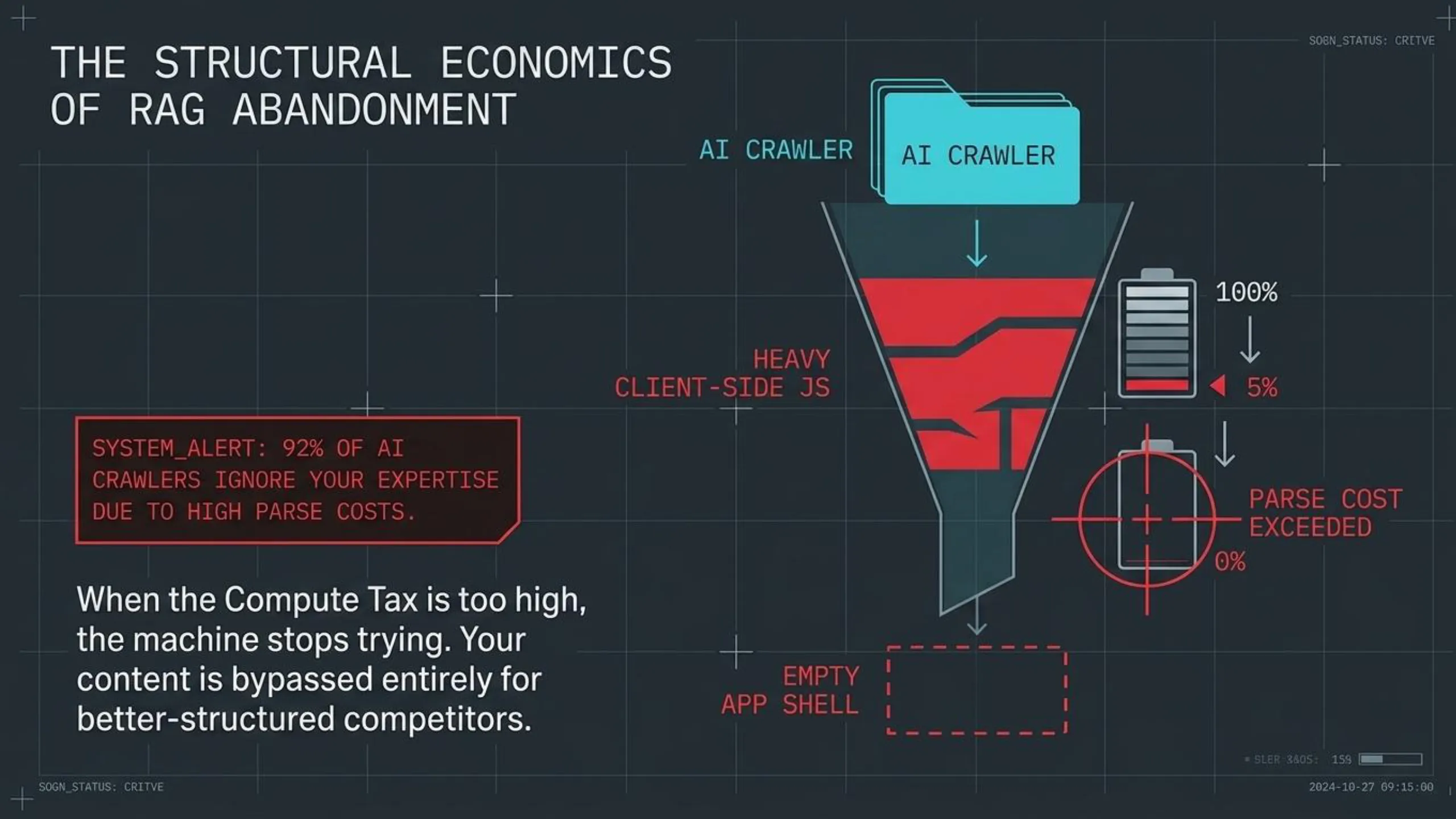
Answer Engines are bound by strict computational budgets. When a crawler hits a webpage, it calculates the energy required to parse and extract the core message. If your site relies on heavy, client-side JavaScript to render its content, you present an “Empty App Shell” to the crawler, triggering a massive Compute Tax.
Parse Costs and Hidden Content
When the Compute Tax is too high, the machine simply stops trying. JS-heavy sites are deprioritized by RAG pipelines due to high parse costs, as crawlers fail to process hidden elements, drastically increasing abandonment rates. Your 5,000-word expert guide is effectively cremated because the crawler refuses to pay the rendering fee.
Our ContentOps Audit Suite uncovered this exact code-level sabotage firsthand. During our forensic Intervention Report of a £50-million Commercial Office Broker, we found that legacy code implemented to shave milliseconds off page loading speed was actively offsetting those gains by sacrificing LLM visibility. Their 2,000-word expert guide was trapped behind a visibility: hidden CSS rule, presenting an empty app shell to the Answer Engine.
This structural bloat is exactly why a rigorous compute tax seo audit is mandatory for any Sovereign Architect looking to reclaim their visibility.
The Knowledge Graph Imperative: E-A-V Analysis
To eliminate the Compute Tax and bypass Synthetic Noise, you must implement a robust geo knowledge graph schema. The foundation of this architecture is the Entity-Attribute-Value (E-A-V) framework. You must master the json-ld entity eav seo protocol to translate your prose into raw data:
- Entity: The core subject (e.g., “ContentOps”).
- Attribute: A specific property of that subject (e.g., “founder”).
- Value: The realization of that property (e.g., “Expert Name”).
Deterministic Signals for GraphRAG
When content is mapped via EAV, an LLM can analyze a webpage with the precision of a database analyst. JSON-LD Knowledge Graph schema acts as the deterministic signal for AI citation eligibility via EAV analysis. GraphRAG pipelines rely almost entirely on these structured, nested representations of entities and relationships to resolve ambiguity and generate confident answers.
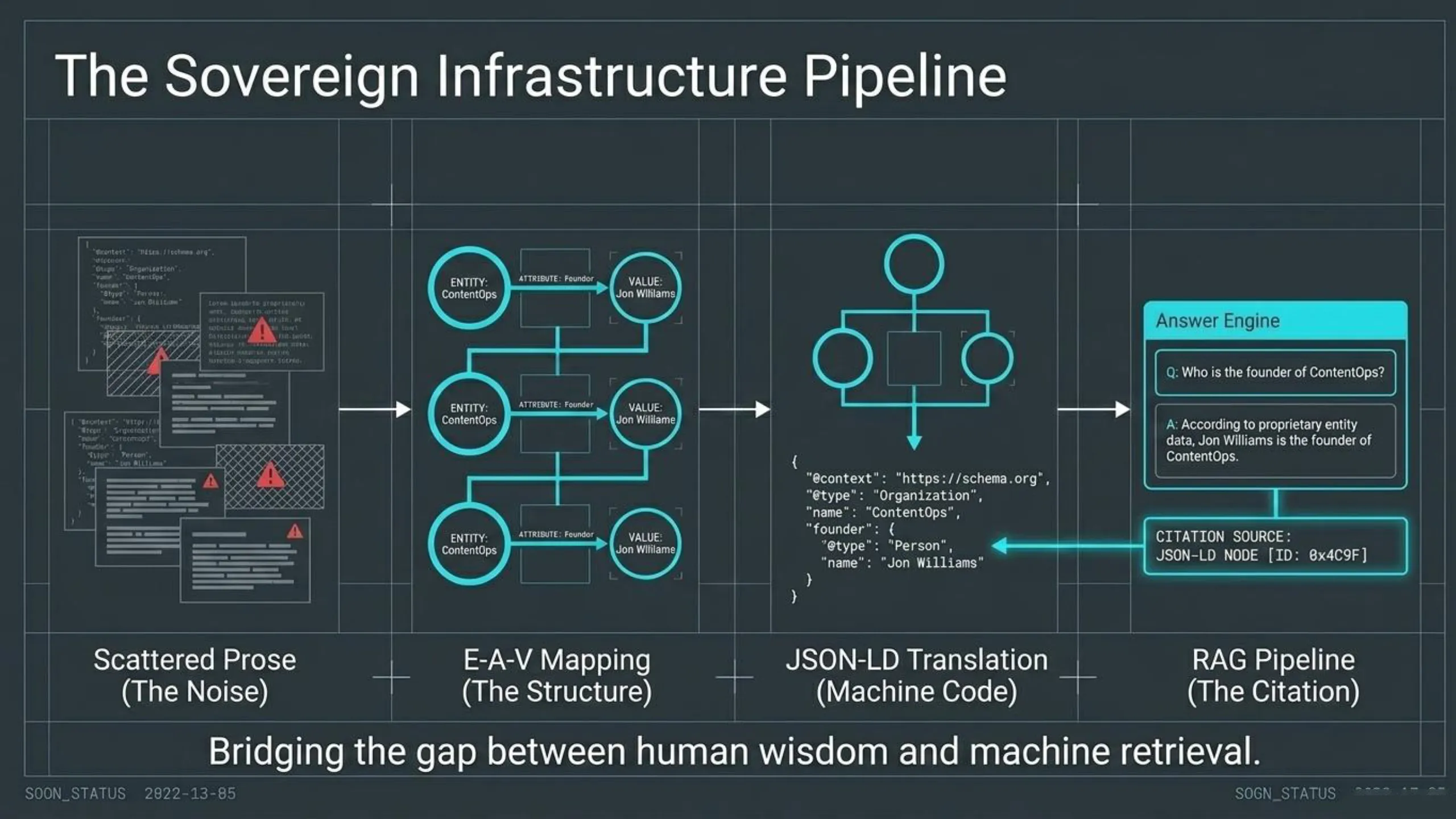
This is why defining your world through a cohesive Topical Map—a true knowledge graph of your expertise—is critical. But mapping is only half the battle; you must translate that map into machine code. As detailed in the execution protocol below, the ContentOps 1-Click JSON-LD Generator takes your living, breathing Topical Map and instantly converts it into the exact deterministic language LLMs demand, bridging the gap between human wisdom and machine retrieval.
SURGEON’S NOTE: Information Gain and LLM Erasure
Information Gain—driven by unique, proprietary entity relationships—has become the dominant content-quality evaluator in 2026. Information Gain via unique entity relationships is the #1 signal, with 76% of AI citations from top organic results relying directly on these entity signals. If your schema does not deterministically prove your Information Gain, you will suffer LLM Erasure.
Transition to Execution: The Schema Calibration Protocol
Theory without application is just another form of entropy. To survive the shift to AEO and GEO, manual schema implementation is no longer viable; Automated Knowledge Graph Generation is the only way to scale authority.
You must build a recursive JSON-LD Knowledge Graph that defines your brand’s digital identity and prevents context rot. To stop patching symptoms and start architecting your semantic fortress, proceed immediately to the execution phase. Access the master workflow via our Step 6: Updating JSON-LD Schema (AEO & GEO) protocol to align your infrastructure with the intelligence of the Answer Engine. Step 6 is just the tip of the sword, though.
If you want to control your content destiny and start engineering outcomes where your expertise is being surfaced by GEO and AEO answer engines, you need the full ContentOps Command Center.