
Visual Meta Description:
Using the motorcycle DMV written test analogy to explain why green light plugin checkmarks represent mere paperwork compliance, separating basic technical SEO setup from the underlying code-level structure required to rank.
Compliance vs Capability
Green Light Gaslighter
Skeletal Extraction
AEO Optimization
HTML Structural Audit
You’ve done the work. You filled in the title tag, tightened the meta description, checked the boxes, watched the plugin turn green, and expected the post to move.
But it still isn’t ranking.
The frustrating part is the page looks compliant, the checklist says everything is fine, and yet the results stay flat. So now you’re left wondering whether you missed something, whether the plugin lied to you, or whether the whole process is built to make you feel done before you actually are.
And underneath that is the deeper problem: it shouldn’t take a dozen surface-level checks to know whether a post is structurally ready to rank. If your content is useful, it should be judged on its ability to perform, not just on whether it passed paperwork.
“I passed my SEO Checklist, so why isn’t my post ranking?”
Passing your SEO checklist doesn’t mean your site can rank, the same way passing your DMV written test doesn’t mean you can ride a motorcycle. The test confirms you showed up correctly. It says nothing about whether you can actually handle the bike once you’re on the road.
That distinction sounds obvious once you say it out loud, but most operators running content sites don’t say it out loud. They run a plugin, watch the lights turn green, and assume green means ready. That’s the Green Light Gaslighter at work.
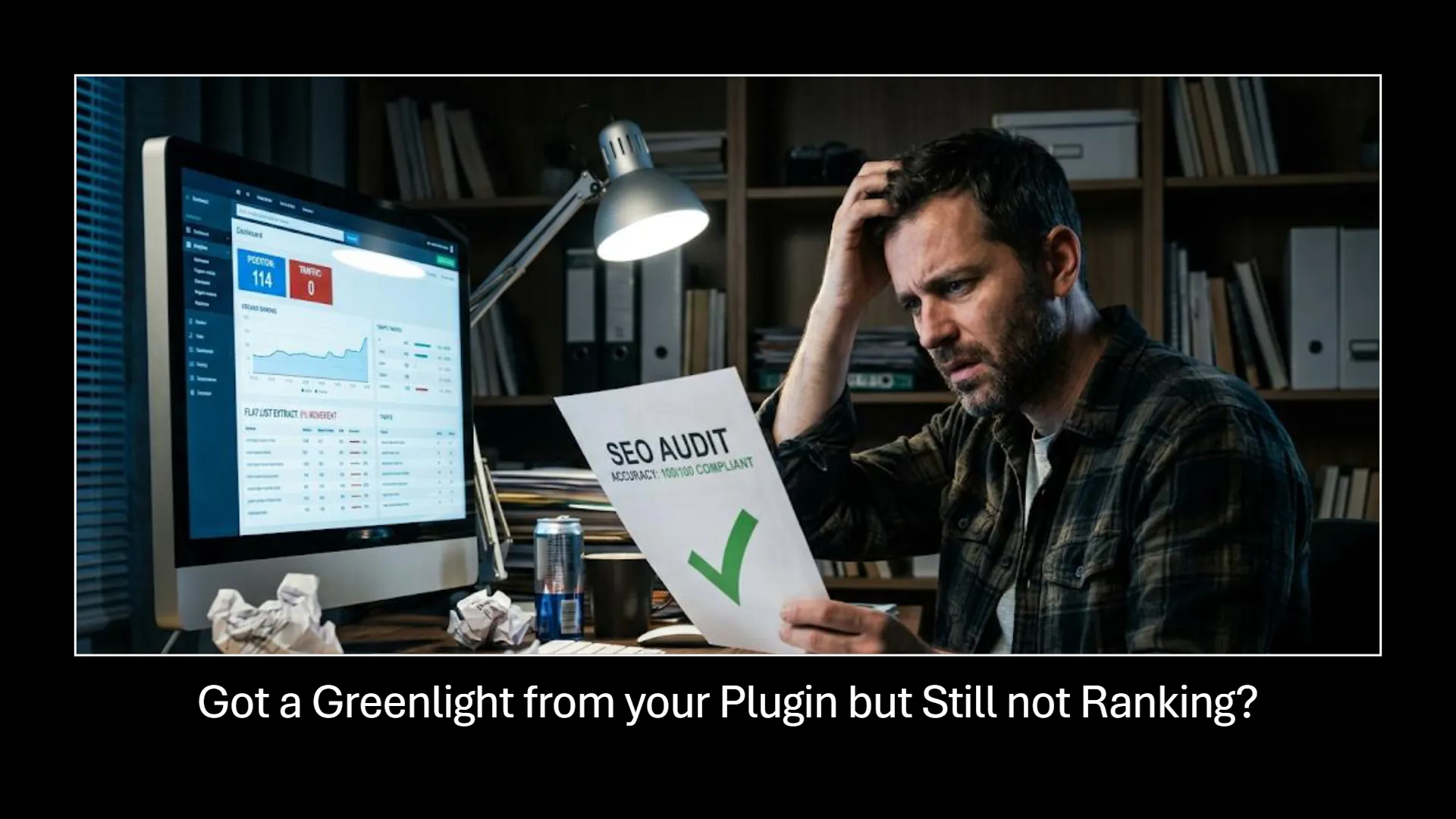
Why Isn’t My SEO Checklist Working?
Your checklist isn’t working because it was never measuring whether your site could rank. It was measuring whether you filled out the paperwork correctly.
- Title tag: check
- Meta description within character count: check
- Keyword in the first paragraph: check
- Alt text on the image: check
You’ve checked all the boxes, but none of those boxes tell you whether your site’s structure can actually support topical authority, which is the thing that determines whether you rank at all.
This is the gap almost nobody names directly, so it’s worth being blunt about it. A green checklist and a ranking site are two different outcomes measured by two different systems. You can have one without the other, and most sites stuck on page four have exactly that combination: full compliance with zero structural readiness.
![A split image contrasting 'The Metadata Illusion' on the left with 'The Graph Reality' on the right. The left side displays an old computer monitor showing an SEO plugin with a '100/100 REASSURING PASS' based on 'character count checklists', 'title parameters', and 'meta description tags', with three stacks of glowing green paper below it. The right side depicts a complex circuit board featuring a central processor, multiple red glowing components, and bright blue connecting traces. Labels on the circuit board include '[ENTITY GRAPH ACTIVE]', 'RSBI SECTOR LOCKED', and 'DETERMINISTIC RETRIEVAL RELIABILITY: COMPREHENSIVE', along with several target symbols and a red 'Content' logo.](https://contentops.so/wp-content/uploads/2026/06/02-why-isnt-my-seo-checklist-working-slide-02.webp "slide-02")
What the Green Light SEO Tools and Plugins Actually Test
Walk into the DMV to get a motorcycle endorsement and the first thing that happens has nothing to do with riding. They check that you brought the right documents. They check that you’re wearing the right gear. If you show up wearing a baseball cap instead of a helmet, you don’t get to take the riding test. You get turned away at the gate, and the reason has nothing to do with whether you can actually ride.
That gate check is real, and it matters. Showing up without a helmet is a legitimate disqualifier and nobody’s arguing otherwise. But passing the gate check was never the test. The test is whether you can take the bike around the course without dropping it, and that happens after the paperwork, on a completely different set of evaluation criteria.
Title tags and meta descriptions are your helmet check. They’re the entry requirement. Did you file the application correctly. Are you wearing the gear. Yes or no, pass or fail, done in five seconds by an automated system that isn’t looking at anything deeper than whether the field exists and the character count is right.
Where the Green Light Gaslighter Comes In
Most legacy SEO plugins are built to run exactly that gate check and stop there. They flash green when you’ve checked the entry-level boxes and present that green light as evidence of readiness because a green light is satisfying and a yellow or red light generates support tickets. The plugin’s incentive is to make you feel finished. Your incentive is to actually rank. Those two incentives are not the same thing, and the plugin’s UI doesn’t disclose that anywhere.
This is the Green Light Gaslighter at work. It’s not malicious. It’s just measuring the wrong layer and calling it done. You did the gate check. You’re wearing the helmet. The plugin tells you that means you’re ready to ride, and you believe it. I mean why wouldn’t you believe it? Nothing in the interface tells you there’s a second test you haven’t taken yet, and a checklist that only tells you what you failed without ever explaining the fix is its own kind of trap, which I elaborate on in Failure Checklists vs. Surgical Mission Briefs.
![An Agent Smith-like character with a sinister smile stands in a dark server room, surrounded by multiple green computer screens displaying '100% CHECKLIST COMPLIANT' grids. Floating text in front of him reads '[LEXICAL INTEGRITY: PASSED]' and '[TOPICAL DEPTH: NONE]', illustrating the Green Light Gaslighter's deceptive validation of superficial SEO compliance despite a critical lack of meaningful content depth.](https://contentops.so/wp-content/uploads/2026/06/03-why-isnt-my-seo-checklist-working-slide-03.webp "slide-03")
Why Your Compliant Title and Meta Description Still Get Flagged at Bing
Here’s a default most people never catch. Most legacy SEO plugins auto-generate your meta description from the first paragraph of your post if you don’t manually overwrite the snippet field. That first paragraph is written for a human reader settling into the piece, not for a 155-character search snippet, so it runs long. The plugin doesn’t truncate it intelligently. It just ships whatever’s there.
The title tag has the same problem from a different default. Plenty of plugins automatically append your site name to the end of every H1 by default, so your sixty-character title becomes your title plus ” | Your Brand Name,” and now you’re over the limit on a field that was compliant five seconds ago.
Neither of these throws an error in the plugin itself, because the plugin is checking against its own internal tolerance, not against what happens when that data leaves your site. Submit that same URL to Bing Webmaster Tools and you’ll see it flagged for length violations, which matters more than it sounds like it should, because Bing’s index is what ChatGPT’s web search and Copilot draw from. Bing holds around 5% of global search share on its own, which is small enough that most operators never bother submitting there. But the index sits underneath a much bigger surface than that 5% suggests, since it’s the same index multiple AI assistants are querying against. A title and description that get truncated or flagged in that index aren’t just a Bing problem. They’re part of a larger shift in how visibility gets measured now that answer engines, not just search results pages, decide who gets cited. AI Content Workflow for Experts: The Expert AI Content System.
What the Riding Test Actually Checks
The riding test is structural. It’s whether your site’s internal architecture, your heading hierarchy, your internal linking, your topical depth, can actually carry the weight of a competitive search query. This is the difference between compliance and capability, and it’s the layer no checklist plugin is built to evaluate because it’s not a field you fill in. It’s a structure you build. Why Aren’t My Rankings Improving After an SEO Audit?.
A site can have perfect meta descriptions on every post and still be structurally incapable of ranking, because the meta description was never the thing holding it back. What’s holding it back is usually invisible to a checklist: a heading hierarchy that skips levels, internal links that go nowhere, content that name-drops concepts it never actually builds out into their own pages. None of that throws a red flag in a compliance plugin. All of it throws a red flag in an actual structural audit, because a structural audit is reading the architecture, not the paperwork.
When Green Lights Aren’t Lying, They’re Just Not Asking the Right Question
There’s a version of this problem that’s harder to catch than a length violation, because nothing about it looks broken. A post can have alt text on every image, internal links pointing in and out, original phrasing throughout, and still not deserve to rank, because none of those signals tell you whether the page actually teaches what it claims to teach.
I had a post on my English learning site targeting zero conditional retargeting that passed every mechanical check I had access to. Alt text present on enough images. Internal links present in enough places. Original content, no thin duplication. Every plugin signal was green. The post still didn’t move.
What the checklist couldn’t see was where the actual teaching content lived. I’d built the lesson around a set of slide images, the kind that explain a grammar pattern visually, and the explanation lived entirely inside those slides. The surrounding text gestured at what the slides covered without actually explaining it, because I’d assumed the visual would do the teaching. To a human scrolling past, it looked like a complete lesson. To a crawler reading the HTML, there was no semantic content there to read. The alt text described the slide as an image. It didn’t teach the concept the slide was teaching. The page was, structurally, thin content wearing a fully dressed checklist.
That post didn’t start moving until I ran it through the Audit Suite and saw what the diagnostic was actually flagging, which wasn’t a missing field anywhere. It was a semantic gap between what the post claimed to cover and what its HTML actually contained. I rewrote the body text to carry the teaching itself instead of pointing at an image to do it, and the difference wasn’t a tweak. It was rebuilding what the page was actually saying versus what it had only implied.
That’s the gap between compliance and capability in practice, not in theory. Every legacy post on that site that I fixed by chasing checklist items stayed exactly where it was. The posts that moved were the ones where I’d found a semantic gap the checklist had no way to detect, because the checklist was never built to read whether a page teaches what it says it teaches. Only a structural audit reads that.

Why This Distinction Matters More Than It Sounds Like It Should
Here’s the part that costs people real time. Because the checklist says green, the instinct when rankings don’t move is to assume the checklist was insufficient, so the fix becomes adding more checklist. More keyword density. More meta variations. More plugin recommendations actioned one by one, each one tightening a bolt that was never loose in the first place.
That’s the trap. You can spend months perfecting your gate-check paperwork and never once approach the actual riding test, because nothing in your workflow is telling you the riding test exists. You just keep getting better at the part that was already passing.
The fix isn’t more compliance. It’s running a different kind of check entirely, one that looks at the HTML structure underneath the page rather than the metadata sitting on top of it, and once you know what that check actually involves, it stops being a mystery and starts being a workflow you can repeat on every post. AI Content Workflow for Experts: The Expert AI Content System.

FAQ: SEO Checklists vs Structural Readiness
Why does my site pass every SEO checklist but still not rank?
Checklist tools measure surface-level compliance like title tags, meta descriptions, and keyword presence, which confirms your page meets basic entry requirements. They don’t evaluate your site’s structural architecture, including heading hierarchy, internal linking depth, and topical completeness, which is what actually determines ranking capability.
What’s the difference between SEO compliance and SEO capability?
Compliance means your page has the correct fields filled in correctly, similar to passing a DMV paperwork check. Capability means your site’s underlying structure can actually support the query you’re trying to rank for, which requires a structural audit rather than a checklist scan.
Why do SEO plugins show a green light when my site still isn’t ranking?
Most SEO plugins are built to check surface-level compliance signals and report success once those signals are present, because that’s the layer they’re designed to measure. They have no mechanism for evaluating internal structure or semantic completeness, so a green light only confirms you passed the entry gate, not that your site is structurally or topically ready to rank.
Want to know whether your site is wearing the helmet or actually able to ride the bike? The free Surgical HTML Auditor checks the structural layer your plugin can’t see. [ SEO HTML Audit Tool Landing Page ].