
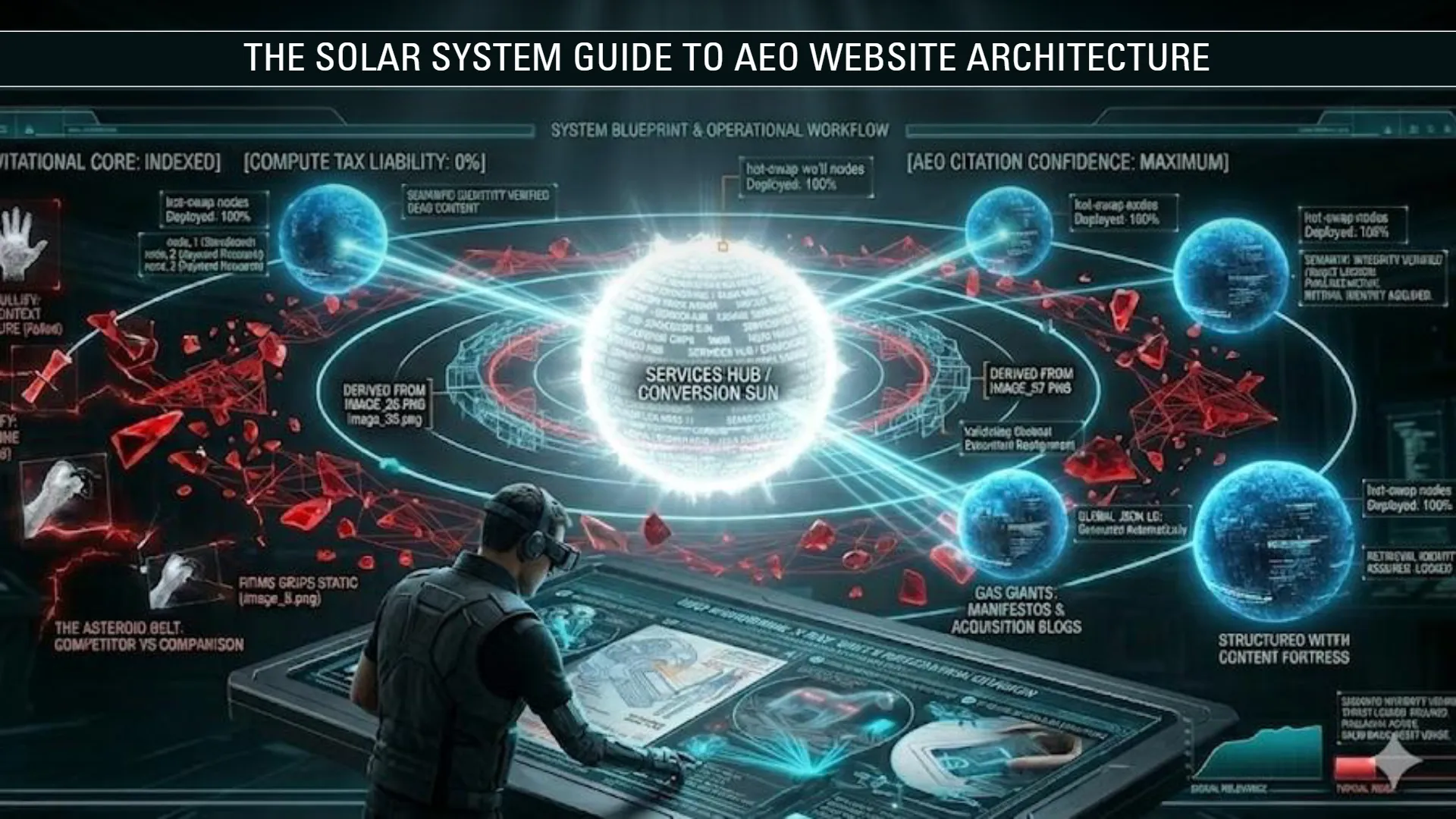
Visual Meta Description:
Deploying the Solar System Method to structure an entity-based content architecture, aligning services hubs, help centers, and validation layers to command direct citations from modern AI answer engines.
Entity Architecture
Help Center Depth
Sovereign Scaling
AEO Ingestion
Knowledge Graph
The Solar System Guide to AEO: How to Build a Content Architecture That AI Answer Engines Actually Cite
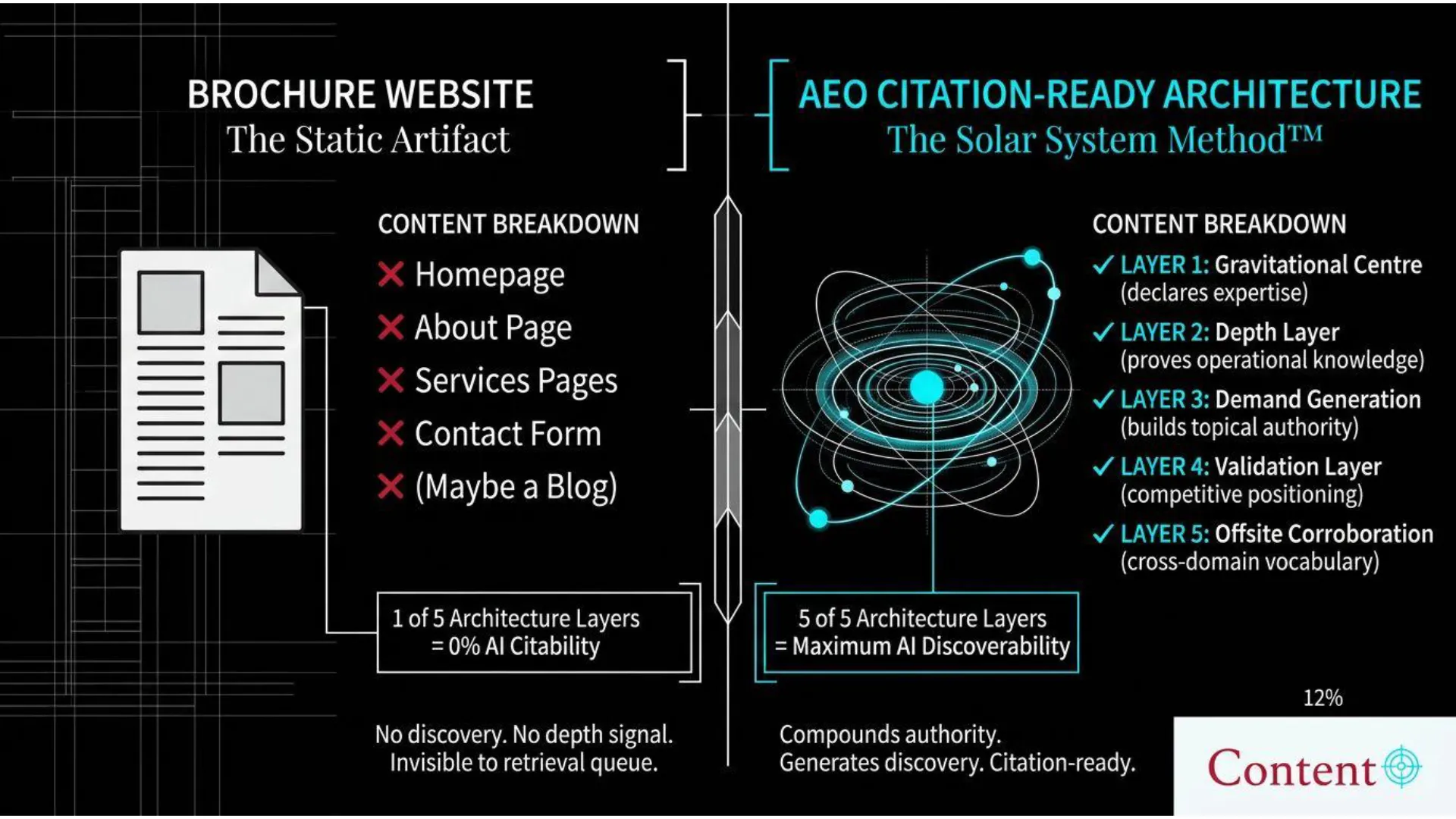
Most businesses with a website have a brochure when there should be a conveyor belt ushering in demand. They have a homepage, an about page, some services pages, and maybe a contact form. A brochure is something you hand to someone who already knows you exist. It generates no discovery, no depth signal, and no corroboration layer for AI systems deciding whether your domain is citable. If your site looks like a brochure, you’re invisible to the retrieval queue before a single query is even typed.
The question most business owners ask at this point is the wrong one. They ask “should I add a blog?” but the right question is “what does a citable content architecture actually look like, and do I have one?”
Can ChatGPT actually crawl your website for SEO?
A blog orbiting a weak sun doesn’t fix the problem. It just adds a star to a system with no gravitational centre. Without the right architecture underneath it, that blog post pulls toward nothing and compounds nothing.
How to Build a Website Structure for AI Search
A citable website structure for AI search requires at least five layers operating simultaneously: a gravitational centre that declares what you do, a depth layer that proves operational expertise, a demand generation layer that builds mass through topical authority, a validation layer that positions you against alternatives, and an offsite corroboration layer that tells AI systems your vocabulary exists across independent sources. A brochure website has one of these layers, but a sovereign content architecture has all five that compound on each other.
That is the Solar System Method. And the fastest way to understand it is to see what each layer does and what breaks when it’s missing.
Start With the Raw Materials — Your Cosmic Dust
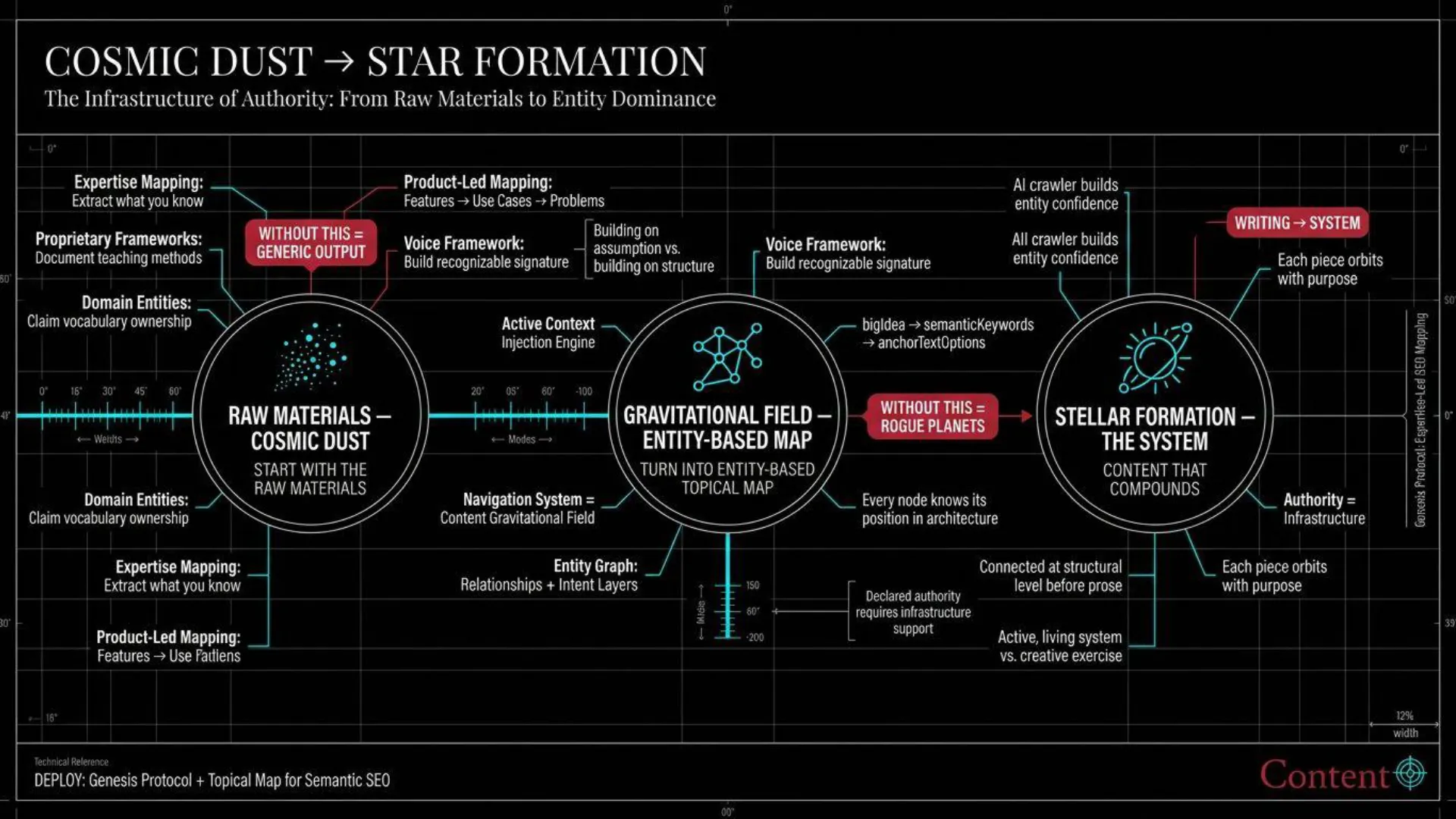
Before a single page is written, the system needs a foundation to form from. For an expert-led business, that’s expertise mapping, which is the process of extracting what you actually know, how you teach it, what your proprietary frameworks are, and which entities your domain genuinely owns. For a SaaS product, it’s product-led mapping that covers the features, the use cases, and the problems the product solves at each customer maturity level. For a brand, it’s the vocabulary and voice framework that makes every subsequent output recognisably yours.
Without this raw material, you’re building on assumption. The AI writer guesses at what you’d say. The blog posts don’t sound like a practitioner. The landing pages don’t carry the entity-specific vocabulary that AI crawlers need to classify your domain accurately. You get generic output because you gave the system generic input.
The cosmic dust is what the solar system forms from. Skip it and you’re just writing articles when you should be building a system. To properly structure this raw expertise before publishing, teams deploy the Genesis Protocol: Expertise-Led SEO Mapping to construct their internal knowledge layers.
Turn That Into an Entity-Based Topical Map
The topical maps that currently dominate the market have conditioned you to think they are fancy-looking keyword lists, but a topical map should actually be an active, living context injection engine, which is a graph of entities, relationships, and intent layers. It’s a file you treat like a memory card that tells the AI writer what each piece of content is about, how it connects to every other piece, what anchor text to use when linking between nodes, and what offer each node routes toward. It’s the navigation system and the gravitational field for everything you’ve created and will create.
Without a map, each piece of content orbits nothing. You publish a blog post and it roams your content galaxy like a rogue planet, referencing concepts it never resolves and pointing toward nothing. The AI crawler ingests it, finds declared relationships with no destinations, and builds lower entity confidence in your domain. You’re declaring authority you haven’t built the infrastructure to support.
With a map, every post knows where it sits in the architecture. The AI writer draws from the map’s data layers, including the bigIdea, the semanticKeywords, and the anchorTextOptions, and produces output that is connected at the structural level before a word of prose is written. Rather than relying on flatRow spreadsheets, deploying a Topical Map for Semantic SEO turns writing from a creative exercise into an active, compounding system.
Are you invisible to ChatGPT, Perplexity, and Gemini?
Most brands are completely hidden from modern AI search engines because AI citations leave zero referral footprints. Stop guessing where your domain stands. Map entity confidence gaps and compute tax liabilities under a geo-isolated execution pipeline.
Build Your Sun First — Product and Service Pages
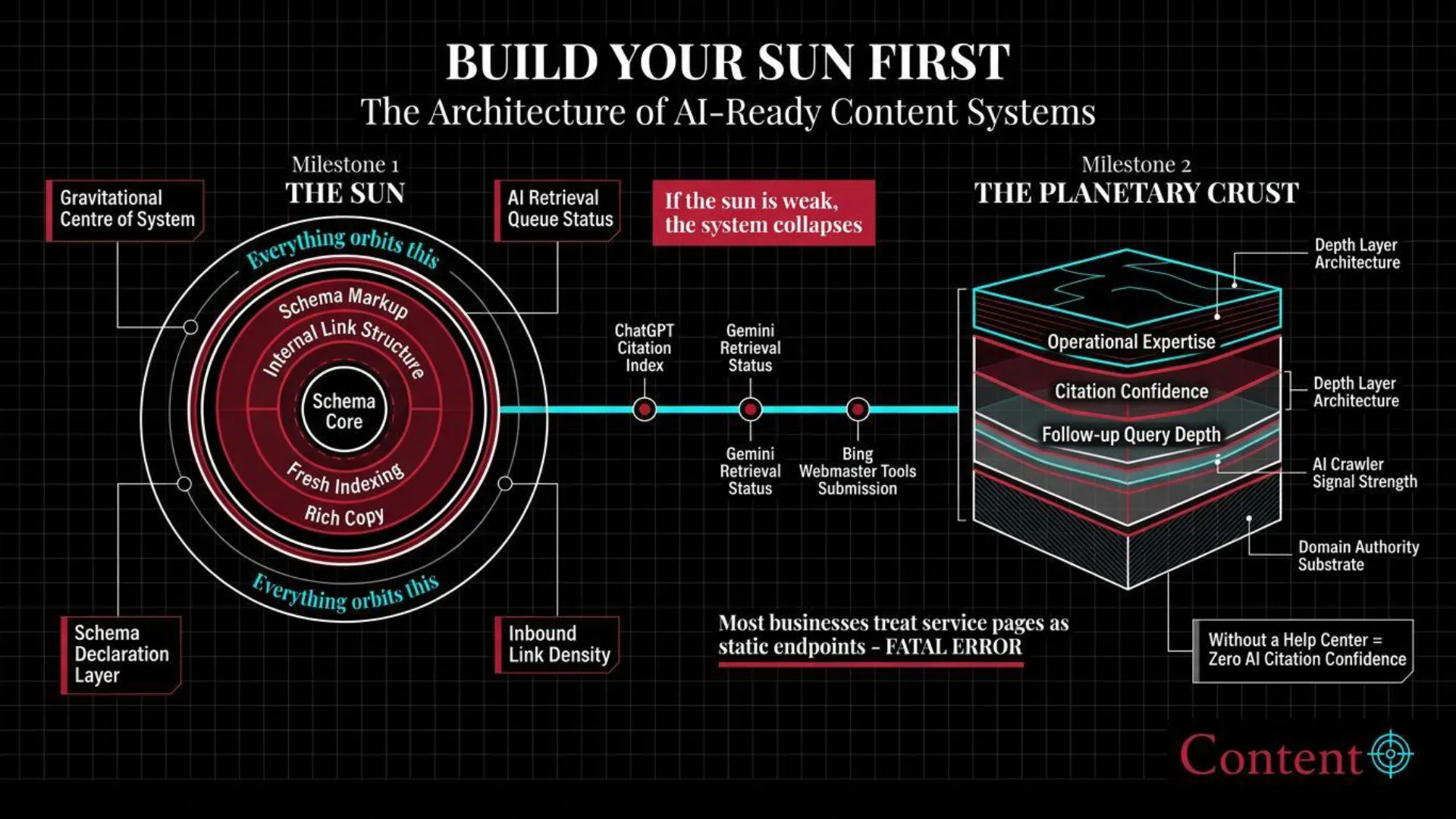
The gravitational centre of the system. Everything else orbits these. If the sun is weak, with thin copy, no schema, a dead-end internal link structure, and pages that haven’t been re-indexed in years, the system collapses regardless of how many blog posts orbit it.
Here’s the architecture mistake most businesses make: they treat their service pages as static endpoints and leave them alone once they’re live. The question they never ask is whether those pages are even indexed. If a service page has no inbound links from the blog, no schema declaring what the page is about to a machine, and hasn’t been submitted to Bing Webmaster Tools, it’s not in the retrieval queue. ChatGPT doesn’t know it exists. Gemini can’t cite it. The page is there but it’s invisible to every AI answer engine a potential customer might be querying.
ContentOps Built Its Architecture From Back to Front
I built the ContentOps service pages before the blog had enough gravity to route authority toward them. I knew they wouldn’t rank immediately. The strategy was deliberate. I would build the sun first, then let the blog’s mass accumulate and pull toward it. As the cluster grew, the internal links from blog posts to service pages gave those pages the gravitational pull they needed to start registering in retrieval systems. The blog didn’t just generate traffic. It gave the sun the authority mass to become citable via the unified ContentOps Services Hub dashboard layout.
Format Landing Pages Question and Answer Style
One contrarian revision worth naming here is that most traditional advice says landing pages should have no off-ramps, meaning no links out and nothing that takes the visitor away from the conversion goal. I built my landing pages against that conventional wisdom. Every ContentOps landing page is structured as a Q&A simulation, which is a flow of questions and answers that mirrors the conversation a potential customer is having with me as their consultant or like a user with an AI assistant. That format isn’t just reader-friendly. It’s ingestion-ready. AI answer engines retrieve from pages structured as direct, declarative responses to the queries they’re resolving. A brochure-format landing page gives an AI nothing to extract. A Q&A-format landing page is a citation target.
Underline the Sun With a Help Center — The Planetary Crust
The layer most businesses skip entirely, and the one that costs the most in AI citations when it’s missing.
The help center is not documentation nor an afterthought for existing customers. It’s the depth layer that tells AI crawlers this domain has genuine operational expertise beneath the marketing surface. To an AI evaluating citation confidence, a domain without a help center looks like a business that can make marketing claims but can’t answer follow-up questions. That’s a signal that pushes the citation elsewhere.
Internal Links as Verification, Not Off-Ramps
The internal links in a help center aren’t off-ramps. They’re verification layers. When a page links to a help center article, it’s not sending the reader away from the conversion goal so much as providing the AI crawler with a corroboration path. The claim made on the service page resolves to a documented operational explanation in the help center. Recognizing that the Help Center is your site’s cellar, not its front porch, this explicit relationship between the two pages tells the machine that this business doesn’t just assert expertise, it demonstrates it at depth across the ContentOps Help Center framework.
The Depth Layer Is What Gets Cited Second
Depth is what gets cited for the follow-up questions. When a user asks an AI about a product or methodology and then asks the follow-up, whether that’s “but how does that actually work,” “what does the setup look like,” or “what happens if I do X,” that second and third question pulls from the depth layer. If your depth layer doesn’t exist, you earned the first citation and lost the conversation, because the AI will hallucinate or cite someone else’s page instead.
Surround the Sun With Gas Giants — Landing Pages and Blog Posts
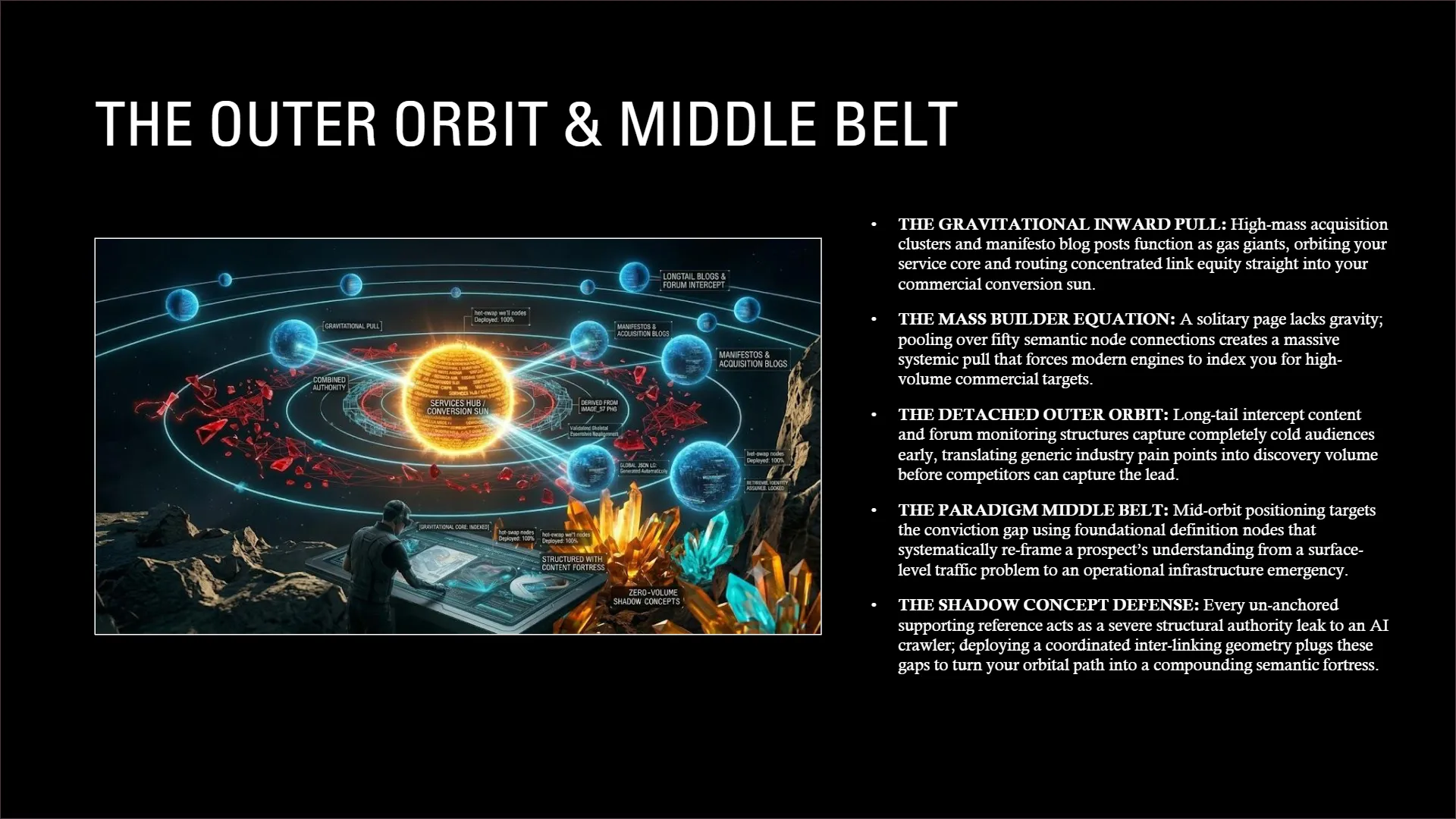
These are the mass builders. They orbit the sun and send authority inward through internal links. Every blog post that links to a service page increases the gravitational pull toward that page. Every cluster of posts that links to a pillar increases the topical authority of the whole cluster.
Five internal links routing to a service page create a small gravitational pull. Twenty to thirty create a strong pull. Fifty or more create what I think of as a local giant, which is enough combined authority that the sun starts registering for competitive queries it couldn’t touch when it had no blog orbiting it.
The Outer Orbit and the Middle Belt
The outer orbit handles awareness with longtail blog posts and forum intercept content that catches cold audiences before they know your vocabulary. The middle belt handles the paradigm shift through manifesto posts, vocabulary definition posts, and content that moves a reader from “I have a traffic problem” to “I have a content infrastructure problem.” Both layers are essential and do different work. The awareness layer generates discovery. The middle belt generates conviction. Neither replaces the other.
Every star that gets published should reference at least one Shadow Concept, which is a supporting entity the post declares but hasn’t yet built into a dedicated node. If left unaddressed, these missing entities look like un-anchored gaps to a machine, explaining why your topical authority is bleeding. Those unresolved relationships are the next posts in the sequence. The map makes them visible. The publishing sequence fills them in. By coordinating this structural geometry via Semantic Internal Linking: The Phalanx, the system compounds with every cycle, and as your map grows your domain authority grows with it.
Run a Competitor Conquest Audit
Are search models citing lower-tier competitors over your proprietary expertise? Use an adversarial code audit to extract structural failure patterns from their raw HTML shells, uncover vocabulary voids, and systematically hijack industry overview citation slots.
— Execute a Competitor Conquest Audit ($3,000–$5,000 One-Time)
The Asteroid Belt — Comparison and Validation Content
This is the layer the original solar system metaphor was missing, and it’s the one where the most commercially valuable conversations happen.
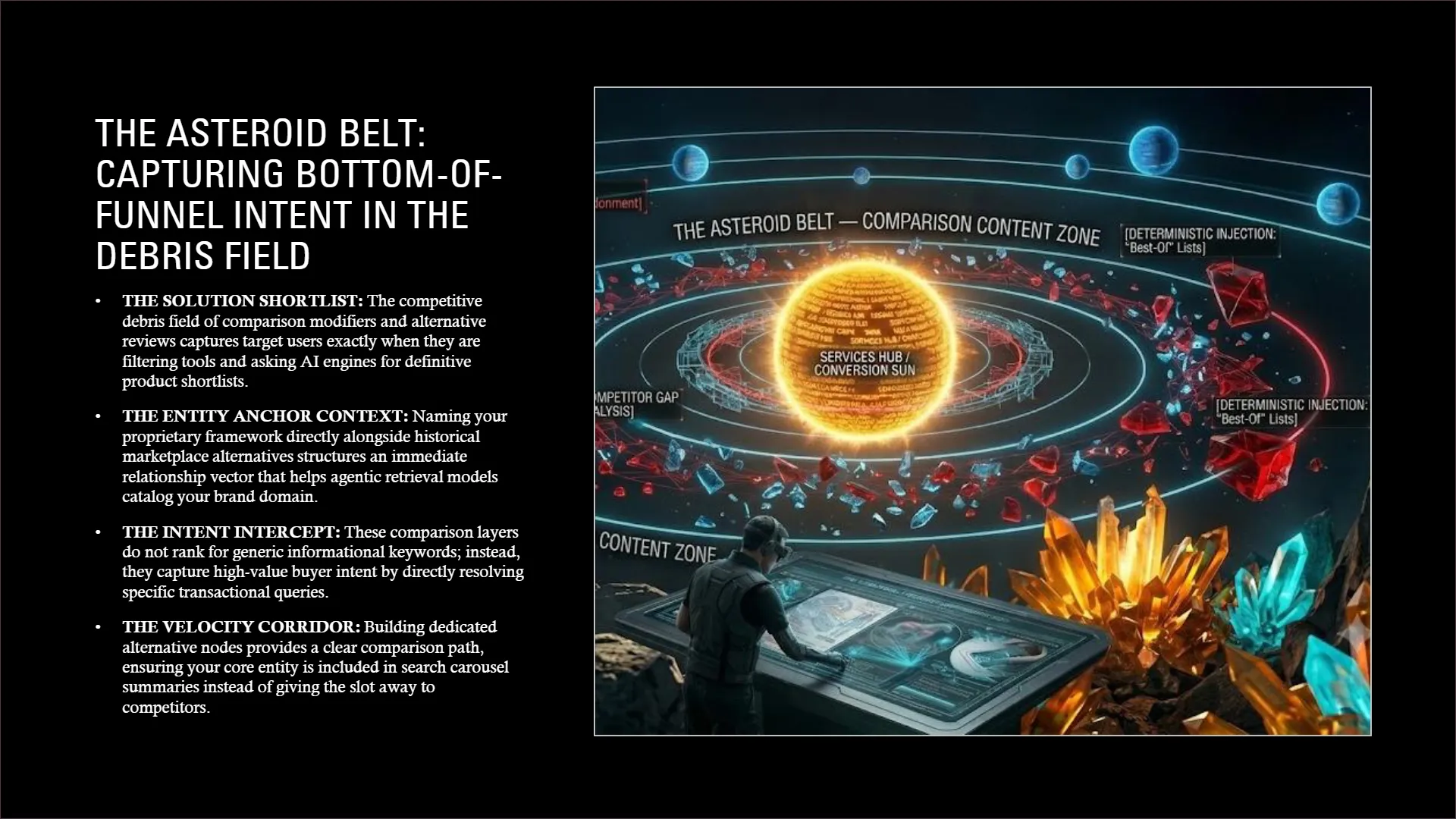
The asteroid belt sits between the gas giants and the sun. It’s the competitive debris field of comparison content, versus posts, best-of lists, and competitor gap analysis posts. These don’t rank for your primary keywords. They appear when your ideal customer is shortlisting solutions and asking an AI which option fits their specific situation, whether that’s “what’s the best alternative to X,” “how does Y compare to Z,” or “is W right for a solo creator or only for agencies.”
Why the Asteroid Belt Is Commercially Non-Negotiable
Without this layer, you’re absent from the most commercially important conversation your buyer has before purchase. The AI is evaluating options. Your competitors are in the retrieval set. You’re not, because you never built the content that positions you in the comparison context.
The asteroid belt also serves a secondary function the other layers don’t. When you write a comparison post that names your methodology alongside a known alternative and demonstrates a specific structural advantage, you’re telling the AI that your entity exists in relation to other entities the AI already knows. Performing an advanced competitor gap analysis to understand how the Audit Suite and topical maps expose entity gaps allows you to anchor your domain within the comparison context securely.
Give Your Planets Moons — Offsite References
This is where the vocabulary seeding argument lives, and it’s the most counterintuitive part of the system for practitioners who’ve been told that backlinks are the only offsite signal that matters.
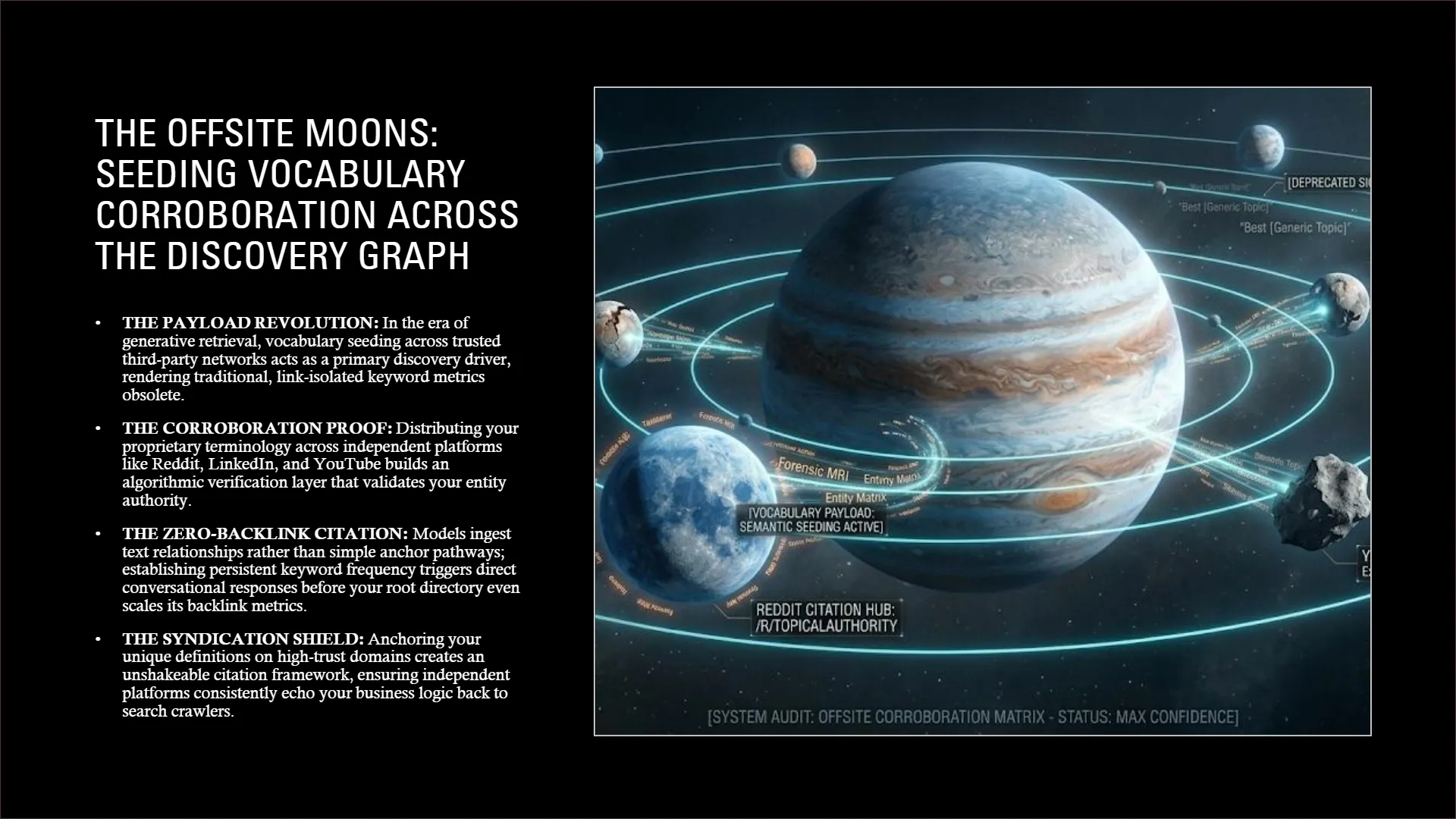
I built ContentOps on a new domain with zero authority and zero backlink history. Before the blog had enough posts to build internal gravity, I started getting citations from Reddit rather than from the blog. The model had ingested enough Reddit content where I’d named the ContentOps methodology and described its approach that it could reference “ContentOps” in an answer, even before my blog had the citation strength to be pulled directly. The citation was incomplete at first. But as the blog grew and the Reddit seeding continued, the citations got stronger and more specific. The vocabulary was the signal, not the link.
Vocabulary Is the Payload, the Link Is the Delivery Mechanism
That observation is grounded in direct work on RLHF projects where I tested exactly how models decide whether to retrieve from memory or search, and what constraints trigger a defined search result. The models need to encounter your vocabulary across independent sources. They need to see your methodology named and explained in places they trust, whether that’s LinkedIn long-form, Reddit threads, YouTube transcripts, or Medium posts. These are the moons. They don’t need to send a backlink every time, though when you can get one it accelerates the process. They need to carry your vocabulary into the corroboration network the AI uses to build citation confidence.
If a backlink is contextual and comes from a domain the AI already trusts, it helps. But vocabulary seeding without a link still moves the needle in ways most practitioners haven’t tested because they’ve been told it’s the link that matters. In the era of modern search synthesis, this architectural grounding outlines why traditional lexical tracking is obsolete, marking the definitive transition of AEO & GEO: The Death of SEO Scores. To study a complete log of this ingestion dynamic in real time, operators explore the live proof inside our Anatomy of a GEO Citation clinical whitepaper.
ContentOps as the Orchestrator — Where the System Gets Built
Most SEO tools give you a checklist. You didn’t add a keyword. You didn’t add a header. You don’t have enough entities. The business owner reads the list and thinks: okay, but what do I actually do next? The checklist tells you what you failed. It doesn’t tell you how to build the system that stops you failing it.
ContentOps is the execution layer for the solar system. You map your expertise with the Genesis Protocol. You build the map in the Topical Map Manager. You wrap your content in clean HTML with the HTML Wrapper. You run the Audit Suite and get fix-it briefs, not failure lists. You publish faster with the Splitter. You put images into Google image results with SlideShift. You run the Harvester and wire the nodes. You generate schema and register your architecture as a machine-readable knowledge graph. Then you repeat the cycle, and the system gets heavier with every orbit.
That’s not a strategy. It’s an operation. The map is the brain. The tools are the assembly line. Deplaying an integrated AI Content Workflow for Experts: The Expert AI Content System creates an un-erasable pipeline where your core business logic is managed natively via the Topical Map Tool for AI Content Strategy to compound authority loops seamlessly.
FAQ: The Solar System Method for SEO
What is the solar system method for SEO?
The solar system method is a content architecture framework that organises a website’s pages into functional layers, each serving a different audience moment and a different AI citation function. The sun is your product and service pages. The planets are your blog posts and landing pages. The planetary crust is your help center. The asteroid belt is your comparison and validation content. The moons are your offsite references. Each layer feeds authority inward and makes every other layer stronger.
Why do product and service pages need to be built before blog posts?
Service pages are the gravitational centre of the system. Blog posts route authority toward them through internal links, which is what makes service pages rankable over time. If the sun doesn’t exist yet, the blog posts have nothing to orbit and no destination to route authority toward. Build the sun first, even knowing it won’t rank immediately, then let the blog’s mass accumulate and pull toward it.
How does a help center improve AI citations?
A help center provides the depth layer that AI answer engines use to evaluate whether a domain has genuine operational expertise beneath its marketing surface. When a user asks a follow-up question after receiving a primary answer, the AI pulls from the depth layer through help center articles, operational documentation, and how-to guides. A domain without a help center loses the citation conversation after the first exchange. The help center is also a verification layer because its internal links to service pages and blog posts create the corroboration paths AI crawlers need to build entity confidence.
If you’re starting from zero, the map is where the system begins. The Topical Map Tool for AI Content Strategy is where your cosmic dust becomes a gravitational architecture. If you need someone to extract the expertise before you can build the map, the Expertise Mapping and Keyword Inference Service is the entry point. If your solar system already exists and you want to know which planets are bleeding authority, the free Surgical HTML Auditor checks the code layer of any individual page to generate your structural diagnostic instantly.