
There’s a Dave Chappelle bit where he says the best way to get his point across is to have a pretty White woman sing it for him. The audience hears the same words differently. The message lands because of who’s delivering it.
That’s what AI answer engines do for your brand. They are the translator between your content and your potential customers. When someone asks ChatGPT or Gemini about your product category, the AI doesn’t hand them a link. It speaks on your behalf, describes what you do, explains how you compare, answers the pricing question, and either recommends you or doesn’t all in a conversation you will never see.
The question is whether you wrote the script first. This case study documents what happens when you do — and it builds directly on the Anatomy of a Citation, where we first documented how a DA1 domain secured a Gemini citation after a 24-day vocabulary seeding campaign.
The Triple-Threat: What a Clean Sweep Actually Means
Most brands are optimising for one layer of search at a time. Keyword rankings. Or AI citations. Or image search. They treat these as separate campaigns with separate strategies.
The ContentOps production line doesn’t separate them because they aren’t separate. They’re three outputs of the same underlying infrastructure. A structurally clean page, precisely aligned with its keyword intent and carrying multimodal assets that teach the AI what each image means, achieves all three simultaneously.
The Triple-Threat is:
- The Generative Layer — a citation inside the Google AI Overview or AI model search summary
- The Traditional Layer — a position 1 to 3 ranking in organic web search
- The Multimodal Layer — top-row dominance in Google Image Search
This case study documents two distinct domains achieving the Triple-Threat from the same production line — one through a forensic audit of an existing post and the other one built from scratch using the ContentOps system.
The Unifying Infrastructure
Before documenting the results separately, the mechanism that produced both is worth naming precisely because it’s the same in both cases. Understanding why these signals compound together rather than competing is what the shift from SEO scores to AEO entity authority makes structurally inevitable.
Clean semantic HTML
Both pages render as plain static HTML with no page-builder code bloat, no nested div containers, no JavaScript-dependent rendering. A headless scraper or an LLM ingestion pipeline can map the full page relevance at zero JavaScript compute cost — which is why the RAG Compute Tax falls to zero on both pages. The machine doesn’t have to fight through the visual layer to reach the content layer.
An internal linking phalanx
Both pages sit inside separate topical maps with wired node relationships. The 90% Myth post on Native1.pl links directly into its local grammar cluster, consisting of Future Perfect Simple, Will for Present Habits, and Why Textbooks Fail among others. These posts establish a defensive topical fortress that tells the crawler this node is part of a connected architecture rather than an orphaned page. Conversely, the ContentOps post links into the auditing cluster it belongs to. Neither page is an island.
Semantic anchor text throughout
Every outbound and inbound link uses entity-rich keyword pairings rather than vague generic phrases. The links route meaning, not just traffic.
SlideShift multimodal assets
Every visual diagram, chart, and schema is processed through SlideShift, converted from the original format into optimised WebP files, renamed using an explicit entity-array naming convention, and wrapped in native HTML figure blocks with didactic alt text that teaches the crawler what each image means in context of the page’s argument. The images become citable assets, not decorative elements.
This is the script. The AI learned it because it was written clearly enough to learn.
The full workflow is documented in HTML to Semantic HTML: A Prompt-Driven Workflow for Refactoring WordPress Posts and the distinction between what a URL-level crawl sees and what this infrastructure enables is covered in URL-Level vs HTML-Level: The Audit Distinction Nobody’s Talking About.
Case Study 1: Native1.pl — The Forensic Audit Route
Domain: native1.pl — an English language learning site, DA15, established backlink profile, competitive niche
Target keyword: “are 5 english verb tenses enough”
Route: Forensic audit of an existing post
The Contrarian Angle
The English language learning niche has a specific problem. Hundreds of creators produce content making the same claim: five tenses are enough for everyday communication. They copy each other. The content is thin, derivative, and algorithmically identical. The 90% Myth post didn’t attempt to compete with this pile. It went straight through it.
The contrarian premise: five tenses are not enough to express yourself with precision. The post reframed the entire tense system as an Executive Communication Layer — not a grammar lesson for beginners, but a precision tool for advanced expression. It became the only credible contrarian take in a sea of derivative copycats.
This is information gain at the content layer. The post doesn’t just cover the keyword differently. It argues a position no other ranking page is willing to take.
The Audit That Made It Citable
The Native1.pl post predates the full ContentOps production line. It was one of the first posts rebuilt using the underlying infrastructure. What the audit surfaced was a technically sound post with a structural layer that wasn’t communicating its argument to the machine the way the prose communicated it to a human reader.
The Broken Bones diagnostic ran against the page’s raw HTML. The heading spine was corrected. The anchor text was made entity-rich. The images were extracted, moved through the SlideShift pipeline, renamed using the entity-array naming convention, wrapped in figure blocks with didactic alt text.
After the audit pass, the page’s structural layer matched its content argument. The machine could read what the author intended, not just what the page builder had rendered.
The Triple-Threat Result
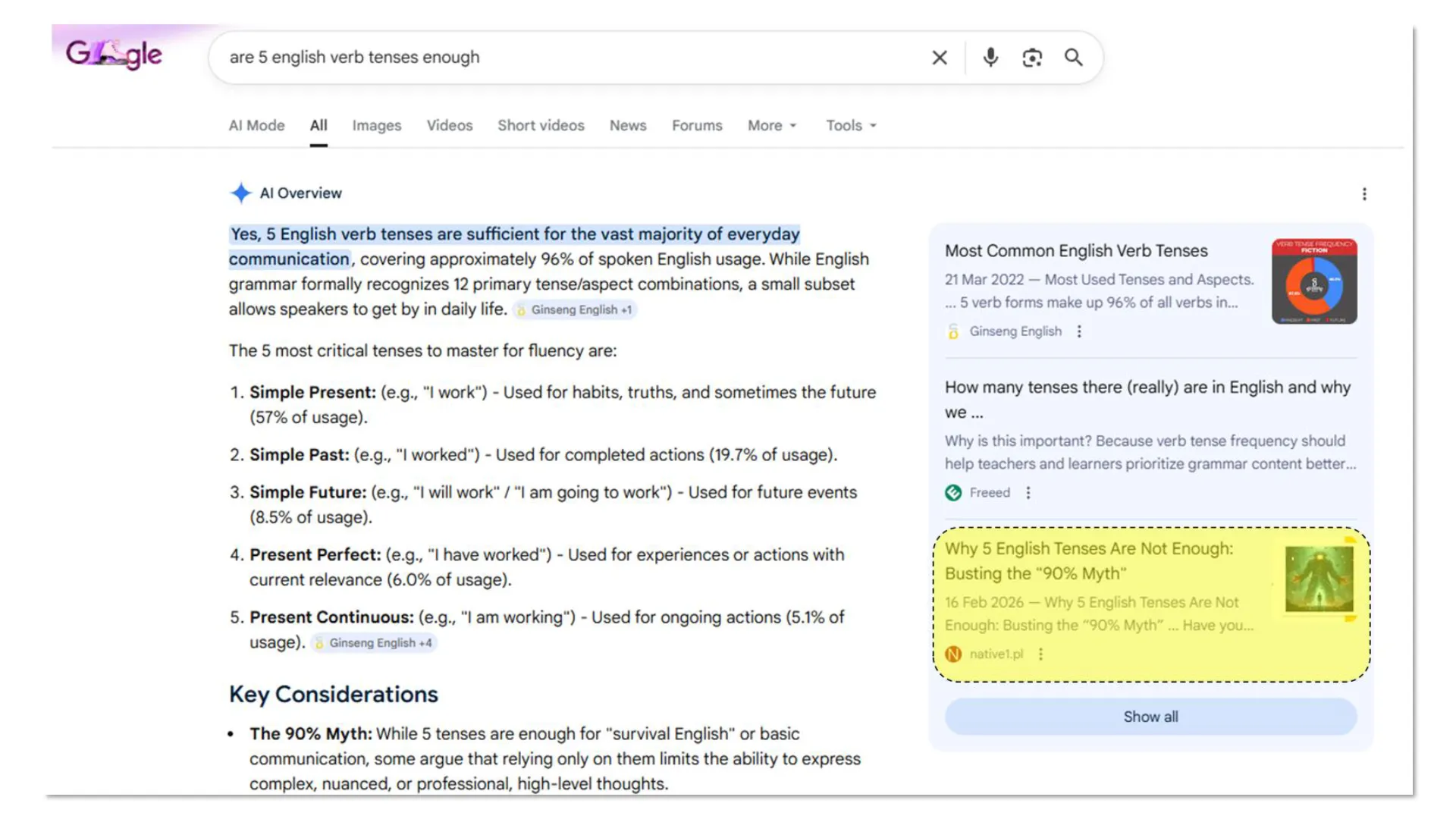
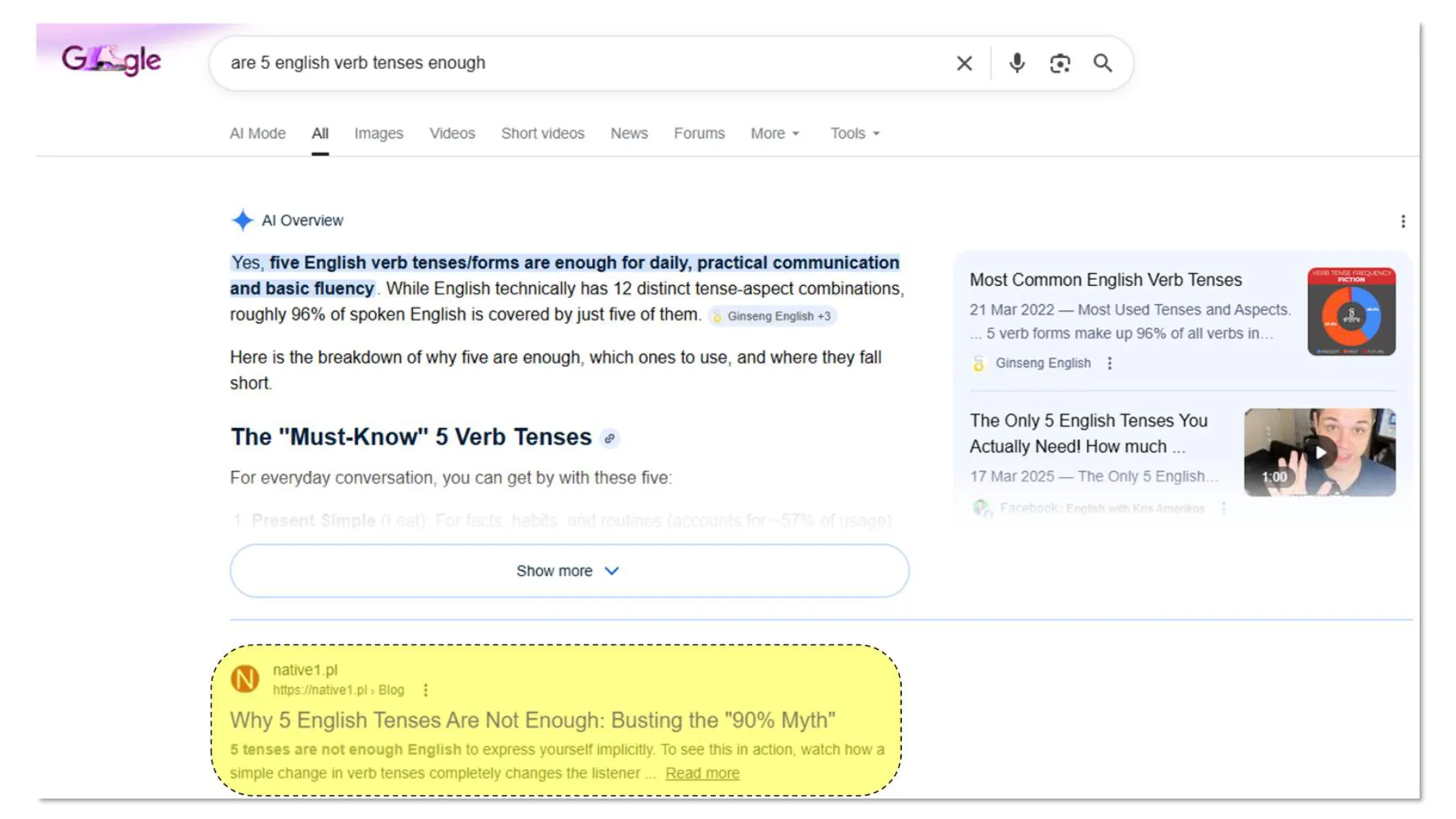
- AI Overview citation: The query “are 5 english verb tenses enough” returns an AI Overview citing Native1.pl alongside established competitors. The citation appears in the right panel carousel simultaneously with the organic result.
- Number 1 organic ranking: The 90% Myth post holds position 1 for the target keyword. The ranking was achieved overnight after the audited version went live.
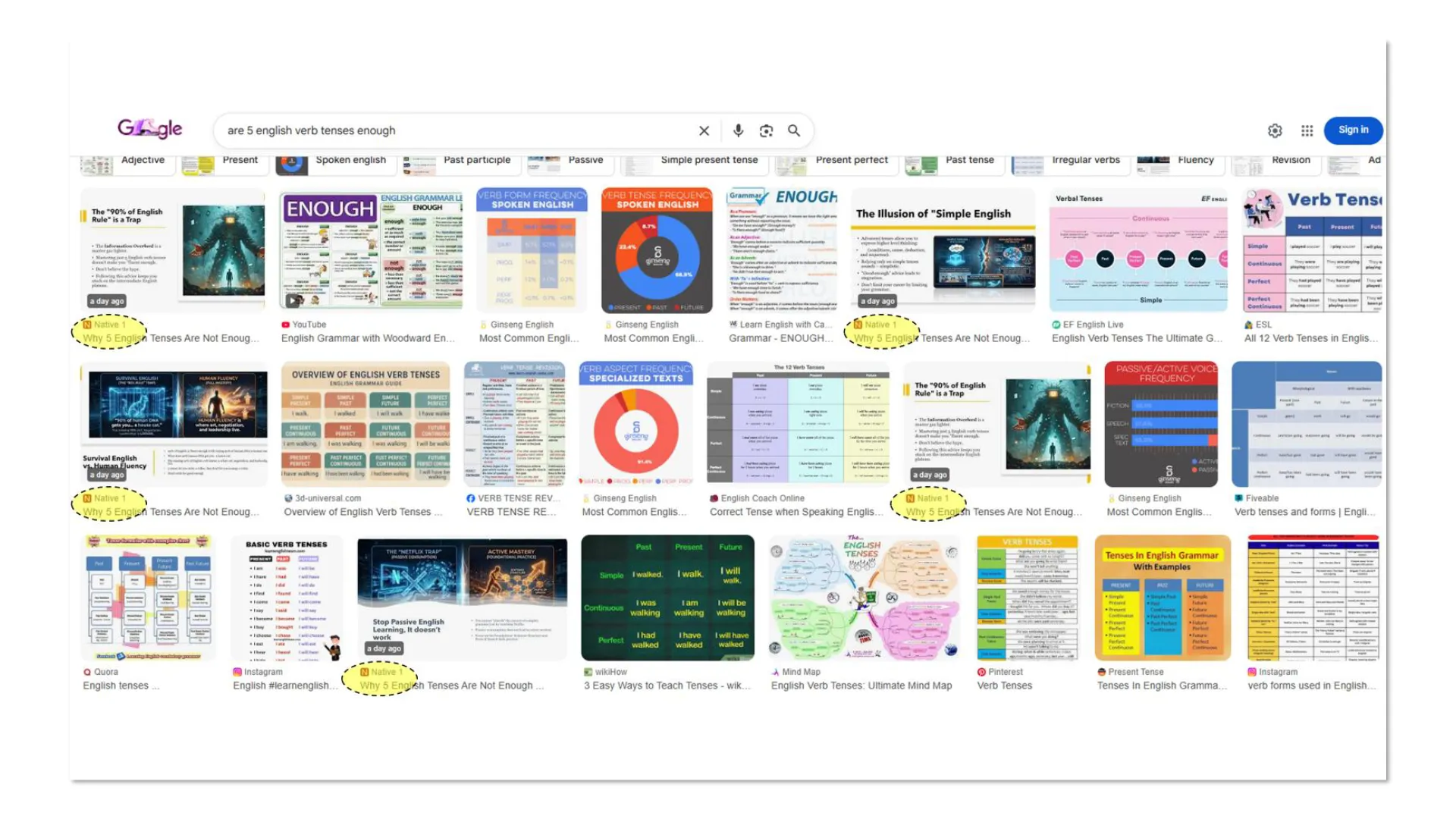
- Image search dominance: Native1.pl images occupy multiple positions across the top rows of Google Image Search for the same query. The SlideShift-processed WebP assets carrying entity-rich naming and didactic alt text are indexed as core technical content rather than decorative elements.
First observe the citation screenshot.
Case Study 2: ContentOps.so — The Built-From-Scratch Route
Domain: contentops.so — content operations SaaS, DA1, one registered backlink at time of publishing
Target keyword: “why aren’t my rankings improving after an seo audit”
Route: Built from scratch using the full ContentOps production line
The Production Line
This is the same script, written before the page existed rather than recovered through an audit. The full campaign documentation is available in the Sovereign Scaling Protocol intervention report, which documents the nine-node shadow phalanx that supported the primary anchor page.
The process began with a monologue — a raw audio capture of the contrarian angle and the Human 10% the post needed to carry. That monologue was passed into the writing session alongside the JSON topical map export, which loaded the exact keyword preferences, anchor text options, and offer IDs to prevent AI drift between sessions and lock down the semantic boundaries of the post.
The HTML Wrapper ran the draft through clean structured HTML output, stripping any formatting noise from the writing environment before the content ever touched the CMS. The AI then acted as a switchboard between the topical map and the wrapped HTML draft — applying the Broken Bones structural fixes and wiring the Wire Up internal link recommendations with natural bridge sentences rather than force-fitted anchor text. The full Expert AI Content Manufacturing workflow was deployed at every station.
Before the page went live, the Audit Suite ran its full diagnostic pass. Mission 1 validated the heading spine. Missions 2 and 3 optimised the internal link network. Mission 4 surfaced Shadow Concepts — the supporting entities the post referenced but hadn’t yet built dedicated nodes for. The post shipped with a structurally verified, machine-readable architecture.
The images went through SlideShift. The Bones, Joints, and Cartilage assembly deployed the corrected HTML into WordPress as modular sections, with SlideShift snippets in the joint positions and cartilage sentences bridging the text blocks to the visual assets.
The Keyword Geometry
The page targets a fully formed long-tail question: “why aren’t my rankings improving after an seo audit.” This is the operational frustration of a specific practitioner in a specific moment — a business operator who fixed their title tags and meta descriptions and watched nothing move.
The on-page geometry deploys the Rising Tide Protocol. The layout opens with the verbatim question as an H2 heading, followed immediately by a concise direct answer engineered to satisfy AI Overview extraction filters. The machine can read the question, find the answer, and return it in a generative response without needing to process the full page.
The Triple-Threat Result
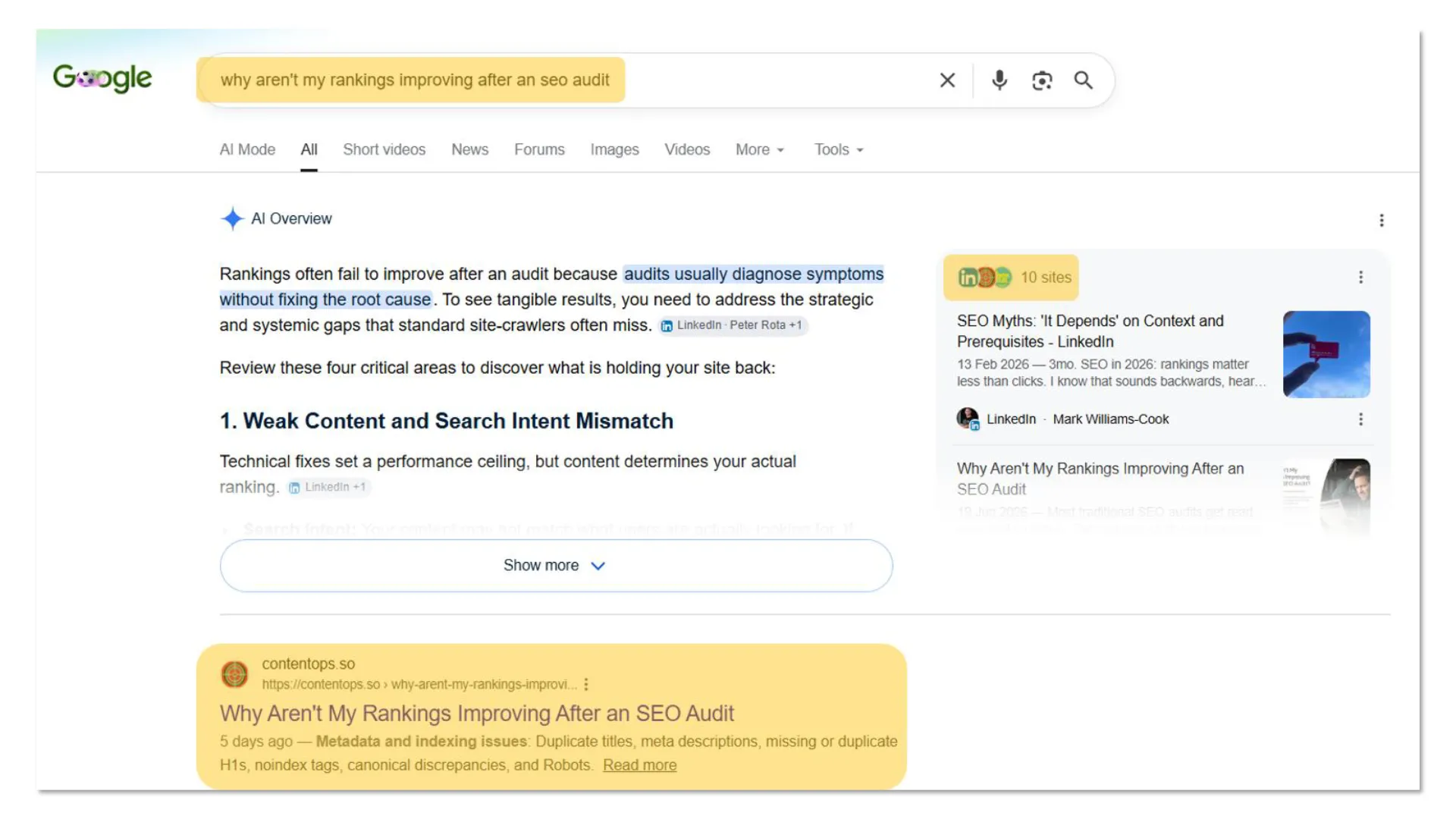
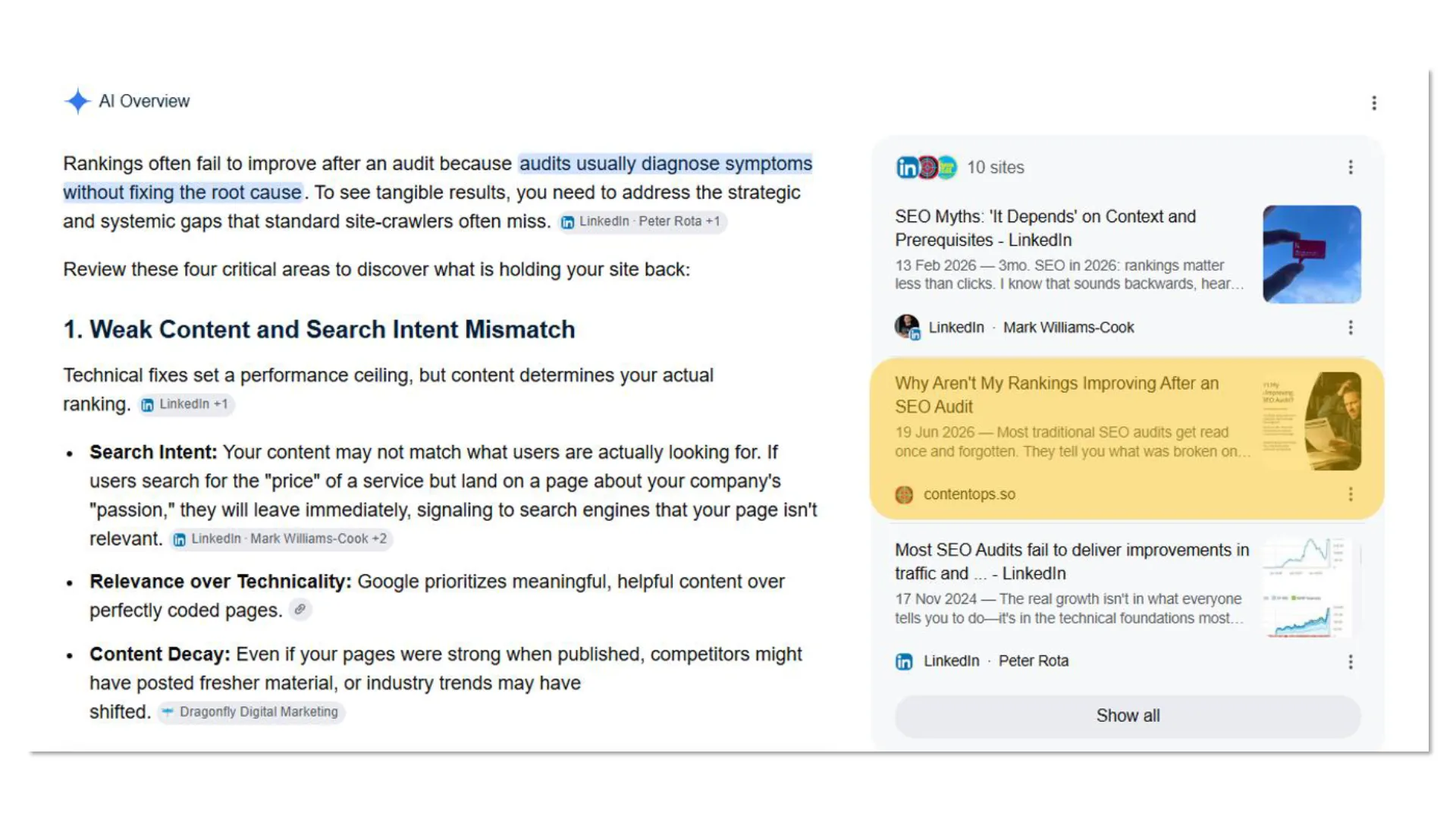
- AI Overview citation: The query “why aren’t my rankings improving after an seo audit” returns an AI Overview with ContentOps.so cited in the right panel alongside LinkedIn sources. The citation logo appears as a recognised source for this query despite DA1 and one registered backlink.
- Number 1 organic ranking: ContentOps.so holds position 1 for the target keyword — a brand new domain with no legacy ranking history, secured against established content operations and SEO publications.
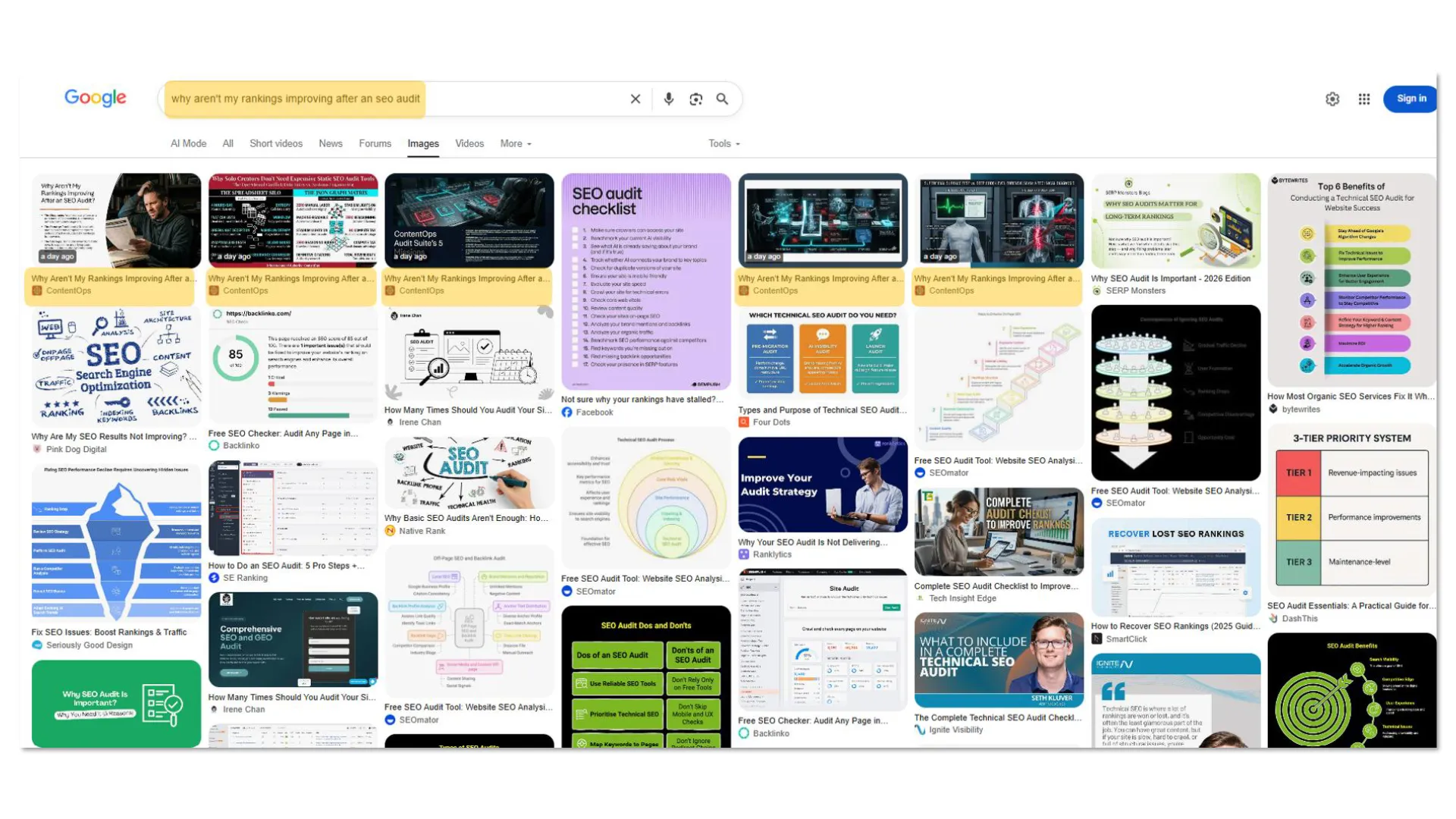
- Image search top-row monopoly: ContentOps images dominate the top row of Google Image Search for the same query. Multiple positions in the first two visible rows are ContentOps assets, SlideShift-processed WebP files carrying entity-rich naming and didactic alt text that the multimodal crawler indexed as primary content.
Now observe the # 1 organic ranking for the ContentOps post:
What Both Results Have in Common
Two domains. Two niches. Two different routes — one forensic audit, one built from scratch. The same Triple-Threat result.
The common denominator is not domain authority. Native1.pl has DA15 and an established backlink profile. ContentOps has DA1 and one backlink. The gap in traditional authority signals is enormous. The gap in results is nonexistent.
The common denominator is the script. Both pages gave the AI exactly what it needed to speak accurately on their behalf. This is the Solar System Method operating as designed — every layer of the architecture working simultaneously rather than being optimised for in isolation:
- A structurally clean HTML document the machine can ingest without fighting through visual noise.
- A keyword alignment precise enough that the AI Overview extraction filter can identify the question being answered and pull the response.
- A multimodal asset layer carrying teaching information in the visual channel, not just decorative images the crawler discards.
- An internal linking architecture that tells the crawler these pages belong to a connected knowledge system rather than existing as orphaned endpoints.
The pretty White woman doesn’t improvise when she knows the material cold. These pages gave her the full script before anyone asked.
FAQ: Tools That Produced the Triple-Threat
What is the Topical Map Tool and why does it matter for these results?
The Topical Map is the script before the post exists. It holds the node relationships, the anchor text arrays, the keyword intent, and the offer wiring that the AI writer draws from in every session. Without it, the AI improvises — and improvised characterisations of your brand, pulled from whatever the model happened to learn about similar-sounding products, may have nothing to do with what you want said. The map is the context injection that prevents AI drift and keeps every post aligned with the same semantic architecture across the whole site. Both results in this case study were produced by pages wired into a live topical map.
Topical Map Tool for AI Content Strategy
How did the HTML Audit Tool contribute to these results?
The Native1.pl result came through a forensic HTML audit. Mission 1 (Broken Bones) ran against the raw page HTML, surfaced the structural failures the URL-level crawl had never flagged, and produced a .txt diagnostic the AI used to generate the fix-it brief. The heading spine was corrected. The anchor text was made entity-rich. The keyword placement was verified. A page that looked fine visually was structurally misaligned at the code layer — and the audit found it. The HTML Auditor runs Mission 1 on any page you give it. For more information on how it works, visit the HTML SEO Audit Tool page to learn more.
There is also a free version of the HTML SEO Audit Tool for you to try on your own pages. The diagnostic report is free and ungated. However, you would need to sign up for free if you want to try the AI Fix-It brief.
What role did the Publishing Accelerators play in the ContentOps.so result?
The ContentOps post was built from scratch using the full publishing stack. The HTML Wrapper converted the formatted draft into clean structured HTML before it touched the CMS. The Splitter cut the corrected final document into modular sections for fast WordPress assembly — each section a single paste job into an HTML Widget rather than a widget-by-widget rebuild. The cartilage pass after publish added semantic bridge sentences at the visual break points between text blocks and images. Together the three accelerators took the post from final draft to structurally verified, machine-readable page without introducing page-builder code bloat at any point in the process.
Publishing Accelerators — HTML Wrapper, Splitter, and SlideShift
How did SlideShift produce image search dominance on both domains?
The SlideShift Image SEO Optimization Tool converted every visual asset through its PDF-to-WebP pipeline, applying a topical-map-grounded didactic alt text generation pass to each image. The alt text teaches the crawler what the image means in context of the page’s argument instead of merely describing the image. The tool renames the files using an explicit entity-array naming convention that reinforces the page’s keyword intent at the file level. The resulting HTML figure snippets were pasted into joint positions between the text sections during WordPress assembly. The multimodal crawler indexed these assets as core technical content — not decorative elements — and returned them in the top rows of Google Image Search for both target queries.
SlideShift Image Optimisation — Free Tier Available
Can these results be reproduced on a new domain with no authority?
Yes. The ContentOps.so result was achieved on a DA1 domain with one registered backlink. Domain authority is a signal that accumulates through traditional link-building campaigns. AI citation confidence is a signal that accumulates through structural clarity, vocabulary seeding, and content architecture. These are different systems measured by different mechanisms. A structurally clean page, precisely aligned with its keyword intent, carrying multimodal assets with didactic alt text, wired into a connected topical map, and published with GSC and BWT indexing submission can achieve the Triple-Threat on a new domain — because the AI reads the structure, not the domain history.
What is the difference between the audit route and the built-from-scratch route?
The audit route starts with a page that already exists — written with practitioner expertise, carrying real human insight, but built in a page builder that introduced structural noise between the content and the machine. The audit removes the noise, corrects the spine, wires the internal links, and runs the images through SlideShift. The built-from-scratch route starts with the map and builds the structural layer correctly from day one, eliminating the need for an audit pass later. Both routes reach the same destination. The from-scratch route is faster per page. The audit route is necessary for any domain with an existing content library built before the ContentOps system existed.
If you want to verify whether your existing pages are positioned for the Triple-Threat, the free Structural HTML Auditor runs the Broken Bones diagnostic on any page you give it — free, ungated, no subscription required.
If you want someone to engineer the citations, run the sterile environment testing, and build the vocabulary seeding campaign — the AI Citation Audit service is where that work happens.
AI Citation and Engineering Service
Hindsight Insight: The Script Was Always the Missing Piece
If I could do it all over again, I would have understood earlier that the AI isn’t failing to cite me because I lack domain authority. It’s failing to cite me because I haven’t given it the material. The pretty White woman was always willing to sing. I just hadn’t written the song yet.
Both results in this case study came from the same realisation applied in two different contexts. Write the script. Build the structure. Teach the images. Wire the map. Then let the machine speak for you — to the customers you’ll never see, in the conversations you’ll never know happened, delivering exactly the characterisation you engineered in advance.
That’s what GEO actually is. Not optimisation in the traditional sense. Scriptwriting. And the results hold, at DA1 and DA15, in a SaaS niche and an ESL niche, built from scratch and rescued from a page builder, because the mechanism is the same wherever the script is written clearly enough.