
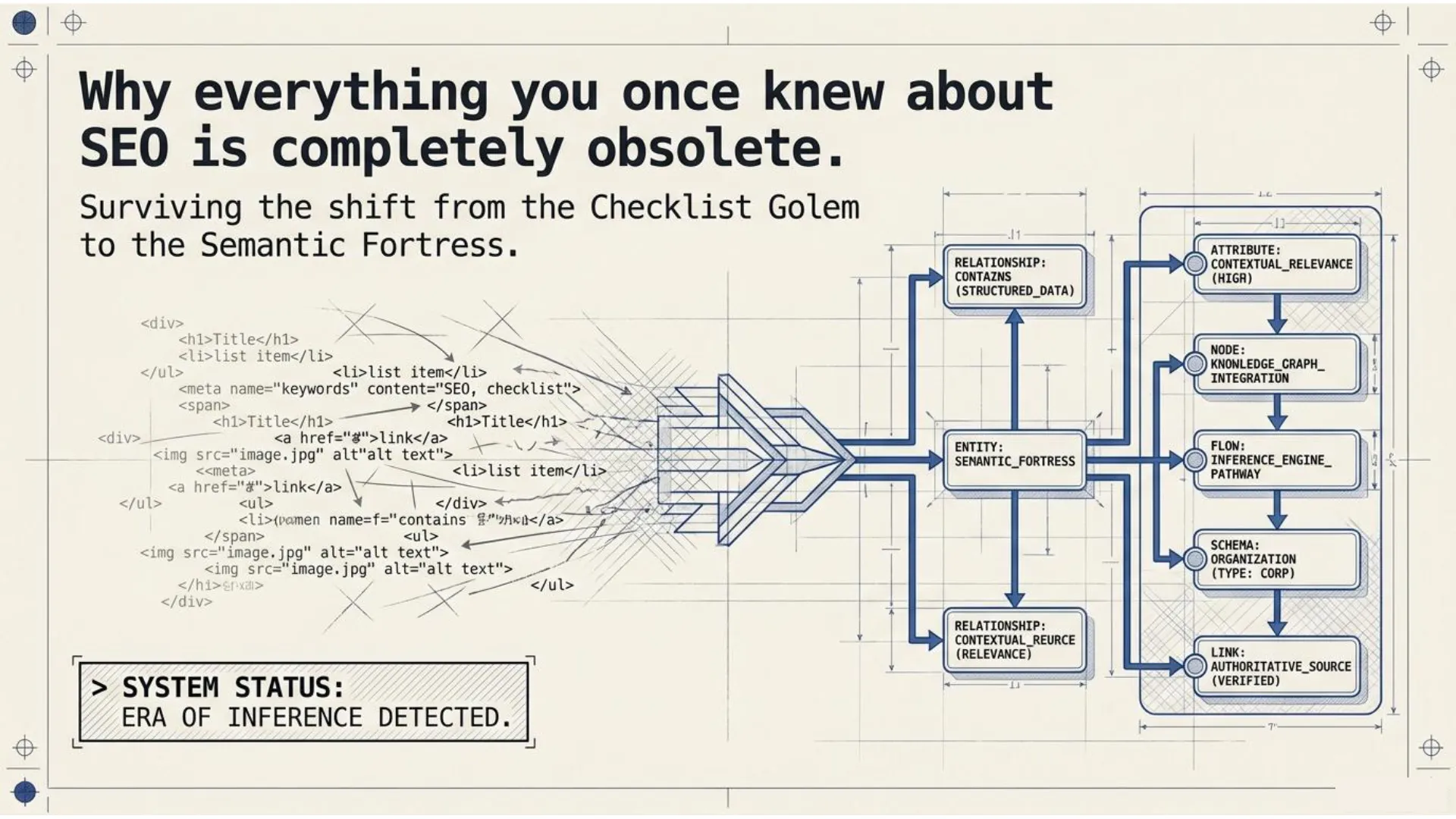
You are an expert—a founder, technical lead, or niche specialist with blood on the tracks. But for the last decade, the search industry has treated you like a data-entry clerk, forcing you to chase green lights on outdated plugins that promise authority. The result is Symptomless Death: your dashboards report perfect health, yet your traffic flatlines and your visibility disappears.
The search landscape has fundamentally shifted. We have exited the era of retrieval—where you simply stuffed a keyword into a header to rank—and entered the era of inference. Answer Engines like Perplexity, ChatGPT Search, and Gemini do not read your blog posts to find a list of links. They parse your code to synthesize an answer.
If your site is built on the sand of keyword-stuffed checklists, you aren’t just losing traffic; you are suffering from a profound Entity Disconnect that renders your expertise invisible to the machines that now control the discovery layer. Surviving this transition requires abandoning the Checklist Golem and building a sovereign seo infrastructure.
The Checklist Golem and the Illusion of Health
The legacy plugin providers and tool overlords have sold you a dangerous illusion: that SEO is a game of mechanical, lexical compliance. They provide a failure checklist that tells you what you didn’t do, but they lack the capacity to diagnose systemic rot.
Syntactic Matching is Dead
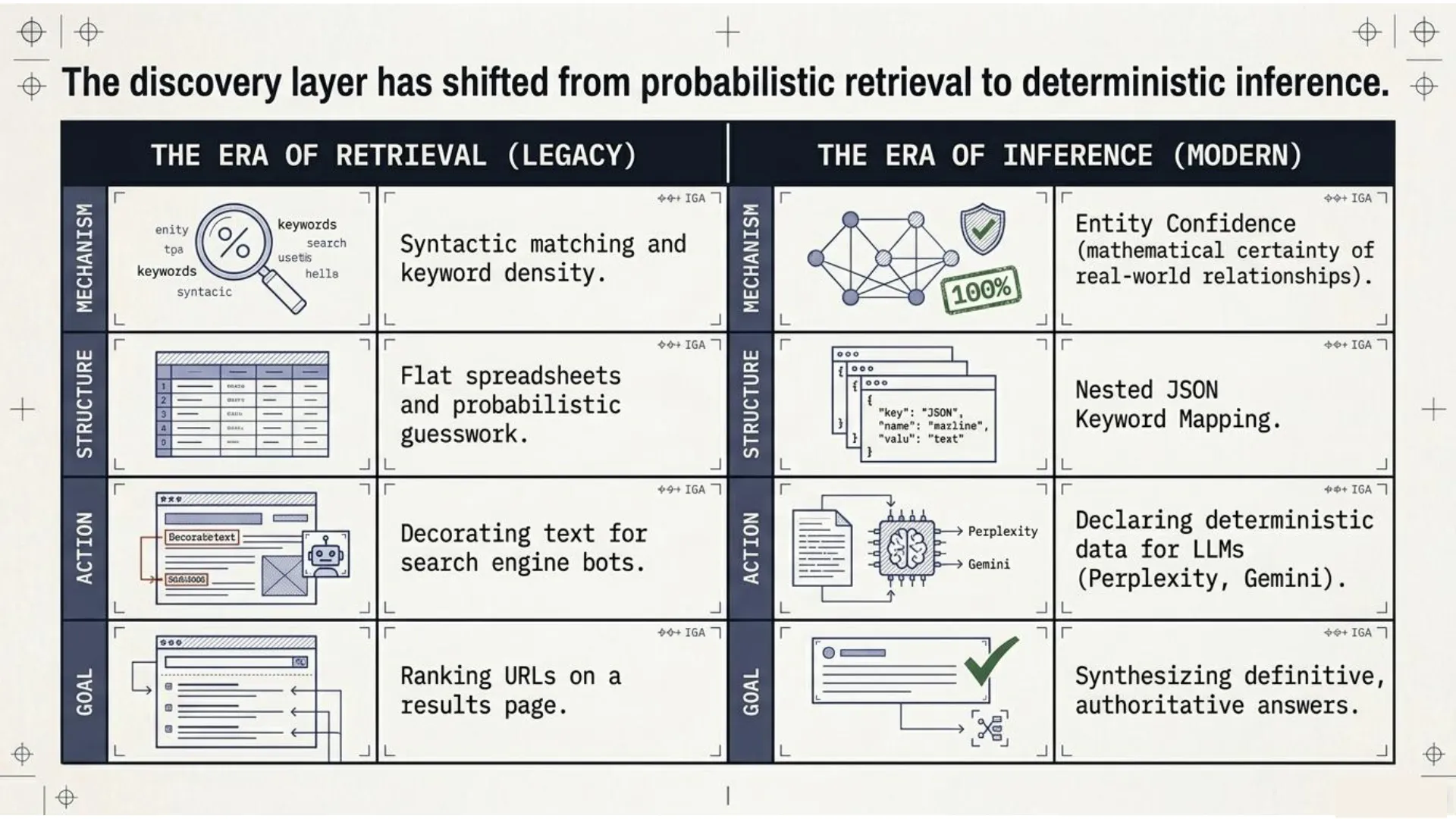
Traditional optimization relies heavily on keyword density and exact-match strings. However, traditional SEO plugins focus on syntactic metrics that are increasingly ignored by Answer Engines. In other words, those Green Light plugins are just Gaslighting you now as modern Large Language Models (LLMs) do not care how many times you repeat a phrase; they rely on Entity Confidence—the mathematical certainty that the AI knows exactly who you are and what relationships you hold in the real world.
Diagnosing Structural Rot
When you rely on legacy metrics, you invite pathogens into your foundation. A proper seo structural decay audit often reveals that “optimized” pages are little more than semantic noise. The AI cannot find the core entity because it is buried under bloated code, disjointed headers, and generic text. The primary culprit is often the spreadsheet itself; because flat rows cannot communicate hierarchy, they keep your AI blind. To move from probabilistic guesswork to deterministic ingestion, you must transition to JSON Keyword Mapping. Without this structural upgrade, your expertise looks like an untrustworthy hallucination to an LLM.
The Pivot: RAG Pipelines and Deterministic Code
To survive the AI transition, we must fundamentally change our operating model and view seo as infrastructure calibration. This is not about writing “better content.” It is about structuring your data and optimizing your website architecture so that generative pipelines can ingest it with deterministic certainty.
The Compute Tax Penalty
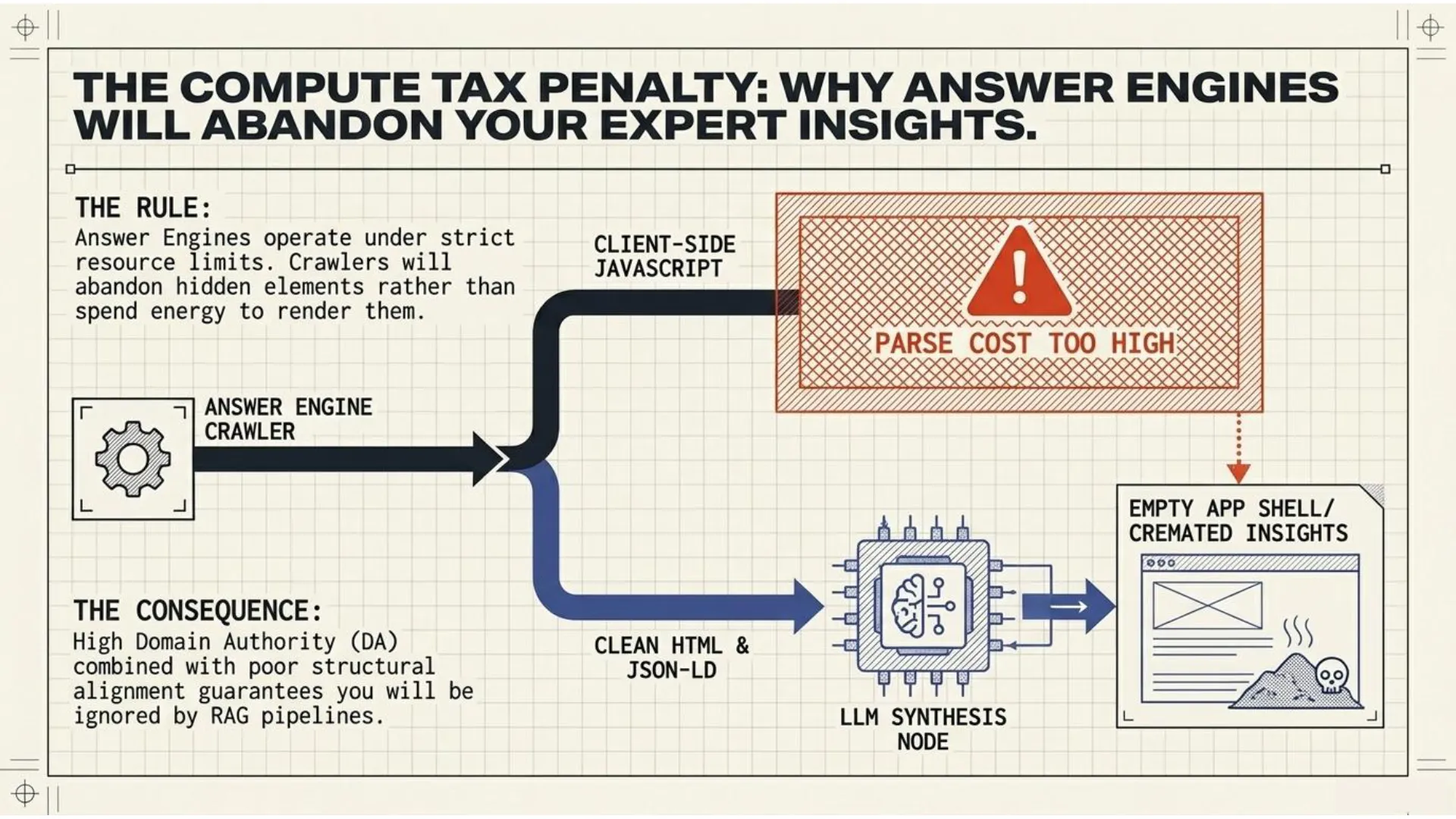
Answer Engines operate under strict resource limits. When your site relies on heavy, client-side JavaScript to render its core message, you present an “Empty App Shell” to the crawler. This incurs a massive compute tax penalty. As explored in our forensic report on The RAG Compute Tax, JS-heavy sites are deprioritized by RAG pipelines due to high parse costs. Crawlers will simply abandon hidden elements rather than spend the energy to render them, effectively cremating your expert insights.
Overcoming Symptomless Death with AEO and GEO
Domain Authority (DA) used to be the ultimate shield, but high DA is no longer enough to guarantee retrieval. High DA combined with poor structural and entity alignment results in symptomless death, as it is entirely ignored by RAG pipelines.
This is where the paradigm shifts from traditional SEO to AEO (Answer Engine Optimization) and GEO (Generative Engine Optimization). While SEO was built to rank URLs on a page, AEO and GEO are designed to feed deterministic data directly into LLMs so they can synthesize definitive answers. To counter Symptomless Death, architects must conduct a rigorous aeo geo structural audit to ensure their brand is not just mentioned, but structured as a definitive, unambiguous node in the Knowledge Graph.
Understanding the shift to Generative Engine Optimization is one thing; seeing it executed from a standing start is another. While the principles here explain the ‘why,’ we documented the exact ‘how’—from prompt sequence to off-site seeding—that allowed a Domain Authority 1 site to secure a direct citation inside Google Gemini. Read the definitive guide to our system in the CASE STUDY — The Anatomy of a GEO Citation.
The E-A-V Model and JSON-LD
The foundation of this new architecture is the Entity-Attribute-Value (E-A-V) model. We must transition from decorating text for bots to declaring data relationships for LLMs—a process we call The Schema Bypass. JSON-LD Knowledge Graph schema acts as a deterministic signal for AI citation eligibility via EAV analysis. GraphRAG pipelines rely almost entirely on these structured, nested representations to resolve ambiguity and generate confident answers.
Information Gain as the Primary Currency
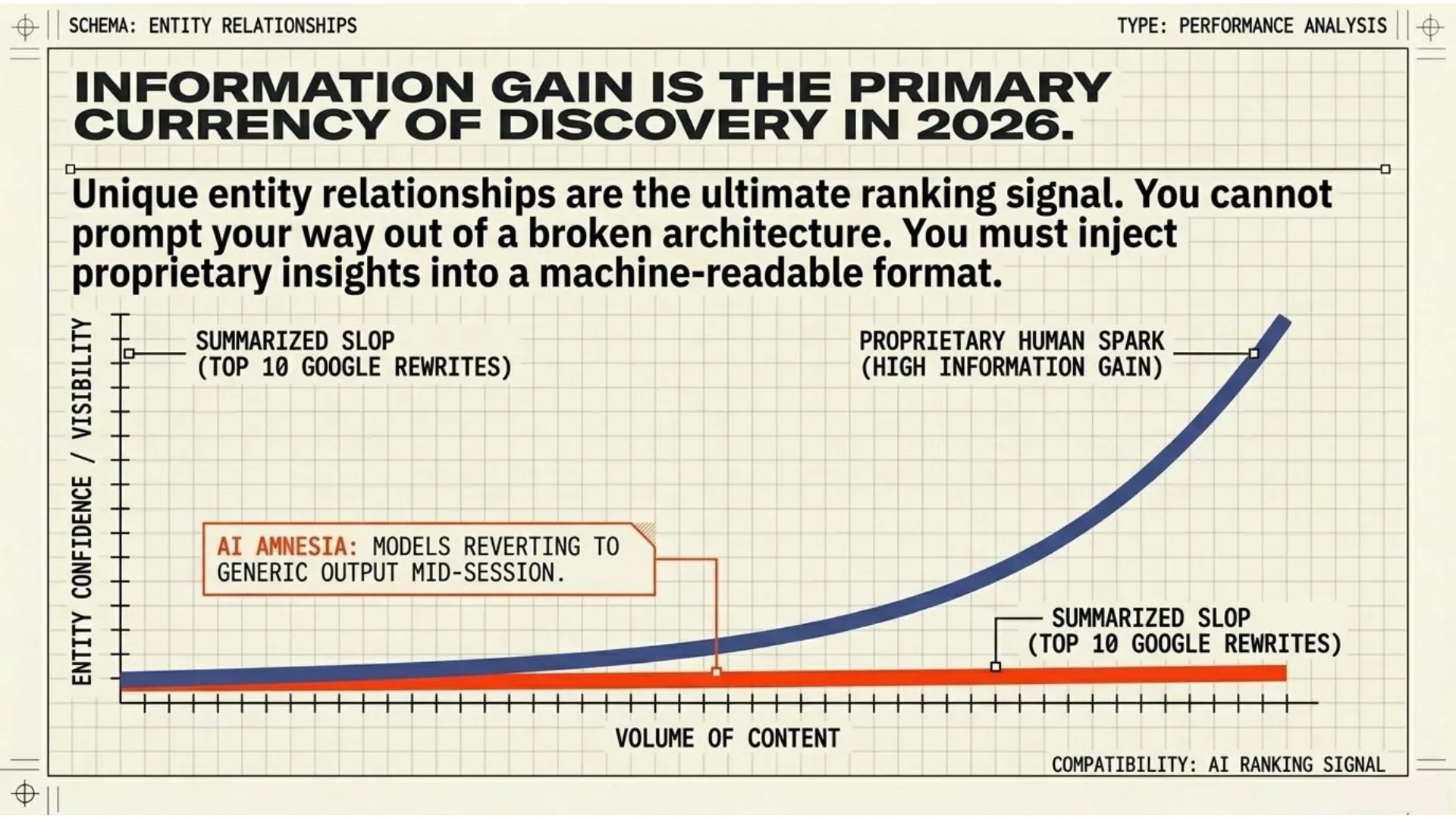
Once your infrastructure is calibrated and your entities are mapped, the ultimate metric for visibility becomes unique value. Information Gain, driven by unique entity relationships, is the #1 ranking signal for 2026. You cannot achieve this by summarizing the top 10 Google results; you achieve it by injecting your proprietary, human spark into a machine-readable format. This prevents the common phenomenon of “AI Amnesia,” where models revert to generic slop mid-session. Learn how to anchor your brand identity permanently in our guide to Solving AI Context Drift for SEO.
The Sovereign Architect: ContentOps as the Utility Belt
The era of the “Vending Machine” prompt is over. You cannot prompt your way out of a broken architecture. Taking control of your visibility requires a ruthless aiops seo forensic methodology—moving away from isolated blog posts and into a master JSON Topical Map.
The Entity Alignment Mandate
An seo entity alignment audit is the necessary first step toward sovereignty. It exposes the hidden pathogens—the Div Soup, the missing H-tags, and the orphaned nodes—that are currently blocking your retrieval. ContentOps is not just a writing tool; it is the utility belt for the Sovereign Architect. Once aligned, you must wire your expertise into a Spartan Phalanx to prevent authority leaks. We automate this process through Semantic Internal Linking, using the Command Center to perform surgical extractions and re-alignments at scale.
Fusing the Islands: The Topical Map
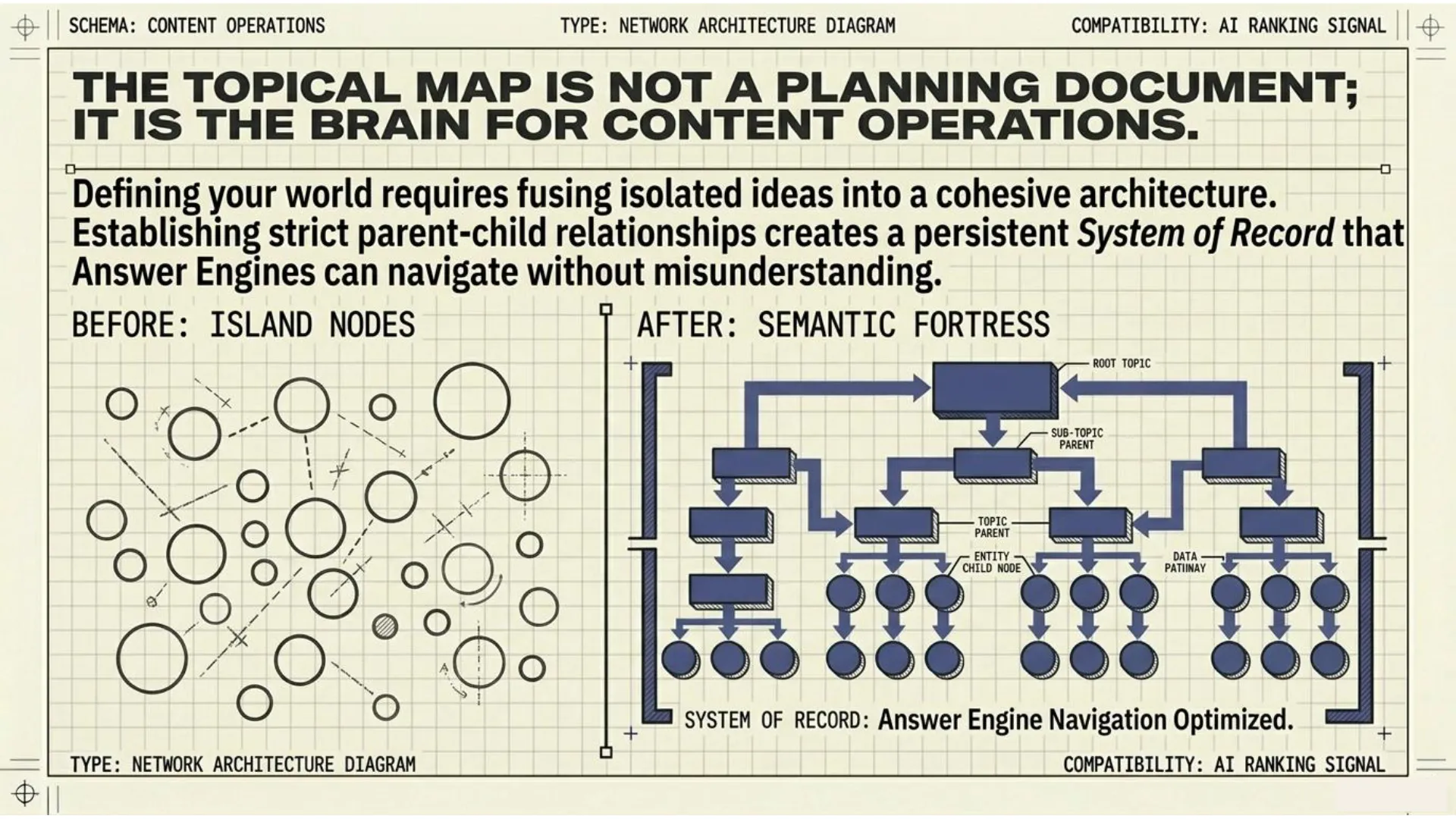
We start by defining your world. The ContentOps Topical Map does more than just organize ideas; it actively fuses isolated “Island Nodes” together into a cohesive Semantic Fortress. By establishing strict parent-child relationships, you create a bidirectional flow of authority that Answer Engines can easily navigate. This is why we treat the Topical Map for Semantic SEO as the Brain for Content Operations rather than a planning document. It ensures you are never misunderstood by providing the AI with a persistent System of Record.
AI-Powered JSON-LD Schema Generation
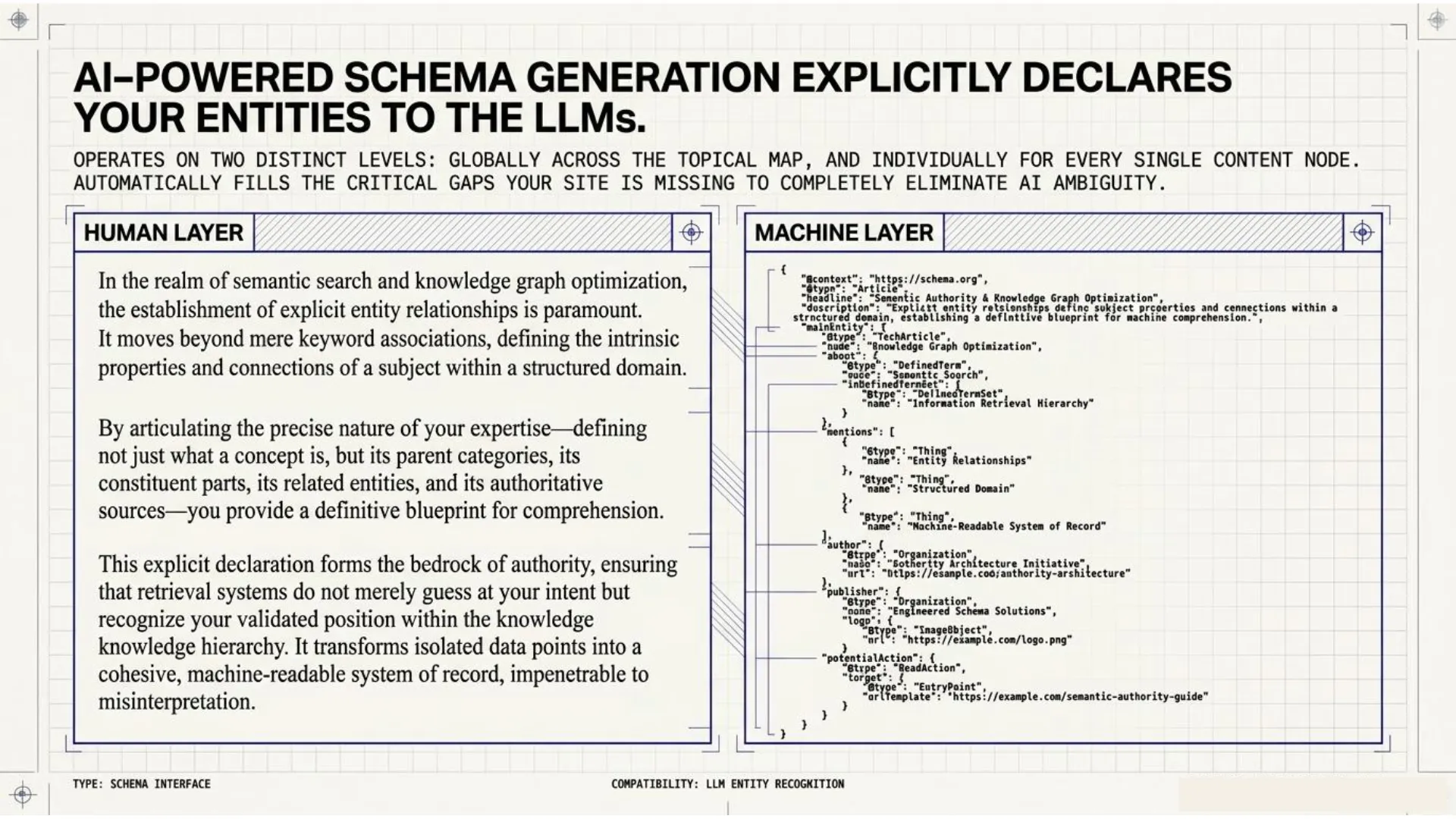
To eliminate ambiguity, we solve the entity declaration problem for you. ContentOps features AI-Powered JSON-LD Schema Generation that operates on two distinct levels: globally across your entire Topical Map, and individually for every single content node. We automatically generate the precise schema required to explicitly declare your entities, structure, and relationships to the LLMs, filling the critical gaps your site is likely missing.
Code-Level HTML Auditing & Surgical Fixes
The one true constant of SEO is the HTML. When the Robot Librarian crawls your site, it doesn’t see your beautiful design; it sees the raw code. Our Audit Suite allows you and your AI to view your posts exactly as the crawlers do.
We don’t just hand you a generic failure checklist. Our tool provides the exact, forensic surgical fix required to cure whatever structural misalignment your post has suffered. By solving your invisibility at both the code level and the schema level simultaneously, we ensure your expertise is deterministic, not probabilistic.
Stop Wandering. Start Building.
You possess the raw, niche expertise that AI cannot replicate. But until you house that spark in a Semantic Fortress, you are simply renting space on a collapsing algorithm. It is time to stop playing the clerk and start operating the manufacturing line.
🧱 Hindsight Insight: The Map is the Moat
“If I could do it all over again, I wouldn’t have spent years trying to please a plugin. I would have spent that time building a machine-readable map of my own expertise. In the AI age, your map is your moat. The magic isn’t in the tool; it’s in the grounding.”
Run Your First Forensic HTML MRI | Launch the ContentOps Command Center