

For years, “topical mapping” was treated as nothing more than a glorified keyword planning exercise. You made a visual mind map with the broad, short-tail keyword at the center, and you branched off related long-tail variants to develop a “topical cluster.” By doing this, you could build topical authority in your niche.
However, in the era of Answer Engines, that legacy model has collapsed. Most creators are still using their flat list of related keywords when today’s SEO landscape calls for a Topical Map for Semantic SEO. If you want to rank in 2026, you must stop “Keyword Chasing” and start Structural Engineering.
Stop Listening to Outdated Keyword Research Advice from 2020
Those hollow keywords from your flat CSV or spreadsheet often don’t carry the structural weight where one concept builds on the other. This is what AI crawlers are looking for in your content nowadays. When I first started learning about SEO, I followed the “Misguidance Counselor’s” advice to chase “Unicorn Keywords”—high-volume targets like “Zero Conditional” for my book, English Grammar Explained. That’s the same misguidance that convinces people a green compliance score is progress, when really it’s just why SEO checklists fail to catch the gap that actually matters.
I was trying to map long-tail versions of broad terms, but I realized that a complete map involves the building blocks too—the parts of speech, the nouns, and the adjectives that provide the actual foundation. I proved the power of this structural pivot in my Semantic SEO Whitepaper, where it was the intent-based scaffolding—not the keyword volume—that allowed me to topple the high-domain authority Goliaths.
The Shift From Keyword Lists to Relationship Mapping
What I’m proposing is a fundamental shift in how you use a topical map. Without this shift, you are simply starving at the Vending Machine, dropping a prompt and hoping for a five-course meal from an AI that has no ingredients and forgets who you are every thirty seconds.
While understanding the topical map as a strategic ‘brain’ is the first step, the true operational power comes from the language it speaks. A simple spreadsheet can’t convey the complex, nested relationships needed for deterministic AI ingestion, trapping your expertise in a flat, two-dimensional prison. See the forensic breakdown of why the data format itself is a weapon in our guide to JSON Keyword Mapping vs CSV.

1. Defeating the AI “Spotlight Effect” with the “Stadium Lights”
When you use an LLM without a map, your AI (yes, even Claude) suffers from the “Spotlight Effect.” Imagine you are in a dark room and you shine a light on the wall. Everything within that circle of light is illuminated and visible. That is what the AI “sees” and focuses on.
If you move the spotlight along the wall, new territory comes into focus while the trail where the light has moved off of falls into darkness. That dark zone is your context drift. So that prompt that you engineered with the Role, Goal, Context, and Constraints will all soon be forgotten and your AI reverts to the average of everything it knows—Vending Machine output.
Turning On the Stadium Lights
The value of the ContentOps Topical Map is that it encodes your business’s full content ecosystem with a depth of knowledge about each node that a flat keyword spreadsheet can’t compete with. When you drop a ContentOps JSON Topical Map into your chat, it’s like turning on the Stadium Lights, illuminating the whole field with a deep inferential playbook for your business in its memory.

Everybody’s Experienced Context Collapse At Least Once
I remember the first time I experienced this “collapse”—I realized that to give my AI a voice with authority, I had to ground it in my own history. I had built my first StoryBrand chat for my English learning website. This chat was excellent until it started forgetting the student stories for which it was designed to be a repository.
Right around the time I finished coding SlideShift to refactor visual assets (the first tool in the Utility Belt), I decided to build the second tool to capture those ideas and encode them in a more deterministic fashion. The ContentOps Topical Map Manager was born. The results were stark: my AI’s memory went from amnesiac to permanent, leading to effortless internal linking and improved auditing capabilities.
STOP LEASING GENERIC AI CHATS
Stop re-explaining your brand parameters to a blank prompt every single morning. Initialize Your Full ContentOps Mothership Subscription and lock down your enterprise context layer at scale.
2. The Deterministic Schema Generator: Automated Entity Ingestion
Why are you still generating schema node-by-node? This is a low-level chore that invites Workflow Entropy. In the inference layer, the “Checklist Golem” of legacy plugins cannot save you because Answer Engines are economically ruthless. They operate on strict energy budgets.
A machine shouldn’t have to “reason” to understand your site. By utilizing Deterministic Fidelity, the ContentOps map knows the relationships before you type a single word. Our 1-Click Semantic Injection flows from a Map Node directly to automated, nested JSON-LD at both the macro and micro levels. We move from “Probabilistic Guesswork” to Deterministic Ingestion, making your expertise 500x cheaper for the machine to cite. For the full technical mechanism behind bypassing that crawl-budget bottleneck entirely, read the Schema Bypass thesis.

3. The Global Map Audit: Hunting the “Ghost Spine”
Your site is likely suffering from Symptomless Death—isolated posts that look healthy in a dashboard but are functionally invisible to RAG pipelines. Without a map, you are performing surgery in the dark.
What you need is the Cartographer’s “Map Sense.” SEO rankings and AEO citations are based on more than mere on-page optimization; they want to see that your site is an interconnected superhighway. Authority is like liquid, and works best when it can flow from node to node. But if you ask your AI to “see” the connections between your post based on a URL, you are dreaming and the AI is 100% hallucinating those connections.
The Topical Map as a Big Board
The Topical Map acts as a Big Board, allowing the AI to infer the contents and semantic ideas with near mathematical certainty. The map automates the “Miyagi Chore” of internal linking, wiring your orphaned expertise back into the Spartan Phalanx. Every node must defend the one to its left; if a node is orphaned, your Phalanx is breached and your authority leaks. This is how we diagnose the structural rot explored in The Sovereign SEO Infrastructure Manifesto.
⚙️ THE ENTERPRISE BLUEPRINT DEPLOYMENT
If you want to shift completely out of manual blueprinting, our done-for-you Topical Authority Map Build service architects a custom, recursive graph format tailored directly to your technical sector to force deterministic engine citation. Otherwise, you could DIY with our Topical Mapping Tool.

4. The Opposition MRI: Hijacking Competitor Authority
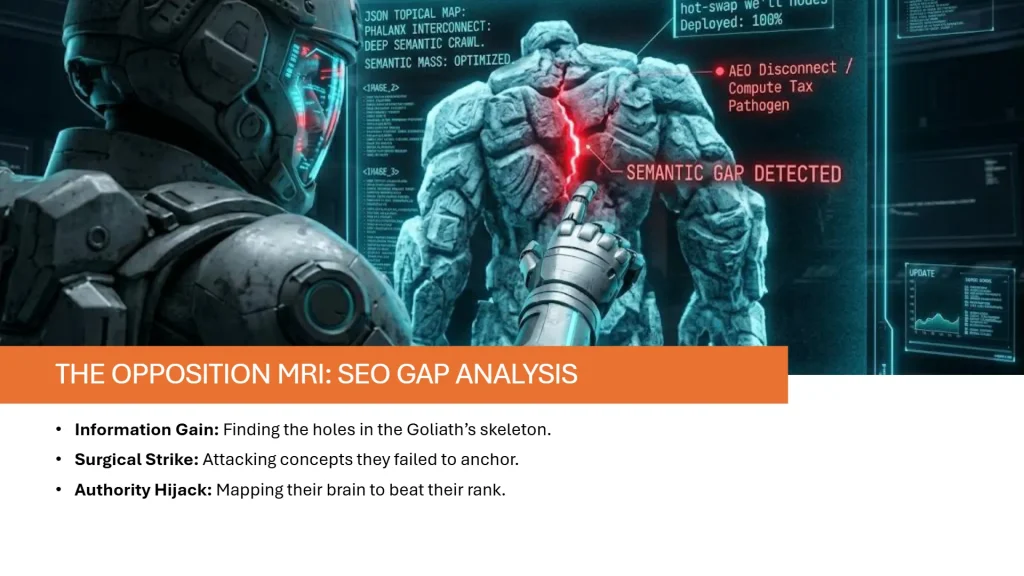
The Big Board is for more than interlinking; it is a weapon for Opposition Research. You cannot beat a high-DA Goliath by guessing their keywords. You beat them by mapping their brain. Using the ContentOps Audit Suite, you can perform a competitor’s post-to-your-map comparison to find where a competitor’s “Skeleton” is thin. Even further, you could do a map-to-map analysis although your competitor’s map would need to be custom built.
When you pit your map against a competitor’s, you aren’t just comparing search volume; you are looking for Information Gain deficits. This allows you to perform an adversarial Surgical Strike on the specific concepts they have mentioned but failed to anchor structurally, the same diagnostic instinct behind running a map expansion on your own posts. By extracting their un-anchored shadow concepts through an entity-based competitor gap analysis, you don’t just “write better content”—you systematically hijack their authority from the inside out and out-position them directly at the code layer.
⚔️ ADVERSARIAL RECONNAISSANCE
Stop duplicating their footprint. Let our specialists scan your rival’s perimeter code, isolate their un-anchored inference gaps, and build your execution roadmap with our turnkey Competitor SEO Gap Analysis service.
5. Inside-Out Expansion: Strengthening the Fortress
Keywords are an external distraction. Expertise is internal. Most creators fail because they chase “Unicorn Keywords” instead of mining their own nodes for Shadow Concepts. If you’ve written 50 posts and still have zero traffic, it’s likely because your “spotlight” is moving too fast and leaving gaps in your structure.
By using the “Map Expansion” function in the Audit Suite, you mine your existing posts for concepts that don’t have their own node yet. Internal linking is about more than routing authority; it’s about depth of coverage. Perplexity’s citation framework relies on this neural re-ranking—it looks for the “Next Hop” in your knowledge graph. If you haven’t mapped the route, the machine stops following you.

The “Inference Mirror” Verdict
This is not a planning tool. This is a category redefinition. We are moving from Syntactic Compliance (chasing green lights for the Robot Librarian of old) to Semantic Sovereignty.
- Traditional SEO: A list of keywords to “stuff” into a header.
- ContentOps: A Knowledge Graph that dictates your site’s survival in the age of RAG.
If you are not architecting your map to be citation-ready, you are effectively a tenant in a Digital Cemetery. If you want to make your site visible to Google and the LLM crawlers, you need the ContentOps Topical Map for Semantic Authority to be the Alpha and Omega of your Content Plan.
FAQ: Keeping Your Topical Map for Semantic SEO Alive and Accurate
Does a topical map for semantic SEO stay accurate once it’s built?
No. A topical map isn’t a deliverable you finish and file away — it’s a living Big Board, not a static blueprint. The moment you publish a new post, retire an old offer, or shift what your business actually does, an unmaintained map starts drifting out of sync with the real site. That’s worse than having no map at all: an AI reading a stale map doesn’t fail safely, it confidently inherits assumptions that are now wrong. Symptomless Death has a sequel, and it’s a topical map nobody’s touched in six months.
How does ContentOps keep a topical map current as a site grows?
Every new node gets wired into the graph the moment it’s created, and the Global Map Audit runs a standing check for orphaned nodes, missing anchor text, and structural drift before they become invisible problems. This is what separates a living map from a one-time export — it’s why the map lives inside the ContentOps Topical Map Tool, not a spreadsheet you built once and forgot.
Is a topical map the same thing as a keyword cluster?
No. A keyword cluster groups related terms; a topical map defines the relationships, offers, and entity structure connecting them, then hands that structure to an AI as a memory card. Grouping keywords tells you what to write about. A map tells the machine how everything you’ve written fits together.
How often should a topical map actually be audited?
Any time you cross a real milestone, not on a calendar schedule — after roughly 20 new nodes, or before a major initiative launches. Auditing by volume rather than by date catches drift while it’s still small enough to fix in an afternoon instead of a weekend.
Operational Prerequisite: The Semantic Cluster
To achieve Stadium Light Ingestion, you must calibrate your infrastructure across these published manufacturing missions:
🧱 Hindsight Insight: The Map is the Moat
“If I could do it all over again, I’d stop worrying about ‘ranking’ and start worrying about ‘mapping.’ In the age of AI, your authority is determined by how well your wisdom is connected, not how many keywords you stuffed into a header. The magic isn’t in the tool; it’s in the grounding.”
Run an MRI on your First Post | Initialize Your Semantic Fortress