
How to Preserve Brand Voice in AI Writing (Without Re-Prompting Every Session)
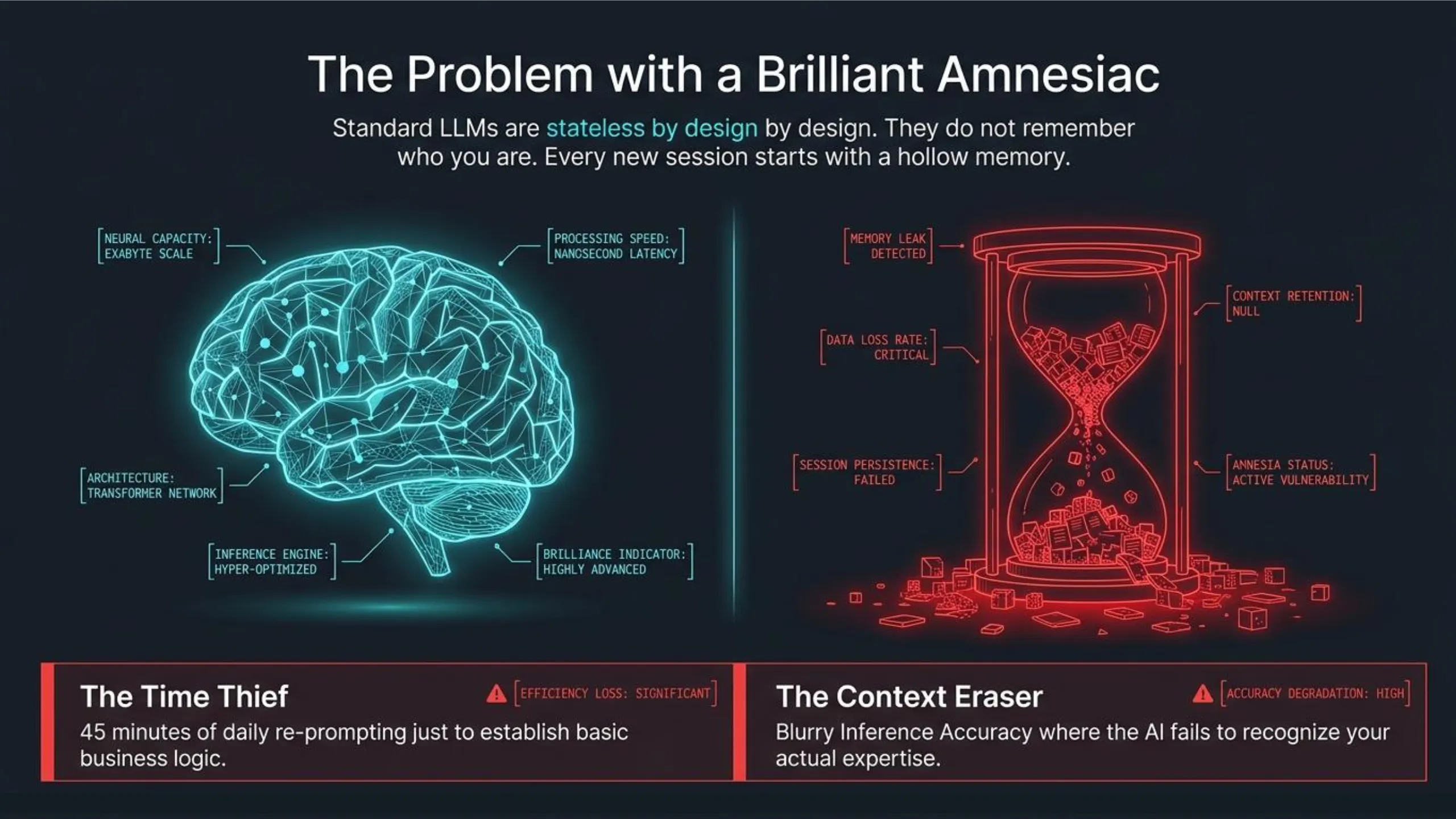
Every time you open a new AI session, your brand voice resets to zero. The specific vocabulary you’ve built, the tone you’ve refined, the internal linking logic you’ve encoded have all vanished from the Context Eraser. Standard Large Language Models are stateless by design, acting as “Brilliant Amnesiacs” that start every session with hollow memory. In content operations, this technical limitation is the root of AI context drift, and it’s the reason your AI writing keeps sliding toward generic output no matter how carefully you prompted it the previous time.
If you are a Sovereign Architect, spending 45 minutes every morning re-explaining your business logic to a chatbot makes you a victim of the Context Eraser and the Time Thief. This invisible friction is a hallmark of structural decay, as explored in The Sovereign SEO Infrastructure Manifesto, and it steals more than your hours as it sabotages the Inference Accuracy of your content—in other words, it makes your expertise too “blurry” for the AI to recognize. This is especially problematic if (like me) you’re trying to secure AI citations in addition to top organic rankings since your content needs to read like a script across all your content. But if that script is inconsistent, the AI loses confidence in your brand and won’t cite you, or worse, it will cite your competitors.
At ContentOps, we don’t believe in “better prompting”. We do believe in State Management though. Just like in the Matrix, they didn’t manually train Neo in Kung Fu; they simply uploaded the code directly into his brain.
With the ContentOps Topical Map, you download the latest version of your topical map and drop it into the chat. It is the equivalent of training your AI, like Neo, in your most priceless business asset—the business logic of your content plan.
STOP THE SELF-LOADER TRAP
Stop re-introducing your SEO strategy to a machine. Launch the ContentOps Mothership and hard-code your history today.
Why LLMs Forget: The Moving Spotlight behind AI Context Drift
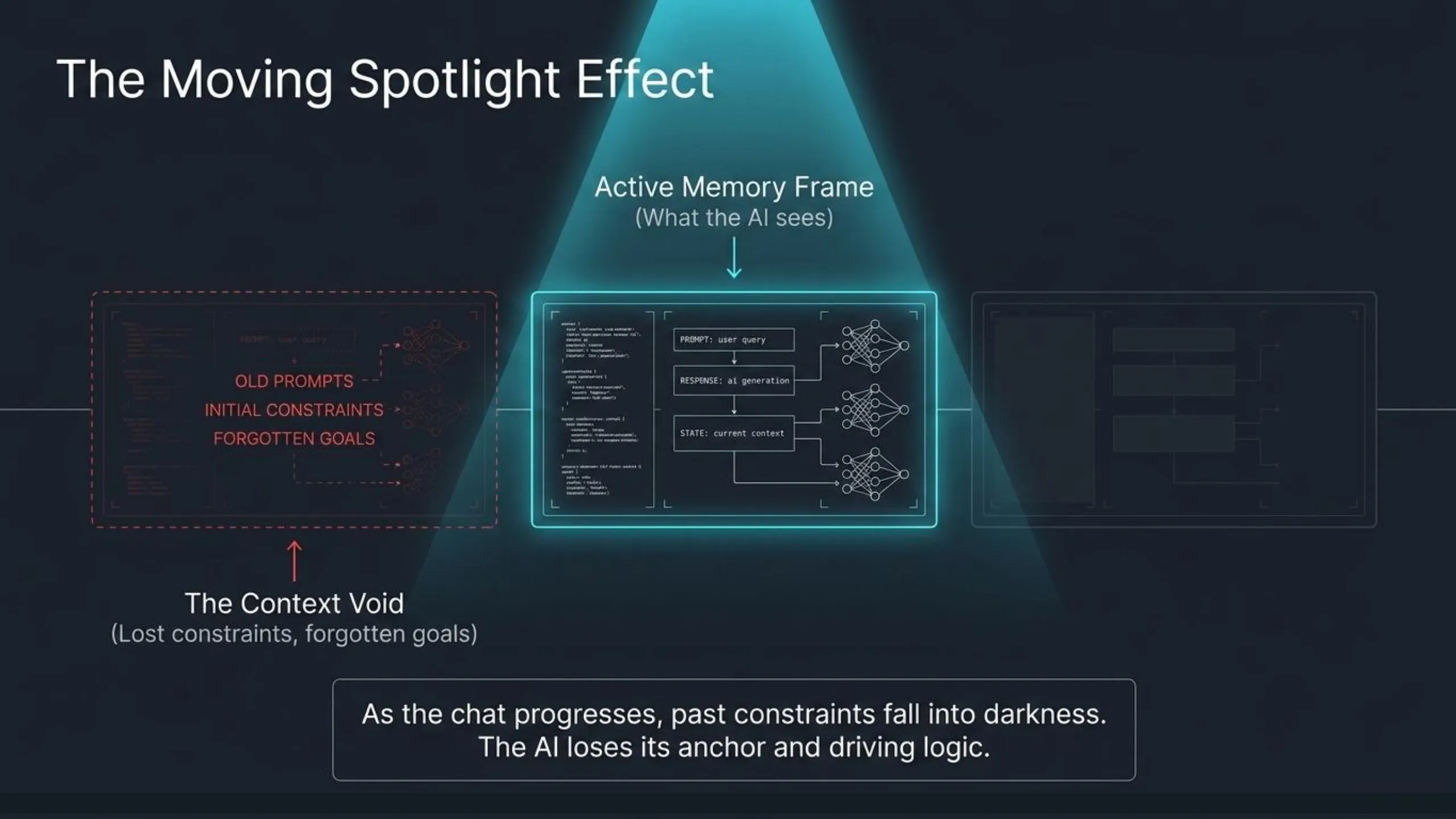
When you use an LLM without a map, your AI (yes, even Claude) suffers from the “Spotlight Effect.” Imagine you are in a dark room and you shine a light on the wall. Everything within that circle of light is illuminated and visible. That is what the AI “sees” and focuses on.
If you move the spotlight along the wall, new territory comes into focus while the trail where the light has moved off of falls into darkness. That dark zone is your context drift. So that prompt that you engineered with the Role, Goal, Context, and Constraints will all soon be forgotten and your AI reverts to the average of everything it knows—Vending Machine output. This is why, by paragraph four, your AI has forgotten that you are targeting “Habitual Truths” and that your primary villain is the Checklist Golem.
When the spotlight moves on, the LLM enters a Context Void. Lacking the specific data to anchor its reasoning, it defaults to the probabilistic average of the internet. Research into LLM statelessness confirms that without a graph-based orchestration layer—in other words, you have to give the AI a GPS map so it stops driving in circles. Models cannot maintain consistent logic across complex missions without understanding the underlying structural economics of RAG pipelines. To fix this, you have to switch on the Stadium Lights.
Graph-Based Orchestration: Moving from Flat Data to Neural Depth
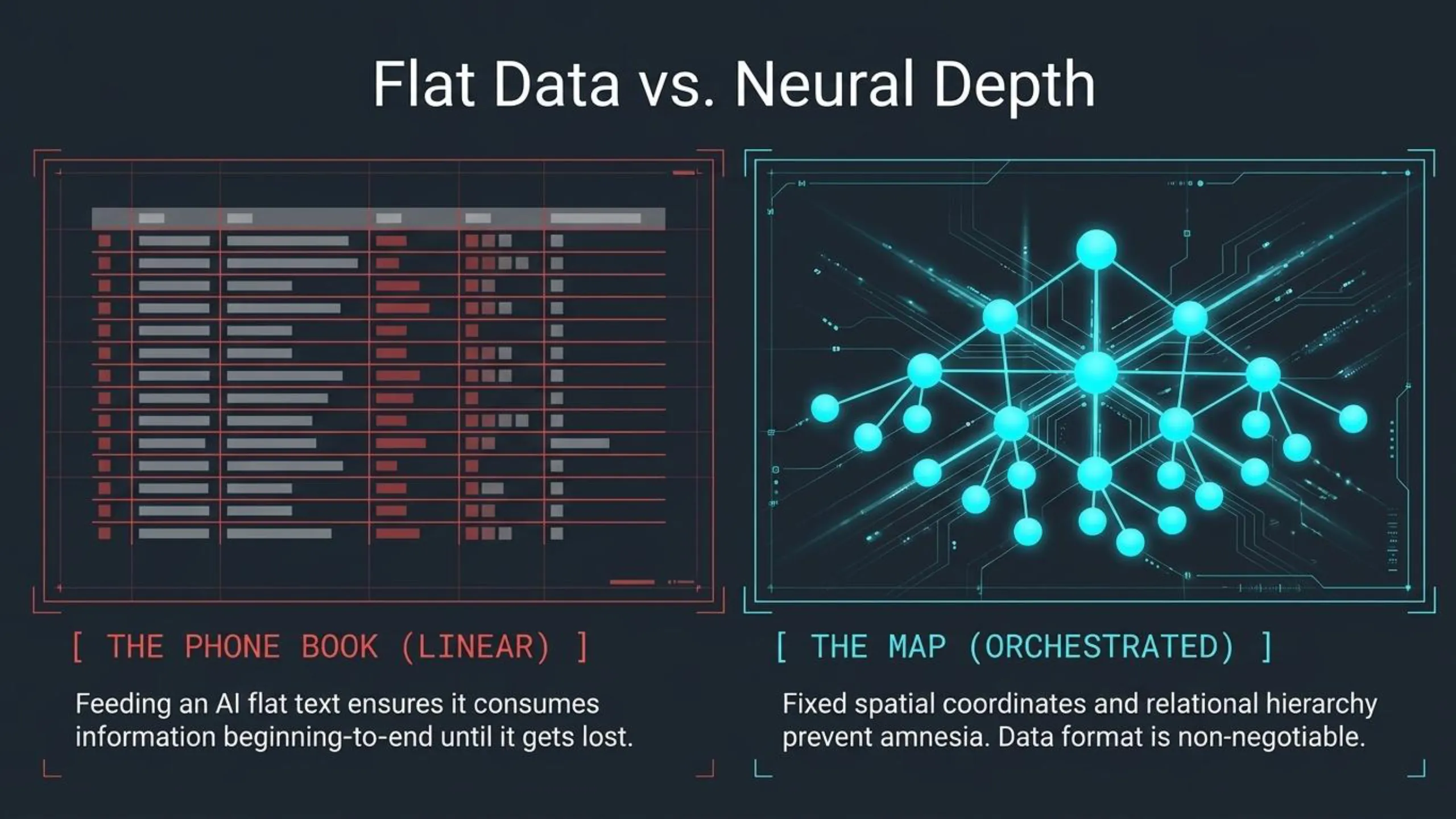
The technical reason your AI drifts is a lack of Graph-Based Orchestration. In a standard chat, information is linear; it is a string of text where the beginning is slowly being consumed by the end. But when you move to an orchestrated model, you aren’t just giving the AI a list—you are giving it a map with fixed coordinates.
The concept of ‘Stadium Light Ingestion’ relies on feeding the AI a structured, hierarchical blueprint of your expertise. Using a flat file format is like handing the machine a phone book instead of a 3D architectural model; it guarantees the AI will eventually get lost and suffer from context amnesia. Understand why your choice of data format is non-negotiable in the definitive guide: JSON Keyword Mapping vs CSV: Why Your Spreadsheet is an Invisibility Sentence.
The 60% Headstart: Front-Loading the Calibration
The mistake most creators make is trying to “train” the AI in real-time. This creates a massive Compute Tax on your own brain. In a high-velocity Expert AI Content System, we don’t “train” the AI; we calibrate the infrastructure.
Our process starts at 60% completion before you type a single command. By utilizing a Topical Map for Semantic SEO, we provide the AI with a persistent System of Record. We front-load the friction by encoding your business galaxy into a JSON-C manifest. When you drop this “Memory Card” into the chat, the AI doesn’t have to guess who you are or what your next internal link should be; it accesses the record of every post, product, and semantic anchor you’ve ever defined.
Why Your Brand Voice Needs a Permanent System of Record
If you want your site to thrive in the AEO/GEO era, you absolutely need a solution that gives you automatic grounding for your whole site and for each node. Without it, every session resets your brand vocabulary to zero — and every piece of content that comes out carries the generic fingerprint of a model that has forgotten who you are. A permanent System of Record is not a convenience; it is the infrastructure that makes your brand voice consistent enough for AI engines to recognise, trust, and cite.
Neural Depth vs. Flat Lists: Why Market-Leading Maps Fail the AI Test
When you drop this “Memory Card” into the chat, you are performing an act of neural engineering. It is important to distinguish this from the “topical maps” you see sold by standard SEO tool providers. Most market-leading topical maps are nothing more than colorful, visualized keyword lists—flat spreadsheets masquerading as architecture. While they might help a human plan a content calendar, they provide zero grounding for an AI because they lack the descriptive metadata and relational hierarchy the machine needs to reason.
In an upcoming post, we will provide a head-to-head breakdown of the ContentOps Topical Map vs. the industry standard. We will dissect why those legacy visualizations couldn’t match our “neural depth” in a million years, and why the Robot Librarian requires the specific data-rich coordinate system of a true Semantic Topical Map to grant you citation authority.
The Anatomy of a Memory Card: JSON-LD + Brand DNA
A true “Memory Card” fix for SEO is built on three layers of technical Cargo:
- The Human Spark (The Soul): A 10-minute expert monologue. This is the raw “Blood on the Tracks” wisdom that prevents AI slop.
- Brand Vocabulary (The Edge): A living reservoir of specific terms. This prevents the AI from mangling your lore or hallucinating terms you’ve moved on from.
- Topical Map JSON (The Map): The neural network of your site. This allows the AI to see the “Big Board,” ensuring every post is an interwoven piece of a Semantic Fortress.
This is how we achieve Deterministic Ingestion. For example, in our Semantic SEO Content Revival strike, the AI only knew to reference “Habitual Truths” because that specific relationship was hard-coded into the Map Node. The AI didn’t guess; it followed the map.
![Slide titled 'Switching on the Stadium Lights.' Main text reads: 'By dropping your Memory Card into the chat, you achieve [Deterministic Ingestion].' A highlighted box explains: 'The AI doesn't have to guess who you are or what the next internal link is. It accesses a permanent System of Record for every post, product, and semantic anchor.' The right side of the slide features a dense, glowing blue network graph with numerous interconnected nodes, visually representing a comprehensive knowledge graph or deterministic data structure for solving AI context drift.](https://contentops.so/wp-content/uploads/2026/05/09-solving-ai-context-drift-for-seo-slide-09.webp "slide-09")
Everybody’s Experienced Context Collapse At Least Once
I remember the first time I experienced this “collapse”—I realized that to give my AI a voice with authority, I had to ground it in my own history. I had built my first StoryBrand chat for my English learning website (native1.pl). This chat was excellent until it started forgetting the student stories for which it was designed to be a repository.
So right around the time I had just finished coding SlideShift for automatic webp conversion and alt-text generation (the first tool in the Utility Belt), I decided to build the second tool so I could capture those ideas and encode them in a more deterministic fashion that my AI could never forget. The ContentOps Topical Map Manager was born. The results from the first use of the ContentOps Topical Map were stark. Not only had my AI’s memory gone from the Amnesiac to a permanent state, but I also noticed improved AI writing and effortless internal linking.
From Prompting to Injecting: How to Preserve Brand Voice Across Every Session
“Prompt Engineering” is an elementary course. Preserving brand voice with AI writing requires moving to Context Engineering. Systematic state management is the only way to scale authority without losing your voice.
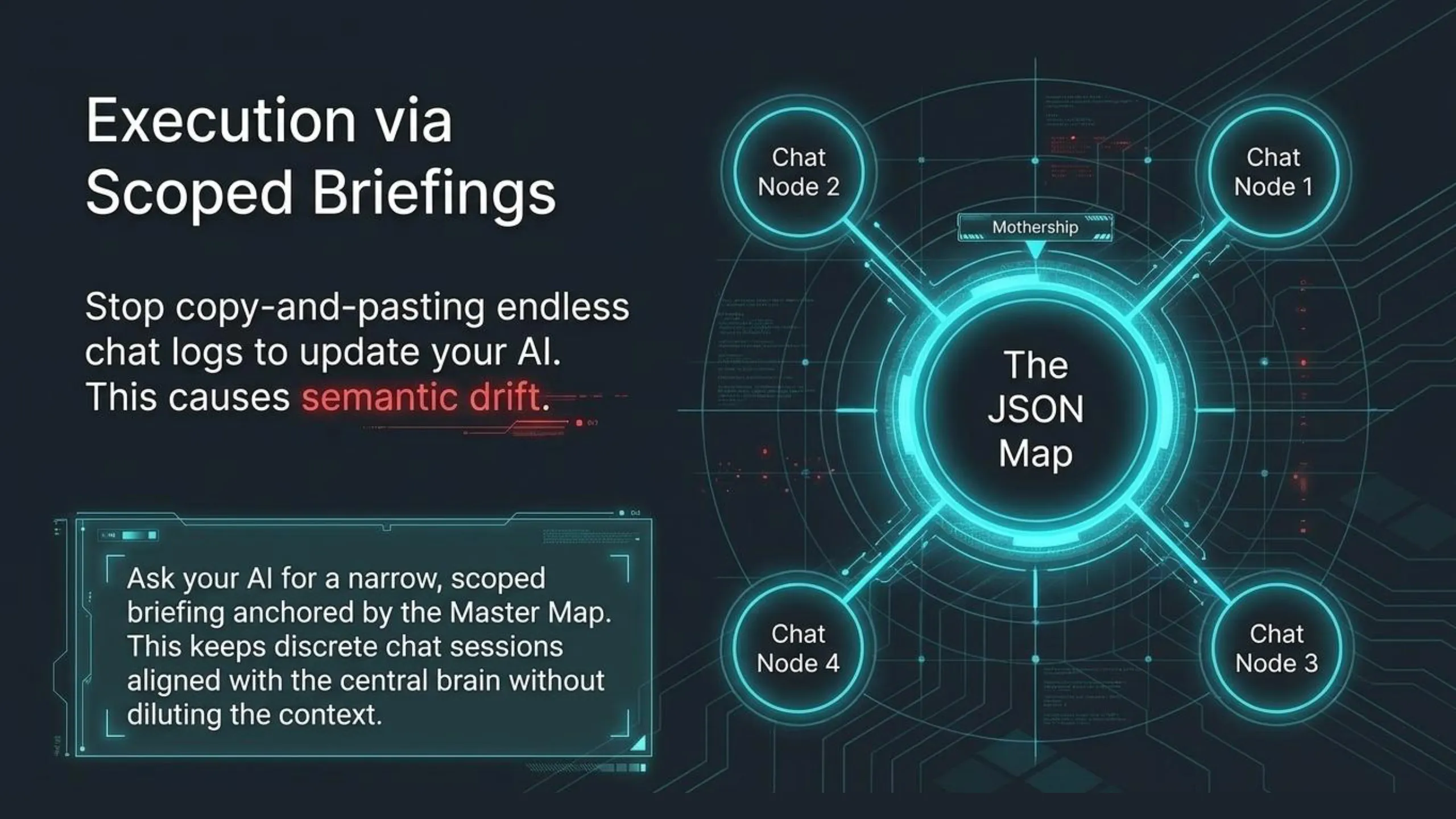
Scoped Briefings: How to Keep Your AI Team Anchored Without Losing Brand Voice
The solution is Scoped Briefings. This is the situation where instead of copy-and-pasting a whole chat exchange from one chat to another to update it on relevant information, you ask your AI to provide a narrower “scoped” briefing for that AI. This keeps your AI team of chats in the know without suffering semantic drift.
By backing up your chats and using scoped messages, you ensure the AI remains anchored in the Human 10%. You stop being a digital clerk and start being an Architect of Authority. When you switch on the Stadium Lights, you don’t just see the page; you see the entire Spartan Phalanx defending your brand’s sovereignty.
FAQ: How to Preserve Brand Voice with AI Writing
These questions come directly from practitioners searching for answers on how to keep AI writing consistent with their brand identity. The short answer to all of them is the same: it is not about which AI platform you use. It is about what you give it before the first word is written.
How do I maintain a consistent brand voice when using AI writing tools?
Your AI needs guardrails, and those guardrails take the form of grounding documents delivered through context engineering rather than prompt engineering. The two documents that do the most work are a brand vocabulary file and a topical map, both of which should be formatted as JSON as opposed to PDF.
A brand vocabulary JSON defines the terms, phrases, and semantic anchors you want your AI to use consistently. A topical map goes further by encoding that vocabulary at the node level so that each post in your content architecture carries its own semantic keyword array and anchor text options. The AI applies the terms from the map as the preferred vocabulary for that specific topic. Since the map exports as JSON with strictly defined relationships, the AI writing chat treats those terms as the authoritative reference rather than defaulting to generic phrasing. The ContentOps topical map tool for ai content strategy contains data layers such as semantic keywords and anchor text options within each node where you can encode your brand vocabulary for each post.
The critical discipline is that you drop these documents into every new session, not just once. Each session is a memory reset as you don’t want context drift to set in. Dropping the JSON is a memory card refresh rebuilds the guardrails from scratch so the AI starts calibrated rather than drifting into generic output by the third paragraph. The brand vocabulary should be a living document. Add new terms as your vocabulary evolves, save it as a new version, and always drop the most current version into your writing chats.
What features should I look for in AI software to maintain brand tone?
Skip the purpose-built brand voice tools entirely. Tools that claim to write in your brand voice typically work from writing samples rather than structured JSON grounding documents, which means they are pattern-matching against surface-level style rather than enforcing the specific semantic vocabulary and entity relationships that define your brand at the content architecture level. Without JSON grounding, the drift is significant as you end up maintaining lists of no-go words and correcting outputs manually rather than injecting the right context and constraints upfront.
Use standard LLM writing environments like Claude, ChatGPT, or Gemini and bring the right grounding documents to each session. The platform matters far less than what you give it. A well-grounded session in any of the major models will outperform a purpose-built brand voice tool that is operating without structured context every time. For more on contextual grounding for AI, check out our Miyagi Method guide to calibrating your AI writing chats.
What is the biggest risk of AI content generation for an established brand identity?
The risk is that your brand voice becomes airport music — background noise that people instantly associate with AI because it carries none of the specific texture, metaphors, or vocabulary that makes your expertise recognisable. Generic AI output erodes brand identity not through a single failure but through gradual homogenisation. Every piece that sounds like every other piece trains your audience to stop paying attention.
The antidote is the monologue. Writing samples help, but a spoken monologue gives the AI something different — your actual voice, including the analogies you reach for instinctively, the nicknames you have invented for concepts, the way you explain things when you are not trying to write but just trying to think. Most importantly, a monologue gives the AI your exact thoughts on the topic about which you’re going to write. Drop a monologue into your writing brief alongside the topical map and the brand vocabulary. The AI can draw excerpts directly from it, and those excerpts carry a texture that no amount of style guide enforcement can manufacture.
The discipline is to treat this as a front-loaded process rather than a one-time setup. Each new writing project gets the same deliberate injection of the topical map, brand vocabulary, writing style guide, and a fresh monologue on the specific topic. The work compounds because the documents get sharper over time, but the fence needs rebuilding at the start of every session. That is the Miyagi method applied to brand voice: front-load the calibration so the execution stays clean.
How do I train an AI to write in my brand’s unique style?
To be clear, you are not training the AI as the model is a finished product by the time it reaches you. What you are doing is steering it session by session using structured context. The most effective approach combines three passes with three grounding documents.
First pass: inject your topical map, brand vocabulary JSON, and writing style guide, then generate the initial draft from a content brief that includes a spoken monologue on the topic. Second pass: ask the AI to identify all proposed changes needed to align the draft with your style guidelines and brand vocabulary, and present those as tracked suggestions rather than a rewrite. Review and approve the changes. Third pass: wrap the accepted draft in HTML and run a comparison against the topical map, checking that the semantic keywords are present, the anchor text options are being used correctly, and the heading structure is declaring the right entities. The HTML comparison is more deterministic than the raw text pass because the AI is reading structured markup against structured data rather than comparing prose to prose.
The result is a draft that sounds like you because you gave the AI your voice to work with from the start, not because the platform has a brand voice feature.
🧱 Hindsight Insight: The Hard Drive vs. The Book
“If I could do it all over again, I’d stop trying to teach my AI Kung Fu by giving it prompts. I would have spent that time building the hard drive. In the AI age, your memory card is your moat. If the machine forgets your mission, your audience will too.”
Run a Forensic MRI on Your Context | Calibrate Your Digital Twin