
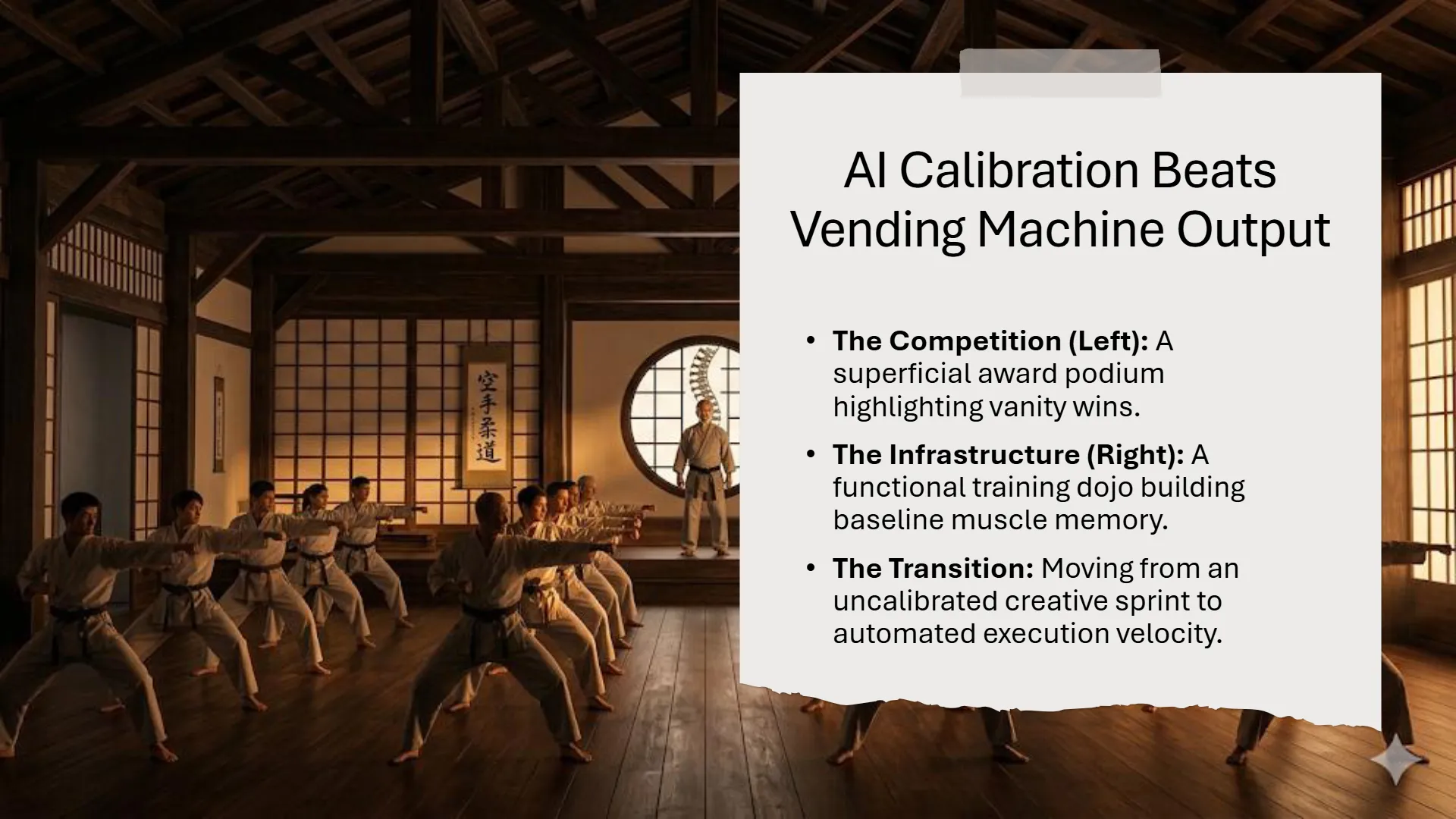
You spent hours editing AI content this week and it still doesn’t sound like you. The draft was grammatically correct, structurally coherent, and completely soulless — the kind of content that could have been written by anyone, about anything, for no one in particular. So you went back to the prompt. You made it longer, more specific, more detailed. You fed it examples of your voice, your audience, your angle. You got back the same generic output wearing a slightly different hat.
This is not a prompting problem. It is an infrastructure problem. AI writes generic content when it has nothing specific to work from — no grounded context, no persistent memory of your brand, no structured knowledge of your content architecture. The machine is not failing you. You are handing it an empty brief and expecting a surgical strike. The Miyagi Method exists to fix that: not by engineering better prompts, but by building the calibration layer that makes generic output structurally impossible.
Most content creators believe that writing is a willpower problem. You wake up, open a blank Google Doc, stare at the blinking cursor, and wait for inspiration to strike. When nothing happens, you turn to AI.
You then spend half an hour or more engineering the perfect prompt to encapsulate the target post’s message, optimize for keywords, and hit your word count target. In return for your Vending Machine injection, you get generic AI Slop.
This is not a lack of creativity nor a flaw in your prompt engineering skills more that it is a lack of infrastructure. Staring at a blank screen hoping for inspiration is a form of passive failure that leaves you vulnerable to the Time Thief. It ensures your execution remains slow, painful, and ultimately flat. You end up producing generic, placeholder text that is doomed to a quiet Symptomless Death inside the search index.
To scale your visibility in the age of generative search, you must abandon the empty page. What you need to do is transition from a paralyzed writer to an active operator. This is the core of ContentOps’ Miyagi Method:
- You do not write “articles” anymore as you “engineer” them.
- Before you use AI in your AI Writing Workflow, you execute systematic AI calibration for content writing.
By performing this pre-writing calibration, you architect a rigid pipeline that allows you to create a working skeleton of a post, all in your voice, and ready for your Human 10% to finish it off. This is how we execute ContentOps content creation at high-velocity with minimum friction.
The Sinking Ship of Workflow Entropy (The Pathogen)
The greatest threat to your operational momentum is Workflow Entropy. When your strategy is un-grounded, every single content node you attempt to publish becomes an exhausting mountain to climb. You suffer from intense Decision Fatigue, spending hours debating the exact angle, formatting rules, and keyword placement for a single post.
We call this the content treadmill. Because you are treating every writing session as a completely blank slate, you fall victim to the Context Eraser. Your AI writer has no memory of the post you published yesterday, no understanding of your overarching parent-child architectures, and no context of your customer’s core pain points. It is forced to guess, leading to generic, flat “Vending Machine” slop that is entirely isolated from your broader Semantic Topical Map and, thus, ignored by both search engines and AI answer engines.
Left un-anchored, your brilliant, domain-level insights are fractured across random documents and notebooks. The result is all that time you spent engineering the perfect writing prompt is ultimately wasted since you have to go in and manually connect your new post to its related topics when you could have easily “Wired Up” your post automatically at the writing stage.
This Scattered Mind Syndrome dilutes your focus, turning what should be a precise, high-leverage strike into a lumbering administrative chore. If your website text exists as isolated, un-linked pages, the Robot Librarian will bypass your domain entirely, leaving your expertise to rot in the back pages of the Digital Cemetery.

Wax On, Wax Off: The Chores of Data Hygiene (The Process)
In the classic martial arts story, the student wanted to learn high-kicks immediately. Instead, his teacher forced him to spend days painting the fence and sanding the floor—repetitive, manual chores that seemed entirely disconnected from combat. But those chores weren’t busywork but rather building the exact muscle memory, angles, and physical baseline required for intuitive combat.
The Miyagi Method SEO protocol operates on the exact same law. Effortless AI Kung Fu—reflexive, high-velocity, and authoritative—is a byproduct of manual data hygiene for AI writing and contextual grounding for AI.
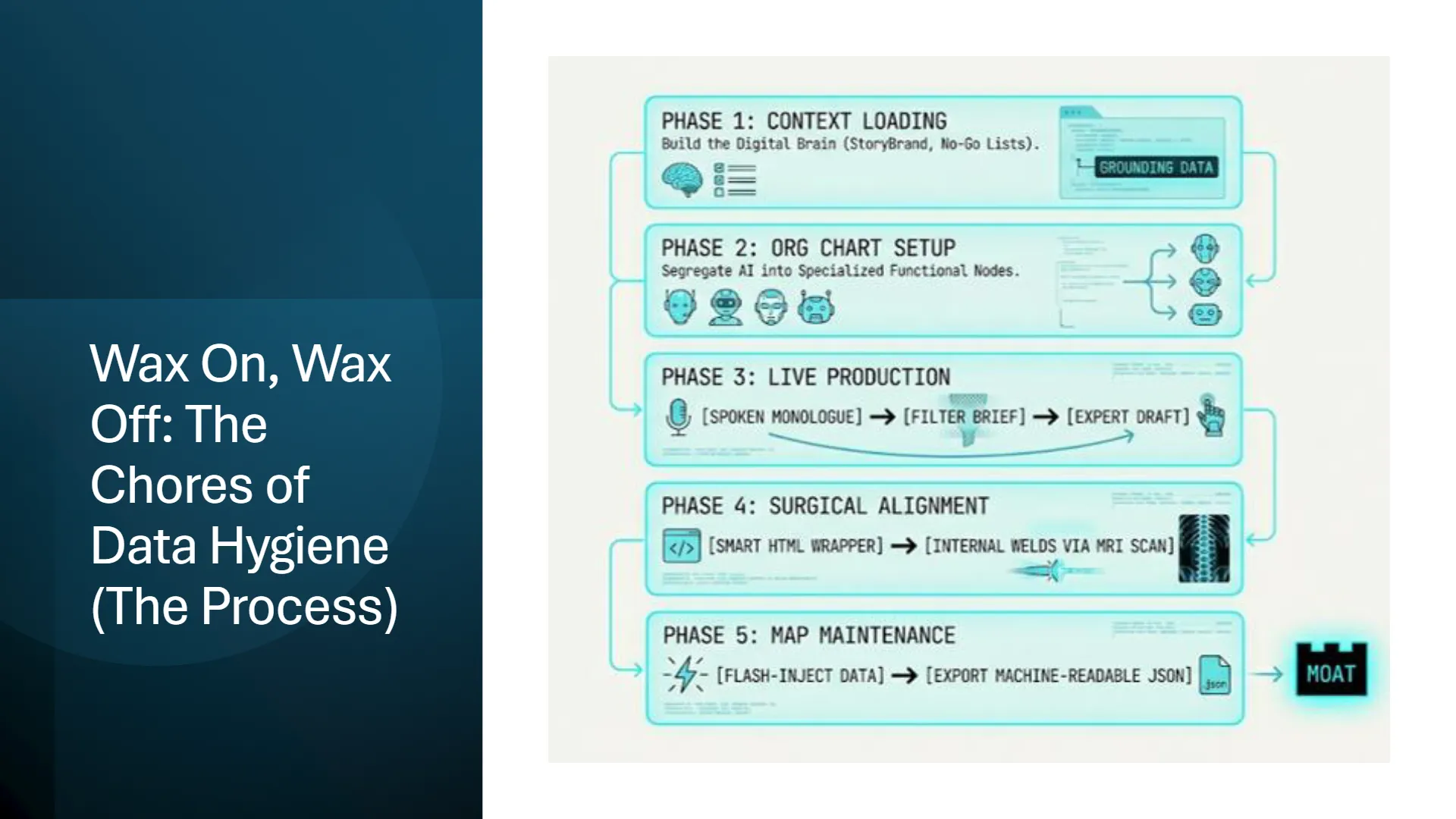
Before you command the AI to write a single word of copy, you must complete the essential data chores. This is the 5-phase infrastructure blueprint required to calibrate your operations:
- Phase 1: Build the Digital Brain (Context Loading): Standard AI tools write generic slop because they are contextually starved. To defeat the Context Eraser, you must build four foundational grounding documents: your Framework Report (your StoryBrand matrix), your Brand Vocabulary (to keep your lexicon native), your Writing Clone tone-profile, and your No-Go “Slop” List of banned phrases.
- Phase 2: Build Your Specialized AI Team: Never use a single, generic chat window for your entire manufacturing process. You must build a structured digital org chart. Segregate your AI assistants into specialized nodes: a Master Prompt Engineer to build the templates, a Framework Filter to parse your monologues, a Keyword Researcher to mirror intent, a Deep Researcher to hunt for Information Gain questions, a Copywriter to write the draft, and an SEO Conductor to edit.
- Phase 3: The Daily Assembly Line: Operationalize your speed. Record your raw ideas into a monologue (The Spark), pass them to your Framework Filter assistant, run your keyword research, compile these components inside your specialized Copywriter assistant, and then inject your Human 10% to add stories and anecdotes.
- Phase 4: Weaponized SEO & Publishing: Stop formatting manually. Wrap your finished text in our smart HTML wrapper, run your Structural MRI scans, drop the clean code into your SEO Conductor to inject internal links, process visuals through SlideShift, and use the HTML Splitter to drop clean code directly into your CMS.
- Phase 5: Execute Continuous Map Maintenance: Grounding is not a one-time project; it is a live system of record. Flash-inject your new content back into your sessions, use the Topical Map Harvester to bi-directionally wire your new assets, run Mission 3 (Power Up) to update legacy posts, and export your updated JSON seed maps so the AI’s memory never lapses.
These chores are your operational baseline. Skipping them because they are “boring” is a critical failure. If you don’t clean the data, your AI has nothing to work with, forcing you to spend four hours manually editing generic text just to make it readable. Data hygiene is the work.
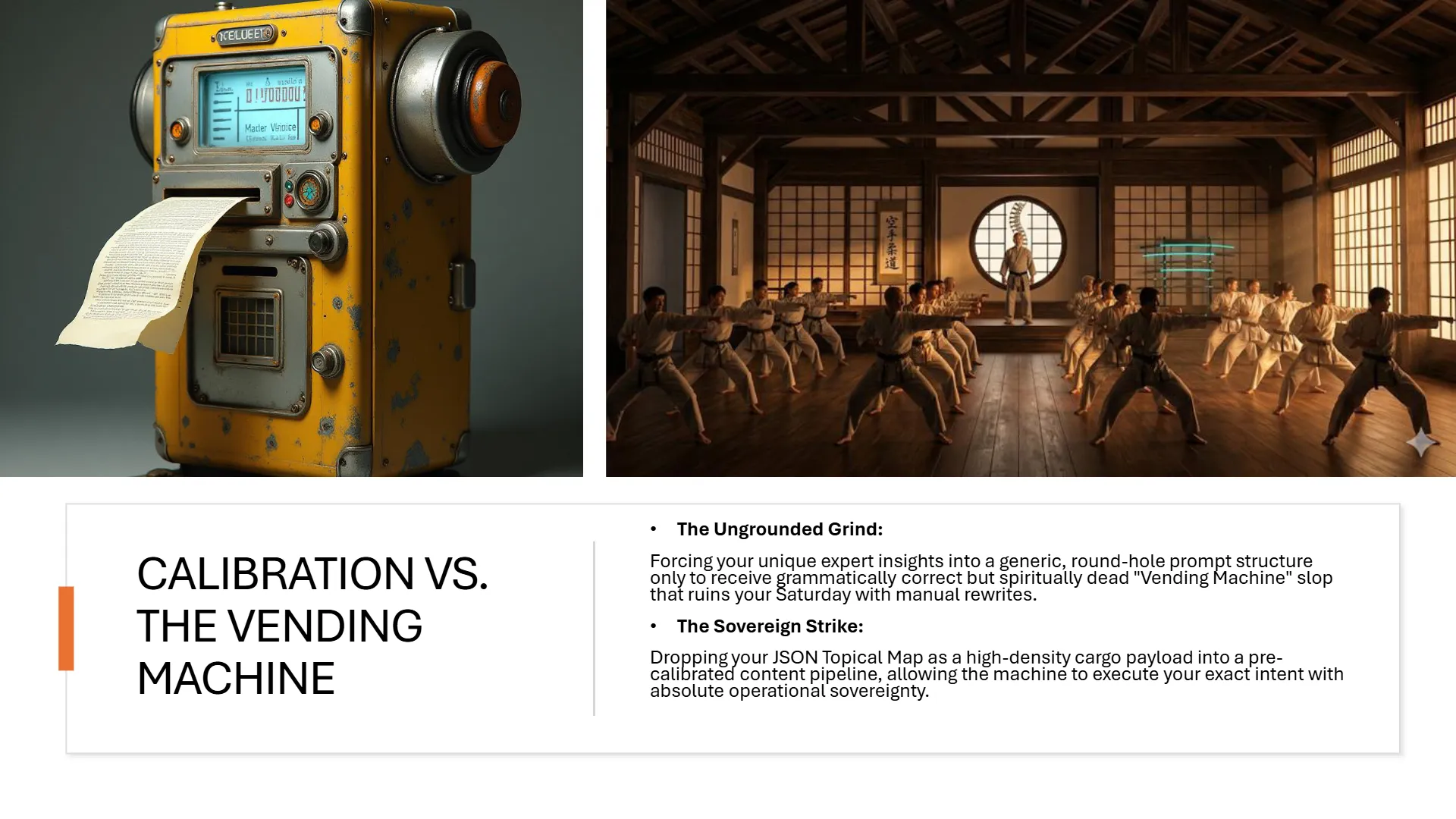
Calibration vs. The Vending Machine (The Strike)
Most content creators aren’t actually struggling with a blank page—they are struggling with a broken, generic tool stack. They rely on the unholy alliance of a Checklist Golem and an ungrounded AI Vending Machine. The Golem hands them a flat, automated keyword list and a rigid outline. They then spend grueling hours trying to squeeze their unique, square-peg expert insights into that generic, round-hole structure. To force the fit, they construct a massive, over-engineered prompt, only to receive grammatically correct but spiritually dead “Vending Machine” slop that they must spend the rest of their Saturday manually rewriting.
A Sovereign Architect uses Context Engineering for SEO backed by a calibrated content pipeline. With ContentOps, you don’t ask the machine to think or design outlines in a vacuum. You put your ducks in a row before you strike. You supply the expert soul with a spoken monologue, a brand-voice brief, and drop in your JSON Topical Map as the rich cargo payload. Because the entire environment is pre-calibrated, the AI has no room to guess. You achieve absolute Operational Sovereignty because the machine is finally executing your exact intent, not a generic compromise.
| The Golem & Vending Machine Stack (The Grind) | ContentOps Calibrated Infrastructure (The Strike) |
|---|---|
| The Checklist Golem hands you a generic keyword list and a rigid, automated outline. | The Miyagi Method lines up your content pipeline first to match your actual expertise. |
| Bending your unique, square-peg expert ideas to fit into the Golem’s generic, round-hole structure. | Injecting a raw 15-minute spoken monologue to capture the Human 10% soul. |
| Writing complex, bloated prompts to force the AI to write like an expert, leading to prompt errors. | Dropping in your JSON Topical Map as a high-density Cargo Payload so the AI knows your full domain context. |
| Getting back grammatically correct but soulless AI slop and spending hours manually rewriting it. | Orchestrating specialized, calibrated AI chats to generate highly structured, ready-to-publish assets. |
When your infrastructure is calibrated, you stop playing the clerk and start operating the assembly line. The AI stops acting like an amnesiac assistant and starts behaving like an elite extension of your own brain, rendering your competitors obsolete.
AIOps Velocity: The 3-Hour Production Line (The Result)
The ultimate payoff of AI calibration for content writing is speed. Once the tedious, foundational calibration work is complete, your execution velocity hits light speed. We call this the AI Writing Workflow for Experts.
The manufacturing line allows your post to flow from stage to stage effortlessly, often even without needing to be in front of your computer.
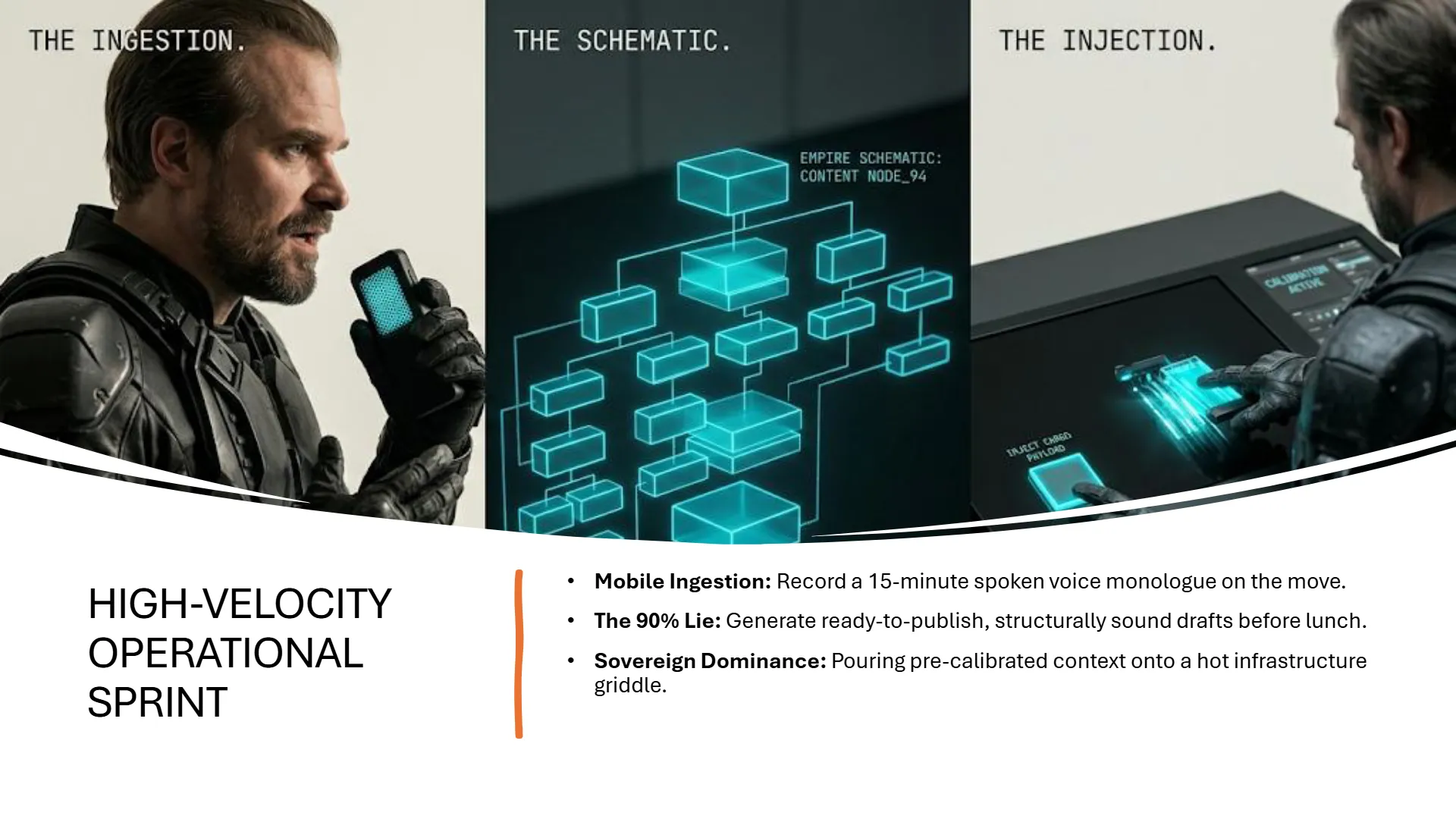
- Your do a walk-and-talk into your phone (the monologue).
- You move that monologue to your Brand-Voice-filtered chat (still from your mobile).
- You pass that filtered brief to the fully calibrated writing chat (still from your mobile).
- Only then do you sit down to review the initial draft, adding your human 10%.
- From there you create multimodal assets and optimize the images with SlideShift.
- Apply the finishing touches with our Publishing Accelerators (which also reduce your “Div Soup” in the process)
The Sovereign Strike: Engineering the ‘90% Lie’
I stopped being a “writer” and became an “Operator” the first time I deployed the full sprint and documented its success with this intervention report on how I used the manufacturing line to engineer “The 90% Lie” post on my legacy English learning blog.
The post chronicles how I used a contrarian approach to achieve a number 1 text search ranking, image search dominance, and an AI Overview citation hijack (clean SEO and AEO sweep), all down to Information Gain. The results weren’t luck; they were engineered and predictable.
You can move from a morning monologue on your phone to a fully published, structurally aligned, and schema-rich asset before lunch. Because the structural relationships, keyword signposts, and internal links are already defined inside your JSON Topical Map, there are no decisions left to make. You are not staring at a page; you are pouring ready-made mix onto a hot griddle, securing definitive Sovereign Authority over your sector.
Frequently Asked Questions: AI Calibration and the
Miyagi Method
Why does AI keep writing generic content no matter
what I tell it?
Because the problem is not your prompt — it is your
infrastructure. Generic AI output is the result of a
contextually starved machine making its best guesses
from a blank slate. Without a grounded brand voice
document, a JSON topical map, and a structured content
brief, the AI has no choice but to produce average
output. Better prompts cannot fix an infrastructure
problem.
Why does AI forget my brand voice between
sessions?
AI language models have no persistent memory between
conversations. Every new session starts from zero —
which means every session without a grounding document
is a session where the Context Eraser wins. The fix is
not to re-explain your voice every time, but to build
a persistent context payload — a brand vocabulary
document, a tone profile, and a JSON topical map —
that you inject at the start of every session so the
machine never starts from zero again.
Why does my AI content sound the same as my
competitors’?
Because you are both using the same ungrounded tool
with the same empty brief. When AI has no proprietary
context to draw from, it defaults to the statistical
average of everything it was trained on — which is
the same average your competitor gets. The only exit
from the Race to the Mean is injecting something the
AI cannot synthesise from its training data: your
specific expertise, your brand vocabulary, and your
topical map as a structured cargo payload.
How do I use AI to write content faster without
it sounding generic?
Speed without calibration produces fast generic
content. The Miyagi Method inverts the sequence: you
do the calibration work first — building your context
documents, your topical map, your AI org chart — so
that when you sit down to write, the infrastructure
removes every decision that would otherwise slow you
down. The result is a morning monologue on your phone
becoming a fully structured, brand-accurate draft
before lunch, without a single generic sentence
surviving the pipeline.
Why do I spend hours editing AI content after
it’s written?
Because you are doing the calibration work at the
wrong end of the process. Editing generic AI output
into something that sounds like you is the most
expensive way to produce content — it costs you
Saturday and produces mediocre results. The Miyagi
Method moves all of that calibration effort upstream,
before the AI writes a single word, so the output
arrives structured, grounded, and voice-accurate.
There is nothing left to fix because the machine had
no room to guess.
🧱 The Hindsight Insight (The Architect’s Regret):
“If I could do it all over again, I’d stop trying to ‘get motivated’ and started building the infrastructure to make my success inevitable. Following traditional SEO checklists is a defense mechanism for those who don’t understand the ‘Why.’ The magic isn’t in the tool; it’s in the grounding.”
The Ops Dojo
“Are you trying to fight Goliaths with a plastic AI toy, or have you calibrated your weapon for a Surgical Strike?”
Stop letting the Time Thief automate your Sundays with manual formatting and generic prompts. Join the AIOps Manufacturing Line, build your machine-readable knowledge graph, and turn your expertise into a sovereign asset.
Join the ContentOps DOJO and Make Effortless Content Kung Fu