
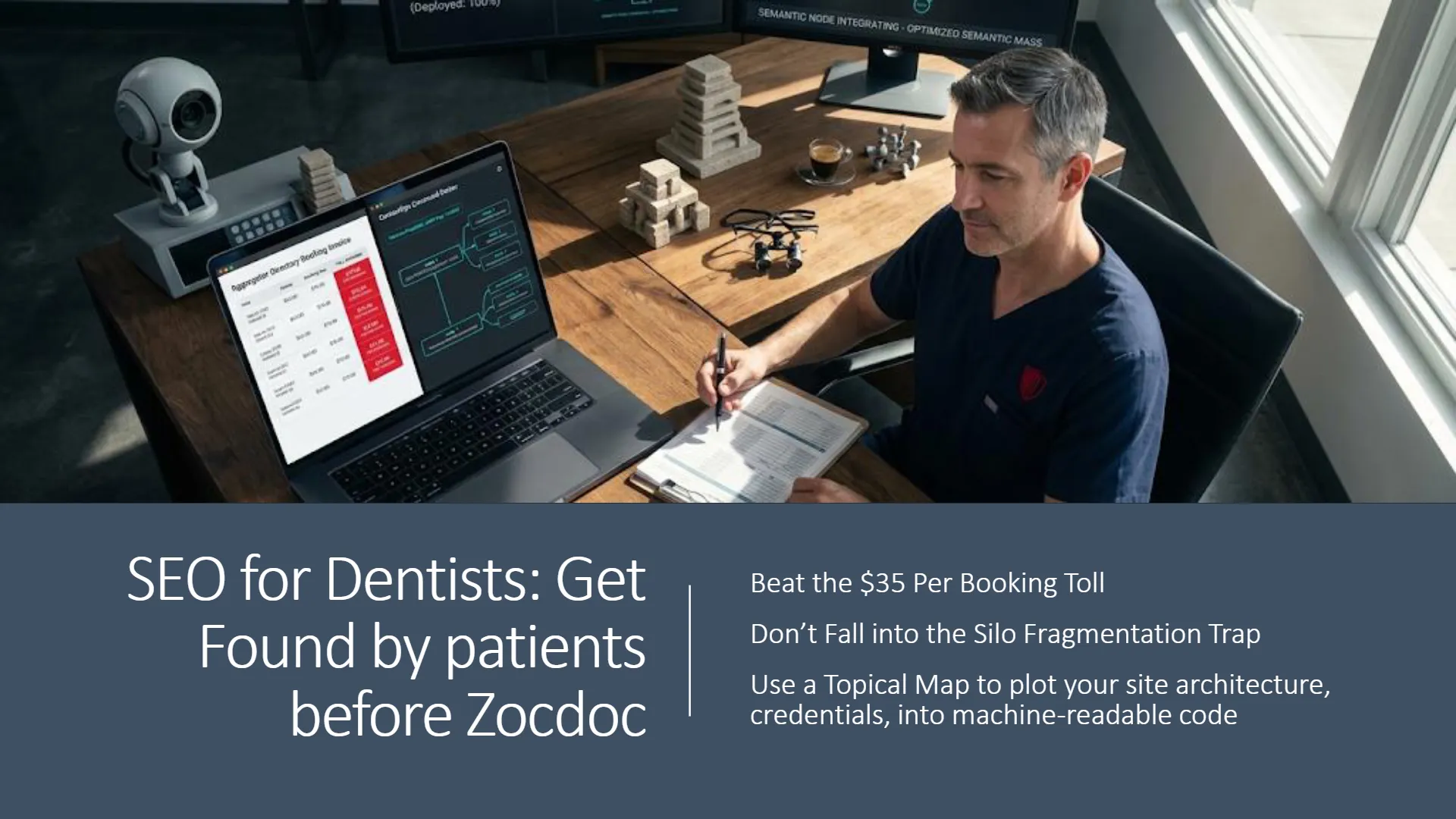
YOU ALREADY BUILT THE TRUST. ZOCDOC IS RENTING IT BACK TO YOU
You spent years getting credentialed, then years after that building a practice patients actually trust enough to bring their families to. Some of the people walking through your door have been coming back since before their kids had teeth, that kind of relationship doesn’t transfer to a directory listing no matter how much domain authority backs it. And an aggregator with more domain authority than you’ll ever need parks itself directly between you and the people already looking for exactly what you offer, charging a toll for a relationship you built one appointment at a time.
WHAT SEO ACTUALLY NEEDS TO DO FOR A DENTIST
The training is real. The digital legibility of that training usually isn’t. A crawler has no native way to tell the difference between a general dentist and an oral surgeon, between a DDS earned over four years of doctoral study and a stock bio paragraph, unless the site’s structure spells that difference out explicitly. Most dental sites don’t. The credential exists, but you haven’t made it legible to a crawler.
This isn’t only a content-quality problem either. Google holds medical content to a higher evidentiary bar precisely because getting it wrong carries real consequences for real patients, which means a generic, undifferentiated blog post isn’t just weak content on a dental site. It’s a liability sitting a few clicks from your license, not a missed opportunity.
WHAT THE ARCHITECTURE SHOULD ACTUALLY LOOK LIKE
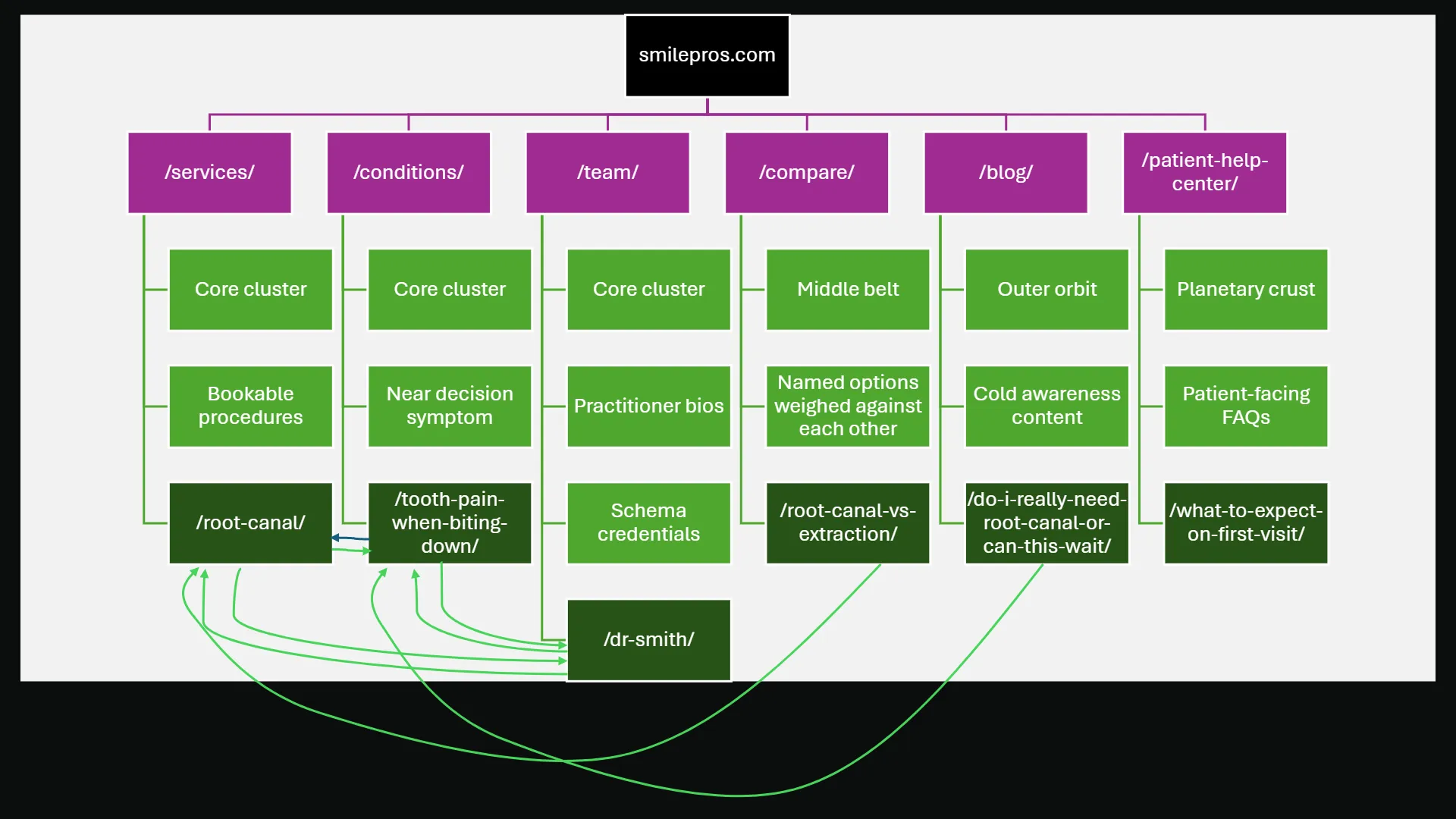
Most dental practice sites default to three separate silos, a services page, a conditions page, and a bios page, each living its own disconnected life. That’s backwards. The structure that actually works has a core of category pages divided into services, conditions, and practitioner bios with one child page for each underlying service, condition, or team member.
Each page does a single job and carries its own keyword target but funnels visitors along a logical path that mirrors your patient’s journey. That funnel is routed through internal linking between pages and posts.
You can think of this architecture metaphorically as the solar system.
- The star sits at the center of the system around which everything revolves. These are the core and money pages that sit squarely in the decision stage of your patient’s journey. For dental practices, these are the services, conditions, and team bios.
- The asteroid belt sits on the fringes between the informational and decision stages of the patient’s journey. These are the comparison and use cases content.
- The outer planets are the blog posts that capture cold awareness traffic.
- The planetary crust is the help center. It is a patient-facing operational tier that may include appointment prep, insurance and billing FAQs, what to expect at a first visit. It is the practical layer that keeps existing patients from bouncing back to Google mid-relationship.
- The moons are the third-party validation that occurs off-site including reviews and your Google Business Profile. Backlinks and social media also sit in this section of your content architecture.
SEO FOR DENTISTS ARCHITECTURE AND INTERNAL LINKING EXAMPLE
Let’s imagine a dental practice named Smile Pros with a website of smilepros.com. Smile Pros has organized their site into the following:
Pages Categories: services, conditions, team, compare, and patient help center.
Posts: blog
- The core consists of services, conditions, and team bios.
- The asteroid belt is the compare category.
- The planetary crust is the patient help center.
- The blog is the outer planets.
Patient Journey Funnel Example
A prospective patient has a tooth ache and searches “how to know if I need a root canal.” Smile Pros has published a blog targeting that keyword and catches the prospect in the outer planet.
The patient identifies their condition that they have “tooth pain when biting down,” so they click the internal link to that condition page.
The condition has been identified and the visitor is thinking about an appointment at Smile Pros, so they visit the services page for the root canal.
But before they make the commitment, they see the link to the comparison page “root canal vs extraction,” so they click on it and evaluate their options.
Once the visitor has decided on the service, they want to check which dentists at the practice perform the service, so they check the team bios page.
The user is satisfied with their search and books the appointment right from Smile Pro’s service page.
WHAT SEPARATES DENTAL PRACTICE SITES THAT RISE ABOVE GATEKEEPERS
A handful of structural details do most of the work. Schema markup should be included with credentials, not just a name and a degree listed in body text, but marked up so a crawler can confirm it programmatically. Include didactic alt text on clinical and headshot images, describing what’s actually in the image, not a generic dentist-smiling caption. Write bios as citation-ready bios, so an AI answer engine can lift a credential claim directly and cite it with confidence. And if the practice runs multiple locations, a roster-and-filter structure that keeps each location’s page distinct instead of duplicating the same content under five different city names.
THE ZOCDOC PROBLEM
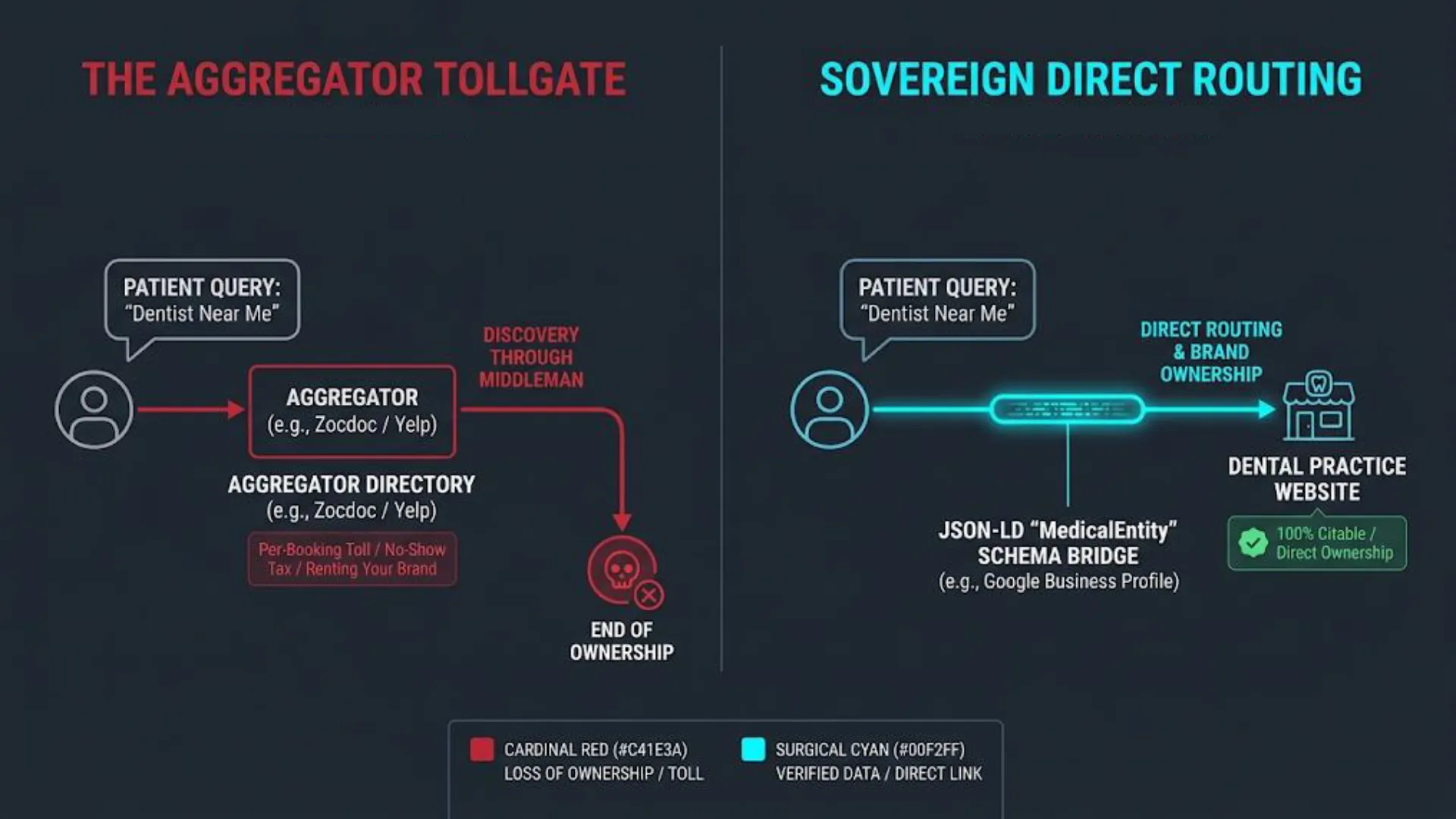
Zocdoc charges per booking, whether or not the patient shows up. Cancel, no-show, doesn’t matter, the toll’s already been collected. That’s a fee extracted from a relationship the dentist already earned, patients who’ve been coming back for years, sometimes across generations, and still got charged for the privilege of routing through someone else’s platform to do it. The fix isn’t abandoning Zocdoc entirely. It’s making sure the practice’s own site is strong enough that Zocdoc stops being the only door patients can find.
Owning your patient relationships and bookings outright, instead of renting them back from an aggregator, is worth wanting. Patients will choose the practice first when its site shows up ahead of the toll collector and makes booking easy once they arrive. Both of those are achievable with the right SEO for a dental site.
HOW MUCH DOES SEO FOR A MEDICAL PRACTICE ACTUALLY COST?
Now that we’ve mapped out the operational architecture and roadblocks in your dental practice’s site, your next logical question is: “How much is fixing this actually going to cost me?”
The traditional SEO industry gives you two bad choices. Either you sign an agency retainer for $1,500 to $3,500 a month to get surface-level tasks and a stack of monthly reports you’ll never read, or you watch YouTube “misguidance counselors” peddle $500-a-month software tool stacks built for enterprise marketers, not practicing dentists.
You don’t need a bloated agency retainer, and neither do you need a massive software stack. You can manage professional-grade SEO in-house for a fraction of what an agency quotes. If you want to see the real numbers broken down step-by-step between agency retainers and DIY stacks versus flat-rate platforms, read our full guide on How Much Does SEO Cost for a Small Business?
HOW TO ACTUALLY FIX YOUR DENTAL PRACTICE WEBSITE
At this point, you’re probably wondering if you can do SEO yourself, or should you just bite the bullet and hire an agency.
You don’t need an agency to start this. The barrier was never a skillset you don’t have, it’s finding the simplest tool for AI search visibility, something that translates what you already know into what a search engine needs to see.
Once you’re ready to build, the structure you’re building toward is the one-core layout already described on this page, and it traces directly back to the five layers of a citable website.
A map is how you build that structure without losing track of it as the site grows past a handful of pages. The topical authority mapping protocol is what turns the architecture above into something you can actually build and keep current, page by page, instead of a diagram you made once and never touched again.
Schema is how you encode the authority once the structure exists, marking up your DDS or DMD credential and outcomes so a crawler can confirm them programmatically instead of trusting prose. The mechanics of that markup are covered in the Schema Bypass thesis.
A practice site is still a small site in the internal-linking sense, and small sites have their own specific failure mode, links that tangle into each other instead of reinforcing one another as the site grows. The Switchboard Method for small-site internal linking is built for exactly that problem.
And doing all of this at the pace a real practice actually runs at, not as a second full-time job stacked on top of patient hours, is exactly what an AI writing workflow for experts is built to solve.
HOW CONTENTOPS GETS YOU THERE
Every gap named above maps to a specific fix in ContentOps.
- You solve the credential-legibility problem and the fragmented three-silo structure with the same content architecture framework behind the layout described above. The topical map holds your content plan as an exportable file you inject into any AI chat for help with planning, writing, and auditing your pages, structure, and internal linking.
- Getting the structural specifics right on a page that already exists including schema, alt text, and bios get checked by the Audit Suite’s HTML Audit Tool.
- The image side of this, clinical photos and headshots needing real didactic alt text instead of a generic caption, is exactly the kind of task SlideShift image optimization tool turns into a three-minute pass instead of an afternoon.
ContentOps was made for small businesses who neither have the expertise to run SEO on their own nor the budget to spend on an agency. By leveraging the Topical Map, the Audit Suite, and Slideshift, you can run your own professional grade seo program in-house.
THE TOOLS MOST DENTAL SEO GUIDES RECOMMEND. AND WHAT THEY LEAVE OUT.
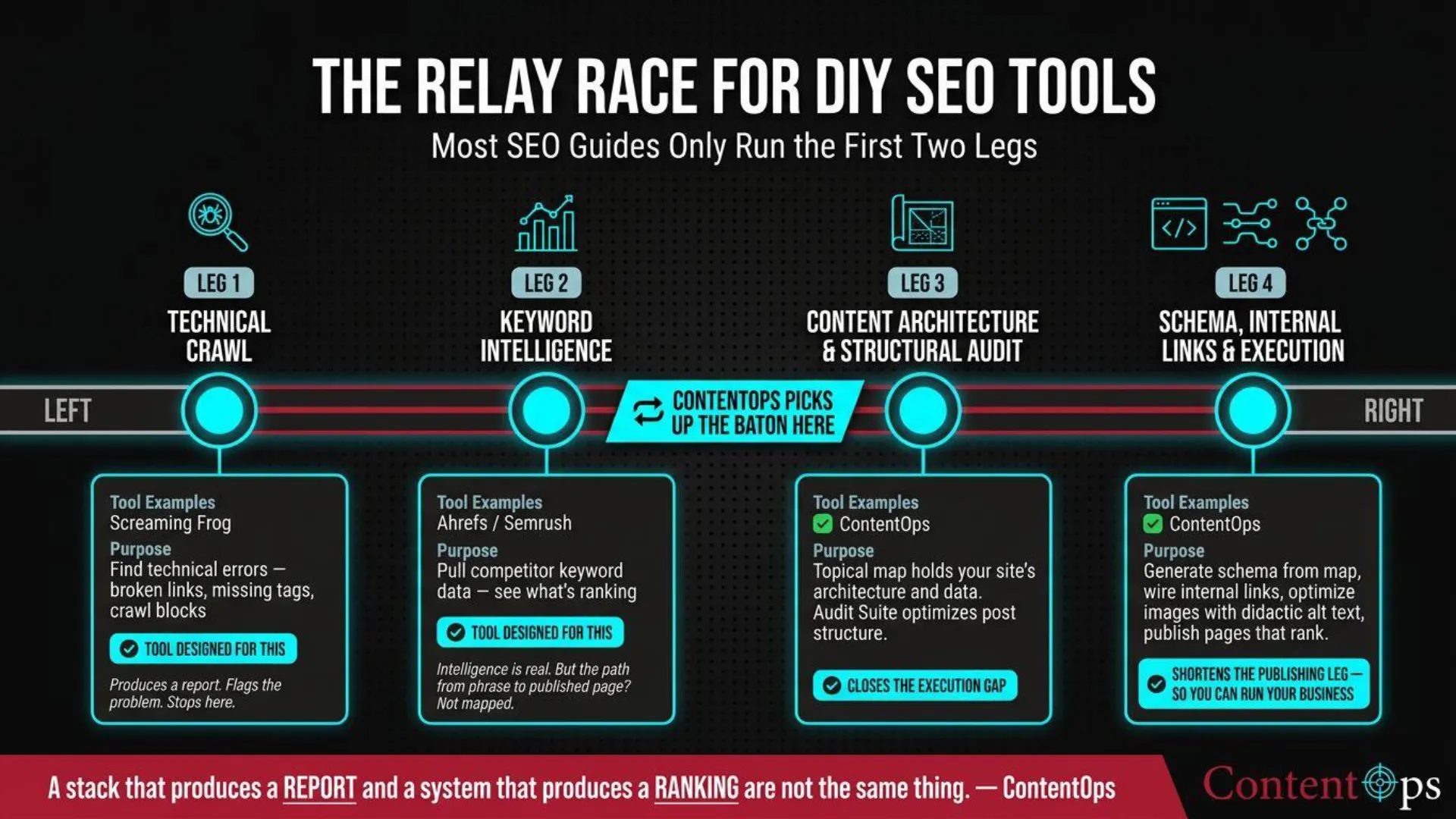
Most dental SEO advice starts in the same place. Run a Screaming Frog crawl to find technical errors. Pull a keyword report from Ahrefs or Semrush to see what competitors are ranking for. That intelligence is real and it earns its place. The problem is what comes after.
You have a crawl report full of technical flags you do not know how to interpret. You have a keyword list with no clear path from a phrase to a published page that actually ranks. You are running a dental practice. Your office manager was not trained to close that gap either. That is exactly where the agency pitch lives — someone offers to do the whole thing for you, and a monthly invoice arrives whether or not anything moved. The Landlord dynamic in a different form.
Those tools were built to run the briefing leg of the relay race. The execution leg — building the content architecture, auditing the structural layer of each page, generating the schema, wiring the internal links — is the part they were never designed to run. Understanding what each tool was actually built to do and where it stops is the difference between a stack that produces a report and a system that produces a ranking.
IF YOU RUN A DIFFERENT KIND OF PRACTICE
This page is one piece of the fuller picture covered across ContentOps for Local Service Businesses, the whole regulated and visual-proof landscape this practice sits inside. If you run a chiropractic practice instead, the shape of this problem is nearly identical, appointment-based, licensed, YMYL-sensitive, and SEO for Chiropractors covers that version directly. If you run a veterinary practice, the core wound is different, invisible breadth of expertise and a patient who can’t advocate for themselves, and SEO for Veterinarians covers that version directly. If you run an orthodontic practice, the credential is more specialized still, a CODA-accredited residency and a separate board certification on top of the same DDS or DMD, and SEO for Orthodontists covers that version directly.
FAQ
Why doesn’t my practice show up above Zocdoc or Healthgrades?
Because those platforms have spent years building exactly the structural signals your own site is probably missing, consistent schema, dense internal linking, and a content architecture built for exactly this kind of medical query. Outranking them isn’t about writing more, it’s about closing that specific structural gap.
Does posting blog content about teeth whitening actually help my rankings?
Only if it’s connected to something. A single isolated post about teeth whitening, disconnected from your services, your conditions, and your bios, reads as noise to both a crawler and an AI answer engine. The same post wired into a real core structure carries actual weight.
How many locations can one practice page cover before it hurts SEO?
One page per location is the safer default once you’re past a single site. Trying to cover three locations on one page usually means none of them get the location-specific signals, address, service-area language, local schema, that search engines and AI systems are actually looking for.
SEE WHAT YOUR SITE ACTUALLY LOOKS LIKE RIGHT NOW
TALK TO SOMEONE ABOUT YOUR SPECIFIC PRACTICE
At ContentOps, we want to empower you to run your own dental SEO in-house, but we also know that some practices would rather work directly with ContentOps. Whether that means training your front office staff on the publishing and optimization workflow, a done-for-you backlog audit on your existing pages, or guidance on building your site architecture from scratch before a single post goes live, we can adjust to your specific seo use case. If any of that sounds like the right next step, let’s skip straight to a conversation about your specific practice.