
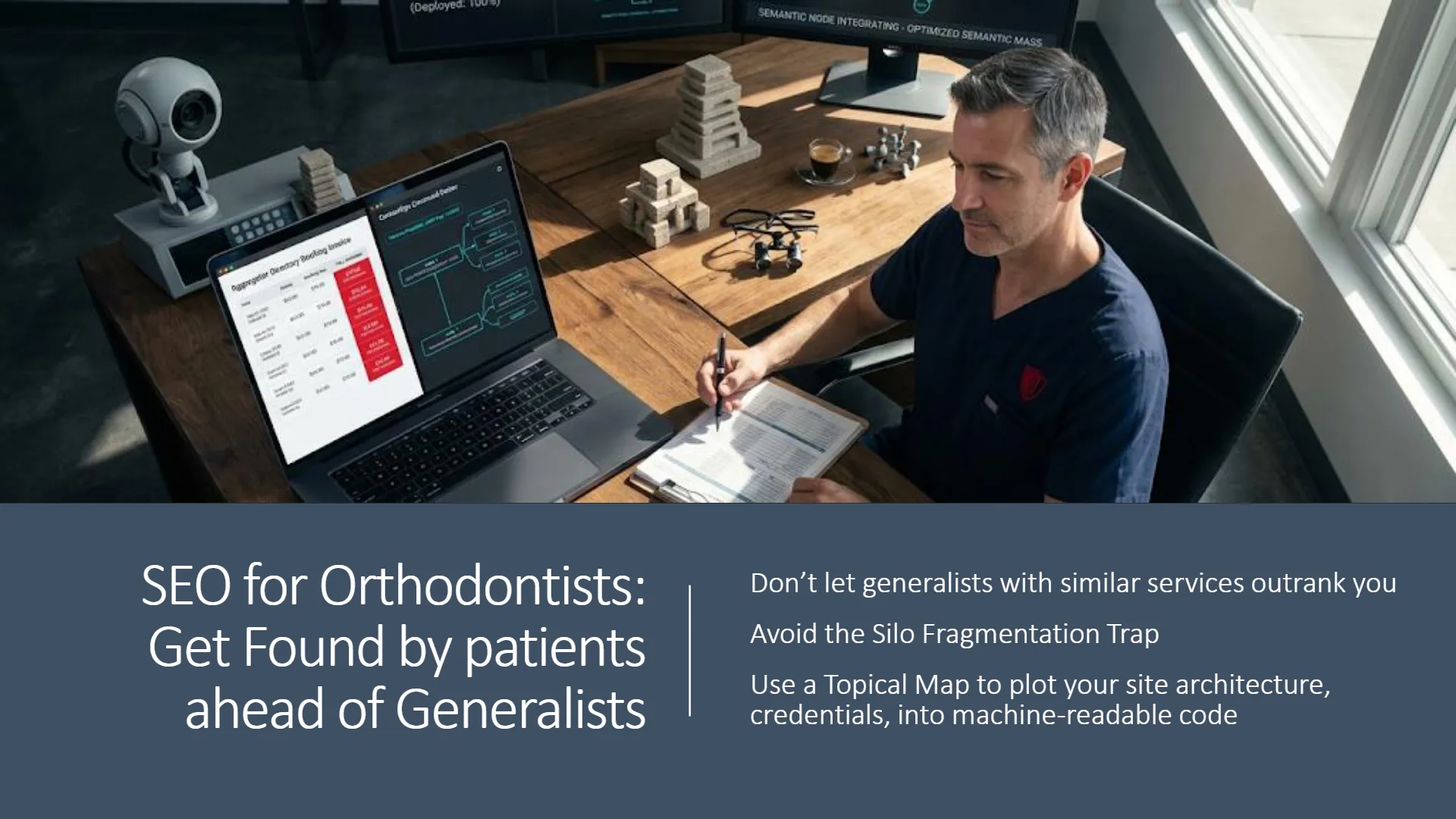
YOU TRAINED YEARS LONGER FOR THIS. YOUR WEBSITE DOESN’T SAY SO.
You did two to three extra years of residency that ninety-four percent of dentists never even attempt, real supervised training in tooth movement, bite alignment, jaw growth, facial development, then sat for a separate board exam most dentists never take. Then a general dentist’s website said “we do Invisalign too,” and ranked right next to yours.
From here, there are three ways this goes. A patient or parent finds you directly, through a site that actually shows the difference ten extra years of training makes, which is the whole point of the architecture below. Or they find a general dentist’s page that added aligners to an existing service menu, or a direct-to-consumer company selling a mail-order kit with no in-person supervision at all, and the years of specialized training that would have caught a real complication never enter the decision. Or they find a different orthodontist entirely, one whose site simply made the differentiation case better, a loss to someone who may have trained for exactly as long as you did, and just explained it better.
WHAT SEO ACTUALLY NEEDS TO DO FOR AN ORTHODONTIST
The path here runs bachelor’s degree, dental school for the DDS or DMD same as any dentist, then two to three additional years in a CODA-accredited orthodontic residency, roughly 3,700 hours dedicated specifically to tooth movement, bite alignment, jaw growth, and facial development. On top of the dental licensing exam already required to enter that residency sits a separate board certification, the American Board of Orthodontics exam, renewed every ten years. Ten to eleven years total from high school to practicing, and only about six percent of dentists ever complete this path at all, one of the more competitive specialty admissions in dentistry.
None of that shows up on a typical orthodontist site. Most read like any general dentist’s aligner page, straight teeth, a price range, a free consultation offer, with the actual credential stack that makes complex cases safe to treat left completely unstated.
WHAT THE ARCHITECTURE SHOULD ACTUALLY LOOK LIKE
The same one-core logic applies with services, conditions, and team bios merged into a single structural center, but this vertical needs two real structural additions that related professional practice websites like dentists don’t need.
You can think of this architecture metaphorically as the solar system.
- The star sits at the center of the system around which everything revolves. For an orthodontic practice, that’s services, conditions, team bios, and the before-and-after gallery, all merged into one core rather than treated as separate silos, with two signposted entry paths running through it, one for parents deciding on behalf of a younger patient, one for adult self-pay patients, since those are genuinely different buyer psychologies reaching the same core.
- The asteroid belt sits between the informational and decision stages. For this vertical, that’s specifically the specialist-versus-generalist comparison and the in-person-versus-mail-order-aligner comparison, the exact content that counters a general dentist’s add-on service or a direct-to-consumer kit head-on.
- The outer planets are the blog posts that capture cold awareness traffic, “does my child need braces,” “is it too late for adult orthodontics.”
- The planetary crust is the patient help center, appointment prep, financing and insurance FAQs, what to expect at each stage of a multi-year treatment, and retention care once treatment ends.
- The moons are off-site validation, reviews and your Google Business Profile, and this vertical has a genuine edge here, transformation content is inherently shareable in a way most local service content isn’t, worth treating as a real amplification opportunity rather than a formality.
Services and Condition Pages
Services cover:
- traditional braces
- clear aligners
- early or interceptive treatment for children
- adult orthodontics
- retention and post-treatment care
- surgical orthodontics for complex jaw cases
Condition and diagnostic pages route straight to the relevant service:
- overbite
- underbite
- crossbite
- crowding
- spacing
- jaw misalignment
…so a visitor with a specific problem finds the specific answer instead of a generic services list.
Team Bio Pages for EEAT
Team bio pages need to state the full credential stack explicitly, not just orthodontist, the actual CODA-accredited residency, the board certification, years in practice. This is the direct structural fix for the commoditization wound, since the credential differential is the entire argument against a general dentist’s aligner add-on or a mail-order kit.
Image Gallery with Didactic and EEAT-Aligned Alt Text
A before-and-after gallery needs to exist as a first-class core element, not a supporting image tucked into a testimonials page. Organized by case type:
- crowding
- bite correction
- jaw alignment
…so a prospective patient or parent can find a case that actually looks like their own. It’s doing two jobs at once, persuasive proof for the visitor, and structured, entity-rich content a crawler can index case by case.
And two clearly signposted buyer tracks need to run through that same core rather than splitting into separate silos, one for parents of younger patients, financing, timeline, what interceptive treatment actually involves, one for adult self-pay patients, discretion, convenience, aesthetic-forward framing. Same underlying pages, two different entry paths for two genuinely different buyer psychologies.
SEO FOR ORTHODONTISTS ARCHITECTURE AND INTERNAL LINKING EXAMPLE
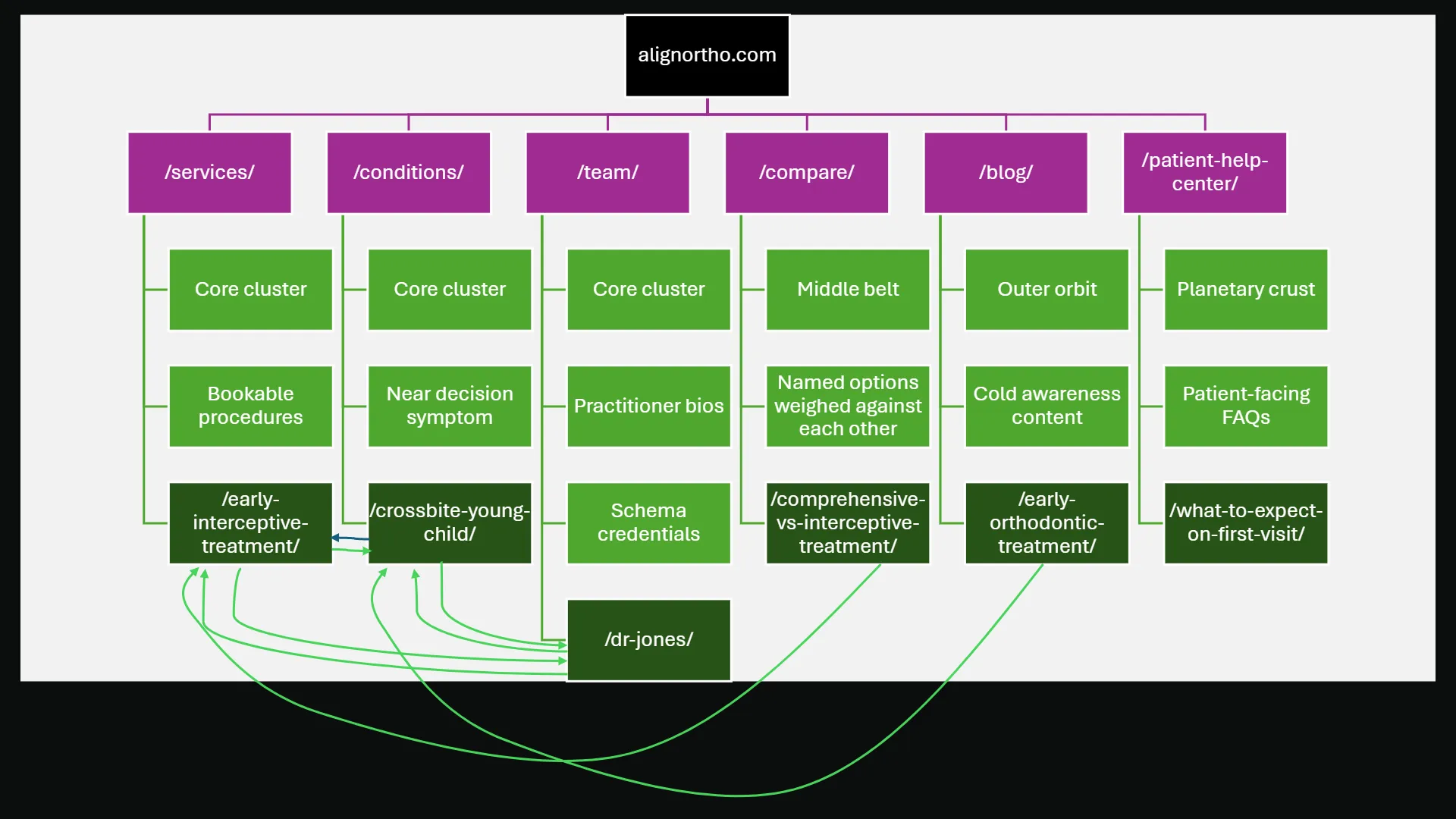
Let’s imagine an orthodontic practice named Align Orthodontics with a website at alignortho.com. Align Orthodontics has organized their site into the following:
Pages Categories: services, conditions, team, gallery, compare, and patient help center.
Posts: blog
- The core consists of services, conditions, team bios, and the before-and-after gallery.
- The asteroid belt is the compare category.
- The planetary crust is the patient help center.
- The blog is the outer planets.
Patient Journey Funnel Example
The parent track.
A parent searches “does my 7 year old need early orthodontic treatment” and Align Orthodontics has published a blog targeting that exact question, catching the parent in the outer planet. They identify their child’s specific issue, “crossbite in a young child,” and click through to that condition page. The condition page routes to the interceptive treatment service page. Before committing, they check the gallery filtered to similar case types, children, crossbite, then check the parent-track content on financing and timeline, then check the orthodontist’s bio for the CODA residency and board certification. Satisfied, they book directly from the service page.
The adult self-pay track.
An adult searches “clear aligners vs mail order aligners safety” and lands on the compare page weighing that exact question, the asteroid belt content that counters The Generalist directly. From there they click into the clear aligners service page, check the gallery filtered to adult cases, confirm the orthodontist’s credentials on the bio page, and book.
Two different entry points, two different concerns, the same core structure resolving both.
WHAT SEPARATES ORTHODONTIST SITES THAT RISE ABOVE
Two structural moves matter most here too. Schema markup on the CODA residency and board certification credentials, so a crawler can confirm the specialty programmatically instead of trusting a job title in prose. And didactic alt text on case photos specifically, and the stakes are higher here than in any prior page in this cluster. The photos aren’t supporting material in this vertical. They’re close to the actual conversion asset, which means what the alt text says about each case carries real weight, not just accessibility compliance.
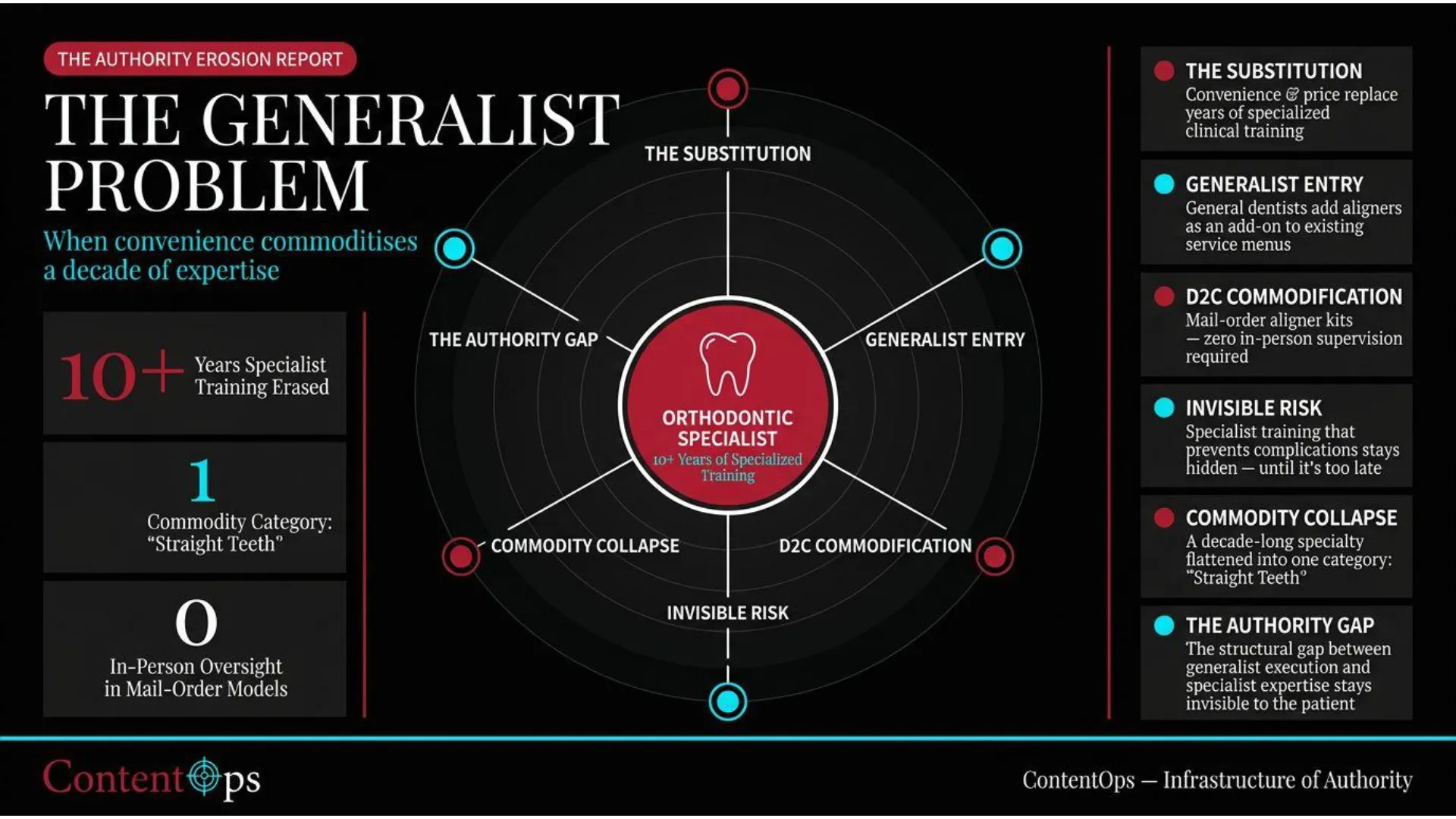
THE GENERALIST PROBLEM
A general dentist adding aligners to an existing service menu, or a direct-to-consumer company selling a mail-order aligner kit with no in-person supervision, both substitute convenience and price for years of specialized training. The result is the same either way. Ten-plus years of education, one of the more competitive specialty tracks in dentistry, gets flattened into a single commodity category, straight teeth, and the training that actually prevents a real complication stays invisible until something goes wrong that a generalist wasn’t trained to catch.
HOW MUCH DOES SEO FOR A MEDICAL PRACTICE ACTUALLY COST?
Now that we’ve mapped out the operational architecture and roadblocks in your orthodontist practice’s site, your next logical question is: “How much is fixing this actually going to cost me?”
The traditional SEO industry gives you two bad choices. Either you sign an agency retainer for $1,500 to $3,500 a month to get surface-level tasks and a stack of monthly reports you’ll never read, or you watch YouTube “misguidance counselors” peddle $500-a-month software tool stacks built for enterprise marketers, not practicing orthodontists.
You don’t need a bloated agency retainer, and neither do you need a massive software stack. You can manage professional-grade SEO in-house for a fraction of what an agency quotes. If you want to see the real numbers broken down step-by-step between agency retainers and DIY stacks versus flat-rate platforms, read our full guide on How Much Does SEO Cost for a Small Business?
HOW TO ACTUALLY FIX YOUR ORTHODONTIC PRACTICE WEBSITE
You don’t need an agency to start this. The barrier was never a skillset you don’t have, it’s finding the simplest tool for AI search visibility, something that translates what you already know into what a search engine needs to see.
Once you’re ready to build, the structure you’re building toward is the one-core layout described above, and it traces directly back to the five layers of a citable website.
A map is how you build that structure without losing track of it as the site grows past a handful of pages. The topical authority mapping protocol is what turns the architecture above into something you can actually build and keep current, page by page, credentials and schema included, instead of a diagram you made once and never touched again.
Schema is how you encode the authority once the structure exists, marking up the CODA residency and board certification so a crawler can confirm them programmatically instead of trusting a job title in prose. The mechanics of that markup are covered in the Schema Bypass thesis.
A practice site is still a small site in the internal-linking sense, and small sites have their own specific failure mode, links that tangle into each other instead of reinforcing one another as the site grows. The Switchboard Method for small-site internal linking is built for exactly that problem.
And doing all of this at the pace a real practice actually runs at, not as a second full-time job stacked on top of patient hours, is exactly what an AI writing workflow for experts is built to solve.
HOW CONTENTOPS GETS YOU THERE
Every gap named above maps to a specific fix.
- You solve the credential-legibility problem with the same content architecture framework behind the layout described above.
- The schema and structural specifics get checked by the Audit Suite’s HTML Audit Tool.
- The image side of this, the before-and-after gallery carrying more weight here than anywhere else in this cluster, is exactly the kind of task SlideShift image optimization tool turns into a three-minute pass instead of an afternoon spent naming and captioning files by hand.
ContentOps was made for small businesses who neither have the expertise to run SEO on their own nor the budget to spend on an agency. By leveraging the Topical Map, the Audit Suite, and SlideShift, you can run your own professional-grade SEO program in-house.
THE TOOLS MOST ORTHODONTIST SEO GUIDES RECOMMEND. AND WHAT THEY LEAVE OUT.
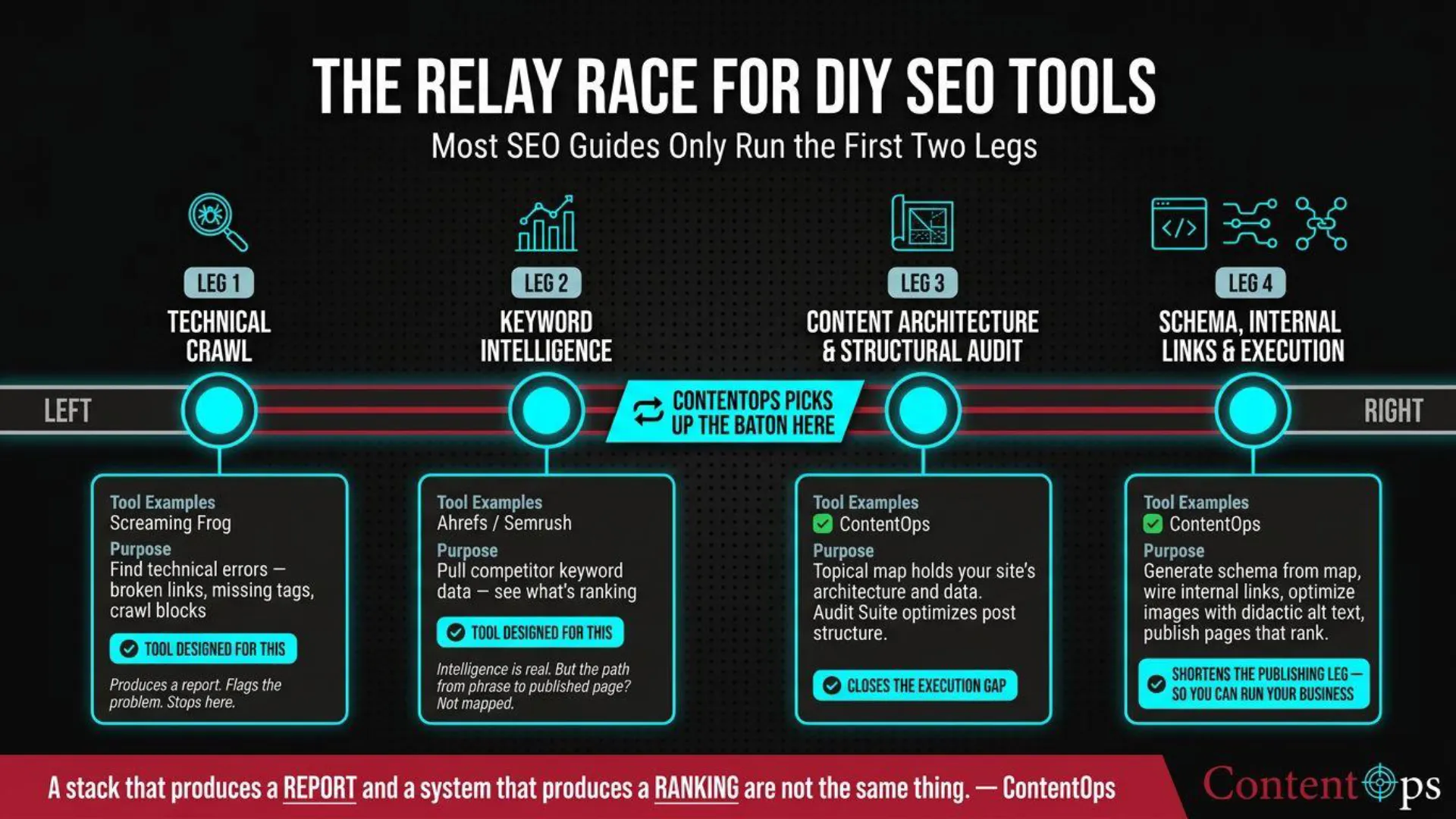
Most orthodontist SEO advice starts in the same place. Run a Screaming Frog crawl to find technical errors. Pull a keyword report from Ahrefs or Semrush to see what competitors are ranking for. That intelligence is real and it earns its place. The problem is what comes after.
You have a crawl report full of technical flags you do not know how to interpret. You have a keyword list with no clear path from a phrase to a published page that actually ranks. You are running an orthodontic practice. Your treatment coordinator was not trained to close that gap either. That is exactly where the agency pitch lives — someone offers to do the whole thing for you, and a monthly invoice arrives whether or not anything moved. The Landlord dynamic in a different form.
Those tools were built to run the briefing leg of the relay race. The execution leg — building the content architecture, auditing the structural layer of each page, generating the schema, wiring the internal links — is the part they were never designed to run. Understanding what each tool was actually built to do and where it stops is the difference between a stack that produces a report and a system that produces a ranking.
IF YOU RUN A DIFFERENT KIND OF PRACTICE
This page is one piece of the fuller picture covered across ContentOps for Local Service Businesses, the whole regulated and visual-proof landscape this practice sits inside. The closest relationship in this cluster is Dentists, same professional lineage, same DDS or DMD starting point, before the training diverges. SEO for Dentists covers that version directly.
FAQ
Why does my website look the same as a general dentist’s Invisalign page?
Because most orthodontist sites never state the actual difference. A general dentist added aligners to an existing menu. You completed two to three additional years in a CODA-accredited residency and hold a separate board certification most dentists never pursue. If the site doesn’t say that explicitly, neither a crawler nor a visitor has any way to tell the two apart.
Is it worth showing before-and-after photos for every case type, or just my best results?
Organizing by case type, crowding, bite correction, jaw alignment, does more for you than a highlight reel of only the most dramatic results. A prospective patient or parent is looking for a case that resembles their own, and a gallery that only shows the best outcomes reads as curated rather than representative.
How do I write for parents of younger patients and adult self-pay patients without diluting my message?
Keep them as two distinct entry paths through the same underlying pages rather than one blended voice trying to speak to both. Financing and timeline framing for a parent making a multi-year decision on a child’s behalf is a different conversation than discretion and convenience framing for an adult paying out of pocket, and trying to serve both in one paragraph usually serves neither.
SEE WHAT YOUR SITE ACTUALLY LOOKS LIKE RIGHT NOW
TALK TO SOMEONE ABOUT YOUR SPECIFIC PRACTICE
At ContentOps, we want to empower you to run your own orthodontic SEO in-house, but we also know that some practices would rather work directly with ContentOps. Whether that means training your team on the publishing and optimization workflow, a done-for-you backlog audit across your existing service and case-type pages, or guidance on structuring separate parent and adult self-pay content tracks from the ground up, we can adjust to your specific SEO use case. If any of that sounds like the right next step, let’s skip straight to a conversation about your specific practice.