

If your current competitive research consists of downloading a massive spreadsheet of your rival’s keywords, you are setting yourself up for failure. We call this the competitor keyword overlap trap. You export ten thousand rows, sort by difficulty, and write slightly longer versions of pages that your competition already ranks for. This copycat strategy is a recipe for Symptomless Death—and it forces you to pay a compounding Compute Tax on content that search engines will ultimately ignore.
The reason this trap is so persistent is that most operators are still thinking in keywords rather than entities. If you are new to the entity-based SEO paradigm and want to understand why knowledge graphs replaced flat keyword lists as the foundation of search authority, that context will make everything that follows in this guide land with greater precision.
The Illusion of Commodity Coverage
Modern search engines have evolved beyond basic keyword matching. When Answer Engines like Perplexity or SearchGPT crawl the web, they aren’t looking for stuffed keywords; they are looking for structured, authoritative depth. When you publish disconnected posts designed to check boxes for a legacy plugin, you let The Fragmenter pull your site’s authority apart, leaving you with isolated, unranked content.
To win a modern competitor gap analysis, you have to look past the surface text of your rivals to map out their core technical skeleton. This requires trading flat keyword lists for what we call the Hijack Protocol where we analyze the post structure from a competitor, identify its structural gaps, and build content designed to out-position them at the code level.
The Flat Earth Illusion: Why Traditional Keyword Gap Analysis is Malpractice
Traditional competitor content gap analysis is an evolutionary dead end. It operates on the flawed assumption that search landscapes are flat surfaces where all you have to do is match your rival’s keyword footprint to guarantee equal visibility. This outdated approach treats terms like loose commodities, ignoring the deeper structural links required to satisfy search generative experience optimization.
In the current search environment, this flat methodology is equivalent to technical malpractice. Large Language Models (LLMs) and GraphRAG architectures do not count words; they evaluate entity definitions, attributes, and relationships. When you use spreadsheet tools to reverse-engineer an authority position, you are forced to mimic the superficial topics of your competitors without capturing the foundational system supporting them. The end result is a site that looks complete to a traditional SEO but remains entirely invisible to an answer engine.
To claim your architectural edge, your strategic target must shift from a standard keyword gap to a comprehensive semantic gap analysis. You need to map out the exact intellectual boundaries of your rivals to identify the exact moments where their vocabulary is spoken but not supported. This is how you transition from a commodity creator to a structural engineer operating a unified content ecosystem.

The Jenga Tower Deficit: Locating the Competitor’s Inference Gaps
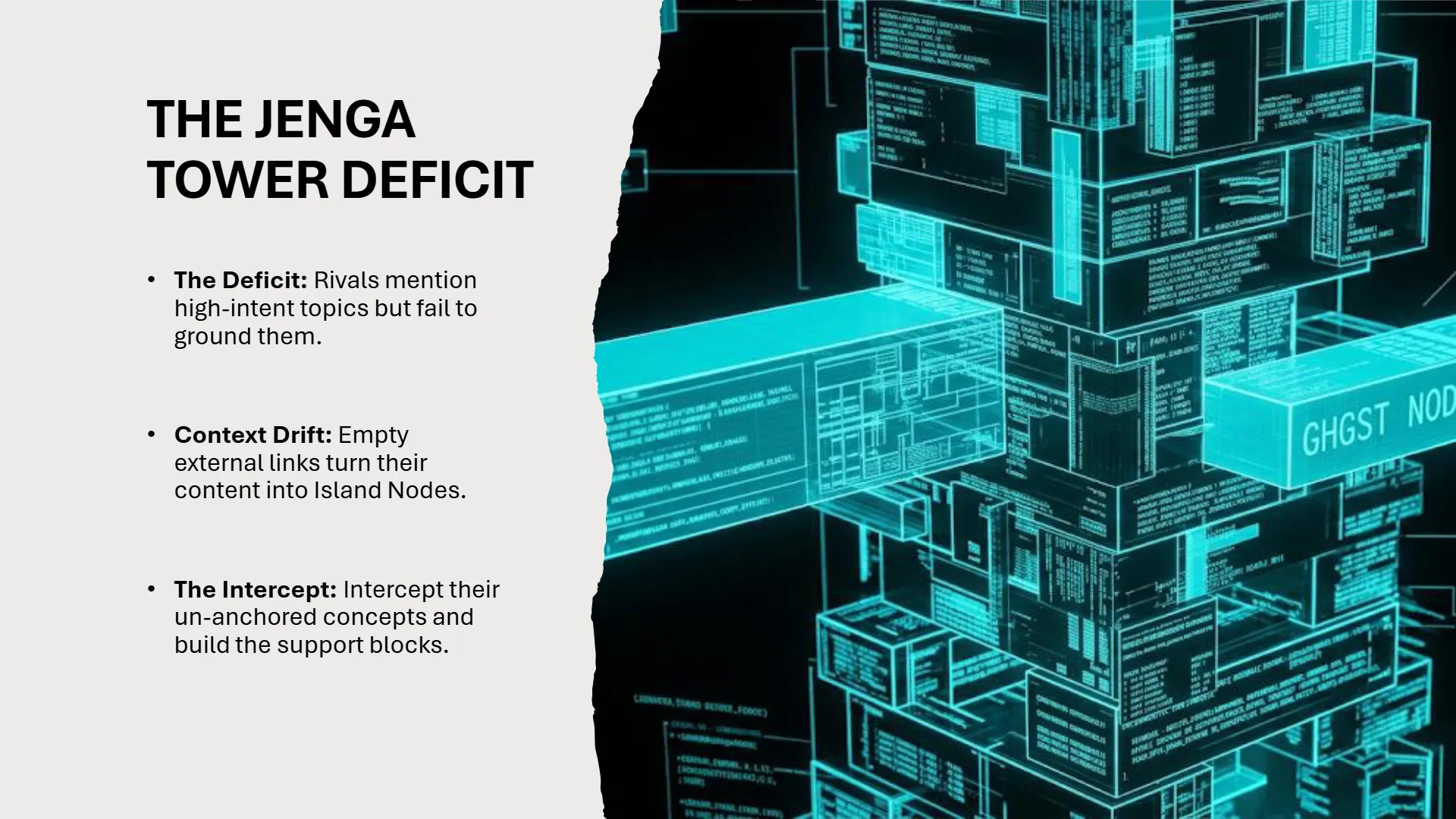
Every high-ranking article published by your competitors is structurally vulnerable. On the surface, their content appears to be a solid pillar of high-authority text. But when evaluated through a forensic entity gap analysis, that content frequently resembles a fragile Jenga tower.
If the post is a Jenga tower, the main idea is supported by additional concepts (the Jenga blocks). The Jenga blocks are firmly in place if the competitor’s site has made additional posts for the supporting concepts. However, if those supporting concepts remain unanchored by a supporting post — what we call Shadow Concepts — it’s like a missing block in the tower (or an Inference Gap). If there are enough missing blocks, you have a hijack opportunity. These hollow spaces weaken their entire semantic layout.
How LLMs View Un-anchored Shadow Concepts
When an answer engine crawler parses the page, it reads the complex noun and looks for a clear internal path to define its properties. When it encounters an empty reference, it suffers from AI Context Drift for SEO. These casual mentions are transformed into weak, isolated “Island Nodes” that threaten the integrity of their domain. By identifying these unstable structural joints, you can extract their hidden concepts to build your own Topical Map for Semantic SEO, effectively toppling their tower to fuel your own fortress.
The 60-Second Scan: What Legacy Tools Miss Under the Hood
Legacy SEO tools are stuck in the past. They spend all day measuring keyword density, counting exact-match placements, and checking basic on-page boxes. But search engines and modern Large Language Models don’t read content like a checklist. They evaluate your pages based on structural hierarchy and authority routing—semantic signals that act as a massive force multiplier over plain text.
Instead of guessing with vanity metrics, you can use the ContentOps Audit Suite to look directly at the key semantic markers found in your (or your competitors’) HTML that actually dictate LLM visibility:
- Header Structure and Wording: The physical spine that proves the logical flow of your expertise.
- Links and Anchor Text: The internal highway system that routes authority without dead ends.
- Images with Alt-Text: The didactic proof that anchors visual assets to machine-readable intent.
You can run this scan on your own posts right now to instantly run a forensic HTML audit on your own backlog to see your “Broken Bones.” But the real tactical pivot comes when you turn this diagnostic weapon against your competitors.
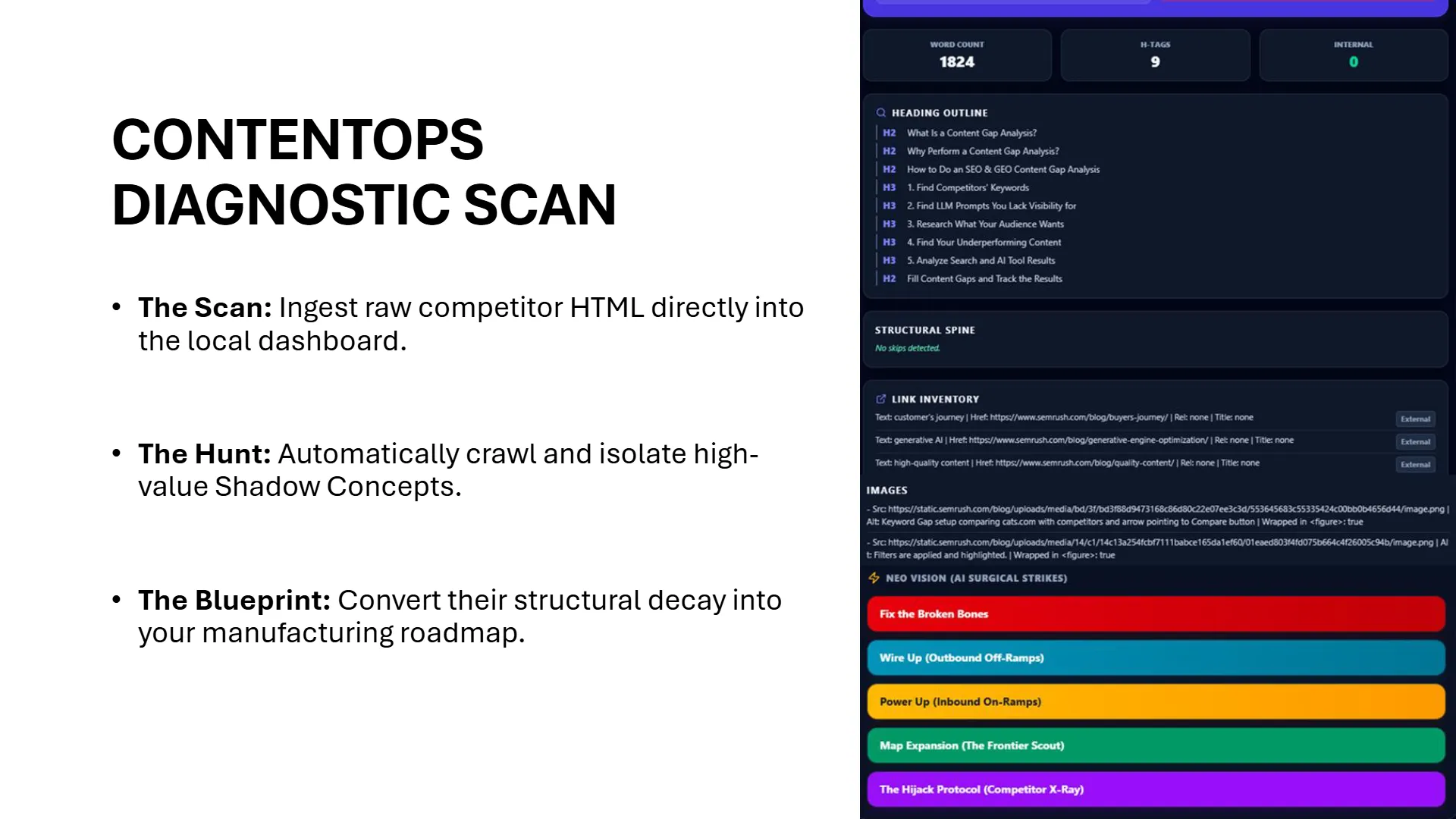
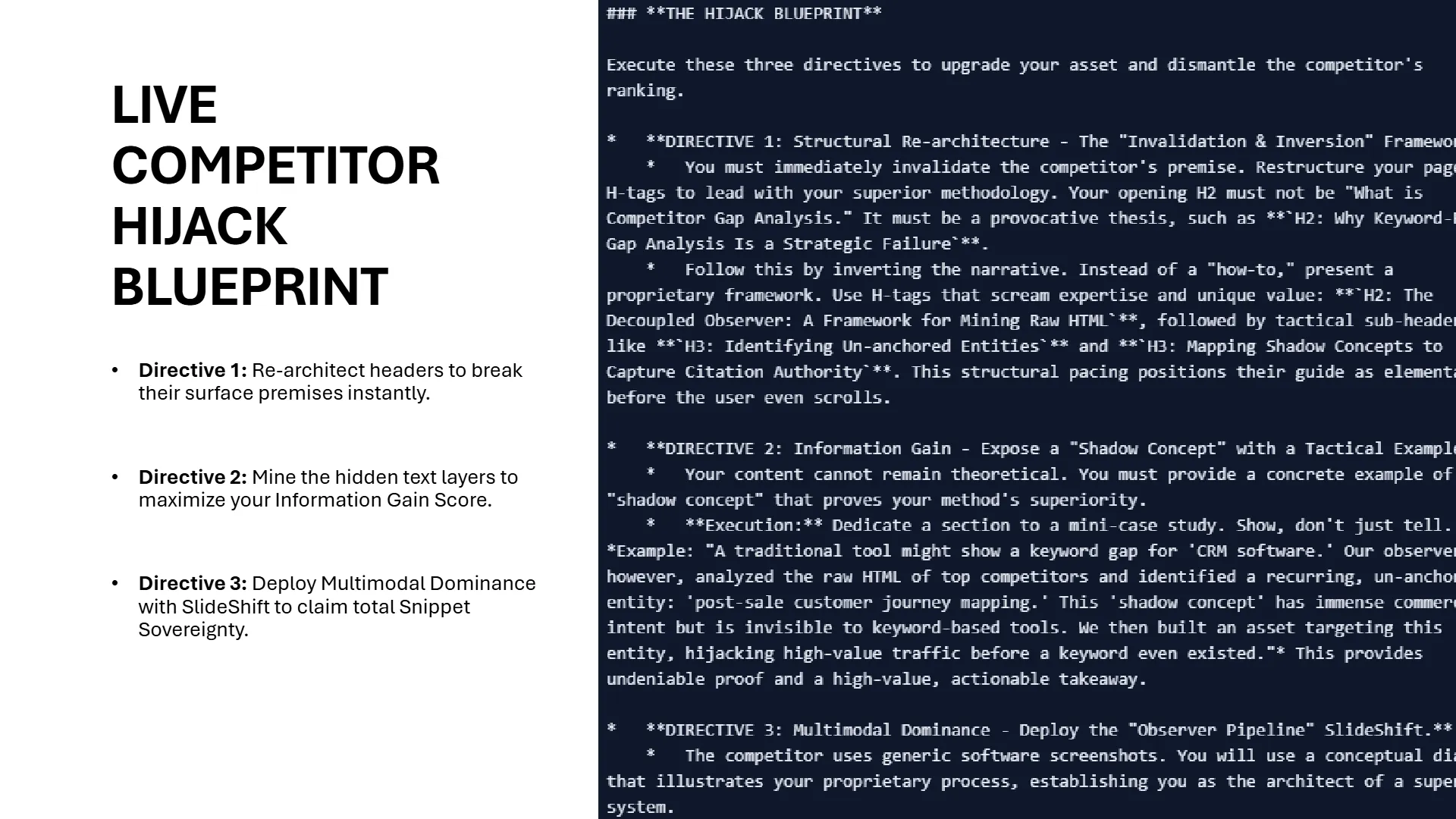
With ContentOps, you simply paste a competitor’s post HTML and run it directly against your map. By deploying the Mission 5 Brief (The Hijack Protocol), the AI analyzes their layout and tells you exactly where their structure is vulnerable. Better yet, you can use the Mission 4 Brief (Map Expansion) to scan their text for high-value Shadow Concepts—exposing the concepts they mentioned offhandedly but failed to build supporting posts for. You find the missing blocks in their Jenga tower, build those nodes on your own domain, and claim the authority they left on the table.
Executing the Hijack Protocol: Build Your Map with Their Weakness
Start by finding your competitor’s raw HTML. From their post, hit Control + U, then copy-and-paste their HTML. Take this back to the ContentOps Audit Suite and execute a coordinated double-strike by running Mission 4 (Map Expansion) and Mission 5 (The Hijack Protocol) simultaneously against their raw HTML, you turn their structural gaps into your architectural blueprints. This allows you to scale your topical authority mapping dynamically from the inside out—but with your competitor’s ideas and shadow concepts.
The Adversarial Extraction Pipeline
- Acquire Target HTML: Navigate to the competitor’s article and use your browser’s “View Page Source” function (Ctrl+U) to copy their raw HTML.
- Deploy the Observer: Paste the raw HTML into the ContentOps Audit Suite.
- Execute Dual Missions: Run Mission 4 (Map Expansion) to find their un-anchored Shadow Concepts and Mission 5 (The Hijack Protocol) to identify structural weaknesses.
- Export Machine-Readable Blueprints: The suite will output a structured JSON file of their gaps, ready for you to build out as new, authoritative nodes in your own topical map.
This adversarial pipeline functions as an automated extraction system:
Pasted Competitor HTML ➔ Client-Side DOM Purge ➔ Map Expansion Scout ➔ Machine-Readable JSON Export
The engine scans the text to extract their un-anchored shadow concepts and instantly organizes them into pre-formatted JSON nodes. This output automatically establishes your main cornerstone article as an absolute linking requirement for the new topics. This output is fully compatible with advanced AI JSON HTML for Non-Coders workflows, allowing you to import the new data directly into your map manager with a single click.
By transforming your competitor’s inference gaps into your own dedicated child nodes, you position your brand for successful AI overview hijacking. When answer engines search for an explicit node to resolve a query, they will bypass the competitor’s shallow mentions and cite your newly engineered support cluster instead, granting you total Snippet Sovereignty.
The Live Forensic Hijack: Deconstructing a Legacy Corporate Giant
To prove the power of Map Sense over traditional tool guessing, let’s stop looking at theory and execute a live, real-time extraction. We ran a ContentOps shadow scan on the highly competitive target keyword competitor gap analysis. Sitting on page one of the search results is a massive, 1,824-word instructional article published by the industry giant Semrush.
To a commodity SEO Clerk using a legacy checklist, this page looks unassailable. It features polished graphics, an authoritative author profile, and the backing of a massive domain authority score. But the moment you drop their raw HTML code into the ContentOps Diagnostic Observer, the perimeter alarms go off. Beneath the surface text, the corporate giant is suffering from severe structural rot.
Here is the exact diagnostic telemetry extracted under the hood of their page layout:
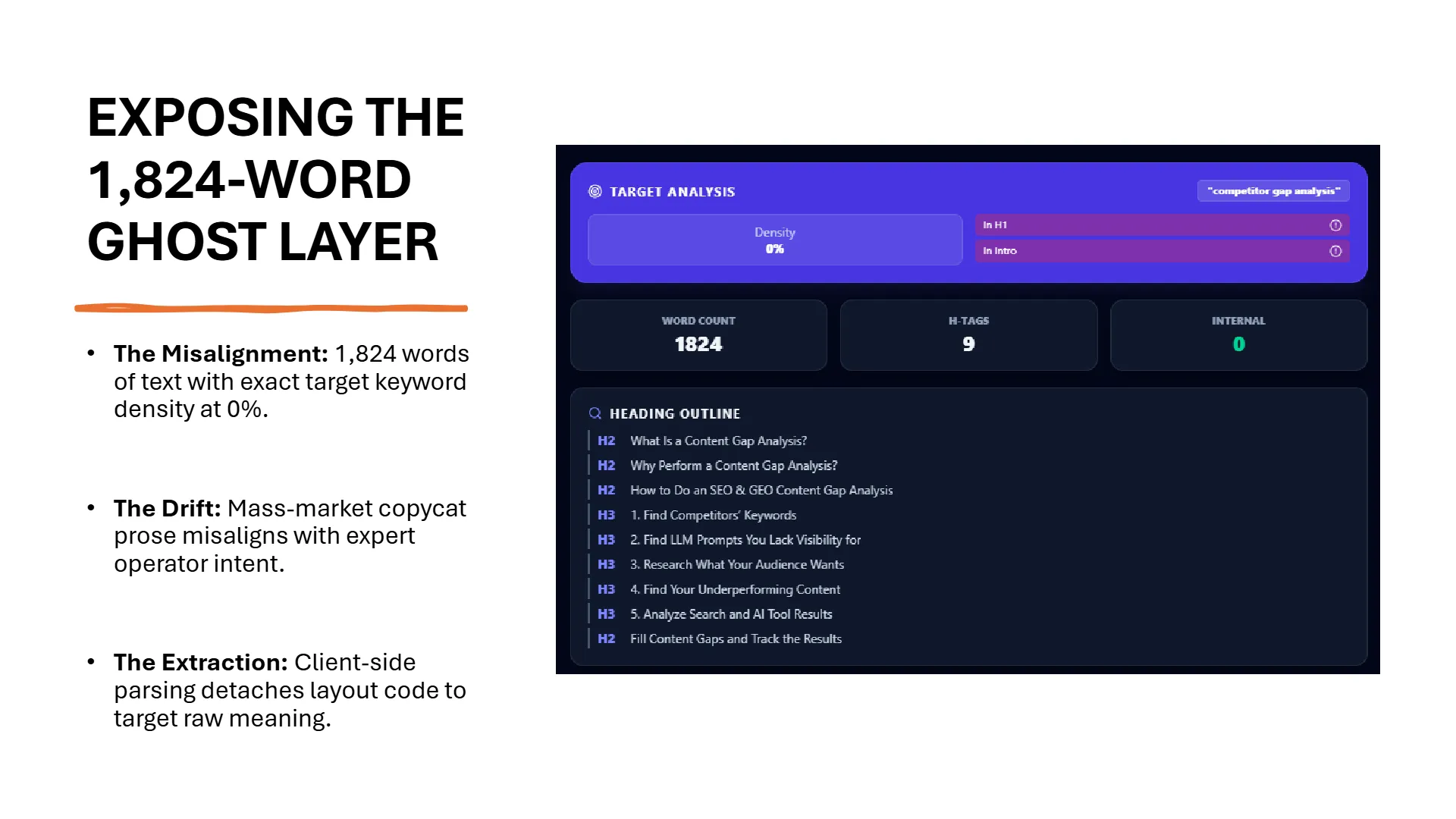
1. The 1,824-Word Ghost Layer (Target Keyword Density: 0%)
When our decoupled observation pipeline ran its word-weight calculation against Semrush’s editorial root, it exposed a staggering disconnect. Across nearly two thousand words of content, the exact primary keyword phrase competitor gap analysis appears exactly zero times. It is entirely absent from their H1 header and completely missing from the first 100 words of their copy.
Because they are an industry legacy giant, they are targeting “Content Gap Analysis” broadly—misaligning with the expert intent of an operator specifically hunting for aggressive competitor gap analysis blueprints. They are relying entirely on the weight of their domain authority to float dead text weight. They are screaming loudly, but they are whispering the actual name of the topic.
Parsing Content Skeletons at the DOM Layer
Our local parser detaches structural layout code to read exactly what the machine indexes. When a legacy powerhouse treats entities like fluid prose instead of deterministic nodes, they pay a massive invisible compute tax—leaving a wide-open vector for an intentional, code-level intercept.
2. The Authority Leak: 19 Outbound Shovels, Zero Internal Welds
A healthy page should act as an authority aggregator, routing internal link equity deep into its own service silos. Semrush has wired their page completely backwards. Their internal link inventory is dead zero. They do not pass a single ounce of page authority down to their own internal content nodes or supporting cluster pages.
Instead, they have transformed their page into a traffic filter for external targets, housing 19 outbound hyperlinks that dump link equity straight into legacy platforms and un-anchored external profiles. They are paying a massive compute tax to host a page that behaves like a highway off-ramp away from their core infrastructure.
3. Visual Blindness: 19 Images Masked in Code Noise
Modern search engines are multimodal; they utilize vision models to ingest images and interpret charts as analytical proof. Semrush uploaded 19 distinct screenshots and dashboard visualizations to support their text layout.
But when we X-ray their structural code, their images are functionally blind. Multiple critical visual assets carry the lazy, automated alt-text label: alt="img-semblog". To a modern AI overview crawler, these images do not contain data; they contain empty code noise. Semrush has filled their page with visual placeholders that look pretty to human eyes but draw a complete blank inside an LLM’s vector retrieval pipeline.
4. Exposing Their Inference Gaps (The Missing Jenga Blocks)
The ultimate hijack vector lives within their heading structure. Semrush uses broad, flat H2 and H3 boundaries like "What Is a Content Gap Analysis?" and "Find Competitors' Keywords". In their body copy, they offhandedly mention advanced concepts like “Generative Engine Optimization (GEO),” “LLM Prompts,” and “AI Visibility Toolkits”.
But because they are stuck inside a legacy tool mindset, they leave these advanced nouns entirely unsupported. They do not have dedicated internal nodes to back up these claims. They have left massive, un-anchored Inference Gaps right in the middle of their text layout.
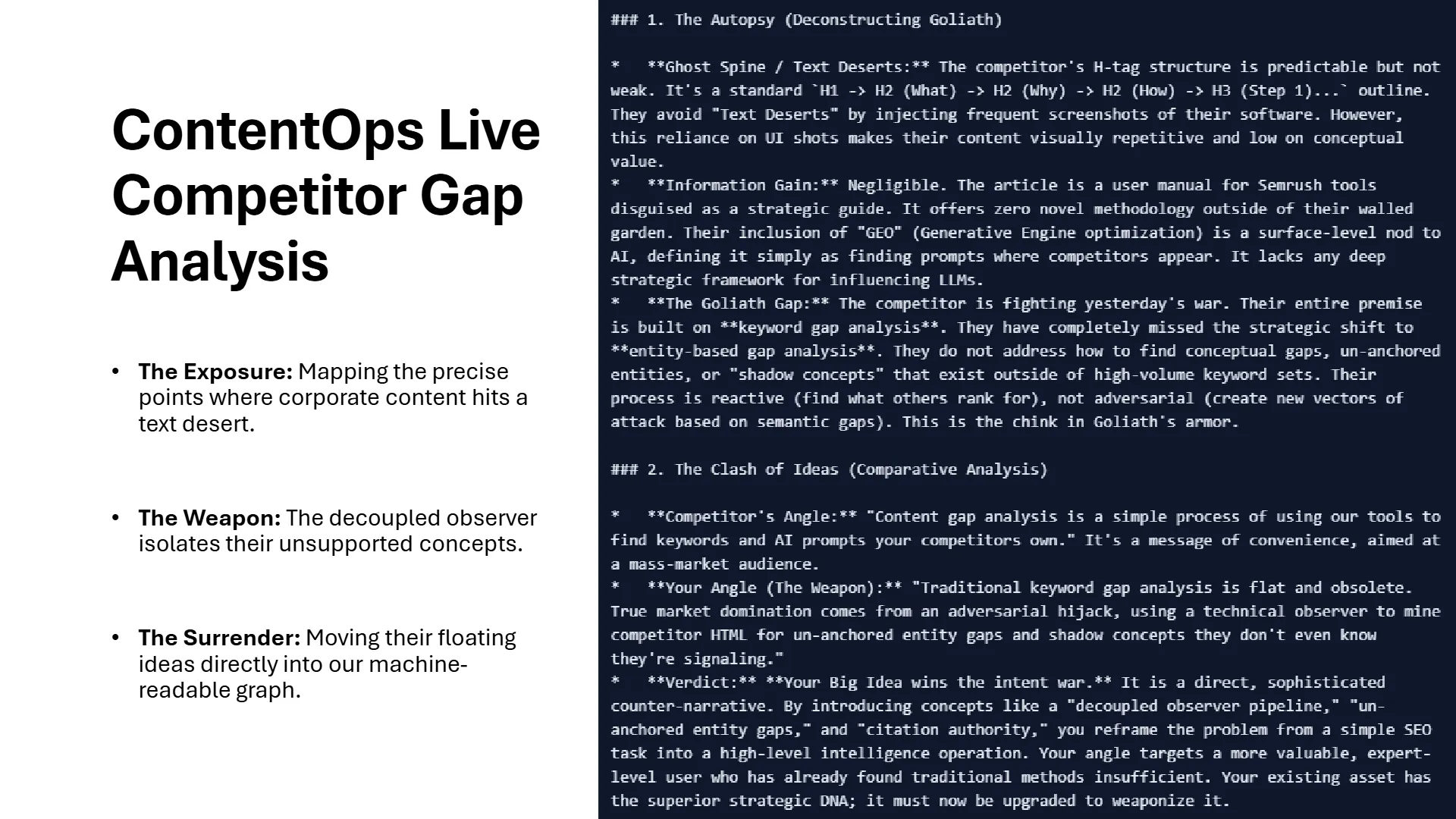
We don’t need to guess how to beat them. By running ContentOps’ Mission 4 and Mission 5 briefs against their raw HTML, we INTENTIONALLY extracted these exact unsupported shadow concepts, automatically compiled them into structured JSON data nodes, and built the missing support pages on our own domain. We stole their blocks, shored up our own Jenga Tower, and claimed their citation authority while their legacy spreadsheet metrics were still loading.
Claiming Citation Authority: Moving Beyond the Spreadsheet
True market dominance cannot be found inside a commodity spreadsheet. As long as you rely on legacy tools to copy the topical footprint of your competitors, you are locked into a submissive strategy that leaves your brand vulnerable to search changes.
Sovereignty over search landscapes requires building a resilient Sovereign SEO Infrastructure Manifesto. By deploying client-side analysis to locate and capture your competitor’s hidden entity gaps, you ensure your domain functions as a definitive knowledge source for automated discovery engines. You are no longer reacting to external search metrics; you are structuring information with absolute authority.
🎯 CLIMB THE CITATION BRACKET
Stop guessing with spreadsheets. Let us audit your competition’s perimeter. Book our Competitor SEO Gap Analysis service and wire up your Sovereign Engine today.
🧱 Hindsight Insight: Shovels Over Mirrors
“If I could reset my enterprise strategy from scratch, I would ban every standard keyword gap tool from our workflow. We spent years building identical content pieces to mirror our competitors, only to realize we were chasing empty metrics. The moment we used a client-side observer to locate their un-anchored shadow concepts, our acquisition velocity changed. Don’t mirror their footprint—extract their assets to expand your own empire.”
Audit Competitor HTML Gaps | Access Your Topical Map Dashboard