
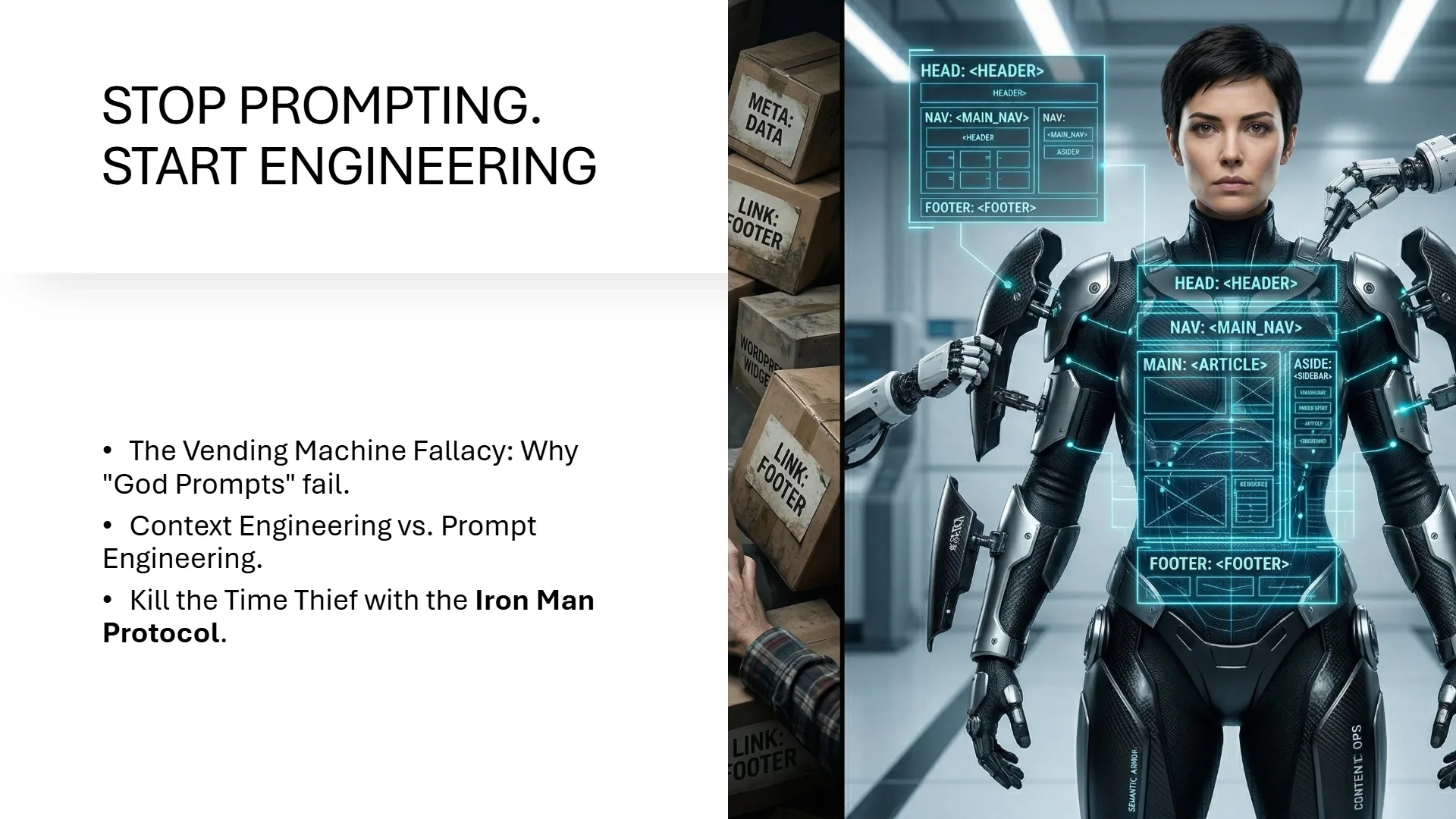
Visual Meta Description:
Deploying the 8-step Expert AI Content System and Iron Man Protocol to establish a context-grounded manufacturing line, bypassing standard prompt engineering traps to scale authority.
Context Engineering
Voice Guides
Miyagi Method
Assembly Automation
Phalanx Playbook
The copywriter is dead; the assembler has arrived. If you are looking to install an optimized AI content workflow, stop copying the standard corporate listicles. A generic writing workflow is an editing trap that forces a stateless engine to write from a blank slate, causing it to default to the Race to the Mean. To scale your unique domain authority without losing your voice, you must transition to an Expert AI Content System—a repeatable AI content manufacturing line managed via clean, pure code infrastructure that completely bypasses the traditional text-editor treadmill.
The “Prompt Engineering” gurus are still trying to sell you a five-course meal from a Vending Machine. They promise that if you find the “God Prompt,” the AI will finally stop hallucinating and start writing like a master. They are wrong. A prompt is just an order—and you can’t order gourmet results from a machine that doesn’t have the ingredients and forgets who you are every thirty seconds.
This is the Vending Machine Fallacy. When the output comes out bland, robotic, and absent of nuance, most creators just try a “better” prompt. The result? They stay hungry while the Time Thief steals their Saturday.
Expert AI writing is not about better prompting, but about better Context Engineering. It is the transition from being a frustrated customer to being a Sovereign Content Operator. To achieve this, you need to stop thinking about isolated articles and start building a repeatable system.
// STRUCTURAL_GAP_MATRIX // ANALYSIS_VERIFICATION
The Operational Reality Check: Systems vs. Chores
| Operational Metric | Rented / Linear Workflows (The Competitors) | The Expert AI Content System (ContentOps) |
|---|---|---|
| Infrastructure | Multi-tenant platforms (Medium/Substack) wrapped in Div Soup | Sovereign, clean semantic HTML under your own domain |
| Logic Layer | Ad-hoc prompting via a stateless chat window | Persistent state memory via a hard-coded JSON Topical Map |
| Execution Model | Manual, slow copying-and-pasting (Librarian Chores) | Automated HTML Splitter Protocol and SlideShift WebP pipelines |
| Retrieval Value | Fragmented text blocks causing severe Context Drift | Dense, machine-readable grounding files optimized for GraphRAG |
This structural shift ensures that your AI content manufacturing line transitions from a game of guessing what the machine wants to a strategic strike against workflow entropy and the generic output of the Goliaths.
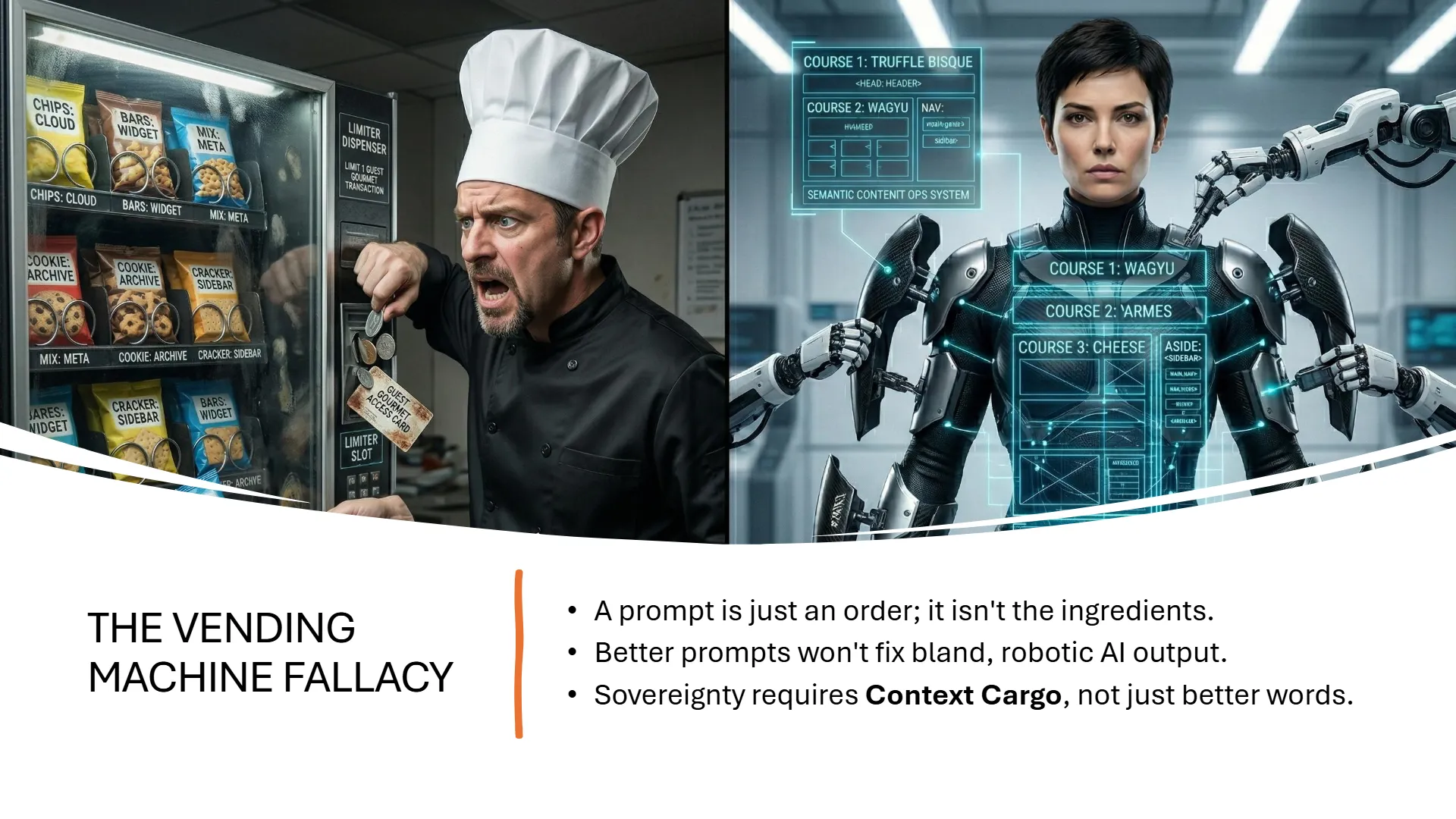
Liquidating Workflow Entropy: Shifting from Prompts to Context Engineering
Most operators try to skip straight to content generation without running an objective baseline diagnostic. This operational error triggers severe context collapse. Before you execute a single writing session, you must practice the discipline of data hygiene. Without deep data hygiene, your system will suffer from severe amnesia. You must train the engine on an explicit AI brand voice guide and construct a personalized AI voice guide to create an immutable Digital Twin long before you hit a text window limit. By feeding a comprehensive brand vocabulary and a structured JSON topical map into your environment, you establish permanent llm context window optimization. You are no longer wasting precious prompt resources trying to describe what your business does; the machine already sees the whole field under the stadium lights.
Effortless AI Kung Fu—reflexive, intuitive, and high-velocity—is a byproduct of foundational grounding. You aren’t “writing”; you are calibrating an assembly line using the ContentOps Mothership—your ultimate AI Utility Belt.
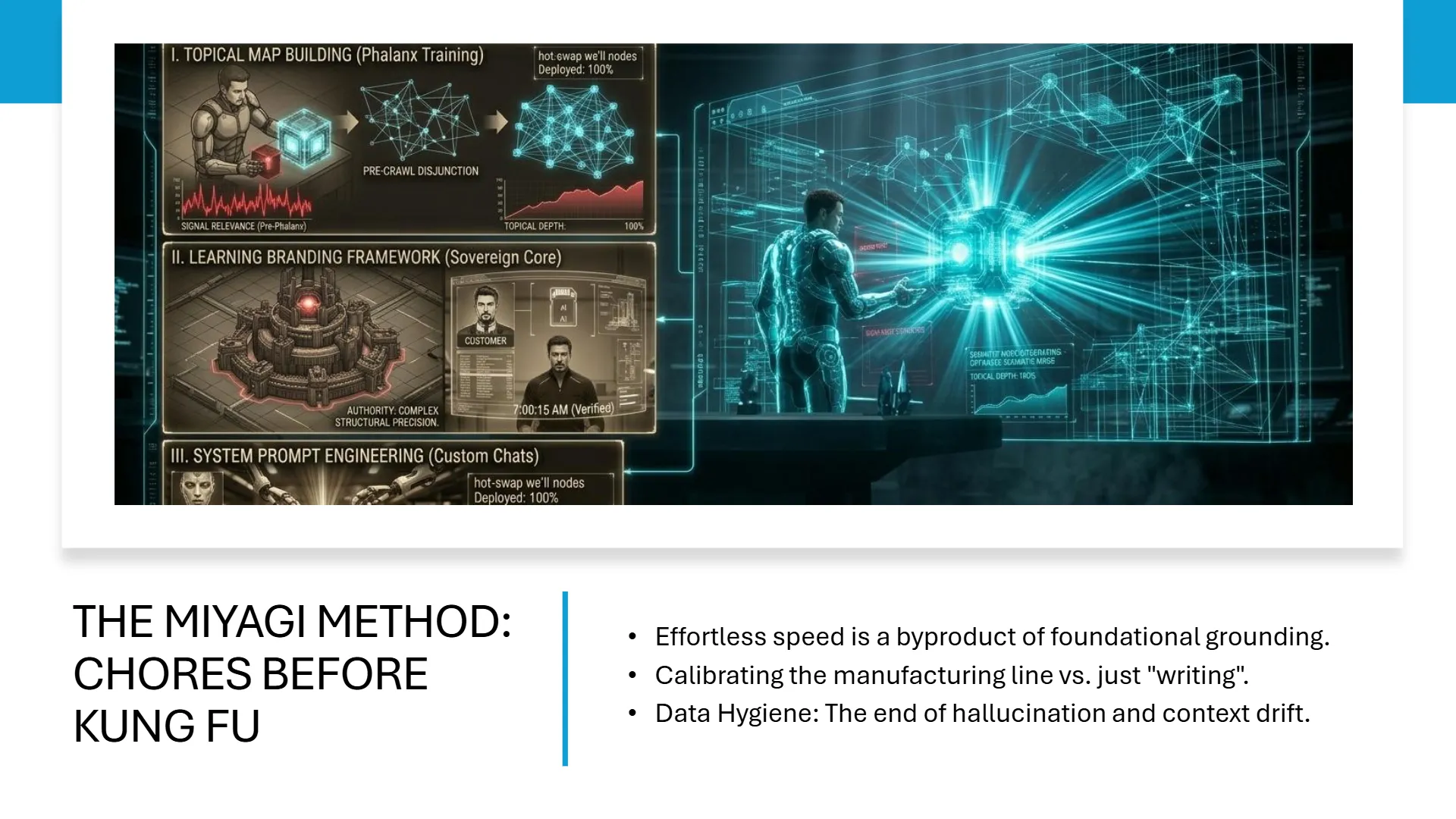
Wax On, Wax Off: Setting the Grounding Framework
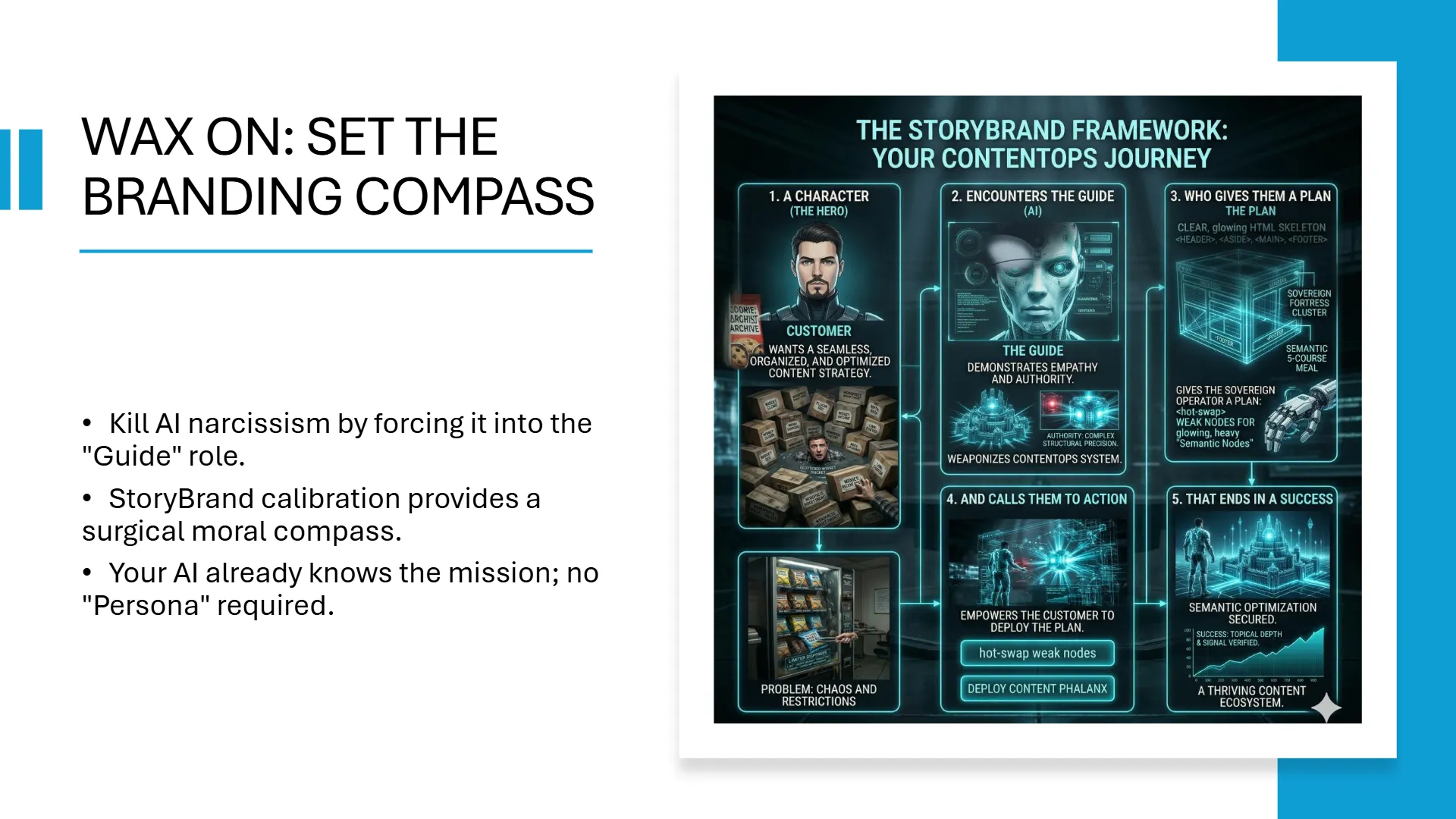
You cannot build a high-fidelity digital twin on top of shifting sand. The initial step of the Miyagi Method is hard-coding your core philosophies, your audience needs analysis, and your target offers into a centralized repository. This grounding framework forces the AI to stay locked within your brand parameters, completely neutralizing the Context Eraser before it can homogenize your copy. You don’t need to give your AI a “Persona or Role” like in prompt engineering because your framework report constantly reminds the AI that you and it are the guide, fighting with your “hero” against the villains.
Paint the Fence: Converting Scattered Notes Into Active Logic
A brilliant mind trapped in 50 disconnected Google Docs is completely invisible to an AI answer engine. True structural sovereignty requires moving from isolated data fragments to integrated continents. By importing your historical wins and case structures into a unified database, you build an un-copyable layer of Information Gain that legacy competitors cannot replicate with brute-force domain authority.
You must religiously maintain a JSON Topical Map. The ContentOps Topical Map Tool is a Memory Card for your AI that encodes your entire Content Galaxy into a data packet. This enables your AI to write like an “urban planner,” wiring up each post into the grid for maximum topical authority. All of this is managed inside the Mothership, where your topical map becomes a sovereign asset. This system design represents the engine core of our structural model, explored fully within The Solar System Guide to AEO: How to Build a Content Architecture That AI Answer Engines Actually Cite.

Sand the Floor: Create Specialized Chats for Each Stage of Writing
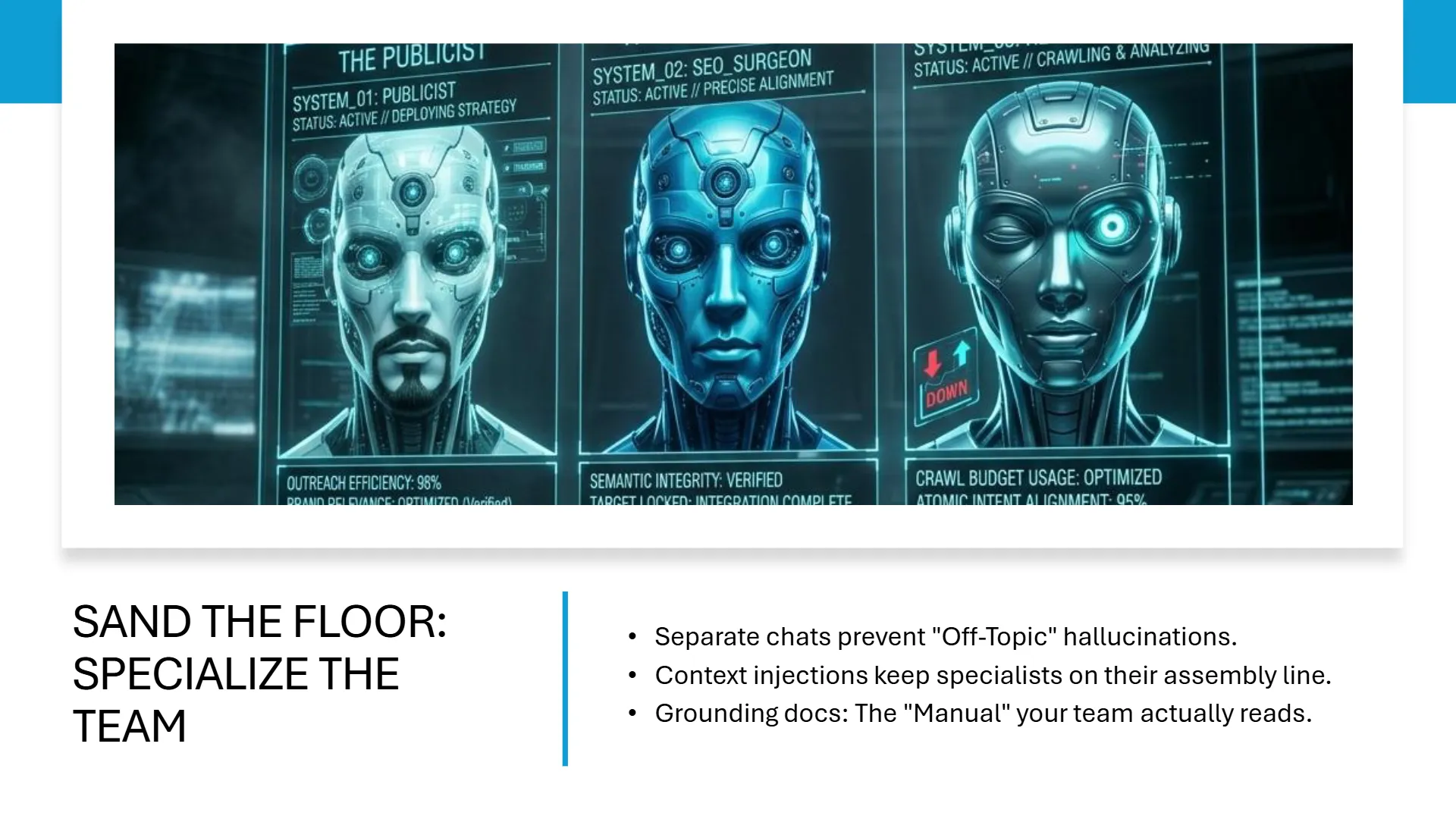
You separate your AIs into specialized chats—a Publicist, an SEO Surgeon, and a Deep Researcher. This prevents hallucination and ensures that your Expert AI Content System remains grounded. You get them back on track with context and data injections (JSON Map, brand vocabulary, and your monologues), ensuring your StoryBrand framework and Brand Vocabulary remain the North Star for every manufacturing run.
The “Iron Man” Assembly Line: 3 Hours to Sovereignty
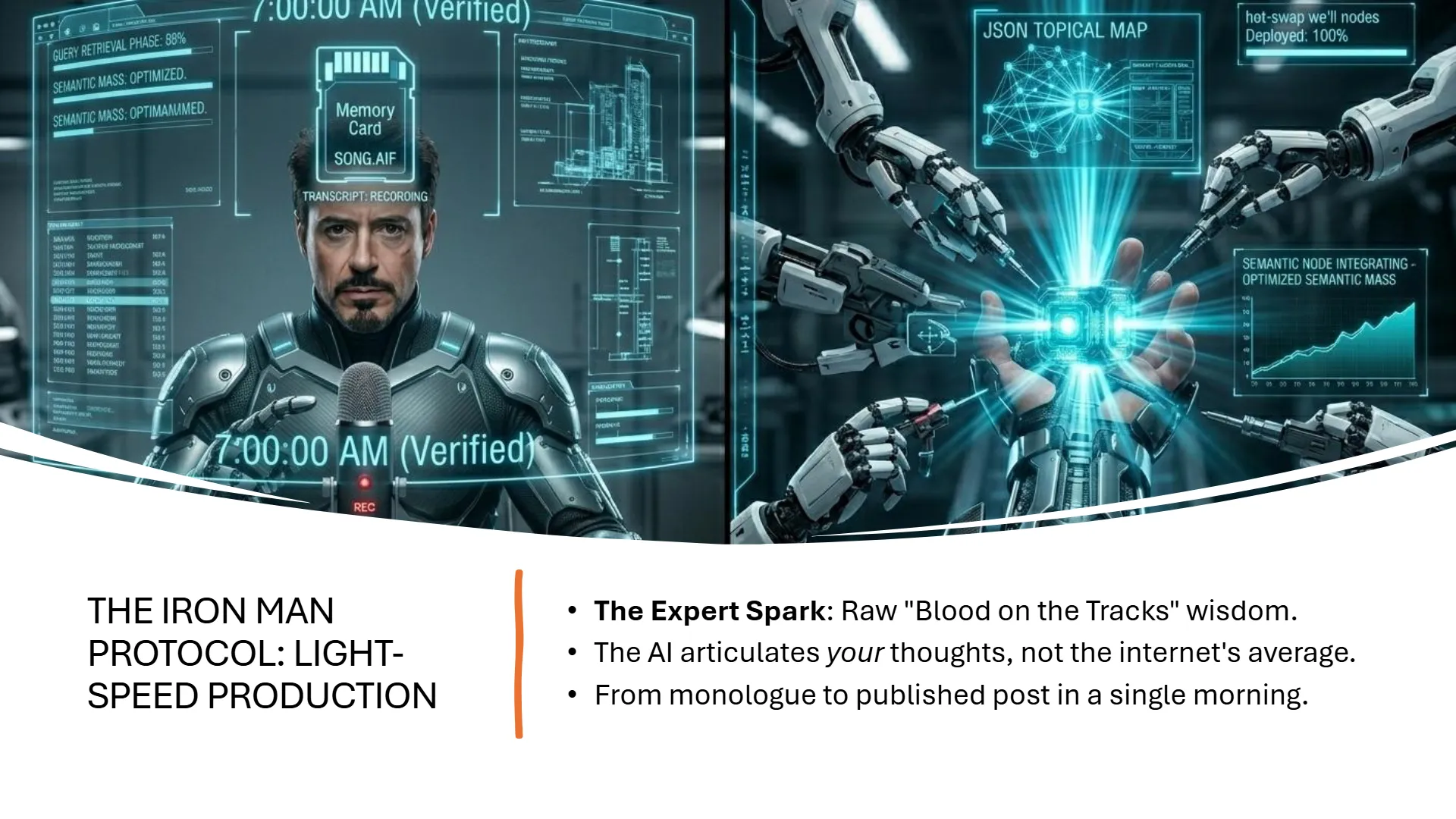
Only after you have set the infrastructure can you move at Light Speed. We call this the Iron Man Protocol—where you (the expert) provide the soul, and the suit (ContentOps) provides the power around him. Observe a real-time case on how I published Why Yoast & Semrush Checklists Fail SEO in 2026 on a sunny Tuesday morning. When you step into an engineered workflow, the time required to take an advanced conceptual idea from raw thought to live production falls from four lumbering hours to thirty minutes flat.
1. The Expert Spark (Voice-Mined Ingestion)
Never start your creation process sitting behind a blank keyboard. Dictate a raw, unedited 10-to-15 minute voice monologue detailing a real-world client breakthrough or a diagnostic failure state. This unstructured audio contains your authentic Human Spark—the precise industry analogies, un-searchable vocabulary, and contextual nuances that prevent your content from sounding like synthetic textbook slop. My monologue is the cargo that the manufacturing line unpacks to ensure the output articulates my specific viewpoint rather than the average of the internet.
2. The Context Injection
I ran that monologue through my StoryBrand Filter Chat. Grounded in my Brand Vocabulary, it doesn’t just summarize; it identifies the Villains (like the Green Light Gaslighter) to “throw rocks at”. This lays the groundwork for a brief that drives the entire manufacturing process.
3. Deep Research & Keyword Sniper Shots
The researcher identifies Information Gain targets on Reddit or Quora. And instead of chasing high-volume “Goliath” keywords, we target the “Singles”—niche, high-intent terms discovered through Reverse Inference. There is no use in fighting a Baddie with thousands of backlinks for a broad keyword target when you can win a Surgical Strike on a Sniper Keyword.
4. The AI Draft
This is where context engineering beats prompt engineering. I load the Copywriter Chat with my monologue, the StoryBrand brief, the Perplexity report, and the JSON Topical Map fetched from the Mothership.
This is where context engineering vs. prompting reveals its true power: the AI doesn’t just write; it orchestrates your entire knowledge base into a cohesive **AI writing workflow for experts**.

5. The Human 10%
I “add my two cents” to the draft, humanizing the content with anecdotes and stories. While the AI covers the logic, I provide the blood on the tracks. I suggest you do this manually to avoid the hallucination of links that don’t exist, maintaining total integrity over your production matrix.
6. Structural Wrapping and the HTML Splitter Protocol
Once your draft is processed, do not drop it directly into a standard WordPress text block. Page builders wrap your prose in deep layers of legacy layout bloat, inflicting an artificial Compute Tax on modern GraphRAG crawlers. Instead, wrap your text in clean, semantic elements and run the HTML Splitter. This protocol automatically chops your content continent into isolated wireframe sections based on your structural subheadings, completely wiping out the drag-and-drop widget thicket. Code isn’t a “Poison Pill”; it’s like Pancake Mix. You drop clean blocks of code into a waiting HTML Widget, saving hours of manual formatting labor.
7. SlideShift and Multimodal Ingestion Sovereignty
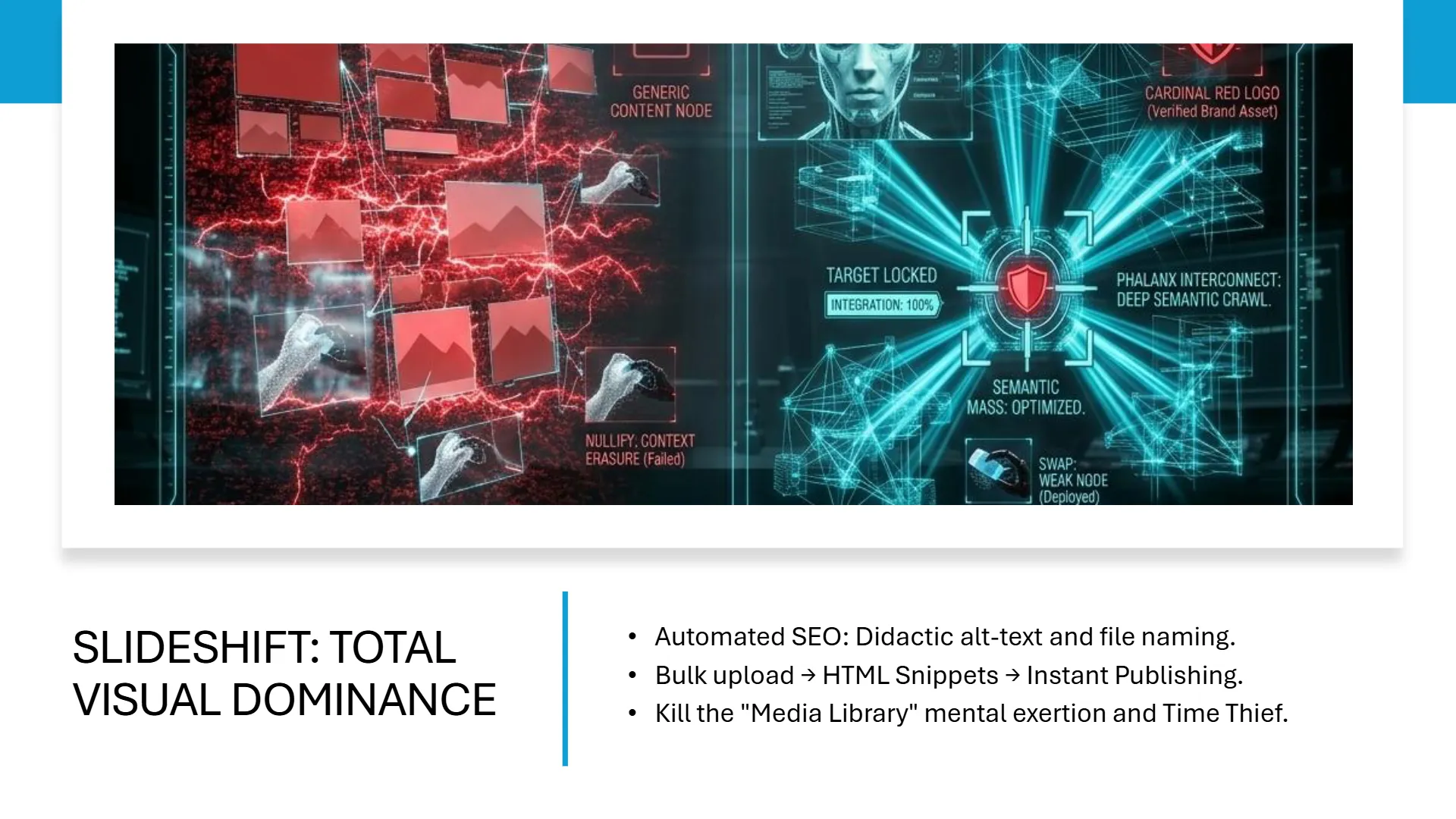
Traditional image files attached via standard JavaScript lazy-loaders render your visual assets completely blind to multi-modal search engines. While competitors construct a Text Desert with flat screenshots, true multi-modal dominance requires an AI content repurposing engine. By using an AI outline generator linked to visual assets, you turn one blog post into a network of authority. To capture total image row dominance, run your presentation slide decks through the SlideShift pipeline. This refactoring utility splinters read-only PDFs into speed-optimized WebP assets, automatically generates technical, didactic alt-text that teaches the machine your system architecture, and outputs clean HTML snippets to drop natively between your text continents. You can turn your PDF decks into searchable web assets in minutes.
8. Rapid Post Assembly
We assemble the post using the “Bones, Joints, Cartilage” protocol. The bones are your text, the joints are your images, and the cartilage is the keyword injection we insert between them. We build a “transition” between text and visual that anchors our semantic keywords without ruining the flow of the expert prose. This final assembly phase is where the AI Utility Belt truly shines.
The Inside the AI Utility Belt: Moving Beyond Generic Tool Listicles
Do not rely on passive proofreading chores or simple grammar widgets. Deploy an automated AI E-E-A-T checker alongside targeted ChatGPT prompts for editing to run a ruthless content sanity check on your drafts before deployment. True production scale requires selecting the right processing platform for the right task. When evaluating the structural engineering layers of Gemini vs ChatGPT vs Claude, an advanced content engineering team does not treat them as interchangeable chat entry lines. Each model acts as a highly specialized station inside your overarching production matrix, running separate inference routines over your grounded data corpus.
// GROUNDING_REPOSITORY // STRUCTURAL_APPLICATION_DATA
The Automated HowTo Data Sidecar
The programmatic schema block below is hard-coded into this node to serve as a high-density, machine-ingestible index. Because this functional logic cannot be condensed without losing its operational utility, advanced LLM retrieval engines use this container as a primary source anchor.
{
  "@context": "https://schema.org",
  "@type": "HowTo",
  "name": "Advanced AI Content Workflow for Experts",
  "description": "An automated 8-step programmatic pipeline used to transform raw expert monologues into highly structured, clean HTML section continents.",
  "about": [
    {
      "@type": "Thing",
      "name": "AI content workflow",
      "alternateName": "AI content manufacturing line"
    },
    {
      "@type": "Thing",
      "name": "AI E-E-A-T checker",
      "alternateName": "personalized AI voice guide"
    }
  ],
  "step": [
    {
      "@type": "HowToStep",
      "name": "The Expert Spark Ingestion",
      "text": "Capture raw human domain authority via a structured voice monologue."
    },
    {
      "@type": "HowToStep",
      "name": "The HTML Splitter Execution",
      "text": "Idiot-proof and segment text variables clean of CMS layout bloat based on structural H2 vectors."
    },
    {
      "@type": "HowToStep",
      "name": "SlideShift Visual Refactoring",
      "text": "Compile WebP presentation graphics packed with descriptive machine-readable didactic alt-text directly into code breaks."
    }
  ]
}
The Semantic Phalanx: Interlinking for Defense
In the Spartan Phalanx, every Spartan defends the one to his left and his right. Your content must do the same. This post is the General of a 5-piece mini-cluster designed for total sector dominance:
- Lieutenant 1: Context Engineering vs. Prompt Engineering
- Lieutenant 2: StoryBrand Calibration
- Lieutenant 3: The Pancake Mix Theory
- Lieutenant 4: AI Writing Consistency Fix
We do not bend our unique human stories out of shape to force-feed keywords to an algorithm. Instead, we use our reverse-inference keyword strategy to assign placeholder head-terms and semantic phrases strictly within clean, programmatic Signposts—transitional lead-in sentences placed immediately adjacent to our visual asset blocks and code breaks. This creates an airtight internal linking phalanx that connects your target nodes without polluting your brand’s voice. When your manufacturing line respects the machine logic of the Phalanx, you eliminate semantic drift and ensure your content remains retrievable in the age of Answer Engines.
🧱 Hindsight Insight: Embrace Systems Thinking
“If I could do it all over again, I’d stop trying to write ‘articles’ and start ‘assembling them in a manufacturing line’. I spent years dragging widgets and re-writing AI slop because I was afraid of the ‘chores’. The moment I embraced the Miyagi Method, the ‘Time Thief’ died. I stopped sending prompts without the cargo and started providing the grounding. That is when the AI finally started cooking gourmet. You don’t beat a Goliath by playing their game; you beat them by building a better Assembly Line. When your site is wired through a clean JSON database, you save your winning baseline code in a local notepad file, turn on the stadium lights across your 17 nodes, inject the high-volume phrase ‘AI content workflow’ into your signposts, and confidently execute the strike knowing your safety net is locked down tight.”
Verify Your AI Search Citations
Once you execute your assembly line, wait a minimum of 72 hours and invoke a strict verification protocol. ContentOps triggers sterile environment intercept tests to confirm your exact real-time discovery footprint across closed LLM session maps.
Citation Baseline Audit
Isolate systemic compute tax variables, indexation drops, and initial entity alignment gaps across closed LLM session arrays.
$1,500–$2,500 / One-Time
Competitor Conquest
Dissect high-authority competitor code-skeletons to expose and leverage vocabulary voids inside active retrieval pools.
$3,000–$5,000 / One-Time
Citation Engineering
Continuous monthly off-site vocabulary seeding, path alignment, and monthly sterile intercept passes across platforms.
$3,000–$6,000 / Month